Beatriz Muñoz García, Adrian Morales Casas, Jose Laparra, David Garrido, Arturo Gomez Pellin (2024). Connected Care Home platforms: Promoting self-management by empowering patients. In: Health Informatics and Biomedical Engineering Applications. AHFE Open Access, vol. 142, pp. 12–20. https://doi.org/10.54941/ahfe1005066
Remote patient monitoring systems are increasingly gaining attention among researchers and healthcare providers who have also started adopting innovative solutions. It is easy to understand why remote monitoring platforms would enhance treatment efficiency and access to healthcare solutions for patients who face difficulties travelling to hospitals, especially older persons and chronic patients who require frequent monitoring of their vital signs and other health indicators, rehabilitation or other social and healthcare support. Therefore, these platforms are, in turn, sources of information for patients about their disease. The fact that they have access to information gives them more knowledge and makes them more in touch with and responsible for it. It empowers them. Besides, from a clinician's point of view, these platforms are a storage system for providing valuable and varied patient information, thus allowing them to have a holistic view of their patients and empowering them. In short, access to and availability of information empowers the patient-clinical staff team.Once these data have been collected, a thorough analysis and interpretation is necessary. This interpretation requires the interdisciplinary collaboration of the technical-clinical and scientific community to develop relevant and exciting functionalities for the improvement of health.This study presents a collection of case studies that collect some insight into the design based on human factors and user experience applied to three monitoring technologies and artificial intelligence algorithms to improve the prevention and management of different conditions.The usability and acceptance measures are generally well received and successful and are particularly effective when conducted during the preparation of the experiment. In other words, if the experiment includes the end-user (patient and clinical staff) as part of the design.
Connected Care Home Platforms: Promoting Self-Management by Empowering Patients 13
health system, prioritising prevention, maintaining optimal health status, and prolonging independent and quality lifetime (Green Paper, 2014).
The current digitalisation in the health system will change how we under- stand healthcare. To start with, certain aspects of conventional medicine will undergo alterations. The conventional approach characteristic of traditional healthcare meant that it focused on the disease, considering the patient as a passive element waiting for a diagnosis or treatment from its doctor (Murgic et al., 2015). This new healthcare concept places the patient at the centre of the intervention, aiming at preventing or optimising their health rather than focusing solely on the cure of diseases. In this new paradigm, the patient is expected to play a more active and participatory role, becoming more co-responsible for its state of health.
The digital revolution in healthcare has the potential to transform the approach and management of the health status of patients, especially those who are elderly or suffer from chronic diseases. To ensure that this digital transformation is genuinely beneficial and accessible to these patient groups, the design and development of new healthcare technologies must be focused on their specific needs and capabilities, combining human factors and user experience approaches (Morales Casas et al., 2023).
Other authors have highlighted the importance of including patients, med- ical staff, and caregivers in health research design and conduct (Jones et al., 2021). They affirm that research that is being carried out ‘with’ or ‘by’ patients and public involvement (PPI), rather than ‘to’, ‘about’ or ‘for’ them, may improve the quality, relevance of the research and have stronger ethi- cal and political arguments for public involvement in decision-making about rights of citizens.
The primary purpose of the Institute of Biomechanics (IBV) is to develop and transfer scientific and technological knowledge to improve human health, well-being, and quality of life (IBV, n.d.). This paper aims to show- case some monitoring experiences and Artificial Intelligence (AI) technologies in chronic patient care, highlighting the added value of personalised human interaction throughout the platform’s development, functionalities, usability and results interpretation.
BACKGROUND
The Origin of Digital Health Several factors have brought about this change in the health intervention model. On the one hand, thanks to advances in molecular biology and, more specifically, advances in the study of the genome (genomics), protein expression (proteomics), and the analysis of metabolites (metabolomics), a significant amount of biological data can be obtained for each patient. Mak- ing the most of this data would allow for a more personalised, preventive, predictive and participatory treatment of patients (Hood et al., 2012). In par- allel, the fantastic development of digital technologies in the field of health, such as the Internet of Things (IoT), AI, the use of big data, wearables and robotics, has enabled the creation of platforms for the collection and man- agement of health data (Global et al., 2020–2025, 2021). These data are collected directly or environmentally, thanks to wearables or ambient sensors.
They have to be processed to transform them into functional and valuable information for patients and healthcare staff.
The Value of Data in Health From the clinician’s point of view, having more patient data will allow them to have a more complete and enriched clinical profile and, therefore, to make more conscious, personalised and better medical decisions. More information about the patient’s health status will make them more capable, responsible or empowered to make conscious decisions about their self-care. Furthermore, thanks to the virtuous union of data and AI and expert data interpretation, supervening and powerful functionalities will appear, such as predicting the state of health/illness, estimating incapacity or recovery times, establishing healthcare priorities, or segmentation of disease risk. In short, there will be a more personalised, preventive, predictive and participative healthcare system (Hood et al., 2012).
Challenges to be Overcome The fact that healthcare can be provided beyond the walls of a hospital thanks to digitalisation is relevant for the whole population but especially useful for patients who face difficulties travelling to hospitals (e.g. patients in rural zones), and especially for older persons, people with disabilities and chronic patients who require frequent monitoring of their health (NHS digital health strategy, n.d.).
Continuous remote monitoring of chronic patients would make it possible to detect changes in their physiological variables that could anticipate a more severe episode in their illness. The challenge in these cases would be to ensure that access to technologies reaches all patients, no matter how remote they are located (Accesibilidad y Brecha Digital, La Ley de Cuidados Inversos 2.0, n.d.). Another challenge is to ensure the digital literacy of this population. Without an effective strategy to educate and train these individuals in the use of digital technologies, there is a risk of widening the digital divide (Moreno & Vida, 2022).
Another susceptible issue for this population is making these technolo- gies truly usable devices. The only way to achieve this is by considering user-centred design principles. This does not only mean teaching them how to use the technology but also that it must be specially designed for them, thus making learning more accessible. Even considering that if they have a sensory disability, it will be an added difficulty in the use of technology. Usability is about accessing and using the devices appropriately and making their information helpful, valuable and easy to understand (Moreno & Vida, 2022). The data obtained through monitoring platforms can be interpreted effec- tively with the help of expert clinical staff. By working with technical and developer profiles, they can give relevant clinical meaning and explore new functionalities or purposes of these data that can enhance the effectiveness and productivity of clinicians and improve patients’ quality of life, extending their independent living. This requires a working team with a holistic point
Connected Care Home Platforms: Promoting Self-Management by Empowering Patients 15
of view about health, disease and people, combining human factors and user experience knowledge.
CASE STUDIES: FROM MONITORING TO REHABILITATION IBV has worked in conceptualising and developing user-centric products, with a particular emphasis on enhancing user experience focused on advanc- ing monitoring technologies and artificial intelligence (AI) algorithms tailored to augment the prevention and management of various medical conditions.
This approach of underscoring the periodisation of the user-centric design principles, ensuring that the functionalities of these technologies are aligned with the preferences and requirements of their intended users, is also sup- ported by other authors (Cristiano et al., 2022). In this context, integrating usability principles and a user-centred design ethos is paramount across these endeavours. The following case exemplifies this commitment, target- ing populations such as older persons and individuals encountering barriers to healthcare accessibility.
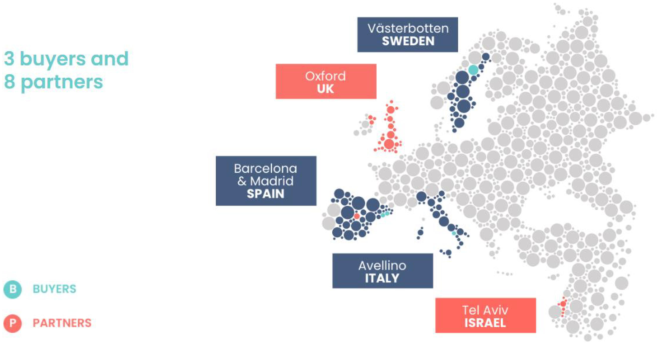
TIQUE: Patients With Advanced Heart Failure TIQUE is a project (TIQUE et al.) to develop a comprehensive approach to treating patients with advanced heart failure (AHF) to be deployed in 3 countries: Italy, Spain and Sweden (Figure 1). The solution will include an interactive digital platform where clinicians and health and social care profes- sionals can access their case management platform (integrated with existing legacy systems), and patients and carers can log into their self-management system. Data obtained through remote monitoring is fed to algorithms that can anticipate a patient’s care needs in time to prevent crises. This proactive model aims to reduce hospital admissions, improve patient’s quality of life, and alleviate the overall strain on the healthcare system by ensuring timely and effective care.
Figure 1: Distribution of TIQUE partners and the buyers of the solution. Extracted from: https://www.tiquepcp.eu/.
As the platform is intended for older, non-tech-savvy patients and requires interaction, usability and acceptability were particularly relevant. IBV has contributed added value to this project by ensuring that the platform’s inter- faces’ language, design, and content are usable and valuable for people with AHF, particularly the elderly. To encourage the active participation of patients, training resources have been developed with the preferences and capacities of potential users in mind.
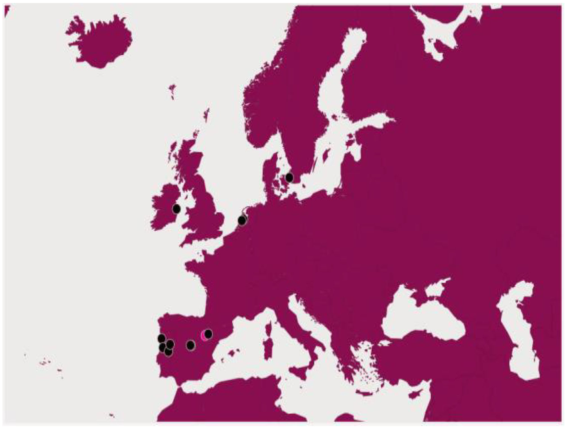
ROSIA: Remote Rehabilitation Service for Isolated or Rural Areas The ROSIA project (“Https://Raise.Iti.Gr/,” n.d.) aims to provide a tel- erehabilitation platform to patients with chronic pathologies who require long-term rehabilitation but are located in isolated areas (Figure 2). The plat- form facilitates communication between clinical staff and patients and stores clinical data. It also offers an open catalogue of applications that can be selected and customised according to each patient’s needs based on clinical criteria. These applications cover various rehabilitation programs, including physical, cognitive, mental, and language.
Figure 2: Distribution of partners throughout Europe. Extracted from: https://rosia- pcp.eu/project-rosia/.
As the target population is the same as in the previous project described above, user-friendliness and acceptability were especially important. IBV has contributed with its knowledge and experience as an expert in the usability, accessibility and compliance with regulations evaluation based on standardised guidelines in the initial ideation, design and development of the platform.
Connected Care Home Platforms: Promoting Self-Management by Empowering Patients 17
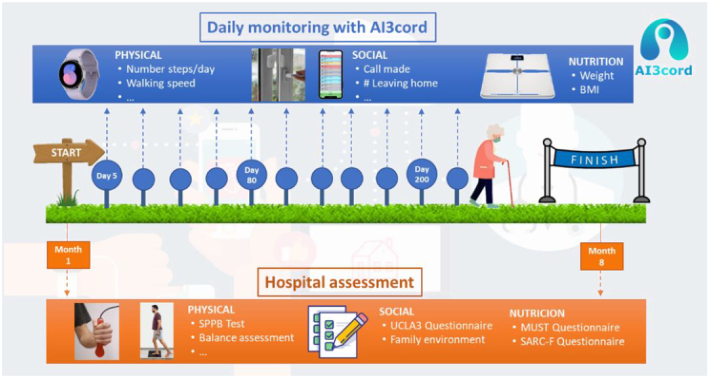
AI3cord: Monitoring and Prevention of Frailty of Older Persons AI3cord is a project aimed at generating a technological platform based on IoT and AI devices for the monitoring and prevention of frailty in the elderly by recording and analysing indicators related to the state of health (AI3cord, n.d.). The aim was to evaluate frailty by considering all the factors contribut- ing to it, such as physical, emotional, cognitive, social, and nutritional aspects (Figure 3). An array of environmental sensors, a smartwatch, and a ques- tionnaire application were utilised to gather data from all these domains. Artificial intelligence models were developed to combine and analyse the data to explore new indicators to enhance the monitoring and prevention of frailty in older adults.
Figure 3: Pilot study and methodology of AI3cord.
As mentioned, the target population for this intervention is older people who are pre-fragile or frail. Therefore, the application had to be designed to be highly usable. It also needed to minimise interaction as much as possible, given that it included environmental sensors and wearables (smartwatches), and it was assumed that this population has minimal experience with tech- nology. Additionally, since the intervention lasted eight months, the usability and acceptability of the application and the sensors were critical.
The assessment and measures developed to evaluate the usability and acceptance criteria of the application are detailed below. The aim was to validate it from the point of view of the participants and the point of view of the clinical staff involved in the project.
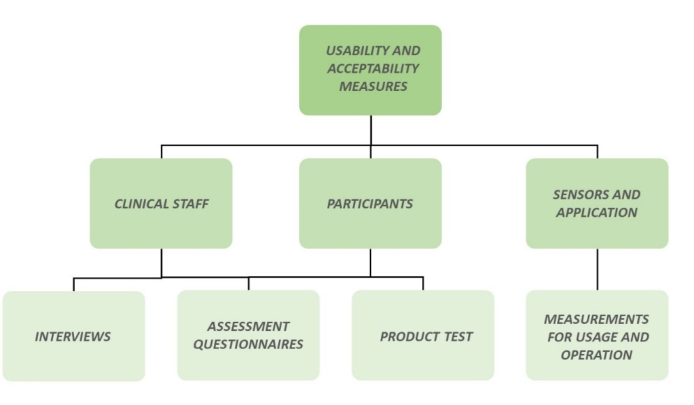
As shown in Figure 4, the interviews enabled us to gather the professional opinion of the clinical staff regarding the ease of use of the application, inter- pretation of the results displayed on the clinical dashboard, and the quality and usefulness of the information obtained for daily work related to the control and prevention of the health of older adults.
Figure 4: Usability and acceptability measures taken in AI3cord project.
A product test was also developed, in which a sample of trial participants used the application according to a predefined itinerary while being observed by technicians. This test helped identify significant issues with the platform’s usability. The results also revealed areas for improvement. Moreover, the application’s usability and acceptance were assessed using questionnaires. Finally, user-friendly aspects of the sensors and the application were also considered from the technology point of view.
Although the application was well-accepted by clinical staff and partici- pants, conducting the product test helped identify and correct some errors or difficulties encountered during the use and handling of the application. Completing the questionnaires was practical, but caution should be exercised when interpreting the results. Older individuals tend to respond positively to technological developments, partially attributing their lack of practice in using the tools.
Additionally, they tend to respond by assuming that improvements are needed in the development and a scenario of use with fully developed and ade- quately functioning features. Therefore, the product test in this population was appropriate and reliable enough for the proposed purpose.
CONCLUSION
The use of monitoring platforms for patients in the healthcare sector shows great promise, allowing healthcare beyond hospital facilities: Connected Care Home. Technology in this field is advancing rapidly, and soon, we can overcome current barriers and achieve previously impossible milestones.
The key players in this process, including healthcare staff and patients, have access to valuable information that can improve their approach to health. For clinical staff, this means making more informed decisions with
Connected Care Home Platforms: Promoting Self-Management by Empowering Patients 19
complete patient profiles, while for patients, it means engaging more collab- oratively with their health status.
These platforms must be designed with the users in mind, ensuring usabil- ity, adherence, and acceptance, not forgetting digital literacy and empower- ment strategies. This can be achieved through user-centred design strategies that involve the users throughout the development process, “humanising”the technology and making it “with” the users rather than “for” them, leaning on human factors and user experience approaches.
As the next step, it is suggested that we gain an in-depth understanding of how to interpret the information gathered by healthcare staff and patients. The data obtained in the user cases presented in this document provide a wealth of information on patient health or behavioural variables, opening up opportunities to explore new functionalities or uses of the data. This provides an innovative way to give the data value, allowing doctors to utilise it for purposes such as detecting a relapse of a chronic illness earlier, estimating the duration of sick leave or recovery after a relapse, and devising a more effective treatment strategy based on the early detection of movement abnormalities.
This approach is particularly relevant for older patients or patients with chronic pathologies, from monitoring to rehabilitation. As we live longer, these years should be lived in optimal health, with better quality of life and greater independence, which requires a focus on personalised, preventive, predictive and participative medicine.
ACKNOWLEDGMENT
The authors would like to thank the Valencian Innovation Agency for its sup- port and funding of the AI3cord project through the 2021–2023 programme to support the development of large R&D&I projects in cooperation between agents of the Valencian Innovation System (INNEST/2021/237), and the col- laboration between the four project partners: MySphera, S2 Grupo, General University Hospital of Valencia Research Foundation (FIHGUV) and IBV.
The authors would also like to thank the TIQUE and ROSIA Consor- tiums. Both projects have received funding from the European Union’s Horizon 2020 research and innovation programme under grant agreements No 965356 and No 101017606, respectively.
REFERENCES
Accesibilidad y Brecha Digital, la Ley de cuidados inversos 2.0. (n.d.). Retrieved February 21, 2024, from https://www.elsevier.es/es-revista-atencion-primaria-27- pdf-S0212656722002050. AI3cord. (n.d.). https://www.ibv.org/proyecto/ai3cord-generacion-de-nuevas-herra
mientas-tecnologicas-no-intrusivas-basadas-en-ia-para-la-generacion-de-nuevo s-indicadores-de-salud-que-favorezcan-la-prevencion-y-mejoren-el-manejo-y-se guimiento-de/ Cristiano, A., Musteata, S., De Silvestri, S., Bellandi, V., Ceravolo, P., Cesari, M., Azzolino, D., Sanna, A., & Trojaniello, D. (2022). Older Adults’ and Clinicians’ Perspectives on a Smart Health Platform for the Aging Population: Design and Evaluation Study. JMIR Aging, 5(1), e29623. https://doi.org/10.2196/29623
Estrategia de salud digital SNS. (n.d.). https://www.sanidad.gob.es/areas/saludDigita l/doc/Estrategia_de_Salud_Digital_del_SNS.pdf Estrategia mundial sobre salud digital 2020–2025. (2021). https://www.who.int/es/p
ublications/i/item/9789240020924 Hood, L., Balling, R., & Auffray, C. (2012). Revolutionizing medicine in the 21st century through systems approaches. Biotechnology Journal, 7(8), 992–1001. ht tps://doi.org/10.1002/biot.201100306 Https://raise.iti.gr/. (n.d.). Https://Raise. Iti. Gr/. Https://rosia-pcp.eu/project-rosia/ IBV. (n.d.). https://www.ibv.org/ Jones, J., Cowe, M., Marks, S., McAllister, T., Mendoza, A., Ponniah, C.,
Wythe, H., & Mathie, E. (2021). Reporting on patient and public involve- ment (PPI) in research publications: Using the GRIPP2 checklists with lay co- researchers. Research Involvement and Engagement, 7(1), 52. https://doi.org/10. 1186/s40900-021-00295-w Morales Casas, A., López Vicente, A., Solano-García, L., & Laparra, J. (2023). 3 sprints from zero to innovative medical device in 16 months: Benefits of combin- ing Human Factors and Agile. 14th International Conference on Applied Human Factors and Ergonomics (AHFE 2023). https://doi.org/10.54941/ahfe1003047 Moreno, I. M., & Vida, M. N. M. (2022). La e-salud. Hacia la medicina 5P: Medicina
personalizada, precisa, preventiva, predictiva y participativa. Revista de Derecho de la Seguridad Social, Laborum, 415–443. Murgic, L., Hébert, P. C., Sovic, S., & Pavlekovic, G. (2015). Paternalism and autonomy: Views of patients and providers in a transitional (post-communist) country. BMC Medical Ethics, 16(1), 65. https://doi.org/10.1186/s12910-015-0059-z TIQUE PCP. (n.d.). https://www.tiquepcp.eu/
LISTED IN THE AHFE DIGITAL BOOKSTORE CATALOGUE
Explore the complete digital volume
Health Informatics and Biomedical Engineering Applications
Read this individual research paper free through the original publisher, or explore the full digital proceedings book.
ISBN 978-1-964867-18-2
Explore this ISBN in the AHFE Bookstore ↗Listed in the July 2026 bookstore catalogue; search by ISBN to confirm current availability · Digital book purchase optional