Hui-wen Hsiao, Dengchuan Cai, Yuting Hsiao (2026). Concept design of bathing aids for long-term care institutions. In: Human Factors and Ergonomics In Design. AHFE Open Access, vol. 210, pp. 170–177. https://doi.org/10.54941/ahfe1007437
Due to the shortage of care service personnel in Taiwan and persistent time pressure, assisting residents with bathing in long-term care facilities is one of the most physically demanding caregiving tasks. Bathing requires a series of labor-intensive actions, including transferring, repositioning, washing, rinsing, drying, and dressing, which impose substantial physical strain on caregivers.This study first investigated these occupational risks through an empirical assessment involving 15 Taiwanese care service personnel. Using the Rapid Entire Body Assessment (REBA) method and a musculoskeletal discomfort questionnaire, the results clearly classified bathing tasks as high-risk operations. Both posture risk scores and reported pain were most concentrated in the lumbar region, indicating significant lower-back strain and a clear need for intervention.Based on these findings, the study proceeded to develop a specialized bathing assistive device. The product development followed a standard design workflow, beginning with direct observations and needs analysis from frontline caregivers, which were translated into concrete design objectives and technical specifications. The design process integrated functional design, mechanical structure, human factors (ergonomic) considerations, and appearance design. The final product key functions include safe transfer between bed and device, assisted mobility between bedroom and bathroom, usability for both sitting and lying down, hygienic temporary waste management, and simplified operation and maintenance. Overall, the device effectively reduces physical and mental burden on caregivers while improving bathing efficiency and safety.
Currently, the long-term care (LTC) industry in Taiwan is facing severe challenges due to labor shortages. As Taiwan transitions into a super- aged society in 2025, the population requiring care is increasing rapidly. According to Taiwan’s LTC policy, care needs are classified into Levels 1 to 8. Individuals who are expected to be or have been unable to care for themselves for over six months may apply for LTC services, provided they are assessed by local Long-term Care Management Centers as meeting LTC Need Level 2 or higher. In 2024, the population in need of care reached Received February 6, 2026; Revised April 5, 2026; Accepted April 25, 2026; Available online July 20, 2026
Concept Design of Bathing Aids for Long-Term Care Institutions 171 390,000 (see Table 1), while the existing workforce stood at approximately 310,000. Notably, 60% of this labor force is composed of foreign migrant caregivers (see Table 2), highlighting a critical deficit in caregiving personnel.
Table 1: Number of people in need of long-term care.
Table 2: Demographic characteristics of participants.
Table available in the original PDF paper.
Total
Year Foreign Social Welfare Migrant Workers
Care Service Workers
2024 214,667 97,526 312,193
2023 200,985 93,364 294,349
2022 187,962 91,653 279,615
2021 192,828 74,601 267,429
2020 217,519 73,700 91,219
In long-term care facilities, caregivers identify bathing as one of the most physically demanding activities (Hui et al., 2001; Nevala et al., 2004; King et al., 2020). Assisting with bathing is typically performed in slippery, confined spaces and involves high-risk postures such as bending, twisting, and lifting (Qareeballa et al., 2018; Hsieh et al., 2021), which often leads to musculoskeletal discomfort or chronic injuries over time.
Bathing tasks are divided into two categories: patient transfer and postural maneuvers during the bathing process. Although most facilities are equipped with assistive devices—including lateral transfer beds, patient lifters, transfer boards, and sliding mats—to reduce physical strain, research shows that actual utilization rates among frontline staff remain low. Regarding transfer methods, manual handling accounts for 79.23%, while non-powered assistive devices are used in only 18.58% of cases (Shih, 2016). In other words, even though caregivers are aware of the physical toll of manual handling, they often prefer it for its perceived speed and efficiency. In scenarios requiring the care of multiple residents daily, completing tasks early allows for more rest time, leading to a continued reliance on manual methods (Lin, 2020).
RESEARCH METHOD This study recruited 15 professional caregivers (3 males and 12 females) from licensed long-term care facilities in the Yunlin and Chiayi regions of Taiwan. The participants’ ages ranged from 20 to 64 years, with a mean
age of 44.1 years. In terms of physical characteristics, the maximum and minimum weights were 73 kg and 37 kg, respectively (mean = 57.1 kg), while the maximum and minimum heights were 172 cm and 148 cm (mean = 157.1 cm). Regarding professional experience, the participants’ seniority in the caregiving industry ranged from a minimum of five months to a maximum of 21 years, with an average tenure of 7.3 years.
The research objective was to develop and design a specialized bathing assistive device. This study systematically performed product development and design as follows: design research, design development, testing and verification, and another three stages. Design research includes both practical observation and theoretical research. Design development included conceptual design, functional mechanism design, human factor design, and integrated design.
Research Tools and Projects The Rapid Entire Body Assessment (REBA) was employed to observe the operator’s body posture, joint angles, and muscular load. These data were mapped onto specific scoring tables to evaluate the ergonomic risk level of the working postures (Hignett, 2000). The assessment procedure is as follows:
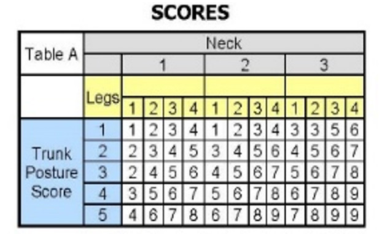
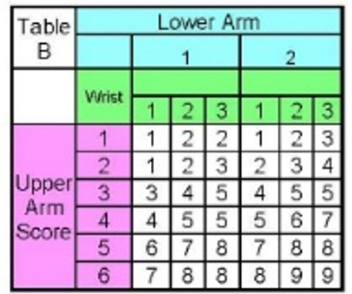
(1) Score A (Figure 1): Analysis of Neck, Trunk, and Legs: Individual scores are determined for the neck, trunk, and legs based on their postural angles. By cross-referencing these scores with Table A, Posture Score A is obtained. The total Score A is then calculated by adding the force/load score. (2) Score B (Figure 2): Analysis of Upper Arms, Lower Arms, and Wrists: The
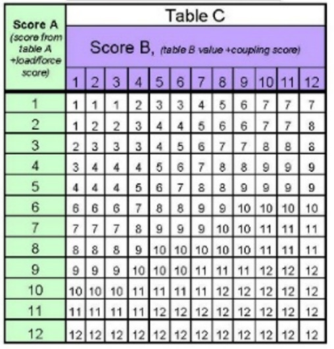
range of motion for these three segments is evaluated to derive individual scores. These are cross-referenced with Table B to obtain Posture Score B, which is then adjusted by the coupling score to reach the total Score B. (3) Integrated Scoring (Figure 3): The total scores from A and B are crossreferenced with Table C. An additional activity score is added to determine the Final REBA Score. (4) Risk Level Assessment: A higher score indicates a greater ergonomic risk.
The risk levels are categorized as follows: 1 point: Negligible (no action required); 2–3 points: Low (change may be needed); 4–7 points: Medium (change necessary); 8–10 points: High (investigate and implement change soon); 11+ points: Very High (implement change immediately).
This study utilized the Nordic Musculoskeletal Questionnaire (NMQ), an instrument originally developed by Dickinson et al. (1992) to assess general musculoskeletal conditions among various occupational groups, including data entry clerks, technicians, administrative staff, and supermarket cashiers. The questionnaire evaluates 15 body regions—including the upper back, lower back, neck, shoulders, elbows/forearms, hands/wrists, hips/thighs, knees, and ankles/feet (distinguishing between left and right sides)—using a 0–5 point scale to assess the level of soreness and joint mobility.
REBA AND NMQ ASSESSMENT RESULTS The Rapid Entire Body Assessment (REBA) was conducted to evaluate the bathing postures of 15 caregivers. The results yielded a mean risk score of 11.7 (SD = 1.0), which falls into the ‘Very High Risk’ category. This score indicates an urgent need for immediate intervention and postural adjustments to prevent long-term musculoskeletal injuries.
Among the 15 caregivers, lower back discomfort was perceived as the most significant (mean = 1.8, SD = 1.61), followed by discomfort in the left forearm/elbow (mean = 1.66, SD = 1.52).
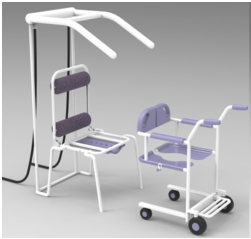
DESIGN RESEARCH AND FEATURES Most bathing aids currently available on the market are designed for single functions and generally lack care-related features such as automatic foam dispensing and rinsing. Consequently, they are insufficient in effectively addressing the operational workload of caregivers in real-world bathing care contexts. This study adopts an observational approach to directly document and analyze caregivers’ operational procedures and behaviors during bathing care. The findings are then translated into explicit design goals and functional plans, leading to the design of a bathing aid device suitable for use in long- term care facilities.
The design features and solutions to the problems of this product are as follows:
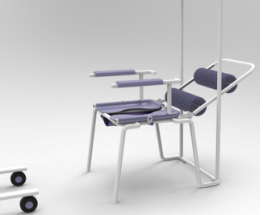
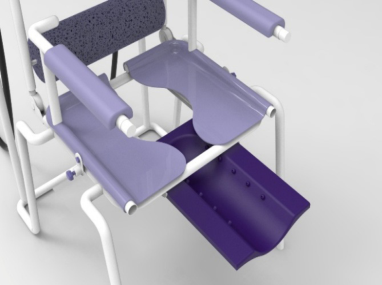
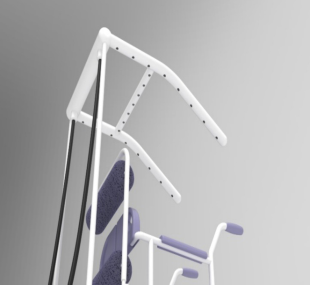
1. Design Feature: Safe transfer between bed and device, assisted mobility between bedroom and bathroom (as shown in Figure 1). Issue Addressed: Mitigates patient fall risks and caregiver fatigue by streamlining the transfer process and reducing the physical load of manual lifting. 2. Design Feature: Usability for both sitting and lying down (as shown in Figure 2). Issue Addressed: By enabling seamless transitions between sitting and lying, it enhances user autonomy and activity range while optimizing spatial efficiency in care environments. 3. Design Feature: Hygienic temporary waste management (as shown in Figure 3). Issue Addressed: This feature implements non-contact hygiene management to mitigate cross-infection and odors. 4. Design Feature: Simplified operation and maintenance. Issue Addressed: Streamlined interfaces and maintenance reduce accidents from misuse and lower cognitive load. The easy-to-clean structure eliminates hygiene dead zones, extending product service life and ensuring long-term usability.
Overall, the device effectively reduces physical and mental burden on caregivers while improving bathing efficiency and safety.
Figure 4: Transfer between bed and device.Figure 5: Usability for both sitting and lying down.Figure 6: Hygienic temporary waste management.Figure 7: Water spray & body wash outlets.
CONCLUSION AND SUGGESTIONS This study has completed the overall design concept construction of the bathing aid, based on the aforementioned observations and needs analysis, considering the main functions and usage scenarios of the device, and proposing specific functional plans. However, this study is still in the design concept and functional design stage and has not yet entered the physical
development and verification phase. Future research suggests further 3D modeling and prototype production of the device, as well as verifying its feasibility, operability, and practicality through actual operation testing and user feedback, to serve as the basis for subsequent design optimization and application promotion.
ACKNOWLEDGMENT
Authors would like to thank the National Science and Technology Council of Republic of China (Taiwan) for financial support under project no. NSTC114-2637-H-224-007.
REFERENCES
Clemes, S.A., Haslam, C.O. and Haslam, R.A. (2010). What constitutes effective manual handling training? A systematic review. Occupational Medicine, 60(2), 101–107. Davis, K.G. and Kotowski, S.E. (2015). Prevalence of musculoskeletal disorders
for nurses in hospitals, long-term care facilities, and home health care: A comprehensive review. Human Factors, 57(5), 754–792. Dawson, A.P., McLennan, S.N., Schiller, S.D., Jull, G.A., Hodges, P.W. and Stewart, S.
(2007). Interventions to prevent back pain and back injury in nurses: A systematic review. Occupational and Environmental Medicine, 64(10), 642–650. Dickinson, C.E., Campion, K., Foster, A.F., Newman, S.J., O’Rourke, A.M.T. and Thomas, P.G. (1992). Questionnaire development: An examination of the Nordic Musculoskeletal Questionnaire. Applied Ergonomics, 23(3), 197–201. Gender Equality Committee of the Executive Yuan. (n.d.). Number of caregivers. Website:
https://www.gender.ey.gov.tw/gecdb/Stat_Statistics_Query.aspx?sn=IE4UKn! NQPyYRRY2FyOrLg%40%40&statsn=G6R7Y6EdU%24wLPNZqkAKIYg% 40%40&d=194q2o4!otzoYO!8OAMYew%40%40&n=393777 (Accessed: 15 November 2024). Hignett, S. and McAtamney, L. (2000). Rapid entire body assessment (REBA).
Applied Ergonomics, 31(2), 201–205. Hui, L., Ng, G.Y., Yeung, S.S. and Hui-Chan, C.W. (2001). Evaluation of physiological work demands and low back neuromuscular fatigue on nurses working in geriatric wards. Applied Ergonomics, 32(5), 479–483. King, E.C., Weiss, B.M., Boscart, V.M., Dutta, T., Callaghan, J.P. and Fernie, G.R.
(2020). Bathing frail seniors at home: Home care providers’ approaches. Work, 66(3), 499–517. Malik, K.M., Beckerly, R. and Imani, F. (2018). Musculoskeletal disorders: A universal source of pain and disability misunderstood and mismanaged—A critical analysis based on the US model of care. Anesthesiology and Pain Medicine, 8(6), e85532. Mekonnen, T.H. (2019). Work-related factors associated with low back pain among
nurse professionals in east and west Wollega zones, Western Ethiopia, 2017: A cross-sectional study. Pain and Therapy, 8, 239–247. Ministry of Health and Welfare, Taiwan. (2023). Annual report on aging and longterm care in Taiwan. Website: https://ageing.nhri.edu.tw/annual_report/resources/ files/2023_F.pdf (Accessed: 13 March 2024). National Development Council. (2024a). Population ageing. Website: https://www.
ndc.gov.tw/Content_List.aspx?n=2688C8F5935982DC (Accessed: 15 November 2024).
Concept Design of Bathing Aids for Long-Term Care Institutions 177 National Development Council. (2024b). Population projections for the Republic
of China (Taiwan), 2024–2070. Website: https://pop-proj.ndc.gov.tw/News. aspx?n=3&sms=10347 (Accessed: 15 November 2024). Nevala, N. and Tamminen-Peter, L. (2004). Ergonomics and usability of an electrically adjustable shower trolley. International Journal of Industrial Ergonomics, 34(2), 131–138. Qareeballa, A.A., Alhamdan, O.A., Almutawaa, A.A., Alsayed, I.M., Kamal, F.A., Al
Abdrabbuh, D.S. et al. (2018). Prevalence of low back pain among female nurses working in secondary and tertiary healthcare, Kingdom of Bahrain. International Journal of Medical Science and Public Health, 7(3), 183–188. Silverstein, B. and Clark, R. (2004). Interventions to reduce work-related musculoskeletal disorders. Journal of Electromyography and Kinesiology, 14(1), 135–152. Tullar, J.M., Brewer, S., Amick, B.C., Irvin, E., Mahood, Q., Pompeii, L.A. et al.
(2010). Occupational safety and health interventions to reduce musculoskeletal symptoms in the health care sector. Journal of Occupational Rehabilitation, 20, 199–219. Yang, M.H., Jhan, C.J., Hsieh, P.C. and Kao, C.C. (2021). A study on the correlations between musculoskeletal disorders and work-related psychosocial factors among nursing aides in long-term care facilities. International Journal of Environmental Research and Public Health, 19(1), 255. Yassi, A. and Lockhart, K. (2013). Work-relatedness of low back pain in nursing
personnel: A systematic review. International Journal of Occupational and Environmental Health, 19(3), 223–244. Ziam, S., Lakhal, S., Laroche, E., Lane, J., Alderson, M. and Gagné, C. (2023).
Musculoskeletal disorder (MSD) prevention practices by nurses working in health care settings: Facilitators and barriers to implementation. Applied Ergonomics, 106, 103895.
LISTED IN THE AHFE DIGITAL BOOKSTORE CATALOGUE
Explore the complete digital volume
Human Factors and Ergonomics In Design
Read this individual research paper free through the original publisher, or explore the full digital proceedings book.
ISBN 978-1-964867-86-1
Explore this ISBN in the AHFE Bookstore ↗Listed in the July 2026 bookstore catalogue; search by ISBN to confirm current availability · Digital book purchase optional