Genovefa Kefalidou (2024). Task-based and Problem-based heuristics: Could they be mobilized as a Verification Mechanism for Usability Heuristics?. In: Usability and User Experience. AHFE Open Access, vol. 156, pp. 331–341. https://doi.org/10.54941/ahfe1005444
Prior research in design indicates that design considerations (as reflected through designers’ decisions) can greatly differ from users’ viewpoints when interacting with technologies. This is typically evidenced within designers’ proposals to focus on utility and appearance whilst users’ viewpoints (or reactions) to technologies can take multiple forms (e.g. visceral, behavioral and reflective). Heuristics are simple 'rules of thumb' applied in designing technologies, focusing on design principles that aim to satisfy utility and appearance while providing a means of ‘standardization’ for designers; the same applies to usability heuristics, which are employed at the end of the design process, to assess the usability of designed systems, both in terms of usability and aesthetics. Whilst design and evaluation heuristics can offer a level of ‘standardization’, users’ viewpoints, reactions and interpretation of the designed technology can be diverse (i.e. their emotional and behavioral responses can greatly differ, making it difficult to ‘standardize’). There are several reasons why this is happening, e.g. from individual differences to context and domain-based reasons; the latter is, indeed, one of the common issues in heuristics-based design and usability heuristics i.e. these are domain-specific. It appears that there is limited research in attempting to understand the relationship and mapping between users’ own behavior (i.e. behavior-based heuristics) and design heuristics. An open question is to what extent the ‘expertise’ and empirical knowledge of designers can overlook any intuitive or unconscious behavior-oriented heuristics that manifest 'discreetly' and 'automatically' when designing technologies.The present paper is drawing data from two different user studies (route optimization problem solving and data analytics), aiming to explore what types of behavior-based heuristics people employ when performing data analytic tasks and problem-solving tasks (without the use of computer interfaces). These two different domains are chosen as they contain different requirements (i.e. completion of healthcare data analytic tasks versus completion of visuospatial mathematical optimization problems), thus providing a diverse enough comparison to explore user behaviors within domains that require some form of computer interface. By identifying behavioral patterns and heuristics people employ when engaging with these two different domains, we are able to identify interactional needs that can inform the design of novel user interfaces (i.e. decision-support systems) that can assist in the completion of complex tasks, instead of designing technologies first and then applying design heuristics to adjust and evaluate the designs. Observation methods, problem-based/scenario-based approaches and Think Aloud protocols have been employed to identify heuristics in both studies while overall performance (in terms of task completion and accuracy) has also been measured. The research found that behavior-based heuristics can be task-based and problem-based and can manifest early in design thus need capturing at user requirements elicitation. Such behavior-based heuristics can be interactional, systemic, cognitive and experiential and need to be considered alongside usability heuristics. There is a need to formalize experiences against tasks, especially as ‘smart’ technologies and multi-systemic data exchange can be stakeholders and ‘end-users’. A conceptual design verification framework is proposed to enhance design and evaluation processes.
Heuristics are ‘rules of thumb’ employed during high cognitive tasks such as problem solving, learning and decision-making. They have been devised and applied -computationally in most cases- in a wide and diverse range of theo- retical fields and applications, including planning optimal orbit trajectories, route optimization, economy theories, management and systems’ design and evaluation (e.g. Newell and Simon, 1972; Gigerenzer and Todd, 1999; Toth and Vigo, 1997; Nielsen, 1994). Usability heuristics -a set of well-established but also debated heuristics- are employed in later stages in the technology design process to evaluate user interfaces (Nielsen, 1994). Although these are not cognitive or computational heuristics, and despite the broad use of usability heuristics in evaluation stages, they are being criticized for being too domain specific (i.e. not be able to apply them in broader application areas and technologies – Hermawati and Lawson, 2016). The multiple variations of domain-specific usability heuristics demonstrate the difficulty to reach a
standardization on the specific usability evaluation guidelines. Furthermore, they run the risk of biases while acknowledged inter-rater reliability issues manifesting within processes and results of usability heuristic evaluations are due to subjective evaluations or system complexity (Seel, 2003). Heuristics in design share some similarities -but also have distinct characteristics- with the notion of heuristics in psychological research. For example, both in HCI design and Psychology, heuristics are ‘rules of thumb’ i.e. simple strategies that people employ to perform tasks - the difference lies in the purpose and nature of these tasks; e.g. in HCI design, heuristics are strategies to con- sider for generating usable designs while in Psychology heuristics refer to strategies employed by humans to solve problems and make decisions. In HCI design literature, heuristics take the form of evaluation guidelines (e.g. Nielsen, 1994) to help designers assess the usability of their prototypes and assist them to optimize their prototypes by ‘re-design’ whilst heuristics in Psychology are instead are ‘highlights’ and manifestations of human behav- ior and cognition, the knowledge of which can help design computational models to further explore cognitive abilities. A question here is how to for- mally map the human behavioral/cognitive heuristics against the design and evaluation heuristics, considering that design and evaluation heuristics are associated to human behavior (at the end of the day, user-centered technol- ogy design aims to support human behavior and cognitions). Furthermore, HCI design (and evaluation) heuristic approaches rely on mainly conscious mechanisms of human interactions as opposed to Psychology heuristics that can also reflect unconscious mechanisms – see e.g. ‘fast and frugal’ heuris- tics (Gigerenzer and Todd, 1999) or tacit knowledge, identified as behavioral patterns – see e.g. sensemaking and decision-making (Weick, 1995). With the introduction of AI-driven technologies where transparency often is not present in UIs and interactions (thus offering limited information to users to construct their mental models and internal representations on how AI works) can trigger more conscious (progressive) or unconscious (automatic) responses depending on the context of the application and system. There is a need to streamline and verify user requirements elicitation and usabil- ity heuristics mapping as 1) the increase of modern UIs complexity (and abstractions) require us to go beyond the current standards in UI expectations and design (often assumed through the use of traditional usability heuristics guidelines); 2) usability heuristics focus on evaluating interactive features or compliance with existing standards and not reviewing or evaluating behav- ioral heuristics. By formulating a conceptual framework to always track behavioral heuristics at the early stages of design (e.g. in user requirements elicitation phase) and verifying their mapping onto usability heuristics at the later stages of the design process (e.g. evaluation stage) we can potentially bridge that gap. The present paper is drawing data from two different and diverse-domain user studies (route optimization problem solving and data analytics), aiming to explore what types of behavior-based heuristics peo- ple employ when performing data analytic tasks and problem-solving tasks (without the use of computer interfaces).
Task-Based and Problem-Based Heuristics: Could They Be Mobilized 333
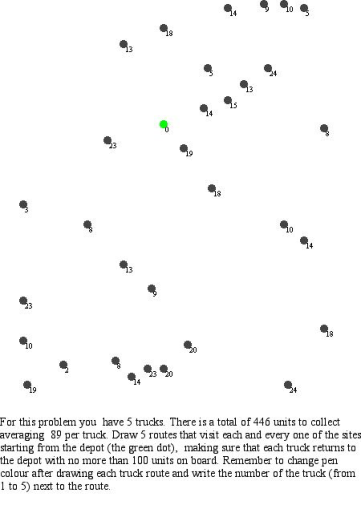
EMPIRICAL REFLECTIONS - STUDY 1: ROUTE OPTIMIZATION Route optimization refers to the process of determining the most cost- efficient route (Toth & Vigo, 1997). This process, albeit well-used in our everyday lives, it has increased complexity as it often entails additional con- straints and demands in finding an optimal (i.e. the best) solution. In such problems, people have not only to find the shortest path amongst a set of nodes in space but also ensure they do not violate certain additional con- straints (see e.g. Figure 1 where the problem is comprised of a set of nodes (including a green node which acts as the starting point of each route) that correspond to points in space where a vehicle (e.g. a logistics delivery truck) has to visit). The numbers next to the nodes correspond to ‘weights’ (or deliv- eries) that each truck has to collect. To solve this problem successfully, one needs to find the shortest path for every route they need to plan without violating the ‘weight’ constraint that is posed for each planned route.
Figure 1: Route planning problem example.
Methods
Twenty participants (M = 22 years old; SD = 1.81) solved optimal path planning problems (i.e. route optimization problems) while thinking aloud. Participants were all from within academia (i.e. 15 doctoral students and 5 post-doc researchers). All students and researchers’ background span across the fields of Psychology {PSY}, Operational Research {OR}, Educational Research {ER} and Computer Science {CS}. Recruitment was done through opportunity and snowball sampling participant were reimbursed for the time
334 Kefalidou
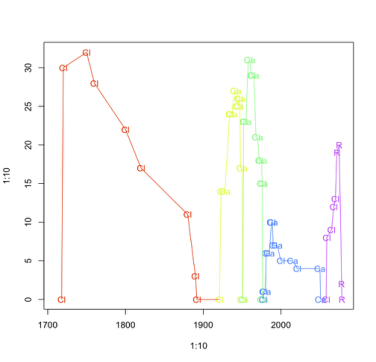
they spent on the session and were asked to verbalize while performing the task. The purpose of tracking human heuristics in this study was twofold: 1) identify strategies humans employ to solve such tasks to inform compu- tational algorithmic design and 2) to inform the design of interactive tools to support such task completion. Identified heuristics (i.e. strategy-based, planning-based, artifact-based and interaction-based heuristics) included: Clustering (CL): solvers group nodes together and based on these groupings they proceed with the rest of route planning – “... There is a clear I think group here…I am grouping them now first and then count …” P14 {CS}. Calculating (CA): solvers’ routes are planned based on the calculations they make to ensure non-violations of weight constraints – “… I am not good at Math I need to make some calculations first (…) I don’t want to violate..” P11 {ER}. Anchoring (AN): solvers start planning routes by incorporating the most ‘exterior’ nodes in the problem space – “.. Why these are so dis- tant…I am afraid I cannot have a short [path] one (…) I have to pick them up..” P3 {PSY}. Nearest neighbor (NN): solvers incorporate nodes in their routes based on the proximity they have with the currently-visited node – “.it needs shortest, isn’t it? I will pick the one next, I think that is more opti- mal...” P6 {PSY}. For a fuller set of such heuristics please see Kefalidou and Ormerod (2014). Figure 2 below shows a snippet of human cognition flow when planning a route - the solver at the 1700 timeframe they used CL for one route (red color) and then when transitioning to another route (yellow) they started adopting two different heuristics – CL and CA. As they moved from one to a next route (green) they switched to CA and so on. The obser- vation and understanding of such cognitive processes is critical in designing performance-aware intelligent systems that adapt (or mimic in some cases!) human behavior and cognitions. Interaction-based heuristics were those that users employed while interacting with the materials and stimuli of the task given (e.g. flickering through previously completed problems, reflecting or re-assessing them).
Figure 2: Heuristics flow and interchange over time (x-axis) against performance (y-axis).
Task-Based and Problem-Based Heuristics: Could They Be Mobilized 335
Interactional heuristics included Memory (MEM) and analogy-based (ANA): solvers tackled the ones that ‘looked’ similar or ‘analogical’ together – “…wait, these look similar, I may do them one after the other” P1 {OR}. Reflection-based (RE): solvers looked back to prior solutions to get ‘inspi- ration’ or expressing links and analogies to prior solutions – “oh this is similar to what I have done before (…) let me have a look at the other to see what I have done…” P9 {PSY}. Evaluation-based (EVA): solvers assessed or estimated the optimality of their planned routes - “I have to check the calculations made (…) if correct, it should work, I think I am ok here…it also looks nice!” P4 {OR}. Finally, artifact-based and system-based heuristics included: Time-based: solvers completed their route planning by allocating specific time completion windows for each task – “it’s because I do not want to spend too much time on that…I want to ensure that more or less I keep track of time for when to complete…you know…each one of these”. P5 {OR}. Paper-based: solver utilize external materials (e.g. paper notes or dif- ferent pens) to pre-plan their routes or to make calculations by hand. “oh dear this is difficult (…) I need something to estimate the weight…can I have a separate paper?” P17 {PSY}. Artefact-based and system-based heuristics are ‘external’ to human behavior but can influence it. Within the context of IoT and intelligent systems, a systemic heuristic can involve time-based data sharing ‘windows’ where data is exchanged across different devices. Although this often happens at the backend (without necessarily the con- scious awareness of human users), it can influence human behavior. Further quotes below demonstrate the flow, trajectory and interchange of task-based heuristics and the emergence of user needs as a separate artifact of the expe- rience of problem solving....in that last one...so maybe it’s best not to go for multiple big ones.. (EVA)(PA) we go for a small one.. (LOCAL).can move it around...like circle...like concentric circles (CL) rather than...fully...maybe it’s best...area...(EVA) we’ll see what happens in this one..(PA).it would be nice to have some kind of automatic estimation how well I am doing [USER NEED – verification support]...so if I do one...around here doing kind of small round circle (CL) P4 {OR}. Sometimes the expression of user needs within a task or process are not necessarily explicit. An example is given in the extract:...100 units per truck…hmm…so far it’s gonna be maths about it…I can divide 415 by 5 (AV)… don’t know [USER NEED – minimize uncertainty] if I just…that complicates everything…[USER NEED – minimize complex- ity] I can produce something that will end up being invalid if I make an error… so maybe 43…hmm… P17 {PSY}. As we move to a different era of ‘intelligent’-based systems and services, we need to revisit the way we provide and apply user-centered approaches. For example, ‘intelligent’-based systems may require a ‘tighter’ mapping of user needs, ‘early design’ heuristics and usability evaluation heuristics, especially if these are to be transformed into unified pseudocodes and ‘design grammars’.
How Could These Be Used With Usability Heuristics?
Verbalizations demonstrated not only the use of specific cognitive heuristics to help them plan efficient (and sometimes close to optimal routes) but also
336 Kefalidou
manifested user needs and other types of task-based and artifact-based heuris- tics that can be translated (alongside with the explicitly expressed user needs) to user systemic requirements. The identification of such heuristics and task- based abstractions can take place during user studies that aim to elicit user requirements by observing and measuring human behavior and performance. This means that these can be tracked at earlier stages in the design process. These heuristics and abstractions could assist the use of usability heuristics later on is by providing a platform for mapping these early identified heuris- tics and abstractions to the later usability heuristics. For example, if the identified cognitive heuristics of e.g. CL, CA, AN etc can be mapped to usabil- ity heuristics (Nielsen, 1994) e.g. #1 Visibility of system status and #2 Match between system and the real world, then the produced design can firstly have a ‘validation’ pathway throughout the design and evaluation lifecycle which will secondly transform the design process towards a more ‘seamless jour- ney’ whereby design and evaluation go hand-in-hand without relying just on iterative processes but rather on ‘parallel’ ones. In the case of designing an interactive route optimization system, the identification of heuristics such as CL, CA, AN etc can be mapped to usability heuristics such as #1 and #2 as in order for CL, CA and AN to be implemented within an interface, there is a need to ensure #1 and #2.
EMPIRICAL REFLECTIONS - STUDY 2: DATA ANALYTICS Big Data forces us to find new methods for exploring and analyzing it (Reiter, Hou, Kefalidou & Goulding, 2017). Furthermore, the design of database management systems could account for natural features of gathered data, such as temporal order. There is a need that big data analysis focuses on “observing what happens”, on making assumptions and predictions and val- idating those through qualitative interviews and more observations (Reiter et al., 2017). There is limited research that looks upon cognition to under- stand and tackle more efficiently big data processing issues. The following example demonstrates the need to capture human heuristics and task-based abstractions as an attempt to understand better how these could be employed in the design of new ‘intelligent’ big data infrastructure.
Methods
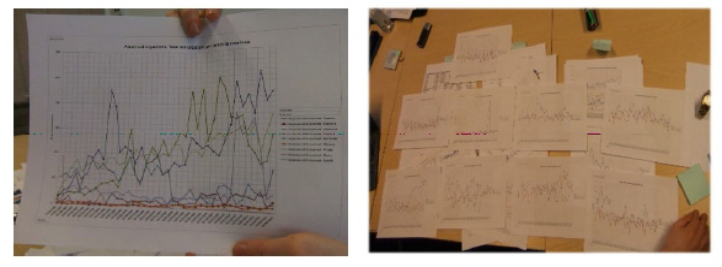
Twelve participants from different backgrounds (10 university students i.e. 5 from Computer Science {CS}, 2 from Business {BUS}, 1 from History {HIS} and 2 from Engineering {ENG}, 1 data analyst {DA} and 1 healthcare profes- sional {Health}; M = 31.5 years old; SD = 1.66) were exposed to healthcare data that typical data analysts are encountering in their everyday work activ- ities. Recruitment was done through opportunity and snowball sampling. Participation was voluntary with no reimbursements. Participants were given a set of different graph-based visualizations accompanied by instruction for the completion of a scenario task. Photos and video-recordings were taken during the completion of the tasks. Figures 3a and 3b below show examples
Task-Based and Problem-Based Heuristics: Could They Be Mobilized 337
of the stimuli of data presented. Participants were also given Help and Doc- umentation (e.g. explanation on terms) and were allowed to make notes on papers.
Figure 3: a and b Figure 3a (left) and Figure 3b (right) stimuli examples.
Overall participants utilized (similarly to the route planning example) a set of different cognitive heuristics when sensemaking the data given. These included: Visual Pattern recognition (VP): analysts identify visual patterns within data and based on these proceed to their further analyses – ‘.. There is clearly a massive increase in that month (…) total consultations over time increases (…) I felt that was quite an interesting one because it is generally kind of increasing… ‘P1. Categorizing (CA): analysts process data based on identified content or data-type categories, thematizing topics and planning further analyses and deriving to conclusions based on these - ‘…well when you’ve got so much data what I always do is separate it into themes if you will’.. P11. Comparing (CO): analysts compare data to each other and draw conclusions based on that comparison. In effect they create data matches for comparison based on theoretical scenarios - ‘.. One practice has significantly more patients and two have significantly less so you probably need to… ‘.. P3. Own Knowledge (OK): analysts utilize their own existing knowledge base to inform their next steps in data processing. The often also use their ‘common sense’ to do so - ‘.. Everyone starts doing a blood test for everything, that’s a lot more demand on blood tests in facilities so I can see that some practices (…) seem to be a lot more proactive… ‘P5. Scanning (SC): analysts scan the data to obtain a global overview of what is there and prepare themselves on how to best interrogate them - ‘.. because when I try to select the useful infor- mation I scan per slice…per slice and firstly…I do not understand this… ‘P6. Hypothesizing (HY): analysts formulate draft hypotheses as they go along with the interrogation of data as a means for enhancing their data under- standing and formulate a storyline. Usually hypothesizing is accompanied by clear querying as well - ‘…it could be that all are in the same area and two have a very poor reputation if that is happening in terms of strain does that mean selling or closing those two and merging it into that one that everyone goes to anyway … ‘P7. Filtering (FI): analysts filter different pieces of data in terms of sorting it out to help them later on categorize and thematize them -
338 Kefalidou
‘…generally [medical diseases] and so on are on the way down but I think it was a [particular one] way way down so I put [condition 1] …I don’t know where I put it [USER NEED] let’s have a look here…see if it tells me … ‘P9. Communicating with others (COM): analysts need communicate with others to assist them in understanding (or cross-validating) expert data and knowl- edge that themselves may not have in their knowledge base – ‘…yeah, yeah, i think i do tend to i write the code, try and get a good feel for the data, (…) and then perhaps then go and discuss it with people, what do you think about this, and they, they might, because they’ve got more knowledge about the area P11. Fusing (FU): analysts combine and match data to make more sense of it - ‘…so the information erm, i would like to, i would like to have two streams of information given to, to target audience [USER NEED – additional data] and then combine them, like finding the overlap point to ‘P9.
The above heuristics were of analytical nature (e.g. assessing, utilizing own knowledge and comparing) but also others were more of a cognitive behav- ioral nature such as spotting visual patterns and hypothesizing in the data. Indeed, such heuristics currently manifest within system behavior (and could form system-based heuristics) such as scanning and filtering. Other heuristics identified were more interactional such as communicating with others, which in the context of IoT networking and data sharing could be related to data package sending. Similarly to the route planning example in the previous sec- tion, both cognitive heuristics and needs co-exist and manifest as part of the process of completing a task. Within the context of big data analytics, it is important to understand how intuitively people reason about complex infor- mation, how they filter it out and how they assess it to formulate hypotheses. It is such knowledge that modern intelligent systems aim to ‘recreate’ or facil- itate by capitalizing on the computational power (e.g. in ML techniques). The following quotes demonstrate the interplay between the analysts’ cognitive heuristics and their needs within the process.…for example the new and leav- ing patients it’s more about a general management point of view [AS], and for those illnesses, cases, they are more a professional point of view [OK], so the information erm, i would like to, i would like to have two streams of information given to, to target audience [USER NEED – additional data] and then combine them, like finding the overlap point to [FUSE], to like, to tell them where they should collaborate and do something together, that’s my intention. P9. Interestingly, P2 realizes that there is a cognitive load that they have to tackle in their attempts to analyze the presented data. This is ‘silently’ expressed as a user need. Their chosen cognitive heuristics involve comparing datasets and utilizing the advantages that their visual system offers; that of visual pattern recognition. They then acknowledge another need (very simi- lar to minimizing overload) by stating that the data seems to be noisy. …so there’s that, and in terms i mean there’s too much data [USER NEED – mini- mize overload] ]i feel to go into things like the differences in illness [CO], so what i was trying to do is actually find stuff that was significantly unusual [VP], so what are these graphs? i feel that if you’re looking at predicting the future strain on something they’re too noisy [FILTERING-NEED] and there is no trend [VP] for most of them that you could reliably make a prediction of strain in the future, (…) i mean you could argue it didn’t exist here, but
Task-Based and Problem-Based Heuristics: Could They Be Mobilized 339
the problem with that is that they’re not all on the same level [USER NEED – consistent presentation] P2. Within a design process this would be perhaps translated to a tool that allows users to change parameters within a graph or pull additional data to facilitate enquiry without overloading the analyst visually.
How Could These Be Used With Usability Heuristics?
Within this data analytics study participants verbalizations suggested again the presence of both heuristics and task abstractions as well as user needs, demonstrating that these are different yet interconnected. As such, it is impor- tant to acknowledge these as ‘co-existing’ information that every designer should acknowledge, not just as thematized data (i.e. perhaps as a product of a specific data analytic method). If we were to map identified abstractions to usability heuristics, examples of such would be the VP and OK abstractions to be mapped to usability heuristic #2 Match between system and the real world and #6 Recognition rather than Recall, while CA, CO, FI and COM could be mapped to #7 Flexibility and Efficiency of use and #3 User Control and Freedom. Again, by mapping these, despite the different stages in the design and evaluation process, would result to a more ‘cohesive’ design with potentially fewer ‘design errors’ at the beginning to mid-design stages.
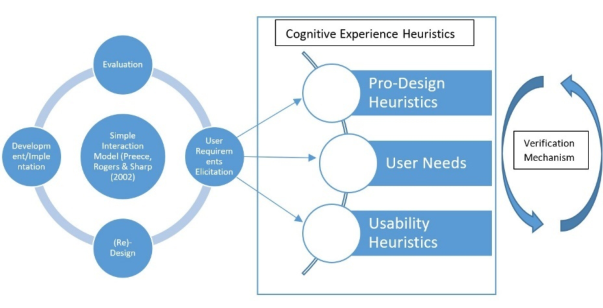
TOWARDS A CONCEPTUAL VERIFICATION FRAMEWORK The above results hopefully contributed to understand the difference between cognitive heuristics and needs and highlighted the importance of capturing both within the processes of user needs analyses and system design. As such, cognitive heuristics tracking alongside with user needs analyses and as part of user requirements elicitation stages is needed so that HCI practitioners and researchers capture both cognitive aspects of human nature and user needs. When designing intelligent systems and services, we need to become aware of systemic behaviors and acknowledge potential system-based heuristics that manifest in human-to-system and system-to-system interactions – both human and system heuristics need to be considered formally within the design process throughout. The proposed conceptual framework (Fig. 4) incorpo- rates parallel tracking of heuristics and needs whereby their interactions are identified and ‘translated’ into a fused user-centered design that is both functional, intuitive and pleasurable. A heuristic-inspired conceptual design framework as such can also act as a reflective mechanism for users, designers and requirements analysts for validating and adapting their designs to make them more intelligent and personalized. It is expected that the present work and proposed framework will inspire a set of new HCI studies to investi- gate UX under new layers of granularity but also trigger studies in mapping and fusing cognitive heuristics (as both human and systemic) with evaluation methods offering new prospects and perspectives for innovative design guide- lines for personalized and cognitive-aware systems. Considering the identified heuristics, and their manifestations within interactions, problem-solving and data interrogations, it is important to map these to existing evaluation tech- niques such as Heuristic Evaluations (HEs). For example, visibility of system
340 Kefalidou
status and match between system and real world as well as recognition than recall and ability to identify errors could map onto VP and CO heuristics. Help and documentation could map to OK and COM heuristics. While the present paper does not provide a thorough investigation on such a map- ping, such could be a useful area to explore further to provide a more robust practical method for designing technologies with conceptual flow.
Figure 4: Proposed conceptual framework for mapping cognitive behavioral heuristics against usability heuristics at early stages in the design process.
The mapping between the task-based heuristics (during the design phases) and the usability heuristics (during the evaluation phases) is not necessarily on a one-to-one basis but it can have different granularity and ‘strength’ of mapping elements. In essence, statistical agreement mappings – akin to kappa statistics for inter-rater reliability – could be applied to determine the map- ping strength between task-based design heuristics and usability evaluation heuristics for a specific system.
CONCLUSION
It is hoped that the present paper has demonstrated a perspective of need for revisiting and enriching current practices and processes within user needs analyses and systems’ design and that it has proposed a conceptual heuristics design framework that provides opportunities for self-reflection, validation and inspiration for new HCI research that strives to design the new gen- eration of intelligent interactive systems that are not only context-aware but also cognitive-aware. The results of the analyses lead to a conceptual design framework proposal which is cognitive-inspired and posits mapping to usability heuristics early on.
ACKNOWLEDGMENT
Genovefa Kefalidou has been partially supported by the UKRI Trustworthy Autonomous Systems Node in Verifiability under Grant EP/V026801/2. Parts of the case studies had also been supported by EPSRC (Grant EP/P50256X/1)
Task-Based and Problem-Based Heuristics: Could They Be Mobilized 341
and RCUK (now known as UKRI) Horizon Digital Economy Research (Hub grant EP/G065802/1). Many thanks to all participants and anonymous reviewers.
REFERENCES
Gigerenzer, G. and Goldstein, D. G. (1996). Reasoning the fast and frugal way: Models of bounded rationality. Psychological review, 103(4), p. 650. Hermawati, S. and Lawson, G. (2016). Establishing usability heuristics for heuristics
evaluation in a specific domain: Is there a consensus?. Applied ergonomics, 56, pp. 34–51. Kefalidou, G. and Ormerod, T. C. (2014). “The fast and the not-so-frugal: Human heuristics for optimization problem solving”, proceedings of the Annual Meeting of the Cognitive Science Society, Quebec City, Canada Newell, A. and Simon, H. A. (1972). Human problem solving (Vol. 104, No. 9).
Englewood Cliffs, NJ: Prentice-hall. Harold, ed. (2003). Handbook of human systems integration. New Jersey: Wiley. Nielsen, J. (1994), April. “Enhancing the explanatory power of usability heuristics”.
Proceedings of the SIGCHI conference on Human Factors in Computing Systems, Boston, MA. Reiter, A., Hou, X., Kefalidou, G. and Goulding, J. (2017). “Novice and Experts Strategies for Understanding Complex Big Data”, proceedings of the Contem- porary Ergonomics & Human Factors 2017, Eds R Charles & J Wilkinson Abe. Seel, N. M. (2003). Model-centered learning and instruction. Technology, Instruc-
tion, Cognition and Learning, 1(1), pp. 59–85. Toth, P. and Vigo, D. (1997). An exact algorithm for the vehicle routing problem with backhauls. Transportation science, 31(4), pp. 372–385. Weick, K. E. (1995). Sensemaking in organizations (Vol. 3). Sage.
LISTED IN THE AHFE DIGITAL BOOKSTORE CATALOGUE
Explore the complete digital volume
Usability and User Experience
Read this individual research paper free through the original publisher, or explore the full digital proceedings book.
ISBN 978-1-964867-32-8
Explore this ISBN in the AHFE Bookstore ↗Listed in the July 2026 bookstore catalogue; search by ISBN to confirm current availability · Digital book purchase optional