Gianni Montagna, Maria Antonietta Sbordone, Alessandra Esposito, Ana Marques, Ilenia Amato, Rita Gaspar (2022). New Territories of Sustainable Fashion. In: Human Factors for Apparel and Textile Engineering. AHFE Open Access, vol. 32, pp. 120–128. https://doi.org/10.54941/ahfe1001546
The paper presents the results of a research carried out in the clothing, footwear and leather goods sectors referring to the Italian territory. The survey was carried out through the collection of data on the field, with questionnaires administered to companies in the area: structured analysis on the company profile and brand identity; focus on sustainability with reference to the measures adopted by the company; technological assessment; collection of new needs expressed by each company. The result of the on-field research suggests, on the one hand, theoretical reflections relating to new sustainable approaches for the fashion sector, and on the other, technological innovation to implement value and profit for each company according to a sustainable and circular economic model. In Italy the local manufacturing systems have had their fulcrum in the industrial districts, which present themselves as centres of relations between multiple stakeholders. Generally, the openness and inclusion of stakeholders and systemic organization are essential for the sustainable development of the sector.The cultural tradition and the organization of Made in Italy production, in parallel with the Portuguese textile production systems, seem better prepared for a real ecological transition (Ricchetti & Frisa, 2011). This research proposes a model that accompanies companies on a transition path towards sustainable production.The methodology investigated, which starts from the enhancement of operational tools, contributes to promoting the adoption of new production processes and therefore to a more conscious consumption.The results achieved by SMEs in recent years, in the areas of ecological and digital transition, promise interesting developments, formulating a starting point to be used as an organizational and productive support to definitively move towards the suggested model. The discussion proposes a series of recommendations that can contribute to adopting a change in the entrepreneurial system of SMEs, vice versa, where there are contradictions and persisting barriers, it will be necessary to consider concrete and unanimously shared measures.
The paper presents the results of a research carried out in the clothing, and textile sector and its link with the territory. The survey was carried out through the collection of data on the field, with questionnaires applied to companies in the fashion and textile area: structured analysis of the com- pany profile and brand identity; focusing on sustainability with reference to the measures adopted by the company; technological assessment; collection of new needs expressed by them. The result of the on-field research suggests, on the one hand, theoretical reflections relating to new sustainable appro- aches for the fashion sector, and on the other, technological innovation to implement value and profit for each company according to a sustainable and circular economic model. Two different productive districts were identified in the two countries participating in the construction of this paper, each with its common characteristics: high quality, inclusion of identity, care in the construction of products, their commercialization and recycling.
In Italy, the productive reality of the Campania Region was observed with its local and regional textile productions, also guaranteeing the tradition and
high quality of their products. In Portugal, realities of textile production in the north of the country were worked on, where the production of traditional and technological textiles is high and recognized.
Specialized industrial districts are a high asset and present themselves as concentrated and specialized territorial centers where different values and knowledge of the multiple actors in the production system cross. Generally, openness, adaptation and inclusion of stakeholders and systemic organi- zation are essential for the sustainable development of the sector and its territory. Generally, the openness and inclusion of stakeholders and syste- mic organization are essential for the sustainable development of the sector. The cultural tradition and the organization of Made in Italy production, in parallel with the Portuguese textile production systems, seem better prepared for a real ecological transition (Ricchetti & Frisa, 2011).
INNOVATION, SUSTAINABILITY AND THE PRODUCTIVE LANDSCAPES Sustainability is probably one of the most used words in the fashion and textile sector in recent years. There is nothing wrong with talking about sustainability, as we need to change our behaviors as soon as possible and before we reach the point of no return. The problem is that many of the people who talk about sustainability are only able to look at one side of the problem, or they do so in an uncoordinated and distributed way. Sustainabi- lity is a process, a method, an attitude, and a way of thinking, which crosses the material and immaterial issues of the fashion object and the individual, placing itself on the limits of the different ecosystems that develop autono- mously but that they also intersect with others, influencing and adapting them within an ever-changing context.
Too often professionals in the fields of fashion and textiles refer to sustai- nability looking at it from a single point of view without realizing that the three classic pillars of sustainability cannot be looked at separately or from the point of view that interests us most, but must be considered in toge- ther (Montagna, 2021), and more than that, they must collaborate in a logic of interdependent relationship and mutual support. The limitations of each pillar of sustainability (financial, material, and social) can only be ove- rcome with a collaborative integrity of the Fashion and Textile system and its subsystems, and only when the relationship between them is integrated and interdependent, looking at the common advantages more than the individual ones.
The required interactivity must be constant, and its results shared, placing companies in an advantageous and healthy productive context, so that it can share its advantages with the human and social capital present in the com- pany and in the geographical region where it is installed, respecting of the environment and the territory where it operates, and can generate benefits for all who live and operate in the territory, in a way considered socially and ethically fair. The idea of the territory linked to the design and production of products has always been an important reality, even if with globalization these limits have become more blurred and weaker. The development of ideas,
materials, objects, and behaviors are strictly linked to the place, and its know- how. On a national scale we have examples of Made in Italy for high quality products, the U.S.A. for the development of sports equipment, the Scots for tartan fabrics and Shetland wool, Norway for the traditional round scapular sweaters with figurative jacquards, Portugal with traditional textile materials embroidered, printed, and worked with a national and colonial scent, among others.
If it is true that the production of textile products can create wealth and contribute to the dissemination of culture and local identity, on the other hand, the intensive use of finite resources creates imbalances in ecosystems and their integration that can be very dangerous and lead the planet to an increasingly difficult decompensation to regain. By betraying the issue of sustainability without concerted and unanimous action, we end up unba- lancing the system and the losses will be global at the level of the pillars that support it.
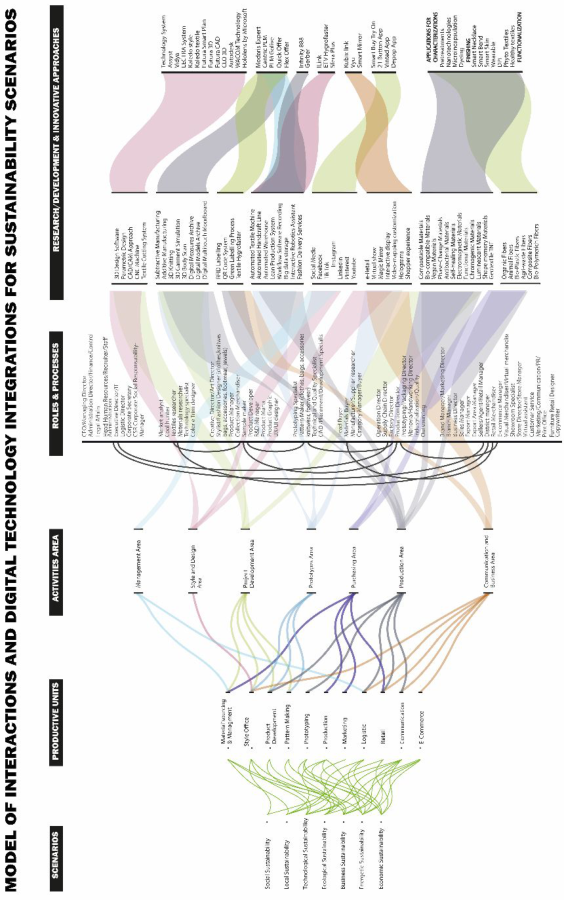
The proposed model was created with the intention of being able to serve as a guide for designers and companies in the creation of new products and with a developed awareness about the impacts on sustainability. The model proposes a set of digital connections and interconnections from scenarios and production activities to different areas of activity, shifting the role of each actor to the innovative approaches proposed by technologies and new interrelation systems.
CASE STUDY: SURVEY METHODOLOGY To deepen the commitment of enterprises in the Textile Clothing Footw- ear Leather (TCFL) sector in the management of social and environmental aspects of production processes, questionnaires and semi-structured intervi- ews were the base for a multilevel research methodology, conducted in the period between February and December 2021. The questions were articula- ted around the following aspects: a first phase of analysis of the company profile and identification of values; a second phase, a focus on sustainabi- lity and the strategies adopted; a third phase, on the technological evaluation with the identification of new needs within the supply chain. The interviews presented were recorded, transcribed, and analyzed. Each researcher colle- cted the information for the purposes of the research up to the realization of video interviews.
Production Process, Interview and Innovations Needs for TCFL Sectors The production of luxury Men’s Tailoring by Attolini (Fig. 2a), emphasizes craftsmanship to make the garment exclusive, extending its values to business ethics, product culture and territorial identity. Attolini defines its productions Timeless, made with sustainable and certified raw materials, designed to last, rooted in what are the origins and traditions linked to a name. The expressed need of technological implementation involves several stages of production: from the use of 3D design software for the digitized simulation of products such as Lectra®, CLO3D® and Autodesk®, which are among the software
New Territories of Sustainable Fashion 123
Figure 1: Model of interactions and digital technology integrations for sustainability scenarios (De Luca A., Amato C.I., Sbordone M.A, 2021). Model proposal for the development of new sustainable and circular approaches.
currently most recommended in the optimization of digital prototyping and simulation processes; to the creation of a digitized archive for models; to the 3D Body Scanner system to capture the dimensions of the body (Kim & Choi, 2021); to 3D and VR simulations for the creation of interactive digital e-catalogues; to virtual fitting visualization with Smart Mirror® systems that simplify the shopping experience.
Divina S.R.L (Fig.2b) produces luxury footwear through its own brand, Evaluna. The company was born with an exclusively Italian distribution, with
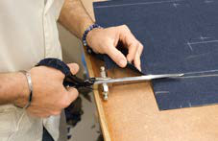
Figure 2: Industrial Production processes in Italy. Fig. 2a Jacket cutting at Ottolini S.P.A.; Fig. 2b Manufacturing process for footwear model at Divina S.R.L.; Fig. 2c Top view focus on the automated manovia at Sunrise Leather Goods. (Source figures 2a, 2b and 2c of authors, 2021).
the opening to the international market only in recent years. The company intends to preserve the excellence of Made in Italy and to achieve the highest sustainability goals, focusing on the choice of eco-sustainable materials; the use of more efficient production technologies; and respond to international consumer needs with eco-friendly products. Technological innovation is still limited, but the company aspires to a future integration in the prototyping phase, replacing the models currently made by hand through 3D digitization software, up to the 3D printing of a pre-model. The innovation proposal concerns the implementation of engineered systems to reduce defects in the cutting phase of the material (leathers), including digital management of the product, raising quality and more efficient practices.
Sunrise Pelletterie S.R.L. (Fig.2c) born with a small laboratory of about 200 square metres with only 20 employees. Today it is a structured company that has undergone an increase of almost 700% in 9 years to become one of the most innovative companies in Southern Italy. Sunrise Pelletterie is active in the Small Leather Good sector with several production lines, including exclusive productions for luxury brands including Gucci, Prada, and other international brands. From the crankcase to the packaging, it inserts a strong component of technological innovation, ensuring quality, optimizing produ- ctivity and pursuing Operational Excellence in different areas (Chiarini & Kumar, 2020): technological machinery allows the management of the raw material used in the realization of the product such as thickness, finishing and stitching, reducing errors in the phases of combination and assembly; integra- tion of automation in the crankcase processes, raising the production to 4.0. The accurate knowledge of internal processes, demonstrates the company’s commitment to maximizing resources, thus defining its own Lean Produ- ction (Womack, 2007). Innovation concerns the integration of sustainable approaches, with bio-based materials and the use of an intelligent system for monitoring the condition and quality of the materials like Hygrofaster® of ETV Elettronica Tessile Varese and Sfera Plus System®.
Approach to the Portuguese Textiles The TEXTILE CLUSTER Technology and Fashion, a sectorial support stru- cture for Portuguese textile companies, refers Ana Tavares (2022) uses technology and artificial intelligence as a way of boosting manufacturing
processes and saving resources. Having state support for the innovation of systems for circularity through the project PORTUGAL 2020. There is a clear focus on upcycling and valorization of waste from various areas, creating synergies between companies from different branches. The aim is to create circular systems, to make the textile industry more attractive to young people and to achieve energy efficiency in all industrial and technological processes (Tavares, 2022).
According to ATP, Associação Portuguesa de Têxteis, the textile material has a remarkable performance and can be considered a privileged material in issues related to circularity. This approach is reflected in the sector in mul- tiple ways ranging from technological development through AI and in the upcycling of textile materials.
To recognize some Portuguese national and international companies that produce in Portugal in the field of high-quality textile production, different realities were identified which, having the capacity to respond to different levels of markets and consumer needs, achieving a high level of production adaptability and product quality. In this sense, we will present three different examples of textile productions in which textile materials and their products can be produced from a more industrial way to a more artisanal.
For the development of this work, the interview guide used by the Ita- lian production companies was assumed, with slight adaptations because the a specific reality. The interview guide was used for a semi-structured open interview in order to be able to gather as much information as possible and, where necessary, deepen the interview.
The Portuguese textile industry, predominantly based in the north of the country, has developed over the last 20 years, especially after China’s entry into the World Trade Organization (WTO) in 2001, a new ability to organize and create an international market. With the support of - CITEVE, Tecno- logia Têxtil - the Portuguese textile industry got a fundamental interlocutor for technological and product development, serving as a basis for technologi- cal support, innovation, and sustainability for local and national companies. Companies started early to have access to certifications for their products, for example Öko-tex and GOTS - Global Organic Textile Standard, and to be able to export qualified products that responded to the needs of users. Currently, they are developing more than 50 scientific-technological projects,
with companies and with the support of technologies, they aim to improve and update the work of workers in the sector looking at new production and market models, such as the recovery of textile waste and new perspectives of circularity.
One of the biggest companies in Portugal are Riopele, situated in the north of Portugal and working at international level. Riopele, founded in 1927, produces innovative and functional fabrics from elements extracted from unconventional sources, such as agri-food waste, and giving the final product new properties (Ex: odour neutralisation or anti-stain treatment). During the production of these fabrics, the company can recycle more than 50% of water, use cleaner energy (such as solar energy), and commit itself to reduce the amount of CO2 released into the atmosphere. As a circular economical system, as well as an innovative company, Riopele always stri- ves for partnerships with technological centres, universities, and other textile companies. As a truly sustainable company, it is also strongly committed to giving all their workers a good and safe work environment, considering that 45% of all their female staff are in leadership roles. The case of the Chi Coração brand is an example of a medium company that develops handcrafted and manual work in all operations where it is necessary. This company is focused almost exclusively on the production of 100% Portuguese wool products. The work is carried out on older looms and the acquisition of Jacquard looms will make it possible in the very near future to produce new products with greater complexity. To control the qua- lity of the product, the company became a vertical company, starting with the treatment of raw wool, until the production of fabrics, blankets and interior products that are sold online and in Lisbon’s own stores, refers Santos (2022). The company is very committed to sustainability in its entirety, promoting constant improvements in products and company, care for the environment and reducing the consumption of drinking water collecting rainwater for use in production and will soon begin dyeing with natural colors to avoid the use of chemicals as much as possible. Chi Coração produces recycled yarn and textiles with production leftovers, trying to limit their impact and ecological footprint as much as possible.
The Capuchinhas example is of a micro-enterprise dedicated to the revita- lization of ancestral methods and techniques to produce high quality, fashion products. It is a small atelier where less than 10 people work and which, with the support of a designer, they develop new products with a traditional flavour and local culture. Conserving their traditions, they explore diffe- rent possibilities in handlooms with traditional products and textile materials such as wool and linen, creating small productions that are very well accepted by the public, women, men and children. Textile exploration is a work that is constantly developed, whether in orthogonal textiles or in knits, producing from sweaters to coats and shoes in wool and linen, and having created a strong and recognizable brand image at national and international level. The Capuchinhas work fundamentally with natural colours and also natural dyes, demonstrating a need to incorporate and communicate strong values in their products, in a constant search to promote and safeguard the territory where
New Territories of Sustainable Fashion 127
they are installed and where they live in perfect symbiosis with the place and its features.
DISCUSSION
Companies that interact in sharing knowledge and skills are involved in a co-creative process, fostering new relationships, enhancing the entrepreneu- rial fabric, safeguarding skills that risk being lost due to new production dynamics. In the data collected through this research work, there are many points of approximation between the analyzed companies, which, even being a small sample of the collected elements, it will already be possible to glimpse a parallel path in the issues addressed. The creation of a sustainable product requires a reorganization of the different companies and the entire supply chain, development, and distribution system, but despite being a demanding issue, it also manages to provide a reduction in the use of resources that are finite and that are increasingly expensive and valuable. Innovation is central to all the companies present in this paper and are concerned with the need to create something new and the different approaches requested by the interme- diate and final users. Technologies are of great interest to this labor-intensive sector as a way of freeing workers from routine work and putting them to develop strategies and opportunities to improve the product, methods, and their relationship with a new reality.
The need to imprinting a personal and identity stamp on the textile mate- rial is undoubtedly an added value of each producing region and each recognized cultural object. The need for companies to incorporate values in which users can recognize themselves is an irreversible path that each company needs to follow, looking at the place and geography they intend to occupy.
CONCLUSION
The results achieved by SMEs in recent years, in the areas of ecological and digital transition, promise interesting developments, formulating a starting point to be used as an organizational and productive support to definiti- vely move towards to the suggested model. With reference to a national and international scenario, it was possible to identify the current state of digital technologies in the TCFL sectors, advancing in the proposal of innovative and sustainable technological integrations supporting the integration between 4.0 and 5.0 industry.
The need to safeguard the planet and its geographical and cultural territo- ries is a global problem that requires responses to scarcity of drinking water, poor air quality, infertility of some lands, carbon, and sustainable footprints, are just some of the emergencies that must be corrected with an awareness of the fashion and textile sector. Corporative innovation is entering a new para- digm, where the most important issue is not the product, but user satisfaction in different aspects of their lives, such as the environment, safety, ethics, pro- cesses, among others, promoting a holistic view of technology and not just
production oriented. Although we are living in a global world, where everyth- ing is instant and fickle, we see that what usually prevails for the longest and helps companies go further, is the magical combination between know-how and innovation.
In Italy and Portugal there are many different companies that work with a focus on sustainability and that commitment with their territory and respect its safeguard to create a balanced relationship between the work carried out and the experience of producers and users on the land.
ACKNOWLEDGMENT
The authors of this paper wish to thank for founding this research-project: the Department of Architecture and Industrial Design (DADI), ARKADIUSZ, Center for Research in Architecture, Urbanism and Design (CIAUD) of the Lisbon School of Architecture of the Universidade de Lisboa and FCT for founding this project.
REFERENCES
ATP Associação Têxtil e Vestuário de Portugal. Fonte: https://atp.pt/wp- content/uploads/2022/01/PressRelease-Exportacoes-da-ITV- Novembro21_10.1.22.pdf. Accessed a 16 de February 2022. Chiarini, A., & Kumar, M. (2020). Lean Six Sigma and Industry 4.0 integration for Operational Excellence: evidence from Italian manufacturing companies. Production Planning & Control, 32(13), 1084–1101. https://doi.org/10.1080/ 09537287.2020.1784485 Kim, K. S., & Choi, Y. (2021). A Study on the 3D Body Scan Data Editing Process
and Errors Analysis for Clothing Design. International Journal of Costume and Fashion, 21(1), 14–24. https://doi.org/10.7233/ijcf.2021.21.1.014 Montagna, G., Pereira, C., & Marques, A. (2022). Creativity and Sustainability. In Creating Through Mind and Emotions. (1st ed., p. 532). CRC Press. Ricchetti & Frisa (2021). Il bello e il buono. Le ragioni della moda sostenibile.
Marsilio Editore. Santos, O. (2022, February 28). Chi Coração—Wool Love 100% (G. Montagna, Interviewer) [On-Line]. Tavares, A. (2022, February 24). Citeve e a Excelência Têxtil (R. Gaspar, Interviewer)
[On-Line]. Womack, J. P. (2007). The Machine That Changed the World: The Story of Lean Production -- Toyota’s Secret Weapon in the Global Car Wars That Is Revolutionizing World Industry (1st ed.). Free Press.
LISTED IN THE AHFE DIGITAL BOOKSTORE CATALOGUE
Explore the complete digital volume
Human Factors for Apparel and Textile Engineering
Read this individual research paper free through the original publisher, or explore the full digital proceedings book.
ISBN 978-1-958651-08-7
Explore this ISBN in the AHFE Bookstore ↗Listed in the July 2026 bookstore catalogue; search by ISBN to confirm current availability · Digital book purchase optional