Gianni Montagna, Maria Delgado, Isabel Duarte De Almeida, Luís Santos (2022). New skills for new designers: Fashion and Textiles. In: Human Factors for Apparel and Textile Engineering. AHFE Open Access, vol. 32, pp. 63–72. https://doi.org/10.54941/ahfe1001539
This work arises as a reflection on what it means to be a designer of the future and their greater need for influence and collaboration with the team throughout the product creation cycle. The renewal of a culture of design and business innovation in the area of fashion and textile design is based on the establishment of bridges with different realities that, increasingly dynamic, change the landscape of different products and their creation processes, blurring the boundaries and limits of each area of intervention and its actors. From the small to the big industry we find new needs and professions that project themselves into the future reaching from the past, as in the case of new craft productions that value the identity, artistic and cultural heritage of each geography, supported by new materials and technologies of Industry 5.0. This new dynamic of integrated work, where everyone contributes to enhance the knowledge of each participant, enabling the renewal of knowledge and the development of innovation and social, cultural, and economic inclusion, needs greater support and connection between academia and the creative and productive reality on the ground. The present research group, sustained by the interpretation of the paths of work innovation in the coming decades, intended to provide a contribution to the industry and the culture of national or international design innovation, through research based on the identification of the knowledge and skills necessary for the future training of fashion designers.The adoption of a qualitative and quantitative methodology should allow the collection of data that can indicate trends of needs of future designers and the need to adapt the academy to these new realities. With this study we intend to establish a network of relationships between the different actors in the process of creation and innovation, as well as promote a greater connection between the different forms of creation and production that allow to satisfy the final consumer and their needs around fashion and textiles.
The academic community, aware of the requirements, evolution and diver- sification of the highly competitive, unpredictable and ever-changing labor market, has been increasingly questioning how Higher Education Instituti- ons (HEIs) are preparing future professionals, in particular fashion and textile designers, to integrate a knowledge-based society and economy. The question arises not only for those who intend to enter the labor market for the first time, but also for those who, already part of that market, need to adapt to the new technological, social and economic paradigm inherent to the challenges of Industry 5.0 advanced manufacturing. The future of jobs, according to Bakhshi et al., is dependent not only on the automation of industry, but also on globalization, an aging population, urbanization and the rise of the green economy (2017).
The European Commission (2021) depicts, through its research and inno- vation working group, that Industry 5.0 provides a new vision of the industry that should go beyond the efficiency and productivity of Industry 4.0. This new paradigm re-introduces the “human touch” by putting the wellbeing of stakeholders at the center of the process, through the use of new technologies that balance prosperity and development while respecting the production limits of the planet. Technological progress increases the
demand for skills. The designer’s work became, in recent years, a multifa- ceted and complex endeavor that goes beyond questions centered on form and function, and increasingly takes into account the ecosystem where users live and are inserted. As said by Weil and Mayfield, (2020, p. 159), “the human-centered design strand drove us further down the path of emphasi- zing design’s emerging role in innovation and strategy versus its traditional role in making”.
The contemporary individual is an informed and multifaceted user, who has become less and less satisfied with the use of standardized fashion. Accor- ding to Jordan (2000), XXI century’s users seek pleasurable experiences through the products they wear. Those products have to address sensorial emotions, to be aligned with the personal image we intend to project on oth- ers, to provide a pleasurable use, and also to act according to our values and beliefs. All these needs must be addressed in a professional and informed way by designers.
Design has gradually become a two-way relationship between users and companies. The designer is the mediator of this relationship and has the responsibility to interpret the different signs of change in it. Therefore, there is a need to build dynamic and flexible teaching-learning models that prepare the designer to address the needs of users and companies.
However, the speed of change of curricula in educational institutions does not always keep pace with technological progress (Schleicher, 2015), sustai- nable economy, nor the investment in skills that this requires. As argued by Bakhshi et al. (2017, p. 18) the resilience of the system of modern economies depends on “the collective ability of individuals, education and labor market institutions to adapt to change without breaking down or requiring exces- sively costly intervention to remedy”. This paper, continuing the ongoing research in the domain of skills in fashion design (Santos, et al., 2021) and having as motivation the changes in the profile of consumers and the job mar- kets, intends to question which competencies fashion and textile designers need to have nowadays.
LITERATURE REVIEW: THE NEW CURRICULA Over the last decade, many studies have been carried out to identify main work activities, their skills profile, and the academic training and know- ledge required for each of them (Bakhshi et al., 2017). Industry 5.0 demands workers with a new set of skills that supports, for example, sustainable eco- nomic growth. These new skill sets, help companies to face globalization and to respond to the economies of scale that flood the markets with products. In this sense, professionals must know how to look at society holistically and creatively, identifying problems and finding appropriate solutions (Sei- xas et al., 2021), serving companies and users with results in terms of greater involvement and competitiveness.
A broader understanding of competencies has been discussed by the international political and educational community, in the light of different concepts, taxonomies and technical specifications. The so-called key compe- tencies for the 21st century that all citizens must acquire encompass cognitive,
New Skills for New Designers: Fashion and Textiles 65
intrapersonal and interpersonal skills (National Research Council, 2012). Therefore, to thrive in the socio-professional context, the designer needs to constantly master new knowledge and skills through a process of kno- wing, knowing how to do and knowing how to behave. It is in this broad vision of training that hard and soft skills need to be interwoven with the different disciplines, supporting a robust design thinking and practice. This wide and transdisciplinary perspective is assumed to be essential in design practice, because it allows a balanced interaction with all marginal areas (Montagna,et al. 2012; Seixas, et al., 2021). As agreed Weil and Mayfield, (2020, p.160) “our curriculum must evolve to a focus on critical, emerging and perennial competencies, rather than technical skills and processes that can quickly become obsolete or outdated”. The design curricula needs to be focused on the trainee’s cognitive and behavioral skills (Scheerens, et.al, 2020), favoring innovative and creative processes and methods, framed in the digital transition process (Xhaet & Derchi, 2018).
OUTLOOK AND TRENDS FOR FASHION DESIGN Fashion designers are currently agents of intervention in society and their careers can follow different paths: not only the creation of fashion or cloth- ing collections, but also a commercial and entrepreneurial path that involves business skills (Friedman, K. 2000), like brand strategy, retail sales and purch- asing, trend forecasting and process management. For Saviolo and Testa (2002), entrepreneurship needs to be understood as an integral part of the curriculum, because in the textile and fashion world, many designers who create their own brand are faced with business challenges and a multitude of external obstacles to the implementation of their business.
Alongside the business dimension, ecological awareness constitutes a new challenge for the fashion and textile industry, which needs to be more inno- vative and improved in terms of the sustainability of supply chains and manufacturing choices.
In a world of accelerated changes, higher education institutions must keep up with these challenges, — especially regarding the curricula — by conne- cting more effectively with the professional world. It is within the academic community that these discussions need to occur, and it is up to HEIs to incor- porate into their curricula not only specialized technical knowledge, but also the training of social and personal skills so that these future professionals can better perform in their jobs, and because of that, build a successful career.
Knowledge and technical mastery alone does not guarantee a professio- nal’s ability to know how to communicate, to solve problems, to adapt to changes or to work collaboratively in a team (Binkley, M., 2012). Thus, inve- sting in the development of students’ soft skills means that, in the future, they may have a better performance in their jobs and significantly contribute to the improvement of companies’ productivity, efficiency, team cohesion and overall communication. The comprehensiveness and consolidation of the skills, in a trans and interdisciplinary perspective, will broaden their range of competencies to other areas (such as management, economy, ecology, digital technologies, communication and language skills, project development and
implementation, as well as social and personal issues), ensuring an entrepre- neurial, autonomous and, above all, responsible spirit towards the challenges of today’s society. These issues have an enhanced role within the new techno- logical and social visions of work, forcing a thoughtful reflection about the effectiveness and efficiency of craft, manufacturing and production, within the perspective of sustainability and integrated collaboration.
The renewal of skill sets reinforces the role of the designer in their ability to collaborate and communicate, to empathize, to articulate design knowledge with other fields, and to act strategically.
Facing these challenges, which are located in the triangulation between different actors — higher education institutions, future professionals and companies —, the intangible aspects constitute a primordial factor in the assumption of a technical and behavioral profile for the success of these future professionals.
METHODOLOGY
This exploratory and non-interventionist study aims to explore the skill sets required in the activity of students, teachers and employees in fashion and textiles design, through the use of surveys as a main methodology. The data collection instrument was adapted to the Portuguese context from the O*NET survey, “that contains hundreds of occupational definitions to help students, job seekers, businesses and workforce development professionals to understand today’s world of work in the United States” (Onetonline.org, 2022). In this survey we defined five main dimensions — Detailed Work Acti- vities, Design Methods, Design Business, Humanities & Ethics and Soft Skills —, derived from the skills, abilities and knowledge areas of the Fashion and Textiles specific field. Convenience sampling was adopted in the applica- tion of the questionnaire to students, teachers and professionals in fashion and textiles. For the treatment and analysis of the data, we used descriptive statistics encapsulating the collected data.
DATA DISCUSSION Highlighting the nature of this study and the respective scientific poten- tial of this research, it promotes positive behavior, relationship building and social skills, through a network of lecturers, researchers and company representatives.
Characterization of respondents - The questionnaire was answered by a total of 124 respondents, during the month of February 2022. Individuals between 17 and 60 years old answered the questionnaire, most of them aged between 18 and 30 years old (54.8%). The majority of answers were obtained from female sex respondents (79%). Most respondents declare having higher and postgraduate training (64.6%) and were almost equitably distributed among small, medium and large urban centers. About 92% of respondents study or work in Portugal, 39% of which come from technical studies, 3.9% are PhD students, 11.7% are students and 13.7% employees, 16% are
New Skills for New Designers: Fashion and Textiles 67
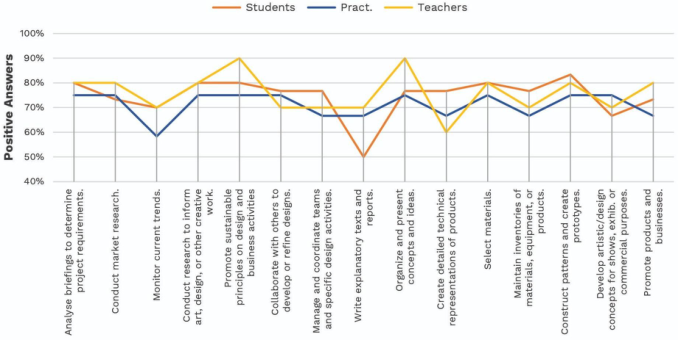
Figure 1: Chart comparing how students, practitioners and teachers evaluate the importance of different fashion design detailed work activities.
businessmen and business students of the fashion system, 13.7% are teachers and 2% are creative directors.
Detailed Work Activities (fig. 1) for Fashion Design from different perspe- ctives and experiences.
Regarding the activities that the surveyed fashion stakeholders identi- fied as the most important, all of them had a very positive evaluation. Those that received the highest score by teachers were the promotion of sustainable principles of design (90%) and the organization and presen- tation of concepts and ideas (90%). For students, the most important skills were the construction of patternmaking and prototypes (83%), fol- lowed by project requirements, research conduction on creative mediums, sustainability promotion and materials selection, all with 80% of posi- tive answers. Practitioners are the most pessimistic regarding the Design Detailed Work Activities, recognizing the importance of producing design concepts for fairs and promotional purposes with 75%. The lowest ponctu- ation was given by the students to the development of explanatory texts and reports (59%).
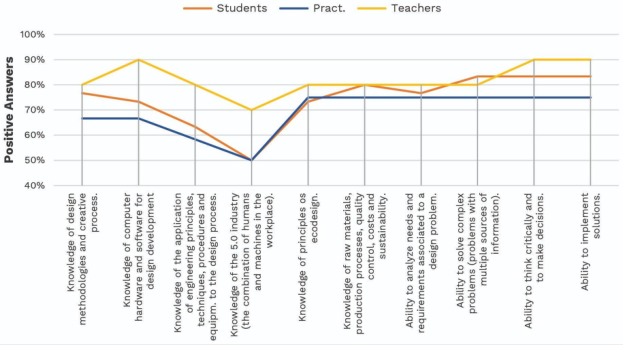
Design Methods (fig. 2) - Design methods are an important strategic element for project development whether in textile or fashion design.
Regarding the development of skills for design methods, the group of inte- rviewees recognized its great importance for the development of their work. The highest scores were attributed by the teachers, except on the question of whether students can develop complex problems, where students were the most optimistic, with 83% of positive answers (3% more than the teachers). Knowledge of industry 5.0 principles and practices received little conside- ration by students and professionals (50%), with teachers being the most optimistic, with 70% of positive answers.
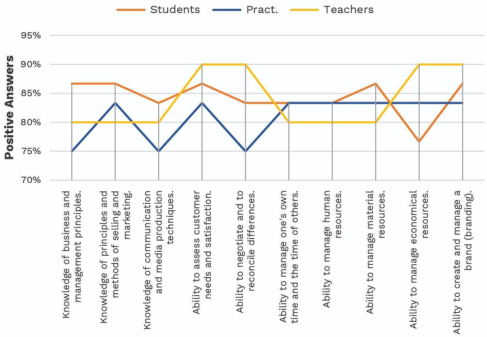
Design Business (fig. 3) - This issue aimed to understand the perception of the different stakeholders in fashion design about the skills linked to fashion business.
Figure 2: Chart comparing how students, practitioners and teachers evaluate the importance of different skills related to design methods for fashion design.Figure 3: Chart comparing how students, practitioners and teachers evaluate the importance of fashion design business skills.
Once again the answers to these questions are quite frankly positive, with a minimum of 75% and a maximum of 90% positive answers. Practitio- ners give less importance to parameters such as knowledge of business and management principles (75%), knowledge of elements of communication and media (75%) and the ability of designers to develop negotiation and mediate conflicts (75%). Teachers are more enthusiastic with the ability to assess customer needs, ability to negotiate and mediate conflicts, to be able to manage economical resources and the ability to manage a brand, all with 90% acceptance. Students are receptive to the knowledge of business and management, selling and marketing, communications and media production, and managing materials resources (about 83%) and they agree less with the management of economical resources (77%).
New Skills for New Designers: Fashion and Textiles 69
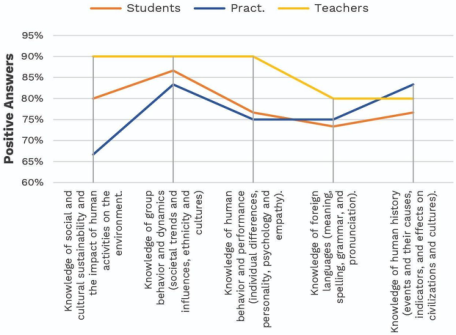
Figure 4: Chart comparing how students, practitioners and teachers evaluate the importance of different skills related to humanities & ethics in fashion design.
Humanities & Ethics (fig. 4) - Skills in the area of ethics and humanities are an increasingly important need for group work, for relationships with colle- agues and customers, for work presentation, and mediation of commitments with customers and suppliers. Reactions to this question are very positive, with design teachers recognizing these skills the most.
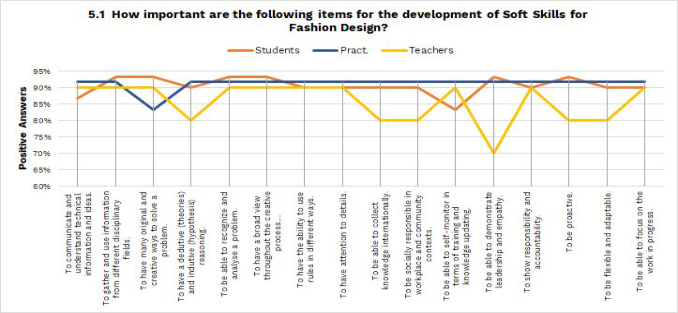
Regarding the question about the importance of skills for social and cul- tural sustainability and its impact on human activities in the environment, teachers declared themselves the most in agreement with 90% of positive answers, maintaining this level of enthusiasm concerning the social and cul- tural sustainability, dynamics of trends and influences of different cultures and ethnic factors. Knowledge of social and cultural sustainability recei- ved very low consideration from practitioners (67%), and knowledge of human history and cultures received the most positive appreciations with 83%. Students present a low profile about this issue. Soft Skills (fig. 5) - Knowing how to behave is as important as technical skills in the development of a specific task (Scheerens, et.al, 2020). Know- ing how to communicate and being able to participate in a working group, sharing ideas and implementing collaborative ways to achieve the best pos- sible result, requires refined relationship skills for managing workflows and people. These human elements, called soft skills, refer to personal attitudes.
Respondents, as can be seen in the chart (Fig. 5), were quite unanimous and constant in recognizing the importance of these attitudinal competencies, whether from the point of view of students, teachers and professionals. A slight divergence was demonstrated by teachers (80% of positive answers) about the designer’s need to have deductive and inductive thinking, in the abi- lity to collect knowledge at an international level, in being socially responsible as a person and as a professional, in being proactive, sensitive and adapta- ble. With 70% of positive answers, teachers are the ones that believe that demonstrating leadership and empathy is an important skill. Students say that information from different knowledge fields, creativity in solving problems,
Figure 5: Chart comparing how students, practitioners and teachers evaluate the importance of different soft skills for fashion design.
being able to recognize and solve problems, a better view about the creative process, demonstration of leadership and empathy, are important skills to have (93% of positive answers).
CONCLUSION
In the analysis of the answers collected with this questionnaire, it became clear that there are great divergences in the opinions of the different interlo- cutors of the fashion and textile sector. In this sense, we can, on one hand, justify these differences with the different points of view of the interviewees and their different professional conditions, and on the other hand, with some age difference and a different understanding of what should be the work of a fashion designer.
Although all the questions asked were positively received by the different respondents to the questionnaire made available for this purpose, it was also clear that the divergences within the three different groups of respondents are sometimes high. This is an issue that deserves further study to better under- stand the underlying points of view and also to seek how the academy can position itself as a bridge between design students and the companies that need them to function and optimize their processes. Special attention should be given to the analysis of the teachers’ answers in confrontation with those of the design professionals, understood as needs that Companies expect from new designers. This connection between training and the needs of compa- nies should allow a reduction of the distance between both sectors, allowing the exchange of information and methodologies that reveal themselves as bringing the trainers of future professionals closer to the real needs of new companies.
In this way, only through the renewal of competencies based on the kno- wledge collected with this work and confronting the different intervening parties about the personal, social and professional competencies of future designers will it be possible to bridge the gaps in these formative areas of fash- ion design. One of the main reasons for this research has to do with the need
New Skills for New Designers: Fashion and Textiles 71
to identify one or more competence profiles that become a differentiation and competitiveness factor in the national and international labor market, elabo- rated through the needs of the academy and the industrial stakeholders. This identification will allow, in a second phase, to monitor and implement the application of these competencies through teaching methodologies and their application in an academic context. Assess the impact of the application of new teaching strategies for the development of these competencies.
The validation of the obtained results will encourage the promotion and collaboration between higher education institutions and business clusters, in a perspective based on the constant update of inter and transdisciplinary knowledge and innovation, oriented to the creation of economic, social and technological value.
Thus, it is hoped to provide guidelines for institutions and lecturers to find new ways of teaching and empowering new designers with comprehensive, creative, innovative and sustainable skills, with an active role in the design and organization of natural and inhabited space. Building bridges between the interdisciplinary project and the business and technological environment, the academy assumes a central and mobilizing role in encouraging productive and critical thinking, detecting opportunities, and creating strategies for the identification and resolution of problems in design.
ACKNOWLEDGMENT
The authors of this paper wish to thank the Center for Research in Archite- cture, Urbanism and Design (CIAUD) of the Lisbon School of Architecture of the Universidade de Lisboa and FCT for funding this project.
REFERENCES
Bakhshi, H., Downing, J., Osborne, M. and Schneider, P. (2017). The Future of Skills: Employment in 2030. London: Pearson and Nesta. ISBN: 978-0-992-42595-1 Binkley, M., Erstad, O., Hermna, J., Raizen, S., Ripley, M., Miller-Ricci, M., &
Rumble, M. (2012). Defining twenty-first century skills. In P. Griffin, E. Care, B. McGaw (Eds.), Assessment and teaching of 21st century skills. Doi: 10.1007/978- 94-007-2324-5_2. European Economic and Social Committee. Industry 5.0.( 2021). Available online: https://ec.europa.eu/info/research-and-innovation/research-area/industrial- research-and-innovation/industry-50_en. Friedman, K. (2000). Design education in the university: Professional studies for the
knowledge economy. Conference proceedings of Re-inventing Design Education in the University, Curtin University of Technology, Perth, 13–27. Jordan, P.W. (2000). Designing Pleasurable Products: An Introduction to the New Human Factors. CRC Press. Boca Raton, FL Montagna, G., Carvalho, C., Carvalho, H., & Catarino, A. (2012). O Designer
de Produto como Elemento de Ligação nas Equipas Multidisciplinares. Revista Lusófona de Educação, 20, pp. 99–108.
National Research Council (2012). Education for life and work: Developing Transferable Knowledge and Skills in the 21st Century. Committee on Defining Deeper Learning and 21st Century Skills, James W. Pellegrino and Margeret L. Hil- ton. Editors. Board on Testing and Assessment and Board on Science Education. Washington, DC. The National Academies Press Onetonline.org (2022). O*NET OnLine. [online] Available at: <https://www.oneton
line.org> [Accessed 10 April 2022]. Santos, L.R., Montagna, G., & Neto, M.J.P. (2021). New Pathways for Design Teaching. In: Shin, C.S., Di Bucchianico, G., Fukuda, S., Ghim , YG., Montagna, G., Carvalho, C. (eds) Advances in Industrial Design. AHFE 2021. Lecture Notes in Networks and Systems, vol 260. Springer, Cham. https://doi.org/10.1007/978-3- 030-80829-7_85 Saviolo, S. & Testa, S. (2002). Strategic Management in the Fashion Companies,
Etas. RCS Libri, Milan. Scheerens, J., Werf, G. & Boer, H. (2020). Soft Skills in Education. Springer, Cham.
ISBN 978-3-030-54787-5. Schleicher, A. (2015). Schools for 21st-Century Learners: Strong Leaders, Confident Teachers, Innovative Approaches. International Summit on the Teaching Profession, OECD Publishing Seixas, S., Montagna, G. & Félix, M.J. (2021). Materials Matters in Textile and
Fashion Design Education. In: Shin, C.S., Di Bucchianico, G., Fukuda, S., Ghim, YG., Montagna, G., Carvalho, C. (eds) Advances in Industrial Design. AHFE 2021. Lecture Notes in Networks and Systems, vol 260. Springer, Cham. https: //doi.org/10.1007/978-3-030-80829-7_84 Weil, D., & Mayfield, M. (2020). Tomorrow’s Critical Design Competencies: Building a Course System for 21st Century Designers.. She Ji: The Journal of Design, Economics, and Innovation, 6(2), 157–169. Doi.org/10.1016/j.sheji.2020.03.001 Xhaet, G., & Derchi, F. (2018). Digital skills: Capire, sviluppare e gestire le
competenze digitali. U. Hoepli.
LISTED IN THE AHFE DIGITAL BOOKSTORE CATALOGUE
Explore the complete digital volume
Human Factors for Apparel and Textile Engineering
Read this individual research paper free through the original publisher, or explore the full digital proceedings book.
ISBN 978-1-958651-08-7
Explore this ISBN in the AHFE Bookstore ↗Listed in the July 2026 bookstore catalogue; search by ISBN to confirm current availability · Digital book purchase optional