Maria Antonietta SBORDONE, Ilenia Amato, Martina Orlacchio, Angelo Rega, Sara De Toro (2024). Reinterpretation of brand fashion archives. Recombining materials and techniques for new applications. In: Human Factors for Apparel and Textile Engineering. AHFE Open Access, vol. 134, pp. 95–104. https://doi.org/10.54941/ahfe1004918
The Textile Industry is one of the sectors with the highest environmental impact in the European Union, both in terms of raw material use and gas emissions. Currently, only 1% of textiles are recycled due to the presence of hazardous substances that hinder high-quality recycling, resulting in the contamination of ecosystems. However, efforts are underway to improve the situation through the implementation of collection infrastructure for pre-consumer and post-consumer textile fractions and investments in plant modernization, Textile Hubs (Waste Framework Directive Revision, 2023). European Fashion recommendations (EU Strategy for Circular Textiles, 2022), call for the adoption of circular and sustainable processes to reduce impacts of overproduction and change consumption patterns (UN SDG's Agenda 2030). The Beta generation faces challenges as resource scarcity and Artificial Intelligence impact that affect every aspect of daily life. In a context of multiple realities, there is a growing interest in combining material experiences with virtual ones. The phenomenon of decluttering in fashion promotes a new vision of the wardrobe (Sharpe, 2022), encouraging upcycling and regeneration practices in the domestic context. The vintage fashion trend and revival of styles and techniques of the past can extend to fashion archives. These plays a key role in preserving historical memory and understanding fashion as an artistic and cultural expression. This is reflected in Cluster 2 - Horizon Europe program (2023-2024), which funds research and promotes better access to European cultural heritage and cultural and creative industries. The laboratorial experience of the Fashion Eco Design 2 and Textile Design courses, proposes new models of upcycling in line with European goals and recommendations. They focus on textile materials through hybrid prototyping systems and experiment with theoretical, practical, and speculative approaches by investigating processes of design for circularity and reassembly (Potting, 2017). The aim of the courses is to design tailored and multifunctional solutions from the archives investigated. The paper illustrates the approach from research to analysis of stylistic elements, materials, fabric patterns, and pattern making, so transferred to the contemporary through design-driven recombination system. The approach sets up a system of relationships by innovating links between past and present, manufacturing traditions, digital technologies, and artificial intelligence, by renewing the cultural and productive heritage of a brand that meets new trends. The revival of the Gutteridge 1878 brand archive enables co-creation processes by merging research, experimentation, and the use of innovative methodologies and technologies to create new, more current values. It promotes the integration of university education, communities of practice, united in the design, communication and dissemination of research results according to the Quadruple Helix model. The critical and evolutionary thinking that guides student projects outline new models of value creation, promoting an adaptive regeneration approach, establishing cooperation between artificial systems, machines and materials (Sbordone, 2023).
The textile industry represents one of the sectors with the highest envi- ronmental impact in the European Union, both in terms of raw material usage and gas emissions. Currently, only 1% of textiles are recycled due to the presence of hazardous substances that hinder high-quality recycling, contributing to ecosystem contamination. However, efforts are underway to improve the situation through the implementation of infrastructure for the collection of pre-consumer and post-consumer textile fractions, invest- ments in upgrading facilities, and the creation of new textile recycling plants, known as Textile Hubs. These initiatives are part of the revision of the Waste Framework Directive in 2023 and are aligned with the goals of the European Union. As emphasized by Korten (2006), a major cultural shift is needed to address global environmental problems and promote sustainabil- ity. This reflection reflects the new worldview based on collective awareness of reconnecting with natural systems. This awareness will guide consumer choices and influence the demand for goods and services, generating a significant impact on the global economy. Furthermore, the acquired envi- ronmental responsibility will manifest in more conscious consumer choices to avoid compulsive purchases, taking into account the new dominant social paradigm, DSP (Armstrong and Le Hew, 2011). Consumers are increasingly aware of the environmental and social consequences associated with their choices, demanding greater transparency along the supply chain and active participation in the creation phase. This results in a direct responsibility of producers in the pre- and post-consumer stages (Sbordone et al., 2022).
Sustainable fashion consumption models include a range of services such as renting, swapping, reusing, recycling, and reselling. In this regard, among recycling practices, the focus is on reuse, practiced in second-hand and vin- tage clothing, which promotes sustainable consumption models on one hand and values the intangible aspects of individual garments on the other. In this context of valorization, the fashion archive stands out as a demo-ethno- anthropological heritage, defined as: “(...) in general, material and imma- terial goods that belong to the traditions of European and non-European human groups and testify to the foundational cultural fabric of different communities. They are immovable assets, collections of movable assets and historical documentation; but also intangible assets such as ceremonies, music, legends, and dialects or languages; witnesses to textile manufacturing and typical artisanal processes”.
POST-CONSUMER TEXTILE REGENERATION: SHARING ECONOMY PERSPECTIVES The fashion industry produces tons of waste annually along the entire sup- ply chain, making it one of the most polluting industries on the planet (Niinimäki et al., 2020). Recent studies highlight how textile and apparel production, with problems related to textile disposal, is a contributor to the exacerbation of phenomena such as climate change, water scarcity and biodiversity loss. The problem of textile waste management becomes even
Reinterpretation of Brand Fashion Archives 97
more urgent considering that by 2025 member countries will be obliged to implement separate collection of textiles in accordance with Directive 851/2018 (Circular Economy Package). This directive imposes an obliga- tion on manufacturers and distributors to manage and finance the system of recovery and recycling of products placed on the market. A problem that of waste disposal that sees the administrative and industrial system in the respective European countries engage in investment in the creation of col- lection and recycling infrastructure, Textile Hubs (EU Strategy for circular textiles, 2023), with appropriate technologies and transformation processes. In recent years, several circular business models have emerged for the fash- ion and textile sectors that contribute to the reduction of environmental impact (Boons and Bocken, 2018). Life extensions of clothing and reduced disposal are achieved by improving the physical design of products, and by configuring a system of services to support consumers in maintaining and car- ing for products (Laitala et al., 2015); determining factors in defining how long an item of clothing can remain in the wardrobe. Reuse has been offi- cially defined in the legal context of waste management as an operation by which residual products and components are reused for the same purpose for which they were designed. At the end-of-life stage, there are several clothing- specific reuse models that moreover involve redefining value propositions (Paras et al., 2017). Many concepts related to reuse have been developed to define how circular business models interact (Gray et al., 2022). Within the circular economy and reuse, Product-Service Systems (PPS) are gaining increasing attention by constituting relevant circular business models that facilitate reuse while redefining interactions between consumers, companies, and products (Manzini et al., 2004). In a report on defining circular mod- els for the management of post-consumer textiles by the Ellen MacArthur Foundation (2021), the effectiveness of the “more uses for user” approach that can be achieved through the design of physically transformable prod- ucts by maintaining the same physical qualities in long term. In addition, a “more users for product” approach involves the design and provision of platforms and/or services that facilitate the transition of products from one user to another, promoting wider use of the products. The “beyond physical products”approach considers the design and development of digital products and/or services that replace, enhance, and complement the needs and aspira- tions of users in the fashion industry. This is reflected in the proactivity of many brands and consumers in making the best use of available resources, realizing that it is possible to be productive and competitive even by reducing production (Hickel et al., 2022).
DECLUTTERING WARDROBE: FROM CULTURAL AT-HOME PRACTICE TO NEW SUSTAINABLE CONSUMPTION MODELS The phenomenon of decluttering, defined as the process of preliminary elim- ination and subsequent more conscious re-organization of objects, emerges as a trend in current society. This trend originated in the context of evolving consumer behavior, in response to various factors such as overproduction consumption resulting from awareness of environmental limits. According
to the report commissioned by the European Environmental Bureau (Sharpe, 2022), there is a need to explore the concept of welfare economics, under- stood as a generic term to describe alternative economic models to growth. Guiding principles are identified in the construction of a post-growth direc- tion for the fashion industry such that sustainable development is achieved in the interest of the common good. The phenomenon of decluttering repre- sents a concept-guide for eliminating superfluous objects that helps to create a reconstructed space that moreover fosters a positive emotional connection with stored objects (Kondo, 2014).
This trend promotes a minimalist approach to life, with the fundamental idea that possessing fewer objects promotes well-being. Many studies con- firm how contemporary society reflects a widespread sense of exhaustion and overload due to unrestrained consumerism that is the cause of psychologi- cal and physical discomfort; while highlighting the benefits of decluttering to restore order to one’s life, starting with the selection and elimination of superfluous objects in domestic he article draws from decluttering some practices, promoting new cocreative processes of recycling and upcycling in sustainable fashion design in pursuit of the goals of the ONU SDG’s 2030 Agenda. During the lockdown period caused by the COVID-19 pandemic, domestic spaces and objects themselves took center stage as a measure of individual psychological well-being in the face of an uncertain future. This has been compounded by anxieties related to environmental impact, climate change and the future in general; each individual has found himself or her- self re-examining objects maniacally, thus reflecting on his or her inner self. Decluttering is the practice of selection and getting rid of the superfluous to reconstruct an environment that best represents one’s Insite. One of the consequences of decluttering is the discovery of material objects belonging to other eras, thus historicized, identified with prestigious and renowned brands that define the vintage phenomenon (Holland, 2018).
The authenticity of a vintage garment is anticipatory and among the contents of slow fashion as, “slow fashion defines a culture of conscious consumption, based on the appreciation of unique products that require slow rhythms and respect for the environment and society” (Fletcher, 2007). Vin- tage fashion is an expression of a feeling of nostalgia for the past with its fascination for imperfection resulting from the aging process, the exclusivity associated with wearing unconventional or readily available garments whose techniques have been lost; to imagining stories from the past symbolizing identities and narratives that are charged with meaning in the present (Gnoli, 2023). According to Veenstra and Kuipers (2013), nostalgia is not just a longing for the past rather it is a form of reappropriation and reinvention of consumer goods that contributes to the realization of the postmodern per- spective, emphasizing that vintage is worn to appreciate its aesthetics and qualities. In contrast, Pickering and Keightley (2006) argue that nostalgia, to the desire for the past adds recognition of aspects of the past as a basis for renewal and satisfaction in the future, a way to navigate the uncertainties of the present.
Reinterpretation of Brand Fashion Archives 99
YOUNG GENERATIONS VS VINTAGE MATERIALITY AND MEMORIES In the survey conducted by EY Building a better working world, an analytical unit of Ernest & Young Global Limited (2021), we read about five distinct groups within Generation Z, of carefree/carefree young people, authentic activists, motivated by an obligation to save the world and a fear of what will happen if they do not (EY, 2021). Unlike the teens and 20-somethings of past generations who aimed to fit in and be “in step with the times,” Gen Z aspires to stand out and is constantly looking for new ways to express themselves. Gen Zeta, born between the 1990s and the beginning of the 21st century, has lived through an era characterized by rapid technological devel- opment and a consumerist lifestyle. Alpha generation, composed of those born from 2010 onward, shows a heightened awareness of environmental issues and a growing concern for overall sustainability as they grew up a context in which climate change and ecological challenges are priority issues, stimulating greater sensitivity to the environment. Being constantly online throughout much of their lives has helped them learn to use their voices for activism, promote themselves as teachers, and cultivate self-entrepreneurship with a different experience than previous generations. According to the global authority in consumer trend forecasting, WGSN (2023), the Beta genera- tion, will be the child of a chronically online generation and will be heavily influenced by artificial intelligence. “But being the first generation to grow up in an artificially intelligent environment proposes a dilemma; that is, the advent of deepfake media alters the concept of truth that is no longer central. This implies that generations will spend their lives searching for real- ity”. The search for a new balance between real and virtual experiences is increasingly evident. Vintage plays a key role in preserving historical memory and interpreting fashion as an art and material manifestation. Young people are preferring slow fashion to fast fashion, by valuing the existing between materiality and authenticity.
METHODOLOGY: MATERIALS DESIGN AND PROTOTYPING PROCESS TO RESHAPE CIRCULARITY PRACTICES In the University of Campania “Luigi Vanvitelli,” the Master’s degree pro- grams in Fashion Eco Design 2 and Textile Design focus on experimental prototype workshop practice to develop innovative solutions in response to current issues. Students devise research on desirable scenarios from which new trends can emerge. This dynamic allows theoretical-critical insights to test new applications with materials reconfigured with alternative processes in order to define and share new operational and sustainable practices. The design processes focus on the design-for-circularity approach that implies the adoption of the “R” of Eco-design to reduce the environmental impact of productions. This promotes the use of materials that enable the creation of solutions at an early stage of product development that can be easily repaired, reused, repurposed and recycled. The adoption of the so-called “Recombination Model for Circularity” facilitates the identification of the most effective and efficient solutions, in the logic of circularity, by resorting to combinatorial logic of advanced materials and techniques. In the TexLAB
laboratory bespoke machines and software are used to support processes that translate designs into combinations for the prototype and experimen- tal process. The holistic approach to design originates from Material Driven Design (Karana et al., 2020), which places the material itself at the cen- tre of the design process, considering not only its technical properties, but also its sensory qualities, meanings, and the emotions it arouses. The MDD method has four main stages: understanding the material, defining the vision of the material experience, defining the scenario of the material experience, and developing material concepts. This approach involves in-depth research into the physical, chemical, structural and sensory characteristics of mate- rials, as well as the materials processes, processing and possibility of the specific machines and software that make original hybrid experiments and configurations possible. In fact, the TexLAB lab at the University of Cam- pania “Luigi Vanvitelli” has effectively reinterpreted the MDD methodology with the hybridization of materials made possible by the machines and tech- nologies available in the lab. This allows students to explore and experience firsthand, different material experiences, resulting in innovative projects.
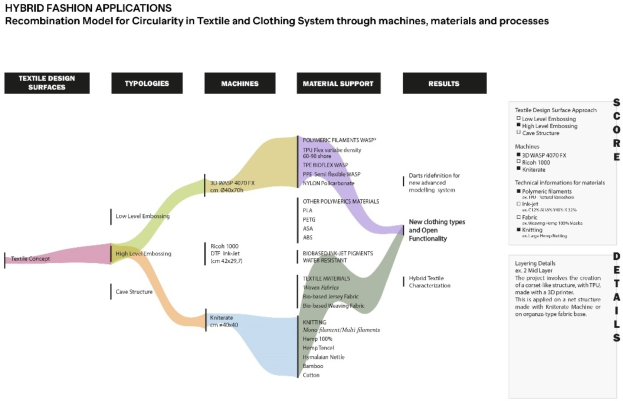
They range from Knitting Textile Design, to 3D Printing, to Direct to Fab- ric (DTF) ink-jet printing solutions, to configure a system of fashion-oriented applications, renewing conventional fashion pattern making, designing cus- tomized and multifunctional solutions. In the logic of the “Recombination Model for Circularity”(Fig. 1), new opportunities are explored through human computer interaction that explicates the co-creative capacity made possible by the interaction between traditional and advanced technologies between digital and AI, for new experiments, in a trans-disciplinary and collaborative approach in which expertise interacts synergistically.
Figure 1: TexLAB recombination model for circularity scheme, a model to reshape circularity practices based on materials design and prototyping process. (TexLAB, University of Campania Luigi Vanvitelli 2023/2024).
Reinterpretation of Brand Fashion Archives 101
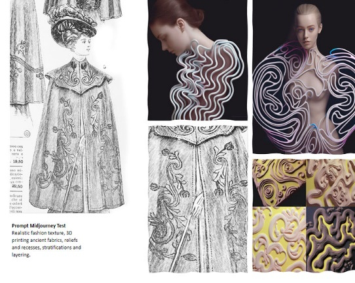
CASE STUDY: NEW TREND ARCHIVES FOR VINTAGE The aesthetic and technical memory present in fashion archives serves as a source of creative inspiration for fashion professionals to examine, eval- uate, interpret, and create new designs, influence fashion trends, and tell the story of a brand or national fashion (Peirson-Smith, 2020). The Univer- sity of Campania in the master’s course Fashion Eco Design 2 and Textile Design collaborated with the company Capri S.R.L., specifically with the brand Gutteridge (1878), to design customized and multifunctional solutions from the resources identified in the archives under study. The project “New Trend Archives for Vintage” proposes revisiting the archives according to processes of recombination of materials and techniques through the inter- pretation of contemporary trends. The process adopted is based on design steps that apply the previously described methodology, through a system of design-driven recombination. Therefore, the design process is defined by the following stages: Trend setting. From WGSN’s (2023) forecasting and trendsetting analysis, emerges how Artificial Intelligence and the new gen- eration’s desire to reconnect with materiality are at the heart of society. “Back to origins,” “Green Provocations,” “Panacea Online” and “Wellbeing Emphasis” are among the emerging and inspiring trends for young design- ers; Research paths. An analysis of fashion archives is conducted focusing on a specific decade chosen by each group of students. Textual and illus- trative informations are collected on Gutteridge’s (1878) fashion archives to identify: silhouettes; decorative motifs; fabrics; accessories and appareillage characteristic of the period. This data is used to create a coherent mood- board, identifying keywords, defining the colour palette and naming; Fashion Design Process. The phase begins with the extraction of the silhouettes of the examined decade, moving on to the phase of conceptual sketches consistent with the previously defined style scenario (Fig. 2a,b). Each group identifies a detail of the decade and imagines possible configurations through textile, polymer materials, envisioning three-dimensional models with a 3D printer or other equipment.
Figure 2: a,b. Moodboard elaboration and elaboration through text-to-image AI, midjourney (TexLAB, University of Campania Luigi Vanvitelli 2023/2024).
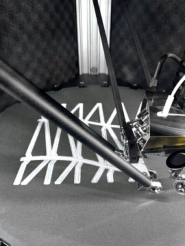
Material-Driven Design and Prototyping Process. At this stage, the imag- ined material concepts are structured using the “Recombination Model for Circularity”to define the design approach. The use of text-to-image Artificial Intelligence algorithm such as Midjourney guides the design path and sug- gests directions for the final result. Constant preliminary checks are carried out before moving on to digital modelling, using machine-specific software, the result of which is the export of valid files for prototyping. Prototyp- ing Lab. This refers to the actual fabrication of prototypes in the TexLAB. It makes use of the WASP 4070 FX 3D printer, which employs thermo- plastic filaments, such as TPU Flex with variable density on natural textile bases; Digital Collection. Collections are redefined and refined digitally, highlighting the dialogue between tradition and innovation through new methodologies. Modelling software such as CLO 3D and other digital fash- ion design software are used to create experimental modelling (Fig. 3a,b). Communication and Dissemination of Results. During Milan Design Week to be held April 15–21, 2024, Vanity Fair (VF) will inaugurate “The Gar- den of Ideas” the first exhibition/workshop on new responsible creativity designed to give voice to the young people who are building the world they will be living in. The project “New Trend Archives for Vintage,” in the col- lection of visions, projects and prototypes of the students of the course, was selected by the VF editorial board for the valorisation of the experimental and sustainable workshop practice developed at the TexLAB.
The results in the area of new responsible design will be displayed in an exhibition through photos, drawings and prototypes. More information is available on the hashtag at the Instagram social channel: #IlGiardinoDelleI- dee; and at the website: https://eventi.vanityfair.it/giardinodelleidee24/home page.
Figure 3: a,b. Material design and prototyping process from archives (TexLAB, Univer- sity of Campania Luigi Vanvitelli 2023/2024).
DISCUSSION
So, if setting things in order corresponds to revisiting the wardrobe, declut- tering, resulting in the rediscovery of garments that can be enhanced and reused, regeneration practices can also extend to other spaces in the fashion environment; think, for example, of revisiting the archives of independent
Reinterpretation of Brand Fashion Archives 103
designers or major brands that include corporate archives, historical archives, academic fashion archives, and online digital archives, which have always been considered primary sources that provide evidence of creative inspiration and preserve memory for social, cultural, educational, and identity purposes (Harrison, 2020). The ≪New Trend Archives for Vintage≫project proposes the revisiting of the archive according to processes of recombination of mate- rials and techniques starting from the analysis of stylistic elements, materials, textile motifs and modelling, transferring the archive into the contemporary world thanks to a design-driven recombination system. However, new val- ues are redefined thanks to new models of responsible design investigated at the TexLAB laboratory of the University of Campania “Luigi Vanvitelli”, with reinterpretations aimed at creating an innovative link between past and present: “The students’ critical thinking and evolutionary approach out- line new models of value creation, promoting a sustainable adaptation of existing balances, establishing mutual cooperation between artificial systems, machines and materials” (Sbordone, 2023).
ACKNOWLEDGMENT
The authors of this paper wish to thank the Capri s.r.l company for giv- ing open-access to brand Gutteridge (1978) archives; and, the students of the Master’s Degree Course in Fashion Eco-Design Laboratory Course 2023/2024 of University of Campania Luigi Vanvitelli. In particular the working teams that participated in the New Trend Archives for Vintage project: Team 1. Riccetti, R., Castaldo, I., Iovino, C., Sorrentino, R.; Team 2. Orlando, G., Rummo M., Muscia M.; Team 3. Ciardullo R., Pomponio, G., Cozzolino, S., Nero, A.C., Giri, M.; Teams 4. Vitale, M., Diana, M., Fusco, D., D’angelo, P., Rosa Falco, F.
REFERENCES
Ellen MacArthur Foundation (2021). Circular business models: redefining growth for a thriving fashion industry retrieved in February 2024. Ernst & Young Global Limited, EY Building Better Working World 2021. https://www.ey.com/en_us/news/2021/11/ey-releases-gen-z-survey-revealing-bus inesses-must-rethink-their-plan-z Fletcher, K. (2007). ‘Slow fashion: Estetica incontra etica’. Teoria della Moda, 1,
pp. 11–22. Boons, F., & Bocken, N. (2018). Towards a sharing economy. Innovating ecologies of business models. Technological Forecasting and Social Change, 137, 40–52. Gnoli, S. (2023). “Historical Mode”. Heritage and Revival in Contemporary
Fashion. Zone Moda Journal, 13(2), 119–131. Gray, S., Druckman, A., Sadhukhan, J., & James, K. (2022). Reducing the environmental impact of clothing: An exploration of the potential of alternative business models. Sustainability, 14(10), 6292. Harrison, R., DeSilvey, C., Holtorf, C., Macdonald, S., Bartolini, N., Breithoff, E.,...
& Penrose, S. (2020). Heritage futures: comparative approaches to natural and cultural heritage practices. UCL Press.
Hickel, J., Kallis, G., Jackson, T., O’Neill, D. W., Schor, J. B., Steinberger, J. K., Victor, P. A., & Ürge-Vorsatz, D. (2022). Degrowth can work — here’s how science can help. Nature, 612(7), 400–403. Holland, S. (2018) Modern Vintage Homes & Leisure Lives, London: Palgrave
Macmillan. Horizon Europe Work Programme 2023–2024. (n.d.). 5. Culture, Creativity and Inclusive Society. Karana, E., Pedgley, O., & Rognoli, V. (Eds.). (2020). Materials Experience:
Fundamentals of Materials and Design. Routledge. Kondo, M. (2014). The life-changing magic of tidying up. Ten Speed Press. Laitala, K., Boks, C., & Klepp, I. G. (2015). Making clothing last: A design approach for reducing the environmental impacts. International Journal of Design, 9(2), 93–107. Niinimäki, K., Peters, G., Dahlbo, H., Perry, P., Rissanen, T., & Gwilt, A. (2020).
The environmental price of fast fashion. Nature Reviews Earth & Environment, 1(3), 189–200. Paras, M. K., Pal, R., & Ekwall, D. (2017). Systematic literature review to develop a conceptual framework for a reuse-based clothing value chain. The International Review of Retail, Distribution and Consumer Research, 28(3), 231–258. Peirson-Smith, A., & Peirson-Smith, B. (2020). Fashion archive fervour: the critical
role of fashion archives in preserving, curating, and narrating fashion. Archives and Records, 41(3), 274–298. Pickering, M., & Keightley, E. (2006). The Modalities of Nostalgia. Current Sociology, 54(6), 919–941. Potting, J., Hekkert, M., Worrell, E., & Hanemaaijer, A. (2017). Circular Economy:
Measuring Innovation in the Product Chain. PBL. Sbordone, M. A., (2023). Fashion Now! Critical Thinking for Change Towards Bio- Digital Couture. Fashion Highlight, (1), 94–103. Sbordone, M. A., Sanches, R. A., De Luca, A., & Amato, C. I. (2022). Capability
based-approach: re-Invent people and materials viable relationships. Modapalavra e-periódico, 15(35), 17–69. Sharpe, S. A., Brydges, T., Retamal, M., Pugh, R., & Lavanga, M. (2022). Wellbeing Wardrobe. European Environmental Bureau. Sterling, S. (2007). Riding the storm: towards a connective cultural consciousness. In
Social learning towards a sustainable world (pp. 63–82). Wageningen Academic. Veenstra, A., Kuipers, G. (2013). It is not old-fashioned, it is vintage, vintage fashion and the complexities of 21st century consumption practices: Vintage fashion and consumption practices. Sociology Compass 7(5): 355–365.
LISTED IN THE AHFE DIGITAL BOOKSTORE CATALOGUE
Explore the complete digital volume
Human Factors for Apparel and Textile Engineering
Read this individual research paper free through the original publisher, or explore the full digital proceedings book.
ISBN 978-1-964867-10-6
Explore this ISBN in the AHFE Bookstore ↗Listed in the July 2026 bookstore catalogue; search by ISBN to confirm current availability · Digital book purchase optional