Avril Accolla, Xinyang Shan (2025). Implementing Design for All: the role of ANAs in addressing Human Diversity. In: Design for Inclusion. AHFE Open Access, vol. 169, pp. 99–110. https://doi.org/10.54941/ahfe1006159
This paper explores ANAs (Aspirations, Necessities, Abilities), a design research tool with a constructivist ontology within a Design for All (DfA) approach. It highlights its importance in understanding and addressing Human Diversity (HD) in design, both in research and implementation. ANAs focuses solely on the HD factors of real experiencers that can impact and be impacted by the designed PSS (Product, Service, System) in a specific context. Methodologically, ANAs pertains to problem-setting and emergent-evolutionary-learning design's epistemological approaches; ANAs also supports functional analysis and problem-solving approaches in the design's implementation phases. To situate ANAs within the broader landscape of design research tools, this study conducts a comparative analysis with three established tools: Persona, Affinity Diagram, and the Behaviour Change Wheel. These tools were selected due to their shared focus on exploring user capabilities, needs, and aspirations. The comparative analysis and phased implementation of the ANAs framework highlight its distinctive strategic structure: a data-driven and context-specific tool combining first- and second-hand data that does not rely on fictionalised user profiles. Thus, ANAs supports designers in creating platforms that enable All Who Wish to participate satisfactorily, minimising discrimination. This is achieved by synergising Necessities and Aspirations to lead the definition of target experiencers, and Abilities subsequently participating in informing specific design solutions. ANAs enables designers to understand and then manage the complexity posed by the HD Factors of their target experiencers, minimising designer bias and promoting social integration. This paper explains how the ANAs tool equips designers with a highly inclusive perspective, empowering them to develop richer, contextually relevant design answers that promote sustainable development and social innovation.
The imperative for inclusive solutions is gaining broader traction in the contemporary design landscape. Design for All (DfA), the design for human diversity, social inclusion, and equality (EIDD, 2004), emerges as a pivotal
approach, aiming to create Product Service Systems (PSS)1 that can be independently enjoyable by anyone who wishes to, regardless of their abilities (Accolla & Zhou, 2023), thus avoiding the stigmatisation, marginalisation or exclusion resulting from arbitrary grouping of potential experiencers (Accolla et al., 2021).
However, the challenge lies in effectively integrating Human Diversity (HD) into the design process, ensuring that solutions are not only functional but also inclusive, enjoyable, and sustainable. To facilitate this integration, various design research tools have been developed, each offering unique perspectives and methodologies.
The tool ANAs (Aspiration, Necessity, Ability) was created to understand and then manage the complexity posed by HD in the contexts of design practice, design research and teaching. It is a data-driven and context-specific tool that aims to empower designers to achieve social integration through their designs and enable them to minimise their conscious and unconscious biases. From a DfA perspective, HD, which poses an undeniable challenge by sheer complexity, is a richness (Bandini Buti, 2010) and constitutes a concrete opportunity for excellence when successfully interpreted by design.
This paper explores the structured yet flexible framework for understanding and addressing HD within specific and clearly defined design contexts that the ANAs tool provides. ANAs is defined as a design research tool that enables maximum social sustainability and innovation. After more than 20 years of application, this study coalesces the developments within the tool itself, situates ANAs within the broader landscape of design research tools and conducts a comparative analysis with three established design research tools: Persona, Empathy Map, and the Behaviour Change Wheel. These tools were selected due to their shared focus on exploring user capabilities, needs, and aspirations.
DESIGN RESEARCH TOOLS EXPLORING HUMAN DIVERSITY In mature markets, understanding and addressing HD Factors is paramount for designers. Various design research tools have been developed for those design professionals who integrate research methodologies into their design process, each offering unique perspectives and approaches. We examine three established tools — Persona, Empathy Map, and Behaviour Change Wheel — alongside the ANAs framework, highlighting their shared elements and unique contributions to the exploration of Human Diversity, specifically from the perspective of designers seeking to utilize these tools to understand their users in the design practice.
Personas are hypothetical archetypes of real users (Grudin & Pruitt, 2002), providing detailed profiles of user goals, behaviours, and motivations (Cooper, 1999). They include fictional background information, tasks, interests, and goals, which help designers understand users and align design decisions with user needs.
1Product Service System (PSS) has been early defined by Tischner and Tukker as “tangible products and intangible services designed and combined so that they jointly are capable of fulfilling specific customer needs” (Tischner, 2002; Tukker, 2004).
Implementing Design for All: The Role of ANAs in Addressing Human Diversity 101
Originating in human-computer interaction (HCI) (Cooper, 1999), Persona is widely used in human-centred design (Miaskiewicz & Kozar, 2011) and HCI-related agile development (Caballero et al., 2014). In the marketing field, the approach of “Segmentation” (Jenkinson, 1994) is almost parallel to Alan Cooper’s work on Personas (Cooper, 1999). Jenkinson proposed implementing an enriched segmentation model that converts the segments into real living people using day-in-the-life archetype descriptions as Personas, laying the groundwork for using Personas in marketing. In recent years, Persona has been widely used in marketing, especially in targeted positioning, personalized recommendations, and advertising optimization (Xu et al., 2024), improving user engagement and conversion rates.
As a visualization tool, it facilitates rapid communication among research teams and stakeholders, enabling a closer connection to potential end users (Matthews et al., 2012). The data collection of Personas can begin with qualitative and quantitative methods such as Interviews and Observations (Cooper, 1999; Pruitt & Adlin, 2010), Surveys and Analytics (Nielsen & Hansen, 2013) and Market Segmentation Data (Jenkinson, 1994; Grudin & Pruitt, 2003). The use of large language models (LLMs) to train Persona has enhanced its accuracy in simulating user behavior in complex markets (Shan et al., 2024). Meantime, Dynamic Persona (Bonnardel & Pichot, 2020) was developed due to the criticism that traditional Persona does not involve the designer in the collection of information (Goh et al., 2017), it simulates real customer interactions by relying on virtual environments like chatbot or roleplay, allowing designers to engage actively in gathering information. However, it still does not reflect real contexts and do not differ from traditional Personas regarding usage and effectiveness (Bonnardel & Pichot, 2020).
Personas innovate in their ability to provide detailed and relatable user representation, which helps designers and other stakeholders empathize with users, especially those who did not partake in the research phases, and align design decisions with user needs during the whole design process. However, they can sometimes be limited by their reliance on fictional profiles, which may not fully capture the data from real users.
Empathy Map (EM) is a method used to understand audiences, including users, customers, and other players in business ecosystems. It is one of Gamestorming’s methods (Gray, 2017) for developing business models from a customer perspective (Ferreira et al., 2015). EM is a visualization tool that includes six dimensions: Goals (WHO are we empathizing with? And What do they need to Do?), See, Say, Do, Hear, and Think and Feel (Pains and Gains). These dimensions help designers develop solutions that resonate with consumers emotionally.
EM is a mature tool template, with each dimension guiding the gathering of key information and understanding of target users (Gray, 2017). Empathy Maps are typically populated using conventional qualitative research methods such as semi-structured interviews with real users (Liedtka & Ogilvie, 2011), in some cases complemented by structured collaborative ideation sessions in workshop settings (Stickdorn et al., 2018).
Like Personas, EM is also a tool for rapid communication and visualisation; it represents a particular user segmentation (Gray, 2017),
102 Accolla and Shan
selecting the shared elements of such consumer groups. Its uniqueness lies in its ability to provide a holistic view of the emotions and experiences of a specific user segmentation, encouraging designers to consider the emotional aspects of user interactions.
The Behaviour Change Wheel (BCW) framework focuses on understanding and influencing behaviour by analysing three dimensions: Capability, Opportunity, and Motivation. It was developed to improve intervention design in public health and social policy fields, providing a systematic approach to understanding behaviour and designing interventions (Michie et al., 2011). Data for the BCW is derived from behavioural studies that identify specific barriers and facilitators to behaviour change, making the interventions more targeted and effective (Michie et al., 2011). However, the data collection process can be time-consuming; for example, it may need extra time to validate data to ensure its scientific rigour.
The BCW’s innovation lies in enabling designers to develop targeted interventions that effectively drive behaviour change by linking the three dimensions to specific intervention functions and policy categories. The framework also identifies nine intervention functions to address deficits in capability, opportunity, or motivation and seven policy categories that can enable these interventions (Michie et al., 2011). For instance, an intervention function such as “education”might involve providing information to increase knowledge and understanding, enhancing capability. Policy categories like “guidelines” or “regulation” can support the implementation of these interventions by creating a supportive environment. By systematically analysing the behaviour system and selecting appropriate intervention functions and policies, designers can create interventions more likely to achieve the desired behaviour change.
ANAS (ASPIRATION, NECESSITY, ABILITY) ANAs is a design research tool with a constructivist ontology within a DfA approach. Its methodological nature, and maybe its most surprising results, pertains to design’s epistemological approaches as problem-setting and as emergent evolutionary learning (Figueiredo, 2008). However, it is equally effective in design as functional analysis and as problem-solving, especially useful when tackling less complex research scenarios and implementation phases.
Aspiration, Necessity, and Ability are the three core dimensions that read the human experience of a specific Context, dimensions in which insights vary for the same real experiencer according to which state of which value chain the researchers are focusing on (Galli & Accolla, 2015), and must be considered within the Context of the designed PSS.
The aim of the tool is to understand and then manage the complexity posed by HD, focusing solely on the HD’s Factors of real experiencers that can impact the designed PSS and be impacted by it, to empower designers to maximise social integration through enriched designs and enable them to minimise their conscious and unconscious biases, so striving for social innovation.
Implementing Design for All: The Role of ANAs in Addressing Human Diversity 103
Aspiration: It addresses the experiencer’s desires, encompassing emotional fulfilment (e.g., satisfaction, pride), measurable performance (e.g., efficiency, uniqueness) and other defined goals. It asks: How do experiencers wish to feel, perform, or influence their environment through the PSS, and why? Rooted in DfA principles, Aspiration (Wish) transcends functional inclusivity to embrace quality, experiential and aesthetic. For instance, this dimension considers interactions addressing excitement, joy, or achieving outcomes that align with personal values (e.g., sustainability). Aspiration challenges designers to create systems that empower experiencers to engage voluntarily and meaningfully, possibly with no compromise.
Necessity: It examines the requirements that experiencers must fulfil to achieve their goals within the PSS. Necessity (Need) identifies the required interactions (e.g., tasks, knowledge, or behaviours) that experiencers need to perform, regardless of their abilities. Necessity focuses on existing constraints and pathways—asking: What actions, knowledge, or systemic compliance are indispensable for experiencers to operate within the PSS successfully? For example, this dimension considers how experiencers may need to master specific interface gestures to achieve their objectives. Necessity guides designs to create feasible pathways for diverse experiencers, avoiding exclusionary solutions.
Ability: It assesses experiencers’ functional, cognitive, and contextual capacities in interacting with a defined PSS. Ability (Can) determines which capacities empower an experiencer to autonomously execute, comprehend, or achieve within the system’s constraints, considering factors such as ergonomic accessibility and comfort (e.g., fine motor skills, effort), sensory perception (e.g., visual or auditory acuity, tactile or olfactory stimuli), and cognitive load (e.g., decision-making complexity, communication codes). For example, this dimension evaluates the ability of a caregiver to navigate a healthcare PSS while multitasking safely under time pressure.
By mapping these capabilities, Ability empowers designers to identify mismatches with both Necessities and Aspirations that hinder inclusive access, ensuring solutions align with real experiencer’s competencies rather than idealized assumptions.
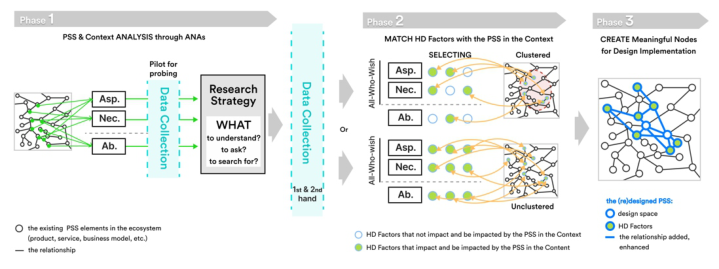
EMPOWERING DESIGNERS THROUGH ANAS FRAMEWORK Established through iterative practice, the framework for employing ANAs in design is structured into three phases. It exhibits a cyclical or iterative nature and is adaptable to specific contexts (Figure 1).
Phase 1: Strategizing the Design Research & Bias Mitigation Following establishing a research focus through consensus among designers and stakeholders, the first phase aims to build a broad and data-based awareness of what to research, ask, and understand. The outcome is the definition of a structured strategy for data collection and the following research phases.
Designers start understanding the PSS in the selected Context through ANAs lenses with a preliminary identification of HD Factors impacting and being impacted by the PSS. This is a process of problem-setting and emergent evolutionary learning. This stage defers prioritizing Abilities to
104 Accolla and Shan
Figure 1: The process of employing ANAs.
mitigate premature bias since early focus can skew the design strategy by prematurely discriminating certain experiencers.
Leveraging Necessities and Aspirations leads to a first understanding of the intended design target: the All-Who-Wish experiencers. In addition, designers define key inquiries, articulate research questions, and determine optimal data sources and collection methodologies through pilot data collection to probe their ANAs’ lenses.
Based on the drafted data collection strategy, designers proceed with qualitative research methods, such as interviews, and quantitative ones with secondary data analysis to gather both first-hand and second-hand data. This data collection allows for refining of HD Factors within Necessities and Aspirations. Designers will record HD Factors related to Abilities and address them primarily in Phase 3. Furthermore, ANAs’ framework provides a structured approach for rapid brainstorming, fostering inclusivity, particularly in workshop settings.
Phase 2: Contextualisation of the HD Factors Within the Existing Ecosystem Subsequent to data collection, designers achieve a more nuanced and evidence-based comprehension of the PSS, its Context and a refined list of pertinent HD Factors. Phase 2 aims to match the probed HD Factors with the PSS and its Context, structured synergically in a designed map, guided by Phase 1’s direction.
The Ecosystem Map is employed as a valuable tool for the holistic representation of the PSS and its Context, effectively capturing intricate relationships, including material flows, service exchanges, and feedback mechanisms, which may be obscured by linear or siloed representations (Kim et al., 2009).
Some contexts can display complexity that requires clustering in multiple design scenarios. This requirement becomes apparent when designers recognise a mismatch between collected HD Factors and some PSS/Context elements. Designers will delineate a specific design Context, selecting elements of the ecosystem that are strategically consistent. In such cases, a re-evaluation of HD Factors ensures relevance to the refined Context, leading to the selection of HD Factors demonstrably impacting and impacted by
Implementing Design for All: The Role of ANAs in Addressing Human Diversity 105
the PSS within the narrowed scope. In more straightforward ecosystems, PSS elements remain not clustered, and all HD Factors found are to be strategically matched with the PSS and its Context. Designers are thus empowered to efficiently ascertain the scope and the key nodes of the Context and the existing PSS requiring (re)design.
Phase 3: Ecosystem Redesign Through HD Factor Integration The third phase aims to create meaningful nodes strategically connected in a redesigned ecosystem for further design implementation. As compelling user insights are foundational to effective (service) design (Yuan & Hsieh, 2015), ANAs’ framework within the DfA approach empowers designers to generate comprehensive and inclusive insights, revealing design opportunities related to HD, where Necessities and Aspirations define the target user group (All- Who-Wish experiencers), while Abilities inform and guide concrete design solutions, addressing what experiencers can do.
These insights can illuminate previously unnoticed system elements, nodes or relationships, equipping designers with viable solutions for redesigning, creating, or modifying interconnections within the system. In an iterative matching and forming process of emergent evolutionary learning, probed HD Factors synergise with the PSS and its Context, consistently redesigning the ecosystem. Hence, the (re)designed PSS may contain enhanced relationships of the elements, design opportunities in nodes related to HD Factors, and design opportunities in nodes related to design space characteristics (e.g., material specifications and structural configurations). The result is a map to Design for All (Accolla & Hansstein, 2021).
DISCUSSION: SHARED ELEMENTS AND UNIQUE CONTRIBUTIONS The tools discussed earlier—Persona, Empathy Map, and BCW—involve concepts similar to those in ANAs. However, from a DfA point of view, differences in their origins, methods of employment, and ultimate goals lead to different understandings of similar dimensions.
For example, while ANAs define the design target (experiencer) by data- driven Aspirations and Necessities, Personas’ core element, the target user’s “Goal”, which guides the design requirements and shapes other dimensions, may not always align with end users’ motivations and even rather reflect the developers’ perspectives (Blomkvist, 2002). By creating fictional profiles with selected characteristics in grouped data, designers struggle to gain a deeper understanding of HD. Although Personas are easy to understand and use, it is challenging to verify whether a Persona accurately reflects user data, as they are primarily used for communication among researchers in agile development (Asana, 2025), an iterative approach with roots also in software development (Boehm, 1986). This reliance on fictional profiles can overlook data accuracy (Bonnardel & Pichot, 2020; Chapman & Milham, 2006), and such a process can introduce significant biases. It risks perpetuating designers’ “cultural habits” that lead to discrimination and exclusion, such as assuming fixed behaviours and desires for certain arbitrary groups (e.g., ‘elderly will
106 Accolla and Shan
have this lifestyle’). Such assumptions hinder social innovation by preventing change, a core design element.
In Empathy Maps, user dimensions are considered based on the definition of target consumers in a business context (Ferreira et al., 2015). Distinct data sources inform different types of Empathy Maps (Gibbons, 2018). For instance, a One-user (individual) Empathy Map is constructed based on data from a single user, such as user interviews or data from a user’s diary study. The other type, namely, the Aggregated Empathy Map, is constructed by synthesising thematic patterns across a user segment, and it can serve as a preliminary step in creating Personas. The “WHO are we emphasising with” and the “What do they need to DO” dimensions collectively define the Goal in EM, which makes researchers focus on clear consumer goals, but it is also leading to a lack of inclusive thinking: on the one hand, EM’s reliance on a fixed customer profile in a single business situation (e.g., “owner managing inventory”) ignores how roles and contexts overlap in the real world. For instance, a shop owner may also be a caregiver, altering their ability to interact with the PSS during childcare hours—a nuance EM cannot capture. On the other hand, EM’s criteria (e.g., “faster checkout”) prioritise efficiency over inclusion and equality. Users who deviate from the “ideal” consumer (e.g., customers needing assistance) are treated as edge cases rather than integral system participants. Whereas ANAs address efficiency inclusively by combining Necessity and Aspiration to define the target, while Ability ensures inclusion by aligning designs with diverse experiencers’ capabilities.
BCW considers three dimensions, similar to those in ANAs, crucial for behaviour change: Capability (individual capacity), Opportunity (external factors), and Motivation (brain processes driving behaviour). For example, in a public health intervention aimed at increasing physical activity, “Capability” might involve providing individuals with the necessary skills and knowledge to engage in exercise, “Opportunity” might include creating accessible and safe environments for physical activity, and “Motivation” might involve using persuasive communication to encourage individuals to adopt an active lifestyle. These elements form the ‘COM-B system,’ where Opportunity can influence Motivation, as can Capability, and enacting a Behaviour can alter Capability, Motivation, and Opportunity (Michie et al., 2011). Thus, BCW provides an interesting framework for understanding behaviour and designing interventions. As mentioned, the three dimensions of ANAs have a different relationship. Necessities and Aspirations lead the design targets with what respectively ‘must be achieved’ and ‘experiencers desire’, and the Abilities guide and inform the design solutions and cannot dictate design boundaries. Such structure ensures solutions like offline tools for caregivers or voice-activated interfaces for non-literate users, not assuming users’ use of smartphones.
Implementing Design for All: The Role of ANAs in Addressing Human Diversity 107
LIMITATION While the framework offers significant advantages, its application revealed two key challenges.
The Need for Quick Visualisation and Communication ANAs is a design research tool born to effectively and efficiently explore HD. It provides designers, among the three mentioned dimensions, with a wealth of HD Factors cunningly related to the elements of the PSS and its Context, so it also unearths characteristics and relationships that are otherwise tricky to access. Thus, ANAs enables designers to understand and deal with the complexity of the experiencers in the context. However, ANAs was not born to communicate its findings as such among the design teams and the stakeholders. Therefore, a quick visualisation modality has not been developed. Compared with Persona or Empathy Map quick visualisation, ANAs do not map results for intuitive visual comprehension. Future research could explore how to visualise ANAs’ findings, making this research tool adapt to more design scenarios and possible combinations with other tools.
Reducing Unconscious Biases and Addressing Researcher Subjectivity ANAs aim to avoid implicit discrimination by focusing on HD factors rather than group-specific assumptions (Vanderheiden et al., 2021). For instance, tactile packaging designed for visually impaired users—often critiqued for alienating sighted consumers—was reimagined through ANAs to appeal to both groups, demonstrating how prioritizing human diversity over narrow user archetypes fosters inclusivity. However, ANAs’ reliance on designers’ interpretation still introduces subjectivity risks: cultural backgrounds, disciplinary perspectives, or unconscious biases can influence how HD Factors in dimensions like Necessity or Aspiration are prioritized, although collaborative validation among the research team and external expert reviews could help reduce the risk. This duality underscores ANAs’ value in inclusive design while necessitating vigilance to ensure HD Factors’ priorities reflect true experiencers, not designers’ preconceptions.
CONCLUSION
This study explored the ANAs tool within DfA research, demonstrating its potential to enhance inclusive design practices synergising Necessities and Aspirations with Abilities, where Aspirations and Necessities lead the definition of the target experiencers and Abilities inform specific design choices, thus avoiding discrimination.
From a DfA perspective, the comparative analysis with Persona, Empathy Map, and the Behaviour Change Wheel shows similar dimensions of understanding HD but differ in their approaches and focus, as do the results. Personas provide a fictional user representation for quick communication, Empathy Maps offer a holistic view of who the target user is and her/his emotions in a business context, and the BCW provides a systematic approach
108 Accolla and Shan
to behaviour understanding and change. ANAs, on the other hand, does not focus on any fictional user profiles but on HD Factors in the given Context, making it a valuable tool for addressing the complexity of designing for HD richness.
This comparison highlighted ANAs’ unique strengths where it focuses solely on the HD Factors of real experiencers that can impact the designed PSS and be impacted by it, hence its data-driven and context-specific nature. Moreover, its structured framework – where Aspirations and Necessities lead the design target and Abilities in the design implementation stage inform the design solutions – strategically enables designers to mitigate the premature discrimination of certain experiencers. Its structured process deliberately avoids grouping individuals according to arbitrarily chosen characteristics, minimising the researcher and designer’s biases and pushing for inclusion and social innovation: this allows for a change in cultural perceptions concerning the PSS and its Context where needed.
Ultimately, ANAs equips designers with a highly inclusive perspective and empowers them to develop richer, contextually relevant design solutions. The application of ANAs aims to enable designers to develop a comprehensive understanding of HD and manage it in a complex system. It empowers designers to achieve social inclusion through their designs.
Despite its strengths, ANAs’ application revealed limitations, primarily in visualising ANAs for quick communication and some susceptibility to researcher bias. Future research could focus on developing quick visualisation for ANAs communication and enhancing bias management strategies.
Meanwhile, this article aims to clarify the unique role and purposes of ANAs from a DfA perspective and acknowledges its advantages in pursuing social sustainability and innovation. Exploring the integration of ANAs with other design tools and validating its effectiveness across diverse contexts could further refine its applicability.
REFERENCES
Accolla, A. (2009). Design for All. Il progetto per l’individuo reale. Milan: FrancoAngeli. Accolla, A. et al. (2021). Design for All: Design Approach and Practice Catering for
the Real Individual. Shanghai: Tongji University Press [(意) 艾薇儿·阿科拉, 等著 (2021). 全民: 面向真体的. 同大出版社]. Accolla, A., & Hansstein, F. (2021). Culturally localized DfA driven learning on electronic waste management and recycling behaviour in China. In R. S. Goonetilleke (Ed.), Proceedings of the Congress of the International Association of Societies of Design Research (pp. 2376–2392). Singapore: Springer Nature Singapore. Accolla, A., & Zhou, Z. (2023). Seniors with early AD in China: Study of a design
for all (DfA) approach for a transformed, happier family life. In Life-changing design, changing communities. IASDR 2023. Politecnico di Milano, Italy. Asana. (February 20, 2025). Agile Methodology|Principles and Benefits. Retrieved March 15, 2024, from https://asana.com/resources/agile-methodology.
Implementing Design for All: The Role of ANAs in Addressing Human Diversity 109
Bandini Buti, L. (2010). Elogio della diversità - la pratica del design for all trasforma la diversità in una risorsa. Round table organized by Design for All Italia in the Palazzo dei Mercanti, Milan, in the framework of the Innovation Festival. Blomkvist, S. (2002). Persona–an overview. Retrieved November 22, 2004, from
https://www2.it.uu.se/edu/course/homepage/hcidist/vt05/Persona-overview.pdf. Boehm, B. (1986). A spiral model of software development and enhancement. ACM SIGSOFT Software Engineering Notes, 11(4), 14–24. Bonnardel, N., & Pichot, N. (2020). Enhancing collaborative creativity with virtual
dynamic personas. Applied Ergonomics, 82, 102949. Caballero, L., Moreno, A. M., & Seffah, A. (2014). Persona as a tool to involving human in agile methods: Contributions from HCI and marketing. In Human- centered software engineering: 5th IFIP WG 13.2 International Conference, HCSE 2014 (pp. 283–290). Paderborn, Germany: Springer Berlin Heidelberg. Chapman, C. N., & Milham, R. P. (2006). The personas’ new clothes: Methodological and practical arguments against a popular method. Proceedings of the Human Factors and Ergonomics Society Annual Meeting, 50(5), 634–636. Cooper, A. (1999). The Inmates Are Running the Asylum. Indianapolis, IN: Sams
Publishing. Cooper, A. (2004). Why High-Tech Products Drive Us Crazy and How to Restore the Sanity. Indianapolis, IN: Sams Publishing. Ferreira, B., Conte, T., & Barbosa, S. D. J. (2015). Eliciting requirements using
Personas and empathy map to enhance the user experience. In 2015 29th Brazilian Symposium on Software Engineering (pp. 80–89). Brazil: IEEE. Figueiredo, A. D. D. (2008). Toward an epistemology of engineering. In 2008 Workshop on Philosophy and Engineering, The Royal Academy of Engineering, London. Galli, F., & Accolla, A. (2015). Design for All: The role of Design as Anomaly for a
Changing. In 11th European Academy of Design Conference (EAD11). Gasson, S. (2006). Emergence in organizational ‘problem-solving’: Theories of social cognition (Working Paper). Retrieved November 8, 2014, from https:// cci.drexel.edu/faculty/sgasson/papers/probsolv.pdf. Gibbons, S. (January 14, 2018). Empathy mapping. Retrieved March 15, 2024, from
Nielsen Norman Group: https://www.nngroup.com/articles/empathy-mapping/. Goh, C. H., Kulathuramaiyer, N., & Zaman, T. (2017). Riding waves of change: A review of personas research landscape based on the three waves of HCI. In P. Nielsen & H. Kimaro (Eds.), Information and Communication Technologies for Development: Proceedings of the 14th IFIP WG 9.4 International Conference on Social Implications of Computers in Developing Countries (ICT4D 2017) (pp. 605–616). Yogyakarta, Indonesia: Springer International Publishing. Gray, D. (2017). Empathy Map – Gamestorming. Retrieved December 20, 2024,
from https://gamestorming.com/empathy-mapping/. Grudin, J., & Pruitt, J. (2002). Personas, participatory design and product development: An infrastructure for engagement. Proceedings of the Participatory Design Conference (PDC) (pp. 144–152). New York: ACM. Jenkinson, A. (1994). Beyond segmentation. Journal of Targeting, Measurement and
Analysis for Marketing, 3(1), 60–72. Kim, Y. S., Wang, E., Lee, S. W., & Cho, Y. C. (2009). A product-service system representation and its application in a concept design scenario. Proceedings of the 1st CIRP Industrial Product-Service Systems (IPS2) Conference, Cranfield University, 1–2 April 2009. p. 32.
110 Accolla and Shan
Liedtka, J., & Ogilvie, T. (2011). Designing for Growth: A Design Thinking Tool Kit for Managers. NY: Columbia University Press. Matthews, T., Judge, T., & Whittaker, S. (2012). How do designers and user
experience professionals actually perceive and use Personas? In Conference on Human Factors in Computing Systems (pp. 1219–1228). Michie, S., Van Stralen, M. M., & West, R. (2011). The behaviour change wheel: A new method for characterising and designing behaviour change interventions. Implementation Science, 6, 1–12. Miaskiewicz, T., & Kozar, K. A. (2011). Personas and user-centered design: How can
Personas benefit product design processes? Design Studies, 32(5), 417–430. Nielsen, L. (2013). Personas-User Focused Design (Vol. 15). London: Springer. Pruitt, J., & Grudin, J. (2003). Personas: Practice and theory. In Proceedings of the 2003 conference on Designing for user experiences (DUX ‘03) (pp. 1–15). New York, NY, USA: Association for Computing Machinery. Pruitt, J., & Adlin, T. (2010). The Persona Lifecycle: Keeping People in Mind
Throughout Product Design. Elsevier. Shan, X., Xu, Y., Wang, Y., Lin, Y. S., & Bao, Y. (2024). Cross-Cultural Implications of Large Language Models: An Extended Comparative Analysis. International Conference on Human-Computer Interaction (pp. 106–118). Cham: Springer Nature Switzerland. Stickdorn, M., Hormess, M. E., Lawrence, A., & Schneider, J. (2018). This is Service
Design Doing. O’Reilly Media, Inc. Xu, Y., Shan, X., Guo, M., Gao, W., & Lin, Y. S. (2024). Design and application of experience management tools from the perspective of customer perceived value: A study on the electric vehicle market. World Electric Vehicle Journal, 15(8), 378. Vanderheiden, G. C., Jordan, J. B., & Lazar, J. (2021). Design for people experiencing
functional limitations. In G. Salvendy (Ed.), Handbook of human factors and ergonomics (pp. 1216–1248). Hoboken, NJ: Wiley. Yuan, S. T. D., & Hsieh, P. K. (2015). Using association reasoning tool to achieve semantic reframing of service design insight discovery. Design Studies, 40, 143–175.
LISTED IN THE AHFE DIGITAL BOOKSTORE CATALOGUE
Explore the complete digital volume
Design for Inclusion
Read this individual research paper free through the original publisher, or explore the full digital proceedings book.
ISBN 978-1-964867-45-8
Explore this ISBN in the AHFE Bookstore ↗Listed in the July 2026 bookstore catalogue; search by ISBN to confirm current availability · Digital book purchase optional