Anabela Simoes, Ling Suen (2022). Research Needs for a Quality Service Assessment Model of Inclusive Community Transport. In: Human Factors in Transportation. AHFE Open Access, vol. 60, pp. 252–260. https://doi.org/10.54941/ahfe1002455
IntroductionMobility is defined in the Universal Declaration of Human Rights as the freedom of movement from one place to another to conduct activities such as work, school, health, recreation, social or shopping. According to the 11th goal of the 17 Sustainable Development Goals adopted by the UN at the 2015 General Assembly ”to make cities and human settlements inclusive, safe, resilient, and sustainable”, accessible, reliable, safe, and comfortable transport services are required to serve multiple trip origins and destinations.This abstract discusses the research needs for the inclusion and equity in sustainable and resilient transport services by outlining the steps towards the development of a Quality Service Assessment Model (QSAM).Transport Services and Their Inherent Qualities Planning community transport services with people in mind requires the provision of a high-quality service embodying the following parameters:Inclusion – Inclusive transport should be open to all by offering accessible, safe, comfortable, and reliable services with human support along the travel chain.Equity – An equal distribution of resources by level and type of transport services should ensure that accessibility and affordability for everyone in the community are built into the operation.Sustainability - Every transport service should be sustainable, both in environmental and economic terms, by offering green travel modes, which are adaptable to critical situations and reliable in schedule adherence.Resilience – When disruptive incidences or accidents occur during travel, the transport system should have standby solutions to ensure trip completion under safe and comfortable conditions.The Quality Service Assessment Model The QSAM is built upon the dynamic interactions in forum discussions by the following three actors: the Users versus those of the Service Providers. The third actor group involved would be independent Stakeholders composed of experts in the fields of Mobility, Transportation, Human Factors, and Rehabilitation, and Academicians, as they will balance the idea exchanges, hopefully resulting in recommendations on service improvements towards the fulfillment of the users’ needs within the service providers’ budgetary and policy constraints.MethodologyMultidisciplinary research teams are required in carrying out the following steps of work:1. Classify targeted user groups according to their mobility limits;2. Define relevant travel scenarios supported by simulation tools;3. Collect qualitative data by means of Focus Groups discussions that address both the users’ perception of the service quality relative to their needs and expectations, versus the service providers’ awareness about gaps between the actual/planned services.4. Design new improvement solutions to fill the service gaps;5. Develop guidelines and recommendations towards inclusion and equity in sustainable and resilient transport services.ConclusionsThis QSAM aims at developing an approach for community transport services that match users’ needs and expectations. Each recommended solution should be designed and tested in a simulation environment. The resultant design guidelines together with policy recommendations, to be published and disseminated, should guide transport providers in achieving the targeted inclusive and equitable mobility in a sustainable and resilient community.
As referred by Rupprecht et al. (2019), Mobility focuses on the satisfaction of needs, while transport is the instrument that is required for its actualiza- tion. Due to the spatial separation of activities, demand for transport services requires a high-quality service in terms of accessibility, reliability, safety, and appropriate comfort (Alexopoulos and Wyrowski, 2015). However, many individuals have mobility limitations resulting from a disability, older age or any temporary or occasional impairment or condition. Furthermore, the built environment needs to be barrier-free. Thus, the concept of Inclusion as expressed in Urban Goal (no. 11) to make cities and human settlements inclusive, safe, resilient, and sustainable. The SDGs have now replaced the Millennium Development Goals (MDGs) from 2016 (Simon, 2016) onward. It should be highlighted that the SDG apply to all countries, regardless of per capita income or position on the Human Development Index. Based on the 11th SDG, the fundamental support of this paper, every community in the world and its government are committed to such target.
Research Needs for a Quality Service Assessment Model 253
TRANSPORT SERVICES AND THEIR INHERENT QUALITIES Mobility, as mentioned in the Introduction, is a human right. Thus, the sup- ply of transport services is expected to be safe, reliable, inclusive, equitable, sustainable, and resilient. Vulnerable individuals with mobility limitations will require high quality services to accommodate their needs along the tra- vel chain. Since any transport system operates in a dynamic and interactive environment, its services may be susceptible to extreme strains caused by pro- pagation of shocks within a network (Reggiani, Nijkamp and Lanzi, 2015; Reggiani, 2014) (Reggiani, Nijkamp and Lanzi, 2015; Reggiani, 2013). Vul- nerability can also be expressed as the differences in the degree of damage incurred from natural hazards suffered by an individual, a whole commu- nity, or an entire region and the system’s ability to cope with the social and economic liability of the resulting event (Fekete et al., 2014). Furthermore, today’s concern about environment protection, coupled with the existence of unforeseen threats and stresses (such as weather-related disasters, intentional man-made acts, accidents, among others), require to safeguard inclusion and equity within the transport system. Following a pandemic outbreak imposing the development of a sustained adaptability, community transport services must be planned to overcome such challenges having the following qualities in mind.
Accessibility Accessibility is being used to plan and offer accessible transportation to peo- ple with the aim of providing the services and facilities to reach the targeted goods or services (Waters, 2016). Geurs and Wee (2004, cited in Simon, 2016) define accessibility as “the extent to which land-use and public transport systems enable individuals to reach activities or destinations using transport modes”. In this approach, the authors define four main components of acces- sibility: the land-use, addressing the spatial distribution of opportunities and the relationship between demand and supply; the transport component, representing the characteristics of the transport offer according to the users’ needs to reach a chosen destination; the temporal dimension, representing the provision of transport according to the individual’s timetable; and the customization relating to one’s needs and perceived limitations, according to health status, income, gender, and education level. These accessibility com- ponents and their multiple interactions reinforce the importance of a holistic approach in the design and development of accessibility projects.
To complete the broader view of Accessibility, the work from Monzon and Lopez (2020) about the four dimensions of acces (financial, physical, organi- zational, and temporal) should be revisited. The financial dimension imposes limits and trade-offs between different service alternatives, which may com- promise equity. Physical barriers represent constraints to the access to vehicles and transport infrastructures, which can exclude mobility-impaired users from public transport and compromise emergency operations when needed. The organizational dimension refers to the service provider’s decisions about the vehicles on service and the defined policy related to the relationship with passengers, particularly those with mobility limits. Such concerns should
254 Simoes and Suen
include the needs for appropriate and accessible information and signage. Finally, the temporal dimension is represented by the timely provision of the required transport mode in serving the targeted destination. The system reli- ability regarding timetables and travel duration will avoid crowded travel conditions in vehicles, stops and terminals.
Inclusion The concept of Inclusion, here adopted, means that the transport system should accommodate all potential users. From trip planning to the exit from the transport network, users should be assisted the service offer. This is particularly critical with users having sensorial and/or communication diffi- culties, who require special support in crucial juncture of the trip. In today’s internationally mobile world, coupled with extensive migrations, commu- nication difficulties should be previewed while introducing multi-language information in displays and interactions with front line transport staff. For mobility-challenged users, technological and human assistance should be provided throughout the trip chain: easy access and ingress, low floor/lift- equipped vehicles, easy to use wheelchair attachment and passenger restraint systems, next stop displays/announcements, help buttons; and upon exi- ting the vehicle, wayfinding help at stops/terminals via audio-visual displays and human help. Inclusive transport services represent an important tool for social integration to enable users to be connected to a wider world and the.
Equity According to Litman (2021), Equity refers to the fairness with which, bene- fits and costs are distributed by different members of society. In the field of transport planning, policy decisions will have different equity impacts. Transportation costs include, on one hand, environmental costs, such as the direct emissions from the vehicles use, traffic congestion, and noise pollu- tion, together with the actual costs of the transportation infrastructure. On the other hand, transport benefits include reductions in travel time and travel costs, as well as improvements in accessibility, mobility, and economic vitality (Bills and Walker 2017). Towards a better understanding of transport equity, Litman (2021) considers two dimensions to describe equity: (1) Horizontal equity refers to the distribution of impacts among people with similar needs and abilities; (2) Vertical equity refers to the distribution of impacts among people who have different needs and abilities. Hence, he suggests five main categories of transport equity (Table 1).
A periodic assessment of every community transport quality will impact the overall quality of the service to all users. This requires multimodal plan- ning to provide different travel options, as well as human-centered design to accommodate travelers with disabilities and other special needs, together with priority parking.
Sustainability According to Simon et al. (2016), Sustainability is a complex and contested notion, integrating different elements, some of them being relatively easy
Research Needs for a Quality Service Assessment Model 255
Table 1. Transport equity analysis concepts. (From Litman, 2021).
Costs imposed to others are horizontally inequitable
People having the same needs, get the same resources and costs
Public policies favoring low-income users allowing them to afford their mobility needs
Equitable distribution of impacts protecting and supporting disadvantage groups
Inclusive Community Transport for occasional or permanent disable person and older users Fairness requires minimizing or compensating for these costs
Getting what they pay for and paying for what they get
Ensure that lower-income users can afford basic mobility
Supported by multimodal planning to accommo- date all users
Promoting affirmative action programs and targets, plus employee training
to measure and others more qualitative. Rethinking sustainable cities, the authors define the following key dimensions of sustainability: accessibility, greenness, and fairness. Accessibility, as the first dimension of sustainable cities, is considered as directly related to the urban density. In high density cities, there are the advantages of having higher level of community transport services, more job opportunities and better schools and shopping choices. High density is also frequently associated with social inequity and segregation resulting from higher costs of goods and services, and more expensive dwel- lings compared to low-density suburban areas. However, the lower costs in low-density areas are associated with low connectivity to city core for health services, jobs, schools, etc., together with a low level of community transport service in variety of mode choice and frequency. These trade-offs highlight the importance of good urban planning towards sustainable cities.
The growing recognition of sustainability represents another important prerequisite towards the provision of community transport services. Citing Litman (2006), the concept of Sustainability “… reflects the fundamental human desire to create a better future world leaving a positive and durable legacy”. In this perspective, a sustainable transport service should allow for the completion of individual and societal basic needs to be met safely com- plying with human and ecosystem health, with equity and harmony within and between generations. It should also be affordable and efficient, providing transport mode choice and supporting a thriving economy. Finally, it should: 1. limit emissions and waste according to the planet’s ability to absorb them; 2. minimize consumption of non-renewable resources: 3. reuse and recycle its components; and 4. minimize the land use and the production of noise. As referred by Litman (2011), sustainability balances economic, social, and environmental goals, highlighting the overlapping of these goals in case one goal has negative effects on the others.
256 Simoes and Suen
Resilience Resilience is defined by Pariès (2011) as “the intrinsic ability of a system to adjust its functioning prior to, during, or following changes and distur- bances, so that it can sustain the required operations under both expected and unexpected conditions”. The recent lessons from the COVID 19 pande- mic outbreak and the needs for a fast adaptation to protect people’s lives, their jobs, and the entire community, should guide decisions to empower communities for preventing, reacting, adapting, and recovering from any kind of disturbance towards the desired performance level of every disturbed system. According to Pickett, McGrath, Cadenasso and Felson (2014), this will ensure the presence of the three essential conditions for resilient systems: be prepared to avoid the effects of an undesired and unexpected event, which requires the development of a special quality – sustained adaptability; be flexible to understand what is happening and react in an appropriate and professional manner keeping the system working even in a degraded mode until its complete recovery; and be adaptive towards the normal performance level.
The continuous exposure to potential disruptive events should lead decision-makers to develop and apply resilience procedures into critical dyna- mic systems operating frequently under uncertainty. According to Woods (2014), the uncertainty of dynamic systems like transport operations, should lead operators to develop sustained adaptability as a basic prerequisite to manage the system functioning during a disturbance or accident. Such quality will allow finding solutions to ensure the completion of the initiated travel in safety and comfort conditions. Additionally, a resilient transport system should provide conditions for safe emergency and rescue operations. In such circumstances, rescue operators should find clear and barrier-free paths, as well as appropriate spacious elevators, inclusive information systems, and their displays.
BASIC CONCEPTS AND CRITERIA IN COMMUNITY TRANSPORT SERVICES The role of community transport services within the urban context is viewed as an alternative to private cars. This alternative is desirable for environmen- tal and energy reasons, The perceived quality of the provided community transport services will directly influence on the user’s choice of the service provider. Due to budgetary constraints, community transport services can- not be made available continuously and ubiquitously. Thus, the users should reconcile their travel needs with the actual service, while such services must be accessible and reliable to allow for accuracy in planning their trips. The transport operator needs to have a sound and systematic plan together with operating practices to deliver a high-quality service. In practice, community transport services operate in a complex and dynamic environment where unforeseen circumstances beyond the operator’s control can lead to service disruptions, missed connections or other safety problems. In case of service disruptions or malfunction, users usually expect that operators will provide suitable alternatives.
Research Needs for a Quality Service Assessment Model 257
The Concept of Quality in Community Transport Services Quality is a relative notion as it depends on the relation between the defined means and results. In the context of community transport service, users must reconcile their travel needs with the, which is mainly defined by availability of scheduled services and the accessibility of infrastructure and vehicles, as well as regulations. According to Garcia-Pastor and López-Lambas (2005), “Quality is defined as the degree of excellence of a product or service and, despite of being a subjective concept, quality could be considered as “to fulfil the requirements”, on the understanding that requirement is the relation- ship customer-supplier regarding guidelines or specifications about goods and services”.
This concept has evolved from basic concerns mainly safety-related to a prerequisite for competitiveness. In 1996, the European Commission Green Paper entitled “The citizens’ network: fulfilling the potential of public pas- senger transport in Europe” has launched concerns for quality in transport services. Since then, some research has been carried out on quality in public transport. Finally, the European standard for definition and regulation of the objectives and measurement of service quality in transport services has been published in 2002 (European Standard EN 13816 “Transportation - Logistics and services - Public passenger transport – Service quality definition, targe- ting and measurement”). As main objectives, this standard should: promote the quality philosophy for public transport; direct the focus on the custo- mers’ needs and expectations; draw attention of public authorities on these issues; clarify allocation of responsibilities; enable comparison of quality pro- mises of different service providers; and contribute to a continuous quality improvement. According to this standard, the following quality criteria have been established with the aim of defining and measuring the quality of service (QoS): 1. Availability (network, operation time, reliability); 2. Accessibility (interfaces, ticketing); 3. Information (travel information, regular and occasi- onal); 4. Time (travel time, punctuality, regularity); 5. Environmental impact (pollution, resources); 6. Customer care (availability of personal, compe- tence, assistance); 7. Comfort (space, driving, environment); 8. Safety and Security (avoidance of criminal attacks and of accidents, emergency).
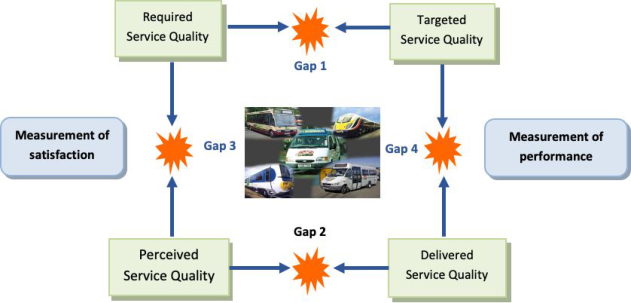
The Quality Loop of Coommunity Transport Service The concept of the quality loop of the provided service is the basis for the assessment of its service quality, following quality criteria according to both customers’ and service providers’ points of view. Thus, a service quality asses- sment model (SQAM) should be based on the dynamic interaction of the following entities: the users’ satisfaction of their needs and wants, on one side; the service providers’ perception of the provided service quality, on the other side (Parasuraman et al. 2005). On the user’s side, the criteria of satisfaction should be measured on the desired and perceived service qua- lity; from the provider’s side, the criteria of performance should be based on the planned and actual service quality, including economic viability. The available technology for planning, ticketing, and wayfinding from the access to and egress from the transport vehicle or network should be evaluated as well. Furthermore, support services at the destination should be previewed
258 Simoes and Suen
Figure 1: The quality loop of the service.
for mobility challenged users requiring help until exiting the transport netw- ork. This feedback loop would represent the basis for the assessment of the transport service quality, against a set of criteria embodying both customers’ and service providers’ points of view.
The walking areas in the urban built environment that must be used to reach the required transport or the destination building after leaving the veh- icle or the transport network should comply as well with the four targeted qualities fitting the needs and wants of every user. It should be noted that systems usability has a major importance in fully accessible transport services. Information and ticketing systems, as well as any technology to be operated by users (in-vehicle, infrastructure, or trip planning-related) should be user- friendly and comply with the accessibility requests regarding the different users’ groups. Independently on the transport mode, the type of vehicles and infrastructure, as well as the provided payment methods and any request for pre-booking, community transport services should have the following cha- racteristics according to the European Standard EN 13816:2002: 1. should be open and accessible to all users, whether travelling singly or in group; 2. should be publicly advertised; 3. should have a defined operating area (urban or suburban), as well as fixed routes with defined origins and destina- tions, and defined stopping places; 4. should have fixed times or frequencies, and periods of operation; 5. should be provided on a continuing basis; 6. should have a published fare.
Considering the importance of the users’ perception of their needs sati- sfaction along the travel chain is an important aspect to be measured, the quality loop in Figure 1 should be completed to form the basis for the deve- lopment of the targeted model, which should be continuously improved and tested. Considering that the user’s opinion about the different satisfaction indicators is the basis for the quality assessment, the collection of the required qualitative data should be periodic according to each improvement introdu- ced by the service provider. From the operator side, the introduction of a new improvement for the service quality is easier to be measured when it will be qualitatively assessed by the users.
Research Needs for a Quality Service Assessment Model 259
RESEARCH NEEDS AND THE NEXT STEPS FOR THE SERVICE QUALITY ASSESSMENT The will be developed upon the dynamic interactions in forum discussions by the following three actors: the Users versus those of the Service Providers. The third actor group involved would be independent Stakeholders composed of experts in the fields of Mobility, Transportation, Human Factors, and Reha- bilitation, as well as Academicians, as they will balance the ideas exchanges, hopefully resulting in recommendations on service improvements towards the fulfillment of the users’ needs within the service providers’ budgetary and policy constraints.
A multidisciplinary research team is required to carry out the following research steps:
1. A clustering activity to identify and define the different users’ groups according to their mobility limits. 2. A definition of the relevant travel scenarios supported by a simulation tool to be developed using virtual reality for testing and demonstration. 3. Collection of qualitative data by means of Focus Groups discussions addressing both the users’ perception of the service quality relative to their needs and expectations, versus the service providers’ awareness about gaps between the actual/planned services. 4. Design and test new improvement solutions to fill the service gaps. 5. Continuous improvement of the simulation tool as a permanent sup- port for the design and development of new solutions towards a desired service quality. 6. Develop guidelines and recommendations towards inclusion and equity in sustainable and resilient transport services.
The aims at developing an approach for community transport services that match users’ needs and expectations. Each recommended solution should be designed and tested in the simulation environment. The resultant design guidelines together with policy recommendations, will be published and dis- seminated, aiming at guiding transport providers in achieving the targeted inclusive and equitable mobility in a sustainable and resilient community.
REFERENCES
Alexopoulos, A. and Wyrowski, L. (2015). Sustainable Urban Mobility and Public Transport in Unece Capitals. The United Nations Economic Commission for Europe, Geneva. Bills, T.S. and Walker, J.L. (2017). Looking beyond the mean for equity analysis: Exa-
mining distributional impacts of transportation improvements. Transport Policy, 54 (2017) 61–69. Fekete, A.; Hufschmidt, G.; Kruse, S. (2014). Benefits and Challenges of Resilience and Vulnerability for Disaster Risk Management. International Journal of Disaster Risk Science 5:3–20 www.ijdrs.com. DOI 10.1007/s13753-014-0008-3 www.springer.com/13753. Geurs, K.T. and Van Wee, B. (2004) Accessibility Evaluation of Land-Use and
Transport Strategies: Review and Research Directions. Journal of Transport Geography, 12, 127–140. https://doi.org/10.1016/j.jtrangeo.2003.10.005.
260 Simoes and Suen
Litman, T (2021). Evaluating Transportation Equity: Guidance for Incorporating Distributional Impacts in Transport Planning. Victoria Transport Policy Institute, Canada. Litman, T (2021). Well Measured: Developing Indicators for Sustainable and Livable
Transport Planning. Victoria Transport Policy Institute, Canada. Litman, T. (2003). Social Inclusion as a Transport Planning Issue in Canada. Contribution to The FIA Foundation G7 COMPARISON. Victoria Transport Policy Institute, Canada. Litman, T. (2011). Developing Indicators for Comprehensive and Sustainable Tran-
sport Planning. Victoria Transport Policy Institute. Litman, T. and Burwel, D. (2006). Issues in sustainable transportation. Int. J. Global Environmental Issues, Vol. 6, No. 4. Lopez Lambas, M., & Garcia Pastor, A. (2005). Quality issues in transport operation
tenders: the difficult equilibrium between price and service level. Paper from The Association for European Transport Conference held in Strasbourg, France on 3-5 October 2005. Monzon, A., and E. Lopez (2020), Dimensions of Accessibility Benefits, International Transport Forum Discussion Papers, No. 2020/26, OECD Publishing, Paris. Parasuraman, A., Zeithaml, V. A., & Malhotra, A. (2005). E-S-QUAL - A multiple-
item scale for assessing electronic service quality. Journal of Service Research, 7(3), 213–233. doi: 10.1177/1094670504271156 Pariès, J.; Wreathall, J.; Hollnagel, E. (2011). Resilience Engineering in Practice: A Guide Book. ISBN 9781472420749. CRC Press. Platzer, K. Ed. (2021). UN SDG. Sustainable Transport, Sustainable Development
Interagency report for second Global Sustainable Transport Conference. UN Department of Economics and Social Affairs, NY. Reggiani, A. (2013). Network resilience for transport security: Some methodological considerations. Transport Policy, 28 pp. 63–68 ELSEVIER. Reggiani, A.; Nijkamp, N., Lanzi, D. (2015). Transport resilience and vulnerability:
The role of connectivity. Transportation Research Part A 81 (2015) 4–15. Rupprecht Consult Ed. (2019) Guidelines for Developing and Implementing a Sustainable Urban Mobility Plan, Second Edition. Simon, D. (2016). Introduction: “Sustainable Cities in Sustainable Societies”. In
Simon, D. Ed. Rethinking Sustainable Cities. Policy Press, University of Bristol. UK. Steward T.A. Pickett, Brian McGrath, M.L. Cadenasso & Alexander J. Felson (2014).
Ecological resilience and resilient cities. Building Research & Information, 42:2, 143–157, DOI: 10.1080/09613218.2014.850600. Waters, J, (2016). “Accessible Cities: from Urban Density to Multidimensional Accessibility”. In Simon, D. Ed. Rethinking Sustainable Cities. Policy Press, University of Bristol. UK. Woods, D. (2014). The Mystery of Sustained Adaptability. Velocity Conference,
September 15-17, New York. (Retrieved on 08-08-2015 from website http://ve locityconf.com/velocityny2014/public/schedule/detail/35613)
LISTED IN THE AHFE DIGITAL BOOKSTORE CATALOGUE
Explore the complete digital volume
Human Factors in Transportation
Read this individual research paper free through the original publisher, or explore the full digital proceedings book.
ISBN 978-1-958651-36-0
Explore this ISBN in the AHFE Bookstore ↗Listed in the July 2026 bookstore catalogue; search by ISBN to confirm current availability · Digital book purchase optional