Debra Satterfield, Ryan G Wilson, Azalea Houdek (2023). Industry Academia Collaboration in UX Education: Bringing the UX Industry into the Classroom. In: The Human Side of Service Engineering. AHFE Open Access, vol. 108, pp. 367–374. https://doi.org/10.54941/ahfe1003139
Students interested in a User Experience (UX) career are facing a multitude of barriers when leaving academia: a competitive, saturated market; poorly written job descriptions and companies unsure of the duties performed by UX practitioners; a rapid evolution of the market and emerging technologies; and individual uncertainty of career direction, be it UX Research, UX Design, User Interface Design, Interaction Design, Front End Design, or more. By developing professional networks and mentor relationships with Industry professionals, students can enhance their understanding of the field of UX and become more acquainted with industry expectations such as working with clients, title definitions, current and emerging technologies, evolving business needs, and streamlining their career focus.To support the industry-academia collaborations, a strategy was developed using a hybrid teaching model, I-SPACE (Innovation for Students, Practitioners, Alumni, and Community Engagement) that brings industry professionals into a college course on UX via online platforms such as zoom and Miro thus creating a virtual internship experience. The I-SPACE teaching method was co-created by design educators and industry professionals for the purpose of simulating internship experiences within an online course. The online virtual internships with industry professionals are conducted in three 5-week segments over a 15 week semester, to give students exposure to three distinct UX industry models and three sets of industry professionals. The goal of the virtual internship is to enhance career preparedness post-graduation through industry exposure, build a social network of professionals in the field of UX, and establish mentors.This paper will discuss the structure of the course, interactions with industry professionals in UX, and engagement with subject matter experts (SMEs). It will also discuss a comparison to traditional internships and a virtual I-SPACE internship experience in terms of the impact on student work, mentorship, and professional networking that are unique to the I-SPACE collaboration strategies and the insights of the industry mentors on the virtual internship strategy. Implications for virtual internship experiences will be addressed regarding issues of diversity, equity, and inclusion in internship opportunities and potential barriers will be identified.
Students interested in a User Experience (UX) career are facing a multitude of barriers when leaving academia: a competitive, saturated market; poorly written job descriptions, and companies unsure of the duties performed by UX practitioners. A rapid evolution of the market, emerging technologies, and individual uncertainty in their career choice be it UX Research, UX
Design, User Interface Design, Interaction Design, or Front-End Design, all increase the frustration experienced by students as they seek to gain the mea- ningful industry informed experience that will be critical to their success in the job market. Therefore, by developing social networks and mentor relation- ships with industry professionals, students can enhance their understanding of the field of UX and become more acquainted with essential industry expe- ctations such as working with clients, title definitions, current and emerging technologies, evolving business needs, thus streamlining their career focus. To support the goal of professional skill building, the I-SPACE (Innovation for Students, Practitioners, Alumni, and Community Engagement) teaching method was co-created by design educators and industry professionals for the purpose of giving students a virtual internship type of experience within the context of an online course (Satterfield et al. 2021). I-SPACE internsh- ips are conducted with industry professionals over a 15-week semester as part of a hybrid college class. The class is broken into three 5-week sprints; each one led by a different industry partner. The objectives of the I-SPACE class are: 1) give students exposure to three distinct UX industry models; 2) network with three sets of industry professionals; 3) provide a barrier- free and DEI-friendly opportunity for students in the class to participate in a high-impact educational practice; and 4) build discipline-specific professio- nal communication skills. Thus, the goal of I-SPACE is to equitably enhance career preparedness post-graduation through industry exposure, building a social network of professionals in the field of UX, addressing confidence and imposter complex issues, and establishing industry mentors for all students (Hurley et al. 2022).
It has been found that equipping all students with the industry-academia engaged skills and experiences necessary to help them transition into the work world is critical to their success. To fill this need, universities have identi- fied experiential learning strategies such as industry-academia engagement through practical training or internships as “high-impact practices” because they are significant predictors of student success. By making these types of experiential learning more readily available to students at all levels of their academic careers, a student’s chances of succeeding in the job market increase (Lucietto et al. 2021).
The F2F College Classroom Experience The f2f classroom has long been the typical strategy used by universities to prepare students for future careers. It often relied heavily on outside experi- ences such as internships or part-time jobs to augment a student’s education and job preparation. To prepare students for the plethora of work experie- nces in UX, UI, and design research, college classes use a variety of strategies ranging from senior capstone projects, research projects, internships, and co- op partnerships. At the department level, industry-academia collaborations may take the form of advisory boards and sponsored projects. In all cases, significant coordination is required on the part of both industry and acade- mia in terms of human resources and coordinated points of engagement to nurture these collaborative relationships (Lucietto et al. 2021).
Industry & Academia Collaboration in UX Education 369
Because university professors often have less extensive experience and are less familiarity with current industry needs, industry-academia collaborations can aid students in making a smooth transition into careers upon gradu- ation. Therefore, by increasing industry-academia interactions, universities can adapt their f2f course curriculum appropriately and be assured that they are appropriately equipping graduates to enter the workforce (Lucietto et al. 2021).
Traditional Internship Experience The traditional internship experience has long been recognized as an impor- tant part of learning the career expectations for students. Participation in an internship has been linked to higher job placement rates after graduation, thus making it even more critical (Lucietto et al. 2021). However, obtai- ning an internship relied on several key factors to assure success, namely a high level of academic achievement, a personal connection to the industry or effective networking skills, and the ability to demonstrate a high level of com- petency throughout the interview process. In addition, the student was often responsible for finding opportunities and successfully navigating the hiring process with very little assistance from industry or academia. This left many students at a distinct disadvantage in obtaining these critical experiences. For many students, the combination of factors necessary to secure an intern- ship has proven to be a significant barrier. Thus, effectively preventing many students from participating in this important skill and confidence-building experience.
I-SPACE Experience To address the changing demographics and students’ needs at an urban uni- versity, the I-SPACE virtual internship strategy was co-created by design education professionals and industry professionals. The I-SPACE virtual internship experience was designed to reduce the barriers to participa- tion in an internship experience and provide a more equitable opportunity for all students to gain critical job skills. I-SPACE integrates high-impact practices such as professional industry experience directly into the hybrid and online classroom and replicates internship experiences in ways that are usually only accessible to students who have traditional internships (Hurley et al. 2022). Integrating industry-informed experiential learning into the college classroom is essential for students experiencing challen- ges such as poverty, homelessness, and food insecurity. Students in these demographics may face the added barriers of jeopardizing their full-time income and financial stability if they take an internship. In addition, for students who are neurodiverse an I-SPACE online internship strategy may have fewer challenges in accessibility and physical barriers (Satterfield et al. 2015) (Abel et al. 2018). Therefore, industry-academia engagement using the I-SPACE model of education can engage students with indu- stry professionals in ways that do not disrupt their economic situations (Hurley et al. 2022).
Barrier Comparisons in College Classes, Internships, and I-SPACE The opportunity for internships is not equal for all students. Many students are dealing with external factors like finances, medical issues, heavy work schedules, and balancing family life; all of which make finding and taking an internship extremely difficult. While beneficial in providing industry expe- rience and networking opportunities, an internship requires an additional time investment which not all students have equal access or the ability to participate (Camacho and Alexandre 2019). Therefore, a tighter integration between industry and education by bringing the benefits of an internship into the classroom can alleviate the need for a student to increase their already significant outside-of-school time commitments and financial burdens.
Internships are also strongly linked to success in the job market. The job search engine, Indeed.com, lists the following reasons for having an internship: building a network, resume, and references, creating a professio- nal network, guiding career goals, and gaining job and research experience (Indeed Editorial Team 2022). The American Institute of Graphic Design (AIGA) describes an internship as an invaluable steppingstone into the profes- sion of design. They note that an internship will allow a student to apply skills learned in school to real projects, allow for collaboration with professionals, gain insight into the profession, “test drive” a specific environment or area of design, and network with professionals (AIGA.org, 2023). Yet, according to the National Survey of College Internships (NSCI) 2021 Report, only 21.5% of undergraduate students reported taking an internship (NSCI, 2023). Of those, the in-person, on-site internships versus remote internships were split nearly in half. This reduced number of internships can in part be attributed to COVID and social distancing during the pandemic.
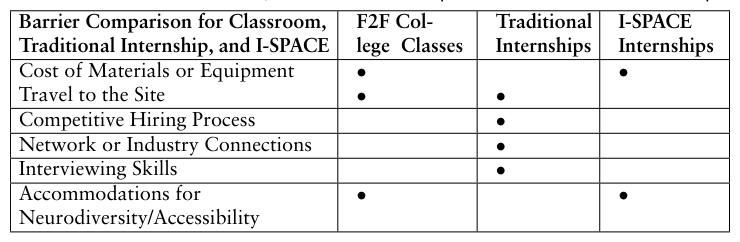
Barriers to equitable participation often exist in education and in access to traditional internships and other industry engagement strategies such as I-SPACE virtual internships. To better address issues of barriers regarding diversity, equity, accessibility, and inclusion, the following six barriers were identified: cost of materials; travel to site; competitive hiring; networking or connections; interviewing skills; and accommodations for neurodiversity and physical accessibility (see Table 1). The barrier of cost in F2F classes is typically associated with textbooks, computer equipment, software, and lab or course fees. These costs can vary a lot depending on the course, but they may be mitigated by free sources for books, rentals, and the fact that some of the costs may be covered by financial aid. Costs associated with travel are associated with on campus F2F and hybrid class and are also associated with in-person or on-site internships. A competitive hiring process may disadvan- tage students who are from underrepresented groups or who face challenges based on ability levels. The factors of networks and interviewing skills are related to competitive hiring process. These factors will make a competitive hiring process an even greater barrier for students who do not have a robust network in their discipline or those students who suffer disproportionately from social anxiety, mental health, or imposter complex issues. Regarding accommodations, physical disabilities are more likely to be addressed in a work site due to Americans with Disabilities Act (ADA) compliance, however,
Industry & Academia Collaboration in UX Education 371
Table 1. Barriers in F2F classes, traditional internships and I-SPACE virtual internships.
aaccommodationss for neurodiversity are just emerging in the workplace and are more likely to be addressed in a university through various sou- rces for support on campus. I-SPACE is conducted virtually and therefore accommodations can be managed through modifications to the digital con- tent delivery systems through the university content management system and digital support tools.
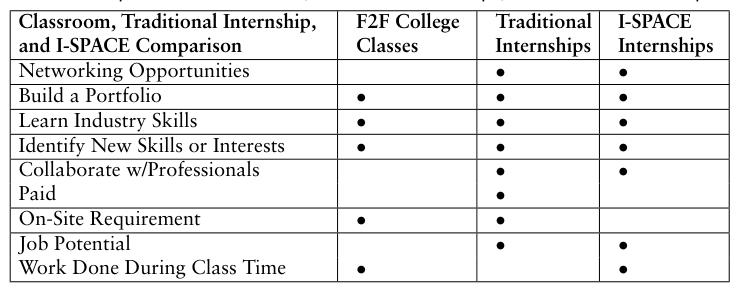
Comparison of Student Learning in Classes, Internships, and I-SPACE Classroom experiences are optimized to traditional lectures, tests, quizzes, labs, and F2F student interactions. Regarding industry skill building, a F2F classroom, a traditional on-site internship, and an I-SPACE experience have some similarities and distinct differences (see Table 2). Industry focused skills and experiences include networking opportunities, portfolio building, industry skill acquisition, skill or interest identification, collaboration with professionals, pay, on site work requirements, job opportunities, and time commitments. College classes can help students build a portfolio or resumé, learn industry skills, and help students identify new interests or skills. For F2F classes students are required to come to campus and their work is done either during class or as assigned homework. By comparison, a traditional internship has valuable networking opportunities, builds portfolio or resumé items, exposes students to industry skills, helps them identify new skills or interests, allows them to collaborate with professionals, and is paid. They will require students to travel to a job site, the work will be done outside of class time, and it has the potential to lead to a future job opportunity. An I- SPACE experience includes networking opportunities, portfolio and resumé building, acquiring industry skills, and collaboration with professionals. It is not paid and there is not an on-site requirement. It does however allow students to complete the work during normal class time or as homework and it has the added benefit of future job opportunities. When comparing the experiences, traditional internships and I-SPACE are both superior to a typi- cal classroom experience. However, an internship is much more difficult to get and will only be an option for a select few students either based on their connections, interviewing skills, and access issues. I-SPACE offers most of the same perks as an internship with the exceptions of pay and required travel. It also offers the advantage of being available for all the students in a class
Table 2. Comparison of F2F classes, traditional internships, and I-SPACE internships.
and allows them to use their allotted class time without jeopardizing other sources of income or other time commitments.
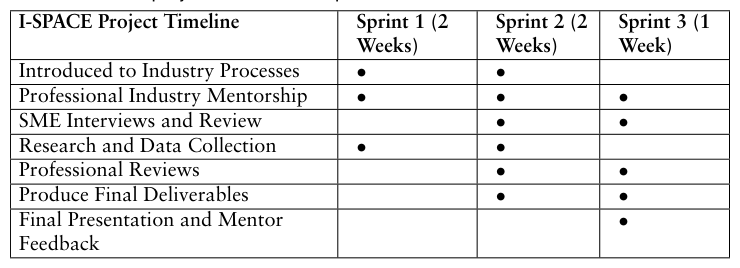
I-SPACE: 3 Industry Aligned Projects With 3 Sprints To approximate a work environment, the structure of the I-SPACE course focuses on interactions with industry professionals in the field of UX and engagement with subject matter experts (SMEs). The course was designed to replicate learning objectives from traditional internships and adapt them to an I-SPACE virtual internship experience. The focus is on improving the quality of student work based on mentorship, professional networking, industry skills, and portfolio building. The professor gives the course the required structure as dictated by the university including securing the indu- stry partners, scheduling them into one of three 5-week slots, preparing the syllabus including project statements, developing the course outlines, set- ting up learning objectives, and determining classroom management issues such as grading and due dates. During the 15-week semester, three industry- aligned professionals worked with the students in an online college class on one project. An online class modality was used for maximum flexibility in working with industry professionals. This allows for professionals to join from a wide range of physical locations and eliminates any travel-associated costs or complications. Each project was divided into three sprints of one or two weeks each (see Table 3). The first sprint focused on introducing the industry and the professionals to the class via guest speakers, class research, and online panel discussions. During the first sprint, the industry professi- onals would share their workflows, and presentation strategies, and help student groups identify possible deliverables. The professional mentors typi- cally joined during one class period for each of the three sprints. The second sprint would focus on in-progress presentations and collaborative work in small groups of 4–5 students and one professional who would follow with that group for the duration of the project. During the second sprint, SMEs would join the project via guest speakers, discussions, and small group Q and As. The third sprint was dedicated to presentation of final deliverables and small group mentorship discussions.
Industry & Academia Collaboration in UX Education 373
Table 3. I-SPACE project timeline and sprints.
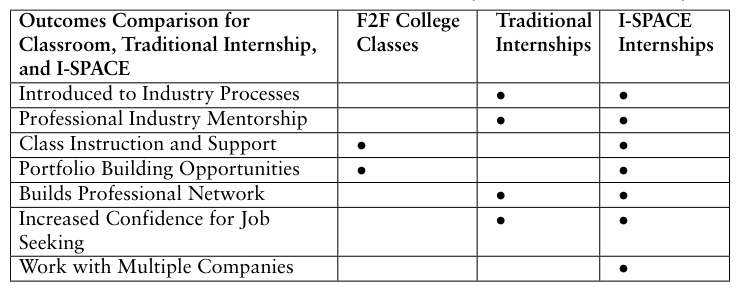
DISCUSSION AND CONCLUSION The structure of the I-SPACE course facilitates direct student interactions with industry professionals in UX, engagement with SMEs, networking opportunities, experience working with a variety of industry strategies and workflows, and opportunities for jobs (see Table 4). By comparison, traditi- onal internships are more limited regarding the number of students who can find them, secure a position through a competitive hiring process, and ove- rcome the economic and physical barriers required for participation. While a traditional internship experience immerses the student in a typical work envi- ronment, this may be less important as more of industry allows work from home and hybrid work options. Additionally, while a traditional internship is longer in duration (15 weeks or more), an I-SPACE internship experience exposes students to multiple work experiences over the same span of time; therefore, allowing the student to gain a greater understanding of differences and similarities between career options.
A virtual I-SPACE internship experience can also be measured in terms of quality of student work, the individual impact of multiple professional mentorship experiences for each individual student, and the extensive profes- sional networking opportunities that are unique to the I-SPACE collaboration strategies. Students who face barriers in acquiring a traditional internship will have greater access to the benefits of professional feedback and men- torship through the I-SPACE experience. Industry mentors are also able to customize the project and strategies to each student. The issues of diversity,
Table 4. Outcomes for F2F classes, traditional internships and I-SPACE internships.
equity, accessibility, and inclusion that are complicated in traditional intern- ship opportunities can be more easily mitigated through an I-SPACE model. Eliminating barriers such as threats to a primary income stream, the added costs of travel, opening high impact practices to students who lack industry connections, less savvy interviewing skills, and uneven skill sets are examples of such mitigations. For the university, an I-SPACE experience will increase the visibility of the programs and provide greater access to industry input and current practicies. The benefits of I-SPACE make it an interesting alternative to the traditional internship model with very few drawbacks.
Future Research Future research will include conducting student perception surveys to com- pare the experiences of students in each of the classroom, traditional intern- ship, and I-SPACE models. The I-SPACE model will also be applied to other subjects within the service learning and design disciplines.
REFERENCES
Abel, T. D., Satterfield, D. (2018). The Divergency Model: UX Research for and with Stigmatized and Idiosyncratic Populations. In: Yamamoto, S., Mori, H. (eds) Human Interface and the Management of Information. Information in Applica- tions and Services. HIMI 2018. Lecture Notes in Computer Science, vol 10905. Springer, Cham. https://doi.org/10.1007/978-3-319-92046-7_1 AIGA: A Guide to Internships. Accessed 2023. https://www.aiga.org/resources/a-gui
de-to-internships Camacho, B., & Alexandre, R. (2019). Design education. university-industry collaboration, A case study. The Design Journal, 22(sup1), 1317–1332. https://doi.org/10.1080/14606925.2019.1594958 Hurley, J., Raddatz, N., Satterfield, D. (2022). Bridging the Gap Between Industry
and Education: Engaging Design Professionals in the Education of Student Desi- gners. In: Christine Leitner, Walter Ganz, Clara Bassano and Debra Satterfield (eds) The Human Side of Service Engineering. AHFE (2022) International Con- ference. AHFE Open Access, vol 62. AHFE International, USA. http://doi.org/10. 54941/ahfe1002537 Indeed Editorial Team. 8-8-2022. Indeed Career Guide. (https://www.indeed.com/ career-advice/career-development/benefits-of-internships). Lucietto, A. M., & Peters, D. L., & Taleyarkhan, M. R., & Tan, S. (2021, Decem-
ber), Academic and Industry Collaboration – A Literature Review Paper presented at 2020 CIEC, Virtual. 10.18260/1-2-650-38725. National Survey of College Internships (NSCI) 2021 Report. (https://ccwt.wisc.edu/ wp-content/uploads/2022/04/CCWT_NSCI-2021-Report.pdf). Satterfield, D., Lepage, C., & Ladjahasan, N. (2015). Preferences for Online
Course Delivery Methods in Higher Education for Students with Autism Spectrum Disorders. Procedia Manufacturing, 3, 3651–3656. Satterfield, D., Rivera-Chang, J., Teubner, D., Tredway, T., & Woelfel, W. (2021).
Evaluating Innovation Strategies in Online Education in Higher Education. AHFE.
LISTED IN THE AHFE DIGITAL BOOKSTORE CATALOGUE
Explore the complete digital volume
The Human Side of Service Engineering
Read this individual research paper free through the original publisher, or explore the full digital proceedings book.
ISBN 978-1-958651-84-1
Explore this ISBN in the AHFE Bookstore ↗Listed in the July 2026 bookstore catalogue; search by ISBN to confirm current availability · Digital book purchase optional