Shuo-Fang Liu, Shiyu Wang (2023). From students, for students: Exploring the online collaborative design education method. In: Training, Education, and Learning Sciences. AHFE Open Access, vol. 109, pp. 217–224. https://doi.org/10.54941/ahfe1003168
With the increase in internet technology and the impact of the COVID-19 epidemic, more and more online courses have gained popularity in recent years, and they are becoming an important component of higher education. Researches on online collaborative processes include team communication, sketching activities, and collaborator performance. Most previous researches have focused on revealing learning phenomena, while scientific solutions or logical explanations have often been neglected. This study designed a cross-cultural collaboration design course with SDGs as the theme and conducted an online teaching experiment. A total of 64 students from different fields participated. Then we invited 6 group leaders as representatives to conduct face-to-face personal interviews. By retracing the whole course process, we investigated the students' attitudes and opinions about the online co-design course and their preferences. The results show that students' attitudes toward online co-design tend to be positive. They believe that online collaborative courses help improve design efficiency. Especially after initial software training, most students found the online collaboration platform easy to use. However, they are also concerned about the current technology gaps, especially the inability to monitor students' real status, and the tendency of students to be inattentive or even absent, making collaboration difficult. In addition, the problem of network latency when collaborating with multiple people needs to be addressed. The results of this study can provide insights for future online design education practices, help improve the quality of design education and provide practical assistance to a wider range of practitioners in the design education industry.
Co-design education is an approach that involves groups of learners working together to address a topic, complete a specific task, or create a targeted product or service. With the increase in internet technology and the impact of the Covid-19 epidemic, more and more online courses have gained popularity in recent years, and they are becoming an important component of higher education.
Typically co-design is a creative process based on teamwork, allowing different people to assess and solve a specific need based on their exper- tise (Roschelle, Penuel and Shechtman, 2006). It enhances staff initiative,
practice reflection, and design ownership. Considering that the future of co- design will be a close collaboration between all stakeholders in the design development process and a variety of professionals with mixed design or research skills. These team members may be cross-cultural, including disci- plines, national cultures, worldviews, ways of thinking, etc. Today, we are also witnessing the realization of the ideas they proposed. A variety of new co-design languages for cross-cultural communication are gradually gaining high attention, and collaborative learning is one of the representative forms.
In terms of pedagogy, the collaborative design focuses on the development of cognitive, social, and aesthetic skills with students (Seitamaa-Hakkarainen, Lahti and Hakkarainen, 2004). Sociocultural skills and values, such as trust, competence, empathy, and openness, are expected to develop when team members are deeply involved and actively participate in each stage of proposing and solving problems (Dreamson, 2017), which are developed through the use of various interactions and communications. However, in existing online design courses, the progress of co-design has been limited by certain specific technical requirements. Nowadays, researchers have develo- ped computer-aided systems to overcome the challenges of online co-design learning. Information and communication technologies (ICT) facilitate col- laboration, communication, and interaction in online environments.
Advantages of Information and Communication Technologies in Design Education With the increase in internet technology and the impact of the COVID-19 epidemic, more and more online courses have gained popularity in recent years and are becoming an integral part of higher education. At the same time, research has demonstrated that the use of ICT in online co-design has many benefits for design education (Lahti, Seitamaa-Hakkarainen and Hakkarainen, 2004). In design education, online collaboration technology allows for timely storage of operational steps, including offline collabora- tion, especially when design projects need to be reviewed, as the application has recorded information on every action and decision of all process visua- lization users, which helps other users to asynchronously review evaluation and deeper engagement (Drinkwater et al., 2004; Karakaya and ¸Senyapılı, 2007). Moreover, the design modification approach has become more strai- ghtforward and the collaborative decision-making process has been enhanced due to the richness of ways to support communication and communication media (Shao, Daley and Vaughan, 2007; Wang, 2011).
The Challenges of Online Collaborative Education The use of ICT in online co-design does have many benefits for design edu- cation, but on the other hand, it has also been found that students show negative attitudes toward collaborative learning, and they often suffer from a lack of socio-emotional interaction and attention deficits. Many works of literature point out the negative student attitudes toward collaborative learning as a common phenomenon in higher education. Causes of negative
From Students, For Students: Exploring the Online Collaborative 219
attitudes include equity issues such as task assignment, differences in lear- ning styles, differences in communication habits, inadequate social skills, and incompatible values, among others (Pfaff and Huddleston, 2003; Ruiz Ulloa and Adams, 2004; Wen and Tsai, 2006; Espey, 2010). Therefore, in order to gain insight into the causes of problems that cannot be solved by current technology, teachers need to understand the opinions of students who expe- rience difficulties and develop negative attitudes in online collaboration in order to minimize their negative emotions and enhance student engagement and learning (Dreamson, 2017).
METHOD
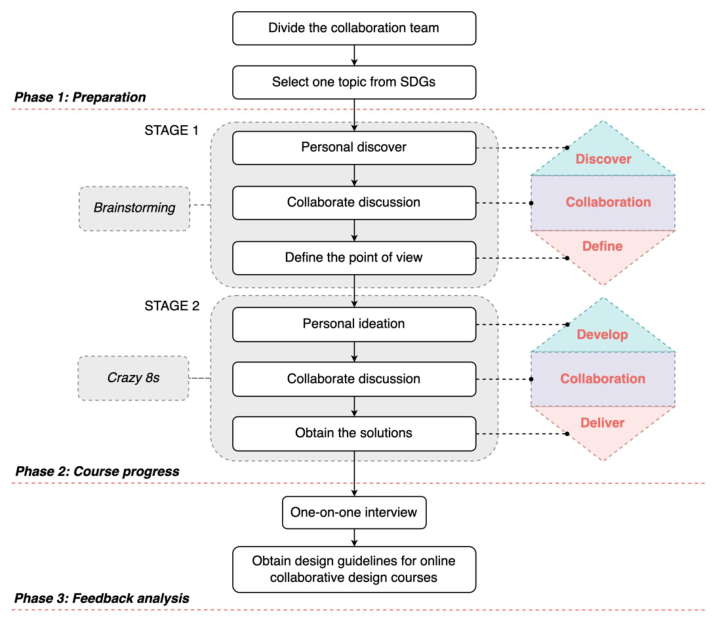
As shown in Figure 1, the study was divided into 3 phases. The first stage was course preparation, which required students to select topics in groups. The second phase is the formal course, where this study adds a collabora- tive component based on the Double Diamond Model of design thinking. The final stage was the feedback and analysis of the results, where in-depth face-to-face interviews were conducted with the course participants to under- stand the difficulties and real feelings that students encountered in the online
collaborative design course, and basic generalizations were made. Finally, guidance suggestions for the online collaborative design course were given.
In summary, the task of this online co-design course is for participants to work in teams according to a specified procedure based on a course exercise template prepared by the instructor, resulting in a complete visualization of the design thinking process and the conceptual solution. The instructor will outline the task at the beginning of the course, remind and assist students in the collaborative process throughout the course, and provide a summary at the end of the course. The specific schedule for the online collaboration design course is shown in Table 1.
Participates In this study, 64 participants with different professional backgrounds were invited. They included students from the Department of Industrial Design, Electrical Engineering, Creative Industries, Biotechnology, Taiwanese Litera- ture, Economics, Social Sciences, Materials, Psychology, History, and Civil
Table 1. The schedule of online collaboration design course.
Table available in the original PDF paper.
Items Item description Day 1 Grouping Students grouped freely. Choose a topic from the SDGs. Course explanation Introduction of course topics and class flow. Personal brainstorming Conducting data collection. Individual brainstorming to identify problems under the topic. Group working Share individual brainstorming content in the
group. Group members discuss together. Continue and add to the questions under the topic. Vote on the most valuable questions and compile them into a summary. Interim presentation Each group presents their progress and gets feedback from the teacher and other groups. Day 2 Course Review Review the course content of day1. Introduce the objectives and time planning of this section of the course. Personal ideation Personal quick association of 8 possible solutions
or tools that can be applied. Group working Share individual ideas within the group. Discuss and add more possible solutions to the group. Vote on and add to the list of possible solutions. Organize a more complete mind map. final presentation Groups present their results. Day 3 Submit the assignment Complement and refine the course results and submit the assignment with a complete Miro link one week after the course.
From Students, For Students: Exploring the Online Collaborative 221
Engineering. They were freely assigned into groups of four, and each group contained two or more collaborators from different fields, ultimately forming a total of 16 cross-disciplinary collaborative teams.
Procedure The interview was conducted one week after the course ended at the Depar- tment of Industrial Design, National Cheng Kung University. Before the interviews began, participants were informed of the purpose of the intervi- ews. Each participant signed an informed consent form and could withdraw from the interview at any time. In the beginning, the interviewer asked the interviewees to provide demographic information. Next, the purpose of the experiment was described to each interviewee. After revisiting the course ses- sion, participants were asked to share their attitudes and perceptions about online co-design learning. They were also asked to provide some of their own course suggestions at the end. The duration of each interview was approximately 30 minutes.
Data Analysis In this study, audio recordings were transcribed verbatim for data analysis. First, open coding is applied. Words or meaningful units that were frequently mentioned by respondents were marked, extracted, and tagged with codes. Second, highly similar codes are categorized into parsed concepts by conti- nuously comparing the data. Highly related concepts are further combined at a more theoretical and abstract level. for example, phrases such as “fast collaboration” and “easy to operate” are categorized as the theme of fast operation, which is a concept of perceived usefulness.
RESULT AND ANALYSIS To explore students’ attitudes toward online co-design learning, participants were asked to express their opinion about the online co-design learning. The majority of students expressed positive attitudes toward online co-design lear- ning and the technology platform. They were further asked to specify the reasons or perceptions behind their attitudes (difficulties/barriers, likes and dislikes, and pros and cons). These reasons fell into facilitation conditions and barriers. A summary of these reasons and perceptions is shown in Table 2.
Participants in this study showed positive attitudes toward online co- design platforms. The reasons behind their attitudes included facilitating conditions and barriers. Detailed aspects of these reasons were also identified. Participants identified the positive usability of the online co-design platform as convenience and efficiency, helpful for epidemic and sick students, high efficiency, fast operation, powerful features, good presentation, low cost and environmental friendly. The collaborative platform is easy to use, chan- ging text and layout on the collaborative platform is quick, and it does not take long to learn the software. Instead, major barriers include network environment issues, lack of monitoring capabilities, and easy distraction.
222 Liu and Wang
Table 2. Participant perceptions of online collaborative design platform.
Table available in the original PDF paper.
Categories Subcategories Examples of selected quotes Facilitating conditions Convenience and efficiency Do not spend a lot of time pasting sticky notes or connecting lines on paper Helpful for epidemic and sick students
Collaboration can be achieved anywhere, without risk of infection High efficiency More efficient than handwriting, typing heh dragging modules Fast operation Just drag and drop the window with the mouse, very effortless Powerful features There are many templates and auxiliary functions that can be used Good presentation Easy to organize and change, the final presentation is complete Easy to use The operation of the collaboration platform is simple for students Easy to change programs Changing text and layout in the collaboration platform is fast Easy to learn Do not spend long time learning the software Environmentally friendly Do not waste paper Low cost Do not need to prepare materials in advance, the online platform is free Barriers Lake of pre-course training I was a little anxious when I first used it, but after training I found it very easy and practical Network environment issues
If there are too many people online on the collaboration platform, there will be network latency Lack of monitoring function
Unable to see members’ expressions and status, unable to confirm whether members are online Easily distracted The switching of pages is convenient, but it is easy to be distracted by other pages
DISCUSSION
The main advantage of qualitative research is that it helps to gain a com- prehensive understanding of the phenomenon, as it allows participants to express their attitudes and experiences in their own words (Coenen et al., 2012). This study conducted a qualitative study using personal interviews to explore college students’ attitudes and perceptions of online co-design educa- tion. Students’ preferences for technology and course elements in operational exercises were determined. The results show that students’ attitudes toward online collaborative design tend to be positive. They think that online colla- borative courses help to improve design efficiency. After the initial training, most students found the online collaborative platform easy to use.
From Students, For Students: Exploring the Online Collaborative 223
A noteworthy finding of this study is that pre-course training was a signifi- cant contributor to students’ adoption of collaborative platform technologies in their online co-design courses. Most students who had no experience with online collaboration were initially intimidated by the course, as their unfa- miliarity with the operation of the software led to anxiety. However, after familiarizing themselves with the basic functions of the collaboration plat- form, students were able to carry out the course tasks smoothly. They may even think that the online collaboration tool actually simplifies the operati- onal tasks and is more efficient in terms of editing and layout. On the other hand, they were cautious about the constraint of online learning, believing that the current inability to monitor students’ attendance status could easily lead to difficulties in course collaboration.
The solutions to these problems should serve as a major direction for future researchers. In the future, more relevant practitioners or experts can be inte- rviewed to find implementable countermeasures to correct and improve the platform in order to enhance user experience.
LIMITATIONS AND FUTURE RESEARCH DIRECTIONS There are two limitations of the current study that should be addressed in future research. One of the limitations of this study is the sample size and number of participants; a larger sample size or in-depth interviews in focus groups may be able to enrich the results. Second, only one representative online collaboration platform was selected as the subject of this study, and multiple similar platforms could be selected for further in-depth comparative studies in the future.
CONCLUSION
As needs change and technology advances, using technology to create effe- ctive online learning environments or online education platforms is no longer an option, but an important new requirement for teachers. Effecti- vely designing such a learning environment requires establishing a clear set of sessions, while also maintaining open lines of communication with stu- dents. This study enriches the emerging research on the adoption of online educational technologies by providing new insights into cross-disciplinary students’ attitudes and perceptions of online collaborative courses and online collaborative technologies.
REFERENCES
Coenen, M. et al. (2012) ‘Individual interviews and focus groups in patients with rheumatoid arthritis: A comparison of two qualitative methods’, Quality of Life Research, 21(2), pp. 359–370. doi: 10.1007/s11136-011-9943-2. Dreamson, N. (2017) ‘Online Collaboration in Design Education: an Experiment
in Real-Time Manipulation of Prototypes and Communication’, International Journal of Art & Design Education, 36(2), pp. 188–199. doi: 10.1111/jade.12079. Drinkwater, P. M. et al. (2004) ‘Adopting a Web-Based Collaborative Tool to Support The Manchester Method Approach to Learning’, Electronic Journal of e-Learning,
224 Liu and Wang
2(1), pp. 61–68. Available at: http://citeseerx.ist.psu.edu/viewdoc/download?doi =10.1.1.117.111&rep=rep1&type=pdf. Espey, M. (2010) ‘Valuing teams: What influences student attitudes?’, NACTA Journal, 54(1), pp. 31–40. Karakaya, A. F. and ¸Senyapılı, B. (2007) ‘Rehearsal of professional practice: impa-
cts of web-based collaborative learning on the future encounter of different disciplines’, International Journal of Technology and Design Education, 18(1), pp. 101–117. doi: 10.1007/s10798-006-9013-1. Lahti, H., Seitamaa-Hakkarainen, P. and Hakkarainen, K. (2004) ‘Collaboration patterns in computer supported collaborative designing’, Design Studies, 25(4), pp. 351–371. doi: 10.1016/j.destud.2003.12.001. Lomas, C., Burke, M. and Page, C. L. (2008) ‘Collaboration Tools’, Internet Cool
Tools for Physicians, (August), pp. 119–128. doi: 10.1007/978-3-540-76382- 6_17. Park, J. Y. (2011) ‘Design Education Online: Learning Delivery and Evaluation’, International Journal of Art & Design Education, 30(2), pp. 176–187. doi: 10.1111/j.1476–8070.2011.01689.x. Pfaff, E. and Huddleston, P. (2003) ‘Does It Matter if I Hate Teamwork? What Impa-
cts Student Attitudes toward Teamwork’, Journal of Marketing Education, 25(1), pp. 37–45. doi: 10.1177/0273475302250571. Roschelle, J., Penuel, W. R. and Shechtman, N. (2006) ‘Co-design of innovations with teachers: Definition and dynamics’, ICLS 2006 - International Conference of the Learning Sciences, Proceedings, 2, pp. 606–612. Ruiz Ulloa, B. C. and Adams, S. G. (2004) ‘Attitude toward teamwork and effe-
ctive teaming’, Team Performance Management: An International Journal, 10, pp. 145–151. doi: 10.1108/13527590410569869. Seitamaa-Hakkarainen, P., Lahti, H. and Hakkarainen, K. (2004) ‘Virtual Design Studio as a Learning Environment’, Knowledge Creation Diffusion Utilization, pp. 1–33. Shao, Y. J., Daley, L. and Vaughan, L. (2007) ‘Exploring web 2.0 for virtual design
studio teaching’, ASCILITE 2007 - The Australasian Society for Computers in Learning in Tertiary Education, pp. 918–922. Wang, T. (2011) ‘Designing for designing: Information and Communication Technologies (ICTs) and professional education’, International Journal of Art and Design Education, 30(2), pp. 188–199. doi: 10.1111/j.1476–8070.2011.01675.x. Wen, M. L. and Tsai, C.-C. (2006) ‘University Students’ Perceptions of and Atti-
Read this individual research paper free through the original publisher, or explore the full digital proceedings book.
ISBN 978-1-958651-85-8
Explore this ISBN in the AHFE Bookstore ↗Listed in the July 2026 bookstore catalogue; search by ISBN to confirm current availability · Digital book purchase optional