Debra Satterfield, Jose Rivera-Chang, David Teubner, Tom Tredway, Wesley Woelfel (2022). “Voices of Design: People, Stories and Innovation” Service Design through University and Community Engagement. In: The Human Side of Service Engineering. AHFE Open Access, vol. 62, pp. 41–48. https://doi.org/10.54941/ahfe1002539
Voices of Design (VOD) is an event that uses Zoom, an online meeting program, and Miro, a web-based whiteboard platform, to create a virtual space for group collaboration and research. This virtual meeting space and the strategies of the VOD event are discussed regarding their ability to support large and small group interaction, interpersonal communication, design thinking processes, collaboration, complex problem solving, and gamification activities all in real time. Four goals were set as metrics for the success of this event: 1) create a safe virtual meeting place to share ideas, collaborate, and build community, 2) design content that inspires participants and casts a shared vision for design as a catalyst for positive change at global, national, local and personal levels, 3) use the event to build common ground by solving worthy yet complex problems, and 4) actively engage participants in the online activities through a series of gamification strategies. This event, these online and digital platforms, and these four goals are discussed regarding best practices for service design for online and hybrid education and design research conducted in virtual space.
In response to COVID-19, educators were suddenly forced to develop online teaching strategies. In many cases, these new strategies, tools, and platforms for online and hybrid education proved to be highly effective and in fact enhanced previous face-to-face teaching methods.
A combination of these new digital and online strategies was used to cre- ate the virtual meeting space and support the online activities of the Voices of Design (VOD) event. Zoom, an online meeting program, and Miro, a vir- tual whiteboard platform, were used to create a highly effective and scalable virtual space for a research and community engagement event on February 5, 2022, hosted by the Industrial Design Program at California State University Long Beach.
Four goals were identified as central to the VOD event: 1) create a safe place to share ideas, collaborate, and build community, 2) inspire and cast a vision for design as a catalyst for positive change at personal, local, and global levels, 3) solve a worthy problem, and 4) engage participants in the event through a series of gamification strategies. Data was collected in eight classes prior to the event to be used as information for the VOD problem solving activities.
VOD included five activities staged in the virtual event space in Miro: 1) a large group lecture space with a real-time audience reaction board for use during talks given by three professional and nationally recognized speakers each with a distinctly unique background of successes in design, 2) drawing jam boards and tandem drawing boards that were used to create a fun and engaging individual and collaborative design activities with a sense of chal- lenge and co-creation to be used as a relaxing break between the morning and afternoon events, 3) individual values clarification games to rate indivi- dual affinity for creative satisfaction versus monetary gains, 4) an individual goal setting activity to identify personal aspirations at local, national and global levels and barriers to achievement of these goals for each individual participant, and 5) a gamified small group sorting activity for groups of 3-4 participants to work on together in break out rooms using the data collected during VOD Phases 1 and 2.
VOD PARTICIPATION STRATEGIES The combination of zoom and Miro provided a platform for invited guest speakers to give their talk live while the audience engaged in real-time rea- ctions. This audience participation board allowed everyone to engage with the speakers’ messages through individual and collaborative content crea- tion. The pace of the VOD event intentionally varied based on the large and small group activities. As the scope of the activity changed so did the roles of the participants ranging from the more passive role of audience as they listened to invited guest presentations and then to an active engagement in the small break out groups where each participant was given the opportunity to talk and interact with other members of the event in real time. By varying the cadence between physical engagement and virtual interaction during the event, all participants were given the opportunity to slowly absorb content during a passive phase and then actively explore the impact of the information on their own perceptions and beliefs during an engagement phase.
The VOD audience participation activities included 1) Real-Time Response, 2) Sketchy People: Drawing Jam and Tandem Boards, 3) Your Future, 4) IKIGAI: Your Reason for Being, 5) Diversity and Sustainability: Can you sort it out? And 6) Our Central Themes.
1) Real-Time Response was an activity on the Miro board designed to cor- respond to the invited guest presentations delivered via Zoom. Miro was used to support participant engagement with the speaker’s presentations by allowing everyone to add content to the Miro board during the Zoom presentations. While the guests were speaking, members of the audience
“Voices of Design: People, Stories, and Innovation” Service Design 43
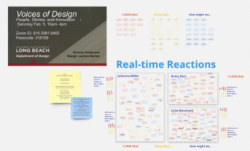
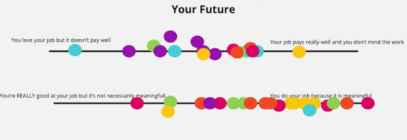
were encouraged to write their thoughts on a communal Miro board and to respond to the thoughts of other audience members. This real-time engagement with the speaker’s content transformed the VOD partici- pants from a traditionally passive audience role into an active listener co-creator role (see Figure 1, left). 2) Sketchy People was an open-ended relaxation space for creative self- expression and co-creation. It was both open format and non- judgmental. Anyone can draw at any time using any tools or styles or levels of sophistication. It was self-expressive and open ended. It also was unmoderated. It was a place to relax and just unwind. Because all drawings and participation were anonymous, the activity was fun and yet safe from the critical expectations that are often associated with drawing. 3) Your Future was a large group activity conducted live and moderated by a speaker who introduced the game. The two boards were set up as a sliding scales between two opposing statements. The questions on one board were: “You love your job but it doesn’t pay well,” and “Your job pays really well and you don’t mind the work.” The second sliding scale board posed the questions, “You are really good at your job but it it’s not necessarily meaningful,” and “You do your job because it’s meaningful.” The workshop participants were asked in unison to take a colored circle and place it on the slider for each of the two questions. The moderator then discussed the implications of the questions and opened the discus- sion to people who had placed their circle in specific positions of interest on the sliders. 4) IKIGAI: Your Reason for Being is a Japanese concept of self-exploration. The IKIGAI exercises revolved around the intersection of ikigai conce- pts, creative careers, and the 17 UN guidelines for sustainable growth. These exercises promoted the sharing of different intents, motivations, and opportunities within creative careers. Each workshop participant created their own boards and reflected upon their own values and future goals. 5) Can you sort it out introduced the “worthy problem to be solved”for the event. It used the Phase 1 data and was conducted as a small group acti- vity in zoom break out rooms, thus encouraging participants to explore their collective beliefs about diversity, concerns about the environment and issues of sustainability, and cast a vision for the future of design as a catalyst for positive change on global, national, and personal levels. Diversity and Sustainability were also identified as two subjects that both had interesting intersectionality regarding the health of the environment and the health of all people in society. The symbiotic relationships of social justice, access to wealth, and environmental resources touch every member of society in some way and have ramifications at all levels from local to global. Therefore, these two topics gave many opportunities for solutions and visions for change. (see Figure 1, right). 6) Our Central Themes were the culmination of the event that brought toge- ther the coded themes from the Phase 1 data and the areas of personal emphasis from the IKIGAI boards. These data points were added to one common board for final synthesis at the end of the VOD event.
Figure 1: Voices of design event miro boards for real-time reactions (left) and phase 2 data coding game activity (right).
VOD was designed to bring together students, faculty, and community stakeholders in ways that elicit authentic inclusion and reflect the individual and collective values of the group on the issues of diversity and sustainabi- lity. The event was designed to collect important data about the views and beliefs of the participants by creating a safe space to share ideas and co- create value using a wide range of shared skills and knowledge. The VOD data collection process and the data itself can be used to inform better tea- ching and learning practices in the design of education as a service industry. Faculty and participants were asked to identify ways to use the data for the purpose of creating more meaningful learning experiences. The event brou- ght together these diverse groups and provided the opportunity to identify common ground and create a shared history of problem solving and value co-creation. Critical communication strategies, thinking skills, collaboration strategies, and values clarification techniques were integrated into the event and discussed regarding the service design in education.
PHASE 1 QUALITATIVE DATA COLLECTION Two series of questions were used to collect student data in Phase 1 prior to the VOD event. The data gathering phase collected individual responses on the topics of diversity and sustainability. A Miro board was created to serve as a safe virtual space where students were given the opportunity to anonymously share their thoughts in ways that represented their authentic voices on these two issues. The data was collected during the fall semester in eight courses in the design department at California State University Long Beach (Nov/Dec 2021).
Framing Questions In Phase 1, the first data collection process was conducted using the following framing questions:
How Might We Promote Diversity and Sustainability in Design curriculu- m/courses at CSULB;
How might we address the challenges of diversity and sustainability in society through design education at CSULB;
How might CSULB students engage with the community to increase dialog around diversity in the local community; and
How might we engage community partners in sustainable practices?
“Voices of Design: People, Stories, and Innovation” Service Design 45
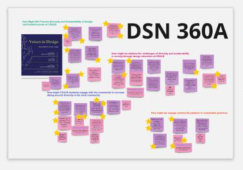
Figure 2: Phase 1 data collection board with responses and star reaction ratings (left) and Phase 2 data collection boards showing initial state and with responses (right).
A second data collection process was conducted using more focused questions on diversity and sustainability. Those questions were:
What does the term Diversity mean to you? Please give an example of how Diversity affects your life.
Can you describe a way that CSULB could encourage more Diversity on campus?
Can you describe a way that CSULB students could engage with the community to increase dialog about Diversity?
What does the term Sustainability mean to you? Please give an example of how Sustainability affects your life.
Can you describe a way that CSULB could encourage more Sustainability on campus?
Can you describe a way that CSULB students could engage with the community to encourage Sustainable practices?
Data Gathering The intent of Phase 1 was to gather a plethora of data from as many individu- als and student groups as possible. The data process used a grounded theory method of data collection that allowed topics, patterns, intentions, passions, and concerns to exist in this shared collection space with equal emphasis and significance. Since individual respondents were anonymous, the contributors were encouraged to share their ideas in a safe, non-exploitive, authentic, and non-judgmental forum. The Phase 1 data collections used two Miro boards and two sets of questions on diversity and sustainability issues and beliefs (see Figure 2).
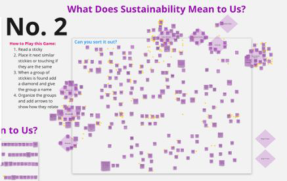
Phase 2 Data Coding: Can You Sort It Out In Phase 2 Data Coding, using a gamification process, the workshop partici- pants were asked to perform the role of coders and as such they were tasked to collectively sort and code the raw data. As part of the game, the partici- pants were asked to create nodes of related concepts by moving the individual sticky notes into groups of related concepts or nodes. They were then asked to identify any relationships between the nodes and connect them using lines and physical proximity to visually identify relationships known as linkages between the nodes. Three main nodes were identified to be the focus of the Phase 2 processing. For each group of workshop participants, the rationale
Figure 3: Phase 3 data gamification activity, “Can you sort it out?” and coding strategies used by two teams on the same initial data set.
for creating nodes and linkages was unique to the societal perspectives and priorities of the coders in that group.
Phase 3 Data Processing: Our Central Themes The Phase 3 Data Processing is the data interpretation phase. By using a process of questioning, called the POWER tool (Positives, Objections, What else, Enhancements, and Remedies), participants are taken through a series of distillation and elaboration questions to identify characteristics of the concepts and areas for expansion or focus for final solutions or outcomes.
During the afternoon online workshop, small teams of 3-4 students coded the information and distilled it into individual solutions in the form of acti- onable data for application in products, services, environments, or virtual community situations (see Figure 3). The goal of this phase is to take the coded information and transform it into a set of summary statements or directives that are actionable data.
DISCUSSION
Data collection for Phase 1 was conducted in three classes during Novem- ber and December 2021. Using the I-TEACH method of data collection, a Miro board was designed for the Phase 1 data collection. The Miro Board is found at: https://miro.com/app/board/o9J_ll0mGg8=/?invite_link_ id=32877995516 Data Collection for Phase 2 was conducted in eight individual hybrid and online classes during December 2021 with approximately 120 participants. Phase 3 was conducted during the online workshop, Voices of Design: People, Stories, and Innovation, on Feb 5, 2022, on Zoom and Miro, with approxi- mately 40 participants. The Miro Board is at: https://miro.com/app/board/o 9J_ll0mGg8=/?invite_link_id=32877995516 The Phase 3 event was conducted in two parts during the morning and afternoon on February 5, 2022. In the morning session, three speakers and design professionals made presentations on their perspectives and motiva- tions within the design industry in areas ranging from product design and placemaking to interior designs for rehoming the homeless and less fortu- nate. The presenters then reflected on their perspectives through a panel discussion. These presentations were very impactful and emotionally moving. This highly thought-provoking series of presentations served as an effective
“Voices of Design: People, Stories, and Innovation” Service Design 47
Figure 4: Values clarification activities, IKIGAI (left) and your future (right).
catalyst for personal reflection on the role of design for social change and encouraged the audience to engage with the content of the VOD event at a personal level. These highly charged presentations served as an effective framing device to give context to the values clarification activities in the afternoon (see Figure 4).
CONCLUSION
The VOD event and the three phases of qualitative data collection and processing were effective in engaging a wide range of student and faculty par- ticipants. A total of eleven classes ranging from first-year students to graduate students participated in the process with a total of more than 150 respon- dents. The culminating event incorporated alumni, faculty and students in an actively participatory morning event that allowed for authentic inclusion of participants and real time responses to be recorded. Each participant in the event was given the opportunity to consider their own values and to engage in a values clarification exercise which led into the data processing of the Phase 2 data on the meanings and significance of diversity and sustainability.
The structure of the event was carefully crafted to give students a vision of design and its power to bring about transformative change in both indi- viduals and society. Therefore, the inspirational speakers and the Real-Time Response boards were critical to setting the stage for students to see design as a change agent in multiple ways. The second activity, Sketchy People, was meant to be fun and relaxing while getting students into a content creation mode by drawing on the boards individually and in tandem with other desi- gners. The Your Future and IKIGAI activities were both self-reflective and important content creation on personal levels that were attached to goal set- ting. The Can You Sort it Out put participants back into a collaborative role and one of understanding societal views. All these events and engage- ments were then summarized at the end in the Our Central Themes board. The order of the agenda was successful in keeping participants engaged in both learning information and immediately using it for content creation or evaluation activities.
Because the Phase 1 data was collected directly from students in our classes and recorded on Miro in raw form, it is available to faculty and community stakeholders for the purpose of making better informed and authentically engaging events, curriculum design, and activities for use in education and with the community. In addition, the raw data can be processed using the strategies outlined in this paper by any number of faculty and student groups
to better understand these views and to apply them as actionable solutions regarding these two important subjects.
The VOD event will be repeated annually for longitudinal analysis of changing student perceptions on diversity and sustainability. In addition, que- stions of relevance to the department, university and students will be added as needed for curriculum development and program enhancement.
REFERENCES
Brown, H., Cook, R., Gabel, M.: Environmental Design Science Primer. Buckminster Fuller Institute. https://www.bfi.org/design-science/primer/environmental-design- science-primer Creative Education Foundation: Creative Problem Solving Resource Guide. Massachusetts, Creative Education Foundation (2015). Hansen, M.: IDEO CEO Tim Brown: T-Shaped Stars: The Backbone of IDEO’s Collaborative Culture. ChiefExecutive.net, January 21, 2010. https://chiefexecutive.net/ideo-ceo-tim-brown-t-shaped-stars-the-backbone- of-ideoaes-collaborative-culture__trashed/. IDEO.org.: The Field Guide to Human-Centered Design, 1st edn. IDEO.org/Design
Kit (2015). Kang, S., Satterfield, D.: Connectivity model: evaluating and designing social and emotional experiences. In: Proceedings of International Association of Societies of Design Research, pp. 2247–2256 (2009). Osborn, A.: Applied Imagination: Principles and Procedures of Creative Problem-
Solving, 3rd edt. Charles Scribner’s Sons, New York (1963). Rivera-Chang, J.: Case study: how design students tailor their crowdfunding presentation to different audiences. In: Di Bucchianico, G., Shin, C.S., Shim, S., Fukuda, S., Montagna, G., Carvalho, C. (eds.) AHFE 2020. AISC, vol. 1202, pp. 927–931. Springer, Cham (2020). Rivera-Chang, J.: Case study: use of online tools in the classroom and their impact
on industrial design pedagogy. Procedia Manuf. 3, 2275–2280 (2015). Satterfield, D.: Factors influencing academic success for design students: a study of curricular expectations and ethical issues. In: Freund, L.E., Cellary, W. (eds.) AHFE 2017. AISC, vol. 601, pp. 153–161. Springer, Cham (2018). Satterfield, D., Rivera-Chang, J., Teubner, D., Tredway, T., Woelfel, W. “Evaluating
Innovation Strategies in Online Education in Higher Education.” In: Advances in the Human Side of Service Engineering, pp. 219–225 (2021). Sezer, O., Nault, K., Klein, N. Don’t underestimate the power of kindness at work. Harvard Business Review, May 7, 2021. https://hbr.org/2021/05/dont- underestimate-the-power-of-kindness-at-work United Nations: THE 17 GOALS | Sustainable Development. https://sdgs.un.org/
goals.
LISTED IN THE AHFE DIGITAL BOOKSTORE CATALOGUE
Explore the complete digital volume
The Human Side of Service Engineering
Read this individual research paper free through the original publisher, or explore the full digital proceedings book.
ISBN 978-1-958651-38-4
Explore this ISBN in the AHFE Bookstore ↗Listed in the July 2026 bookstore catalogue; search by ISBN to confirm current availability · Digital book purchase optional