Comfort Iyiola, Winston Shakantu (2026). Framework for Integrating Smart Waste Management System in the South African Construction Industry. In: Sustainable Built Environment. AHFE Open Access, vol. 225, pp. 140–151. https://doi.org/10.54941/ahfe1007906
The construction industry in South Africa is a major contributor to solid waste generation, driven by rapid urbanization, infrastructure development, and inefficient site management. The growing volume of construction waste and the limitations of existing waste collection and disposal systems pose serious challenges for urban areas. Consequently, prior studies have emphasized the need for smart waste management (SWM) to improve waste monitoring, segregation, collection, transportation, and environmentally responsible disposal in the construction industry. Despite its potential, the adoption and performance of SWM in construction remain limited due to several persistent barriers. To address these challenges, this study proposes a comprehensive framework for enhancing SWM systems in the South African construction industry. The framework is structured around three key aspects: barriers, facilitators, and benefits of implementing SWM. A quantitative research approach was adopted using a structured questionnaire administered to construction professionals across South Africa, yielding 195 valid responses. The data were analysed using descriptive and inferential statistical techniques. The findings indicate that the primary barriers are poor digital infrastructure, high investment costs, technical complexity, and limited technical expertise. The facilitators to overcome these barriers include technological readiness, organizational capability, and institutional and regulatory support. The results further demonstrate that adopting SWM can significantly reduce landfill disposal, enhance waste reduction and material recovery, and improve operational efficiency. This study contributes to sustainable construction by providing an empirically grounded, context-specific framework to support policymakers, construction firms, and industry stakeholders in advancing innovative WM practices in South Africa and other developing countries.
Despite significant advancements in the construction industry, poor WM remains a persistent challenge. Although government organizations, industry, and academia continue to implement various WM measures, the rising volume of waste in the construction sector remains unacceptably high. Likewise, the construction industry is significantly behind the “zero waste” goal promoted by many organisations. This is primarily due to
Framework for Integrating Smart Waste Management System 141 the industry’s heavy reliance on traditional WM practices, which rely on parametric models and manual methods (Fatimah et al., 2020). This highlights the need for innovative WM solutions that perform beyond traditional methods. Marimuthu et al. (2021) noted that integrating advanced digital technologies (DT) in construction offers a promising approach, enhancing waste-handling efficiency and sustainability. Consequently, integrating SWM is not just about handling waste; it is about improving the entire system to support the circular economy (CE) and sustainable cities. Over the years, numerous DT have emerged, offering a wide array of WM applications. These include Artificial Intelligence, Building Information Modelling, the Internet of Things, and Big Data Analytics, among others. While many developed countries have successfully implemented these technologies to reduce construction waste, developing countries remain in the early stages of digitalization (Iyiola et al., 2024). Thus, this transition remains particularly challenging for countries like South Africa, where conventional WM have long been the norm. South Africa, like many other countries worldwide, is grappling with WM issues that exacerbate environmental degradation, threaten public health, and undermine the overall quality of urban life, with a negative impact on vulnerable communities. Adeleke et al. (2021) noted that South Africa faces mounting waste-related problems, including illegal dumping, inadequate collection services, and improper waste disposal, which have long plagued the country. Serge Kubanza and Simatele (2020) further affirmed that the WM system is far from sustainable in South Africa. In short, SWM in South Africa is not fully integrated, as participation from both the private and public sectors is rare, social awareness of environmental sustainability is limited, and cleanliness is limited. Given this, various studies have examined how WM effectiveness can be enhanced in the construction industry through innovative technologies. Despite these studies, existing WM approaches have proven inefficient, as SWM in South Africa remains beset by numerous issues. This indicates the need for a holistic systems strategy that brings stakeholders together to effectively resolve WM problems. Likewise, there is no structured framework specifically designed to provide strategic guidance for implementing SWM. This research aims to fill these gaps by developing a conceptual framework that can provide strategic guidance for SWM implementation to enhance WM in South Africa. The framework is based on a thorough evaluation of key SWM benefits, barriers, and facilitators for implementation. Although the primary focus is on the South African construction industry, the framework’s principles and methods can be adapted for other developing countries facing similar challenges. The findings offer critical insights that can inform policies and industry practices, supporting a broader move towards a safer and more sustainable construction industry.
LITERATURE REVIEW
Main Aspects of SWM Implementation Based on the literature review, this study identifies the key barriers, benefits, and facilitators of SWM implementation, which underpin the proposed technology implementation. Digitalization in the construction industry offers significant benefits for SWM performance, and awareness of these benefits is essential for improving SWM adoption, particularly in WM. Accordingly, Table 1 summarizes the potential benefits of SWM identified from the literature.
Table 1: Potential benefits of SWM implementation.
Table available in the original PDF paper.
SWM Performance References
Increased material recycling and reuse, Enhanced cost and operational efficiency, Reduced environmental impacts
Improved waste reduction efficiency, (Rejeb et al., 2022, Yu et al., 2022, Abioye et al., 2021, Iyiola et al., 2024, Akinradewo et al., 2022, Huang et al., 2021) Reduction in waste generation Enhanced integration of circular economy practices
Reduction in landfill disposal Improved waste segregation at source
Real-time monitoring and tracking of waste flows Improved recovery of high-value materials
Digitalization in the South African construction industry remains at an early stage, with technologies, policies, regulations, and infrastructure still evolving, resulting in several significant barriers. Based on the literature review, eight SWM implementation barriers were identified and are presented in Table 2. Likewise, the effectiveness of SWM implementation depends on how well these barriers are addressed. In this regard, Table 2 also outlines fifteen key facilitators that can help overcome these barriers and support the effective integration of SWM in the construction industry.
Table 2: Barriers to SWM implementation.
Table available in the original PDF paper.
Barriers Sources
Weak digital infrastructure Poor regulatory enforcement
Resistance to change and organisational culture Technological complexity
High investment costs (Zhang et al., 2019, Charef et al., 2021, Akinradewo et al., 2022, Rayhan et al., 2025, Rodrigo et al., 2024, Huang et al., 2021, Iyiola et al., 2024, Rejeb et al., 2022, Yu et al., 2022, Abioye et al., 2021) Data management concerns Skills and training gap
Lack of standardisation
(Continued)
Table 2: Continued.
Table available in the original PDF paper.
Barriers Sources Facilitators
Reliable power supply Availability of supporting hardware and software support
Good organizational culture Excellent network connectivity
Reliable data management systems (Izzati et al., 2024, Fatimah et al., 2020, Zhang et al., 2023, Zhang et al., 2019, Iyiola et al., 2024, Rafiq et al., 2025, Yadav et al., 2023, Khan and Ali, 2022, Rayhan et al., 2025, Sharma et al., 2020, Rodrigo et al., 2024, Olawade et al., 2024), Sharma et al. (2020) Top management commitment Policy and regulatory enforcement for SWM
Compatibility with existing infrastructure Supported industry standards
Availability of financial capacity and resources Training programs to enhance competencies
Availability of government incentives Adequate digital skills and continuous training
Data governance and cybersecurity regulations Effective stakeholder’s collaboration
RESEARCH METHODS The research adopted a mixed-method approach, integrating literature review with a comprehensive questionnaire survey of construction industry professionals in South Africa. This section provides a detailed overview of the research methodology.
Research Design The research design comprised three main sections. The first section detailed the respondents’ demographic characteristics, comprising education level, area of expertise, and years of experience. The second section assessed the perceived importance of SWM benefits, barriers, and facilitators. Data were collected anonymously through a structured online questionnaire administered via Google Forms to construction professionals. This approach enabled wide geographical reach, convenience, and voluntary participation. The questionnaire consisted of closed-ended items measured on a 5-point Likert scale (1 = strongly disagree; 5 = Strongly Agree). Informed consent was obtained online prior to participation.
Sampling Methods and Respondent Demographic Characteristics The study employed convenience and snowball sampling techniques. Initial respondents were selected through convenience sampling, targeting construction professionals known to the authors to ensure representation across South Africa. These participants then referred other eligible
144 Comfort and Winston professionals through snowball sampling. In total, 195 valid responses were received. Table 3 presents the respondents’ characteristics. Over half of the respondents 98(50.3%) held a master’s degree, and the majority had substantial industry experience: 9(4.6%) had up to 5 years, 57(29.2%) had 6–10 years, 41(21.0%) had 11–15 years, and 85(45.1%) had over 16 years of experience. This indicates that the respondents were sufficiently qualified to provide reliable and informed responses.
Table 3: Respondents’ demographic information.
Table available in the original PDF paper.
Demographic Characteristics Frequency Percentage Level of education
Master’s Degree 98 50.3 Doctorate (PhD) 17 8.7 Area of Expertise
Architect 25 12.8 Construction Manager 54 27.7
Project Manager 63 32.3 Quantity Surveyor 28 14.4
Civil Engineer 25 12.8 Years of Experience in the Construction Industry
1 - 5years 9 4.6 6 - 10 years 57 29.2
11 - 15years 41 21.0 16 – 20years 70 35.9
More than 20 years 18 9.2
Data Analysis Descriptive and inferential statistics were used for the study. The relative importance index (RII) method was applied to assess the perceived importance of factors related to SWM benefits and their implementation barriers. A threshold value of 0.6 was adopted to identify significant factors, and the RII for each factor was calculated using Equation (1). In addition, factor analysis (FA) was used to analyse the facilitators of SWM in the South African construction industry.
;(0 1) A × N = < < ∑W RII RII W = Weighting (1 to 5) given to each factor by the respondents. A = Highest weight (i.e., a score of 5 on the scale). N = Total number of responses.
RESULTS AND DISCUSSION
Relative Importance Index of the Benefits of SWM
Table 4 presents the relative importance of SWM benefits in the construction industry, with “reduction in landfill disposal” ranked highest (RII = 0.91), indicating the effectiveness of SWM in diverting construction waste from landfills. Closely following this are increased material recycling and reuse, better integration of CE practices, and reduced environmental impacts (0.89 respectively), reflecting the industry’s growing focus on sustainability and responsible resource use. Reducing overall waste generation and improving waste segregation at source (0.88) further helps limit waste at its origin. Real-time monitoring and tracking of waste flows (0.87) improve control and transparency in waste handling. While slightly lower in ranking, cost and operational efficiency (0.85), waste reduction efficiency (0.83), and improved recovery of high-value materials (0.79) remain important, as they support long-term economic benefits and more sustainable construction practices.
Table 4: Potential benefits of SWM implementation.
Table available in the original PDF paper.
Benefits Mean SD RII Rank Reduction in landfill disposal 4.61 0.58 0.91 1
Increased material recycling and reuse 4.59 0.56 0.89 2 Enhanced integration of CE practices 4.59 0.57 0.89 3
Improved recovery of high-value materials 4.09 1.13 0.79 10
Relative Importance Index of Barriers to SWM Implementation
Table 5 presents the RII-based prioritization of barriers to SWM implementation, with each barrier assigned a unique code. Poor digital infrastructure emerged as the most critical barrier, consistent with previous studies in developing countries. Effective SWM relies on reliable digital infrastructure, including broadband connectivity, cloud platforms, and sensor-enabled devices; however, limited internet coverage, unstable power supply, and inadequate ICT infrastructure hinder real- time data collection, system integration, monitoring, and scalability of smart waste solutions. High investment costs are the second most critical barrier to SWM implementation (RII = 0.95), as the upfront costs of advanced infrastructure, hardware, and software, coupled with uncertain returns on investment, long payback periods, and limited funding, discourage adoption. This challenge is particularly pronounced among South African construction firms operating on small- to medium-scale projects, where cost efficiency is crucial, leading to reliance on conventional practices. Balancing technology investment with return on investment is therefore essential for advancing SWM. Technological complexity
146 Comfort and Winston (RII = 0.85) also hinders adoption, as deploying, integrating, and maintaining digital systems are challenging, especially for organizations with limited experience and under time constraints. Additionally, limited technical expertise (RII = 0.85) constrains SWM implementation due to shortages of personnel with the digital and technical competencies required to operate and maintain smart waste systems. A lack of standardization (RII = 0.84) emerged as a significant barrier, as the absence of industry-wide standards leads to fragmented digital tool implementation, creating compatibility, security, and functionality challenges that undermine SWM effectiveness. Poor regulatory enforcement further constrains adoption, as inconsistent policies, weak monitoring, and limited penalties reduce pressure on organisations to shift from conventional practices, highlighting the critical role of government. Resistance to change (RII = 0.81) and data management concerns (RII = 0.79) also impede SWM implementation, driven by adherence to established workflows, perceptions of disruption or cost, skills gaps, and limited leadership support. Although data management concerns are currently less critical, they are expected to intensify as digitalization increases, as risks to data security, privacy, quality, and inadequate management frameworks can undermine system reliability and decision-making.
Table 5: Barriers to SWM implementation.
Table available in the original PDF paper.
Code Barriers Mean SD RII Rank B1 Poor digital infrastructure 4.48 0.71 0.98 1 B2 High investment costs 4.48 0.75 0.95 2
B6 Poor regulatory enforcement 4.43 0.80 0.81 6 B7 Resistance to change and organisational culture
4.39 0.82 0.81 7
B8 Data management concerns 4.10 0.98 0.79 8
Result of Exploratory Factor Analysis The suitability of the dataset for factor analysis (FA) was evaluated using the Kaiser–Meyer–Olkin (KMO) measure and Bartlett’s Test of Sphericity (BTS). As shown in Table 6, the KMO value of 0.843 indicates adequate sampling suitability for FA (Pallant, 2020). Bartlett’s Test was statistically significant (χ² = 911.615, df = 105), confirming sufficient inter-variable correlations and validating the dataset for FA.
Table 6: KMO and Barlett’s test of sample adequacy.
Table available in the original PDF paper.
KMO and Barlett’s test of Sample Adequacy Kaiser-Meyer-Olkin Measure of Sampling Adequacy 0.843
Bartlett’s Test of Sphericity Approx. Chi-Square 911.615 df 105
Sig. 0.000
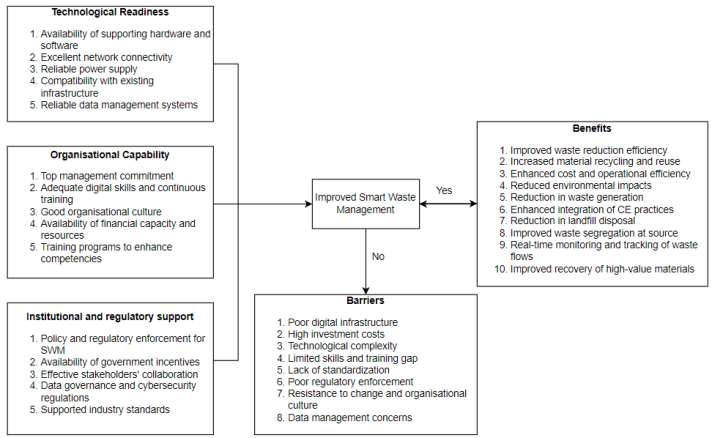
Framework for Integrating Smart Waste Management System 147 Principal component analysis (PCA) with varimax rotation and Kaiser normalization was used to analyse the drivers, with Table 7 presenting the total variance explained. Factors were retained using a loading threshold of 0.50 (Field, 2024). Guided by the rotated factor matrix in Table 7, three components were extracted, explaining 63.541% of the total variance across the 15 facilitators. The variance contributions were 28.713% for Component 1, 22.023% for Component 2, and 12.806% for Component 3. Based on variable loadings, the components were labelled “Technological readiness,” “Organisational capability,” and “Institutional and regulatory support.” The findings in Table 7 revealed that “Technological readiness” is a major facilitator of SWM implementation. Five key factors contribute to this facilitator and are referred to as the availability and reliability of digital infrastructure. The findings revealed that when construction firms are technologically prepared, they can monitor waste generation in real time, improve segregation, and make data-driven decisions that enhance waste reduction and resource recovery. Adequate technical infrastructure also ensures that SWM systems are scalable, reliable, and integrated across project stages. Component two was referred to as “organizational capability” as it focuses on internal readiness within construction firms, including leadership commitment, skilled personnel, and supportive organisational culture. The findings ascertained that firms with strong management support, adequate training, and effective change management strategies are more likely to adopt and sustain SWM practices. Organisational capability enables employees to accept new technologies, operate smart systems efficiently, and align waste management (WM) goals with overall project performance. Lastly, the third component, which was referred to as “institutional and regulatory support,” plays a critical role in creating an enabling environment for SWM adoption. Clear policies, enforceable regulations, financial incentives, and stakeholders’ collaboration encourage firms to move away from conventional WM practices. Strong government support and industry standards reduce uncertainty, promote accountability, and accelerate the integration of SWM practices across the construction sector.
Table 7: Factor analysis of the identified facilitators.
FA7 0.747 Institutional and regulatory support FA15 0.702 FA14 0.695
FA9 0.637
Framework for SWM Implementation Based on the RII and factor analysis of SWM benefits, barriers, and facilitators, an SWM implementation framework was developed (Figure 1), offering policymakers, practitioners, and academics insights to accelerate digital transformation and enhance SWM in South Africa.
Figure 1: Framework for SWM implementation.
RESEARCH IMPLICATIONS Theoretical Implications
This study introduces a novel, comprehensive framework that guides the implementation of SWM. The rigorous literature review incorporates all essential aspects of SWM implementation, including its benefits, barriers, and facilitators. The factors under each of these three categories were assessed for relative importance using RII analysis and FA, demonstrating a context-specific, replicable methodological approach. While the framework is grounded in the South African context, its adaptability across similar contexts offers opportunities for future theoretical exploration.
Framework for Integrating Smart Waste Management System 149 Practical Implications
The framework provides a comprehensive perspective on key aspects of SWM implementation and their relative importance. The detailed discussion of how to overcome implementation barriers using these facilitators (Table 7) and the developed conceptual framework (Figure 1) provide strategic guidance for implementing SWM in the construction industry. These findings are particularly valuable for policymakers, industry practitioners, and academics, enabling collaborative efforts in overcoming implementation barriers. This well-informed approach helps organizations align their digitalization objectives with the developed framework, ensuring a more structured and efficient digital transformation of the South African construction industry.
Recommendations and Future Studies To enhance the robustness and applicability of the framework, future research should expand the sample size and include professionals from across levels and roles within the construction industry. Additionally, testing the framework in regions with similar socio-economic contexts will further strengthen its applicability. The periodic refinement of the framework is essential to capture emerging trends and ensure its continued relevance. Future studies should also investigate the specific challenges associated with implementing individual technologies, thereby expanding the framework’s scope. Furthermore, sensitivity analyses are recommended to systematically evaluate the framework’s reliability and adaptability across different contexts.
CONCLUSION
This study contributes to the field by developing a conceptual framework for SWM implementation in South Africa. A comprehensive literature review identified key SWM benefits, barriers, and facilitators, which were evaluated using RII and factor analysis based on responses from 195 construction professionals. The analysis highlighted the most critical barriers and the most effective facilitators, forming the basis of the proposed framework (Figure 1). Strategic guidance in Table 7 illustrates how these facilitators can address implementation challenges, confirming the framework’s applicability within the South African context. Overall, the study provides a structured and actionable roadmap for integrating SWM, offering valuable insights for policymakers, academics, and industry practitioners to support sustainable digital transformation in the construction industry.
REFERENCES
Abioye, S. O., Oyedele, L. O., Akanbi, L., Ajayi, A., Delgado, J. M. D., Bilal, M., Akinade, O. O., & Ahmed, A. 2021. Artificial Intelligence in the Construction Industry: A Review of Present Status, Opportunities and Future Challenges. Journal of Building Engineering, 44, 103299. Adeleke, O., Akinlabi, S., Jen, T.-C. & Dunmade, I. 2021. Towards Sustainability in
Municipal Solid Waste Management in South Africa: A Survey of Challenges and Prospects. Transactions of the Royal Society of South Africa, 76, 53–66.
150 Comfort and Winston Akinradewo, O. I., Aigbavboa, C. O., Edwards, D. J. & Oke, A. E. 2022. A Principal
Component Analysis of Barriers to the Implementation of Blockchain Technology in the South African Built Environment. Journal of Engineering, Design and Technology, 20, 914–934. Charef, R., Morel, J.-C. & Rakhshan, K. 2021. Barriers to Implementing the Circular Economy in the Construction Industry: A Critical Review. Sustainability, 13, 12989. Fatimah, Y. A., Govindan, K., Murniningsih, R. & Setiawan, A. 2020. Industry 4.0
Based Sustainable Circular Economy Approach for Smart Waste Management System to Achieve Sustainable Development Goals: A Case Study of Indonesia. Journal of Cleaner Production, 269, 122263. Field, A. 2024. Discovering Statistics Using IBM SPSS Statistics, Sage Publications Limited. Huang, K., Zhang, X., Mu, Y., Rezaeibagha, F. & Du, X. 2021. Scalable and Redactable
Blockchain With Update and Anonymity. Information Sciences, 546, 25–41. Iyiola, C. O., Shakantu, W. & Daniel, E. I. 2024. Digital Technologies for Promoting Construction and Demolition Waste Management: A Systematic Review. Buildings, 14, 3234. Izzati, S. N., Ardi, R., Kim, S. & Putri, S. A. 2024. Evaluating Drivers and Barriers of
Integrated Waste Management System Implementation in Indonesian Construction Industry: A Dematel-Based Analytical Network Process. Sustainability, 16, 2264. Khan, F. & Ali, Y. 2022. A Facilitating Framework for a Developing Country to Adopt Smart Waste Management in the Context of Circular Economy. Environmental Science And Pollution Research, 29, 26336–26351. Marimuthu, R., Shanthi, M., Aramvith, S. & Sivaranjani, S. 2021. Smart Waste
Management Model for Effective Disposal of Waste Management through Technology. Challenges and Solutions for Sustainable Smart City Development. Springer. Olawade, D. B., Fapohunda, O., Wada, O. Z., Usman, S. O., Ige, A. O., Ajisafe, O.
& Oladapo, B. I. 2024. Smart Waste Management: A Paradigm Shift Enabled By Artificial Intelligence. Waste Management Bulletin, 2, 244–263. Pallant, J. 2020. Spss Survival Manual: A Step by Step Guide To Data Analysis Using IBM SPSS, Routledge. Rafiq, M. S., Sultana, R., Apurba, M. S. H. & Khandaker, N. R. 2025. Sustainable
Management of Construction and Demolition Waste in Bangladesh to Promote Resource Recycling. Sustainable and Resilient Infrastructure, 10, 336–350. Rayhan, M. G. S., Masum, M., Tushar, S. R., Fahim, M. R. & Karuppiah, K. 2025.
Identification and Prioritization of Barriers to Smart Waste Management Systems in the Textile and Apparel (T&A) Industry. Journal of Material Cycles and Waste Management, 1–18. Rejeb, A., Rejeb, K., Keogh, J. G. & Zailani, S. 2022. Barriers to Blockchain Adoption in the Circular Economy: A Fuzzy Delphi and Best-Worst Approach. Sustainability, 14, 3611. Rodrigo, N., Omrany, H., Chang, R. & Zuo, J. 2024. Leveraging Digital Technologies
For Circular Economy in Construction Industry: A Way Forward. Smart and Sustainable Built Environment, 13, 85–116. Serge Kubanza, N. & Simatele, M. D. 2020. Sustainable Solid Waste Management in Developing Countries: A Study of Institutional Strengthening for Solid Waste Management in Johannesburg, South Africa. Journal of Environmental Planning and Management, 63, 175–188. Sharma, M., Joshi, S., Kannan, D., Govindan, K., Singh, R. & Purohit, H. 2020.
Internet of Things (IoT) Adoption Barriers of Smart Cities’ Waste Management: An Indian Context. Journal of Cleaner Production, 270, 122047.
Framework for Integrating Smart Waste Management System 151 Yadav, H., Soni, U. & Kumar, G. 2023. Analysing Challenges to Smart Waste
Management for a Sustainable Circular Economy in Developing Countries: A Fuzzy Dematel Study. Smart and Sustainable Built Environment, 12, 361–384. Yu, Y., Yazan, D. M., Junjan, V. & Iacob, M.-E. 2022. Circular Economy in the Construction Industry: A Review of Decision Support Tools Based on Information & Communication Technologies. Journal of Cleaner Production, 349, 131335. Zhang, A., Venkatesh, V., Wang, J. X., Mani, V., Wan, M. & Qu, T. 2023. Drivers of
Industry 4.0-Enabled Smart Waste Management in Supply Chain Operations: A Circular Economy Perspective in China. Production Planning & Control, 34, 870–886. Zhang, A., Venkatesh, V. G., Liu, Y., Wan, M., Qu, T. & Huisingh, D. 2019. Barriers to Smart Waste Management for a Circular Economy in China. Journal Of Cleaner Production, 240, 118198.
LISTED IN THE AHFE DIGITAL BOOKSTORE CATALOGUE
Explore the complete digital volume
Sustainable Built Environment
Read this individual research paper free through the original publisher, or explore the full digital proceedings book.
ISBN 979-8-950676-01-7
Explore this ISBN in the AHFE Bookstore ↗Listed in the July 2026 bookstore catalogue; search by ISBN to confirm current availability · Digital book purchase optional