Ademilade Olubambi, Oluwabukunmi Ogunsanya, Clinton Aigbavboa, Bolanle Ikotun (2026). Integration of BIM-based model in waste management toward net-zero construction using a lifecycle conceptualized mapping. In: Sustainable Built Environment. AHFE Open Access, vol. 225, pp. 71–81. https://doi.org/10.54941/ahfe1007900
1 Department of Civil Engineering Science, Auckland Park Campus, University of Johannesburg, Johannesburg 2006, South Africa ↗
2 Department of Civil Engineering, Surveying and Construction, Kingston University, London, London, UK ↗
3 cidb Centre of Excellence & Sustainable Human Settlement and Construction Research, Centre, Faculty of Engineering and the Built Environment, University of Johannesburg, Johannesburg 2092, South Africa ↗
4 Department of Civil, Environmental Engineering and Building Science, Florida Campus, Johannesburg, University of South Africa, South Africa ↗
The construction industry aims to eliminate waste, a goal achievable through the implementation of sustainable practices within an efficient system that supports sustainability across the entire construction process. This study examines the integration of Building Information Modeling (BIM) technology to reduce or eliminate waste throughout the entire construction lifecycle. To this end, articles addressing the causes of waste generation in the construction industry and the integration of BIM-based systems in waste management were analyzed. A high-capacity, functional BIM-based model with comprehensive lifecycle mapping was developed to achieve net-zero waste across all construction lifecycle phases. Real-time synchronization within this model minimizes errors, reduces waste, and improves efficiency throughout the construction process. Furthermore, by optimizing resource utilization and reducing negative environmental impacts, BIM lifecycle mapping supports sustainable practices. The findings indicate that BIM can effectively facilitate the planning, ordering, production, and delivery of construction components during the design phase. All modifications to the building model are updated immediately during this phase. The 3D geometry enables project sequencing, quantity take-offs, and integrated energy analysis during the procurement phase. Virtual construction modeling, which is cost-effective, can be applied throughout the construction phase. In the operational phase, BIM technology supports disaster planning, asset management, building system analysis, maintenance scheduling, tracking, and space management. The application and adoption of the developed BIM-based model for net-zero waste management in construction projects enabled the elimination and prevention of waste. In conclusion, this study highlights the increasing recognition and integration of BIM-based models in waste management to achieve net-zero construction. Also, as the construction industry continues to adopt these models, future projects could see significant improvements in sustainability and resource efficiency. This shift towards BIM-based approaches could also drive innovation in material reuse and waste-reduction techniques embracing these technologies may pave the way for more environmentally friendly construction practices and industry-wide transformations.
The construction industry remains a major driver of economic growth and development in any economy. However, it has long been considered one of the primary drivers of negative environmental effects due to the massive amount of waste produced by construction, demolition, remodeling, and related operations (Wilson et al., 2013; Aboginije et al., 2020). Roads, bridges, flyovers, subways, remodeling, and construction removers are among the construction projects that produce huge amounts of waste. This waste can be made up of non-biodegradable and inert materials including concrete, plaster, metal, wood, polymers, or non-inert materials (Nagapan et al., 2012; Purnell, 2019; Olubambi et al., 2025b). Furthermore, construction material waste frequently contains bulky and heavy materials such as concrete, wood from buildings, asphalt from roads and roofing shingles, gypsum—the main ingredient in drywall—metals, bricks, glass, plastics, reused building components like doors, windows, and plumbing fixtures, trees, stumps, earth, and rock from clearing sites (Abdulaziz et al., 2022., Mushtaq et al., 2025; Danish et al., 2025).
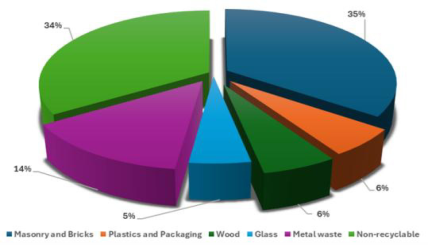
Nearly 35 percent of the waste generated by construction materials in most building projects ends up in landfills untreated. The daily percentage rise in the production of waste construction materials worldwide is depicted in Figure 1. Waste generation is increasing globally, mostly as a result of urbanization and population growth, and it is projected to double by 2050. Since untreated waste debris contributes to pollution and resource depletion, this increase in waste generation presents serious environmental issues. Reducing the environmental impact of building activities necessitates the use of sustainable techniques, such as recycling and material reuse (Bojan et al., 2017; Menegaki & Damigos, 2018; Olubambi et al., 2025a). In modern construction projects, sustainable waste management is an appropriate strategy that can be applied in almost any scenario. The objective is to divert waste from landfills to the greatest extent as is practical under usual circumstances. As a result, using Building Information Modeling (BIM) has been considered one of the most effective ways to minimize or eliminate waste on construction sites (Olubambi et al., 2025c).
Figure 1: Typical construction waste materials production in percentage (Olubambi et al., 2025).
Integration of BIM-Based Model in Waste Management Toward Net-Zero Construction 73 INTEGRATION OF BIM-BASED TOOLS IN WASTE MANAGEMENT SYSTEMS
In today’s construction industry, interconnection, cooperation, and complexity are the most important factors. A BIM is an advanced method of managing social and technological resources that makes sense of these fundamental concepts. The primary aim of this management system is to collect the necessary data at the appropriate moment and location (Balwin et al., 2008; Cheng & Ma, 2013; Liu et al., 2015). Furthermore, BIM is a parametric, three-dimensional reference model system that was developed using file formats that enable data exchange among all disciplines involved in the lifespan of the building project (Arayici et al., 2011; Won et al., 2016; Burcu et al., 2016). But BIM is the entire collection of processes needed to create and manage all the data that characterizes a building’s lifecycle, not just software, technology, and/or tools. The term “master builder,” which previously implied that architects were solely responsible for the structure, has changed to “master of digital architecture” for BIM in today’s design and construction industry (Svalestuen et al., 2017; Olubambi et al., 2025). Several experts in the construction industry, including surveyors, engineers, and architects, go one step further and believe that using BIM technology is essential to reducing waste during building activities, according to Eze et al., (2024).
The goal of the conversation is to draw attention to the possible advantages of BIM, like on-site cooperation and collision detection. However, BIM has been promoted as a means for minimizing waste produced during construction and demolition operations due to these possible advantages (Cheng et al., 2015; Zhang et al., 2024). This is because BIM enables a virtual, computational environment to explore multiple design options and construction plans to reduce waste before it is produced on-site. Furthermore, BIM has been proposed as a workable solution to improve the quality and accuracy of design and construction while lowering design errors, rework, and unanticipated adjustments. It is a viable technique to eliminate the primary sources of construction and/or demolition waste that arise at various stages of building and during design (Azhar et al., 2011; Lu et al., 2017; Atfab et al., 2024). The design information modeling to analyze solutions to reduce construction waste in high-rise residential structures, including prefabrication and precast. They found that BIM is a good platform for advancing the analysis of construction waste and the implications of design decisions (Akinade et al., 2017; Nihmehr et al., 2021).
Cheng et al. (2015) indicate that people have successfully integrated BIM to enhance procurement, site planning, and material handling in construction management, as well as to prevent defective design, residual raw materials, and unforeseen changes in building design. According to Mohammed et al. (2022), people in the construction industry are using BIM, a relatively new technology, to cut waste production throughout the design and pre- construction phase. Although it has been demonstrated that using BIM technology to minimize construction waste is practicable, these efforts were limited to the design phase and did not address specific techniques for using BIM to minimize waste. However, the study did not offer any particular
methods for managing or minimizing construction waste. However, the UK Construction 2025 Strategy states that BIM can reduce construction waste during both the design and construction phases (Olubambi et al., 2025). To date, no initiatives have been undertaken to develop BIM-based design decision-making tools and methods for construction waste management. Furthermore, insufficient effort has been devoted to developing and assessing techniques and instruments that leverage BIM to support waste management decision-making throughout project design and construction. Also, no studies have attempted to link minimization of construction waste materials at source with the application of BIM, but there is growing evidence that this is possible (Meng et al., 2022; Mrema et al., 2022; Karanafti et al., 2024).
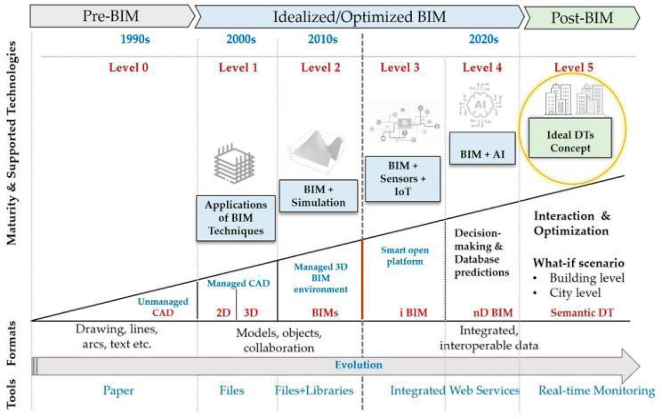
Figure 2: BIM-based model generational progression from pre-post BIM with its applications (Mrema et al., 2022).
Azhar (2011) suggests that applications of BIM, such as quantity takeoff, phase planning, site utilization planning, and design validation, were suggested to reduce construction waste. By avoiding design errors, rework, and unanticipated changes, BIM can also help us minimize waste by enhancing the quality and accuracy of design and construction. Furthermore, BIM could prevent defective design, raw material residues, and unforeseen changes in building design while improving procurement, site planning, and material handling in construction management (Hai et al., 2021; Kang et al., 2022; Haither & Gopakumar, 2025). Furthermore, conflict, interference, and collision detection; construction sequencing and planning; minimizing rework; coordinating design and site layout; error and omission detection (clash detection); and accurate quantity take-off are among the fundamental BIM solutions for waste reduction listed by Burcu et al. (2017). Net-zero waste management in the construction sector can help develop a more environmentally friendly built environment. The net-zero construction hypothesis has surfaced in a recent study. The net zero-waste concept is a
Integration of BIM-Based Model in Waste Management Toward Net-Zero Construction 75 novel approach to waste management, especially because waste is viewed as a resource, its use contributing to the most effective and ideal utilization of natural resources and to a decrease in environmental impact, thereby enabling net-zero construction (Gupta et al., 2022; Olubambi et al., 2025). Ian and Tony (2010) define net-zero waste as a complete system approach that focuses on eliminating waste at the source and throughout each phase of the supply chain. Net-zero waste is a holistic view of the sustainable minimization and management of waste and resources in construction projects (Chileshe et al., 2012; Zaman & Lehman, 2013; Zaman, 2015; Elgizamy et al., 2016). As a result, the construction industry needs to develop a BIM-based model that will promote net-zero construction by minimizing waste through sustainable construction materials optimization and by developing the sustainable waste sector. The aim of this study is to develop a sustainable BIM-based model that will generate net-zero waste at each phase of the construction lifecycle. It also emphasizes the benefits of integrating this model in any construction project (Pitetzsch et al., 2017; Soharu et al., 2022). The literature analyzed in this study provides a more comprehensive grasp of the benefits of applying BIM technology in construction. It suggests that BIM applications at each phase of the construction lifecycle could be used to design a model that enables net-zero waste construction. One method is to connect BIM with real-time data collecting systems to monitor resource utilization and waste generation during the construction process. Another approach is to employ BIM-driven simulations to improve material selection and logistics, decreasing excess and non-recyclable waste. Furthermore, promoting communication among all stakeholders via a centralized BIM platform can guarantee that sustainability goals are linked and tracked from project inception to completion.
RESEARCH METHODOLOGY The construction industry needs to develop a BIM-based model that can impact net-zero waste construction practices. The goal of this project is to create a sustainable BIM-based model that demonstrates the benefits of implementing it in any building project and offers the potential for net-zero waste construction. The literature analyzed for this study provides a more comprehensive grasp of the benefits of using BIM technology in building. This demonstrates how BIM applications may be used at every stage of the construction lifecycle to create a model that is appropriate and functional for enabling net-zero construction. Articles and publications addressing all areas where primary research studies demonstrate waste material generation in construction projects and the value of BIM technological application in reducing and/or eliminating waste across the phases of construction projects were consulted for this study. Although the BIM technology implemented during construction has been evaluated and authorized by prior studies, this research focuses on the design of a BIM-based model. The application of BIM technology capable of minimizing and/or eliminating waste is demonstrated through both primary and secondary BIM applications throughout the construction lifecycle.
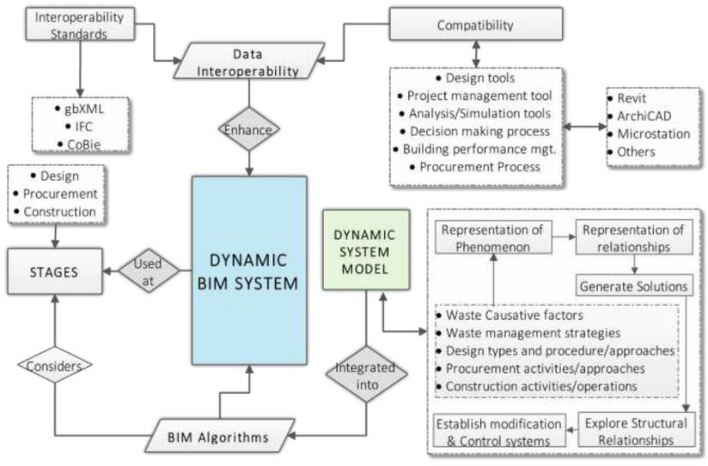
This step-by-step method for BIM application is considered an ideal tool that can be optimized to reduce or eliminate waste. Several studies have shown that life cycle assessment (LCA) is a practical method that considers other areas and can even test alternative solutions. Through this approach, an integrated BIM platform for net-zero construction project delivery, previously developed by Ajayi et al., (2014), was adopted. The primary and secondary BIM applications across the entire construction lifecycle highlight how BIM technology can minimize and/or eliminate waste at every step of the construction process. This methodical approach to BIM implementation is the most efficient approach to reduce or eliminate waste. Lifecycle assessment (LCA) is a useful approach that considers additional factors when evaluating or testing various solutions, as numerous studies have shown. Figure 3 depicts a lifecycle material flow chart that illustrates the phases required to apply a dynamic BIM model.
Figure 3: Dynamic BIM-based model using lifecycle material flow mapping: Adapted (Olubambi et al., 2025).
RESULTS AND DISCUSSION
The potential of BIM technology must be maximized in construction projects; therefore, each phase of the construction lifecycle where it can be used must be selected to meet the requirements of contractors and designers. The capacity of BIM technology to be used for modeling to support lean construction and minimize waste during the project is another significant benefit. Designers are expected to maximize the value of BIM applications at each phase of the construction project to minimize waste. The techniques for using a BIM-based model to achieve net-zero construction are based on a sustainable construction waste minimization framework established through
Integration of BIM-Based Model in Waste Management Toward Net-Zero Construction 77 a lifecycle mapping (see Fig. 3). Despite being relatively new, BIM has been shown to be quite useful for builders, particularly during the planning phase. BIM provides the conceptual framework for this phase from start to finish of the project. Each functional and physical component is generated, assessed, shared, and modified digitally long before anything is built. Therefore, the builder can address and alter course early on if the architectural design differs from the structural engineering designs. Any inconsistencies with the construction component can be resolved prior to starting work and submitting any material orders. Creating a virtual model in the planning phase, before construction begins, enables minimizing unnecessary errors, improving efficiency, and making well-informed judgments.
BIM can be used to create an efficient schedule for material ordering, manufacturing, and the delivery of all building components, reducing waste during the planning phase of construction. Precise program scheduling reduces the risk of damage and enables just-in-time delivery of equipment and supplies. The use of BIM for the automated manufacture of equipment and components enables more effective materials-handling recovery. Site analysis, cost estimation, and present condition modeling are essential BIM components that enable waste minimization. Furthermore, problems are fixed early on in the design phase. As a result, the plans will present fewer challenges. Any design changes entered into the building model are automatically updated. Consequently, there won’t be as much revision due to possible errors or omissions in the sketch. The concept design must be transformed into a coordinated, dimensionally precise design that explains every important component of the building and how it functions. This will give enough details to start submitting applications for statutory approvals. However, before the design is fully developed in the following phase, certain technical aspects must be addressed, such as LEED evaluation, code validation, and essential analysis.
Furthermore, a clear process of activities is established by linking the 3D features in the design model to the construction plan, enabling visualization of how the building and the site will appear at any given time. This capability will reduce unnecessary relocation, additional handling, and material loss. In essence, the procurement process includes project sequencing, takeoffs, integrating energy analysis with 3D geometry, asset tracking, etc. Working in a collaborative environment boosts overall productivity by avoiding time and resource waste when working separately. To further support quantity extraction, budgeting, and costing during the construction process, we can incorporate a large amount of building data into the model. During the entire construction process, BIM can be extremely beneficial. For instance, virtual construction Modelling is extremely cost-effective when utilized during the construction phase. Applying BIM throughout the construction phase, including scheduling, 4D and 5D modeling, installation drawings, etc., is preferable for intricate designs and detailing. However, maintenance scheduling, building system analysis, asset management, tracking and/or space management, and disaster planning comprise the application of BIM during the operating phase.
CONCLUSION
Sustainable construction techniques must be used throughout the construction process to achieve net-zero. This includes using energy-efficient materials, cutting waste, and harnessing renewable energy sources. Green building certifications and the use of innovative technologies can also lessen the environmental impact of construction projects. However, the waste of construction materials can be reduced by including such methods in a BIM- based model. It is obvious from this study that the use of BIM-based models to reduce construction waste is here to stay and will only increase in the years to come. Therefore, any construction industry can successfully integrate a BIM-based model by analyzing its requirements across its lifecycle phases. However, it is very beneficial to integrate the model and the data into each phase. The same methodology developed during the conceptual design stage can be improved at each stage and likewise used to manage construction waste. It is possible to transfer ownership of BIM models to a different person at each stage. However, successfully implementing BIM across different phases can present challenges such as data interoperability issues and the need for extensive training. Each phase might require different expertise, and coordinating various stakeholders to ensure seamless information transfer can be complex. Furthermore, resistance to change from traditional methods and initial costs can hinder widespread adoption.
In conclusion, further studies could expand the BIM-based model to address the growing complexity of waste management systems across countries.
This approach would enable researchers to identify innovative strategies for reducing waste and optimizing resources. By integrating advanced data analytics and real-world applications, these studies could enhance the efficiency and sustainability of construction practices globally. However, there are unique challenges in implementing BIM-based models. These include the high initial costs of implementing new technologies, the requirement for professionals to handle and analyze data, and possible opposition to departing from conventional construction methods. Furthermore, maintaining data interoperability across systems and stakeholders remains a significant challenge. Also, as the construction industry continues to adopt these models, future projects could see significant improvements in sustainability and resource efficiency. This shift towards BIM-based approaches could also drive innovations in material reuse and waste reduction techniques. Ultimately, embracing these technologies may pave the way for more environmentally-friendly construction practices and industry-wide transformations.
ACKNOWLEDGMENT
This paper is based on research wholly supported by the National Research Foundation of South Africa (Grant Number UID: 130423).
REFERENCES
Aboginije, A.J, Aigbavboa C.O, Thwala, W., Samuel, S. (2020). Determining the impact of construction and demolition waste reduction practices on green building projects in Gauteng province, South Africa. In Proceedings of the International Conference of Industrial Engineering and Operation Management, Dubai, UAE, 10-12 March; 1027–1038 (2020). Aboginije, A.J, Aigbavboa, C.O, & Thwala, W. (2021). A holistic assessment of
construction and demolition waste management in the Nigerian construction projects. Sustainability, 13(11), 6241. Abdulaziz, I.A, Mohanad, Y.A, Isaac, G, Jasir, M, Sattam F.A. (2022). Producing sustainable concrete with plastic waste: A review. Environmental Challenges,vol 9, 1-12 100626. Aftab, U., Jaleel, F., Aslam, M., Haroon, M., Mansoor, R. (2024) Building Information
Modeling (BIM) Application in Construction Waste Quantification—A Review. Engineering Proceedings. 75(1):8. Ajayi, S.O., Bilal, M., Akinade, O.O and Owolabi, H.A. (2014). Ineffectiveness of construction waste management strategies: Knowledge gap analysis, Proceedings of the First International Conference of the CIB Middle East and North Africa Research Network (CIB-MENA 2014), Abudhabi, UAE, December 14–16, 261–280. Akinade, O.O., Oyedele, L.O., Munir, K., Bilal, M. et al. (2016). Evaluation criteria
for construction waste management tools: Towards a holistic BIM framework. International Journal of Sustainable Building Technology and Urban Development. 2016, 7(1), 1–21. Arayici, Y., Coates, P., Koskela, L., Kagioglou, M., Usher, C and O’reilly, K. (2011).
Technology adoption in the BIM implementation for lean architectural practice. Automation in construction, 20(2), 189–195. Azhar S. (2011). Building information modeling (BIM): Trends, benefits, risks, and challenges for the AEC industry. Leadership and Management in Engineering 11(3): 241–252. Baldwin, A, Poon, C.S, Shen, L.Y, Austin, S.A and Wong, I. (2008). Modelling design
information to evaluate prefabricated and pre-cast design solutions for reducing construction waste in high-rise residential buildings. Automation in Construction 17(3): 333–341. Bojan R, Neven V, Branka I. (2017). Concept of sustainable waste management in the city of Zagreb: Towards the implementation of circular economy approach. Journal of the Air and Waste Management Association, pp. 241–259. Burcu S, Atacan A, Nilay C, Kofi A. (2017). Construction Waste Reduction Through
BIM-based Site Management Approach. International journal of engineering technologies. Vol. 3, No. 3, 135–142. Cheng, J.C and Ma, L.Y. (2013). A BIM-based system for demolition and renovation waste estimation and planning. Waste Management. 33(6): 1539–1551 (2013). Cheng, J.C., Won, J., Das, M. (2015). Construction and demolition waste management
using BIM technology. In: Proc. 23rd Ann. Conf. of the Int’l. Group for Lean Construction. Perth, Australia, July 29–31, 381–390. Chileshe, N., Zuo, J., Pullen, S., Zillante, G., Fapohunda, J. (2012). Construction Management and the State of Zero Waste. Designing for Zero Waste: Consumption, Technologies and the Built Environment, Earthscan. Available in: https://doi. org/10.4324/9780203146057
Danish, P., Mushtaq, J., Salem, I.B., Gilani, T. (2025). Bacteria-Induced Self- Healing Concrete: A Critical Review for the Construction Industries. In: Danish, P., Rao, K.S.N., Tantary, M.A., Ganesh, G.M., Santhi, A. (eds) Innovative Technologies for Smart and Sustainable Infrastructure. Springer, Cham. https:// doi.org/10.1007/978-3-031-92801-7_8 Elgizawy, S.M., El-Haggar, S.M and Nassar, K. (2016). Approaching sustainability
of construction and demolition waste using the zerowaste concept. Low Carbon Economy 7(1): 1–11. Eze, E.C., Aghimien, D.O., Aigbavboa, C.O., Sofolahan, O. (2024). Building information modelling adoption for construction waste reduction in the construction industry of a developing country. Eng Constr Archit Manage. Vol. 31 (6):2205–23. Gupta, S., Jha, K.N., Vyas, G. (2022). Proposing building information modeling-
based theoretical framework for construction and demolition waste management: Strategies and tools. Int J Constr Manage. Vol. 22 (12), 2345–2355. Hai, Y., Yang, L., Sepasgozar, S. (2021) BIM Applications in Waste and Demolition Management in Circular Economy Concept. Environmental Sciences Proceedings. 2021; 12(1):13. Haither Ali, H., Gopakumar, A. (2025). Advancing construction and demolition
waste management through technology: A framework for integration and sustainable solutions. Environ Sci Pollut Res. 1–18. Ian, D.W., and Tony, C. (2010). Waste Management Research Group, School of Civil Engineering and the Environment, University of Southampton. Kang, K., Besklubova, S., Dai, Y., Zhong, R.Y. (2022). Building demolition waste
management through smart BIM: A case study in Hong Kong. Waste Management, 143:69–83 (2022). Karanafti, A., Trubina, N., Giarma, C., Tsikaloudaki, K., Theodosiou, T. Integrating BIMs in Construction and Demolition Waste Management for Circularity Enhancement-A Review. In: Ungureanu, V., Bragança, L., Baniotopoulos, C., Abdalla, K.M, editors 4th International Conference Coordinating Engineering for Sustainability and Resilience & Midterm Conference of CircularB Implementation of Circular Economy in the Built Environment. CESARE 2024. Lecture Notes in Civil Engineering, 2024, vol 489. Springer, Cham. Liu, Z., Osmani, P., Demian, P., Baldwin, A. (2015). A BIM-aided construction waste
minimisation framework. Automation in Construction, Vol. 59, 1–23 (2015). Lu, C.W., Webster, K., Zhang, C., Chen, X. (2017). Computational building information modelling for construction waste management: Moving from rhetoric to reality. Renewable and Sustainable Energy Reviews, Vol. 68, pp. 587–595 (2017). Menegaki M, Damigos D. (2018). A review on current situation and challenges
of construction and demolition waste management. Current Opinion on Green Sustainable Chemistry. 13, 8–15. Meng Q, Zhang Y, Li Z. et al. (2022). A review of integrated applications of BIM and related technologies in whole building life cycle. Engineering, Construction and Architectural Management. Vol. 27, No. 8, 1647–1677. Mohammed, M., Shafiq, N., Al-Mekhlafi, A-BA, Al-Fakih, A., Zawawi, N.A,
Mohamed, AM, et al. (2022). Beneficial effects of 3D BIM for pre-empting waste during the planning and design stage of building and waste reduction strategies. Sustainability.14(6):3410. Mrema, S.A., Lau, H.H., Liew, S.C., Ekambaram, P., Alam, M., Lee, V.C. Building Information Modeling (BIM) for Construction and Demolition Waste (CDW) Management: Scientometric and State-of-the-Art Review. In: Choo, C.S., Wong, B.T., Sharkawi, K.H.B., Kong, D. (eds) Proceedings of ASEAN-Australian Engineering Congress (AAEC2022). AAEC 2022. Lecture Notes in Electrical Engineering, 2023, vol. 1072. Springer, Singapore.
Integration of BIM-Based Model in Waste Management Toward Net-Zero Construction 81 Mushtaq, J, Danish, P, Salem, I.B, Shahmir, N.G, Gilani, T.A, Wani, T, & Gull, I.
(2025). Analyzing the influence of eggshell powder (ESP) as partial replacement with cement in concrete. Environmental Research and Technology, 8(3), 593–602. Nagapan, I.S, Abul-Rahman., Asmi A. (2012). Factors contributing to physical and non-physical waste. Journal of Advances in Applied Sciences, vol. 1, 1–10. Nikmehr, B., Hosseini, M.R., Wang. J., Chileshe, N and Rameezdeen, R. (2021).
BIM-based tools for managing construction and demolition waste (CDW): A scoping review. Sustainability 13(15): 8427 (2021). Olubambi A, Akinradewo O, Aigbavboa, C. et al. (2025). Towards the application of a dynamic BIM-based waste management system in enabling net zero cities-a review. Discov Civ Eng 2, 193. Olubambi A, Akinradewo O, Aigbavboa C, Ikotun B. (2025). Quantitative
Evaluation of Sustainable Construction and Demolition Waste Management System Performance in South Africa. Infrastructures. 2025; 10(6):150. Olubambi A, Aigbavboa C, Ikotun B. (2025). Conceptualising a dynamic BIMbased waste management system in enabling net-zero cities”. Proceedings of the Institution of Civil Engineers - Waste and Resource Management, Vol. 178 ( 4) 237–249. Pietzsch N, Ribeiro, J.L and De Medeiros, J.F. (2017). Benefits, challenges and
critical factors of success for zero waste: A systematic literature review. Waste Management (New York, N.Y.) 67: 324–353 (2017). Purnell, P. (2019). On a voyage of recovery: A review of the UK’s resource recovery from waste infrastructure. Sustainable and Resilient Infrastructure. 4 (1) 1–20. Rajendran, P and Gomez, C.P. (2012). Implementing BIM for waste minimization in
the construction industry: A literature review, The 2nd International Conference on Management, Malaysia, 557–570. 20. Soharu, A., Naveen, B.P and Sil, A. (2022). An approach towards zero-waste building construction. In: Advances in Construction Materials and Sustainable Environment. Lecture Notes in Civil Engineering. (Gupta AK, Shukla SK and Azamathulla H (Eds)) vol 196. Springer, Singapore. Svalestuen, F, Knotten V, Lædre O, Drevland F, Lohne J. (2017). Using building
information model (BIM) devices to improve information flow and collaboration on construction sites. Journal of Information Technology in Construction (ITcon), 22(11), 204-219. Wilson, D.C, Velis, C.A, Rodic, L. (2013). Integrated sustainable waste management in developing countries. In: Proceedings of the Ice – Waste and Resource Management, 166, 52–68. Won, J, Cheng, C.P., Lee, G. (2016). Quantification of construction waste prevented
by Bim-based design validation: Case studies in South Korea, Waste Management, Vol. 49, 170–180. Zaman, U and Lehmann, S. (2013). The zero-waste index: A performance measurement tool for waste management systems in a ‘zero waste city’. Journal of Cleaner Production 50: 123–132. Zaman, A.U. (2015). A comprehensive review of the development of zero waste
management: Lesson learned and guidelines. Journal of Cleaner Production 91: 12–25 (2015). Zhang, S., Tang, Y., Zou, Y., et al. (2024). Optimization of architectural design and construction with integrated BIM and PLM methodologies. Sci Rep. 2024;14:26153.
LISTED IN THE AHFE DIGITAL BOOKSTORE CATALOGUE
Explore the complete digital volume
Sustainable Built Environment
Read this individual research paper free through the original publisher, or explore the full digital proceedings book.
ISBN 979-8-950676-01-7
Explore this ISBN in the AHFE Bookstore ↗Listed in the July 2026 bookstore catalogue; search by ISBN to confirm current availability · Digital book purchase optional