Liezl Le Roux, Hano Jacobs, Lara du Plessis (2026). Human-Centred Carbon Decision-Making in Early Design: A Systems Review of Lifecycle Carbon Leverage. In: Sustainable Built Environment. AHFE Open Access, vol. 225, pp. 118–129. https://doi.org/10.54941/ahfe1007904
The built environment is central to global climate mitigation, with lifecycle carbon emissions increasingly shaped by early-stage design decisions. As operational standards improve, embodied carbon and whole-life performance have emerged as critical concerns. Although substantial research documents carbon reduction strategies across materials, structural systems, passive design, building services, and cost evaluation frameworks, existing studies remain largely intervention-specific. This study therefore examines which early design decisions exert the greatest lifecycle carbon leverage within an integrated project system and aims to address this gap through a qualitative Systematic Literature Review (SLR) of 44 academic and industry publications examining early-stage lifecycle carbon reduction in commercial buildings mainly between 2015 and 2025. Studies were included if they evaluated feasibility- or conceptual-stage design decisions affecting embodied or operational carbon performance. Thematic synthesis was used to identify recurring intervention domains and reported carbon reduction magnitudes across material, structural, passive, services, and evaluation-based approaches. Findings indicate that structural configuration and material selection are consistently associated with significant embodied carbon variation (20–40% reduction through low-carbon substitution; up to 28–51% variation across structural systems). Passive design strategies demonstrate 25–50% operational energy reductions when embedded during conceptual design. In contrast, building services and renewable integration, while important, are frequently constrained by earlier structural and spatial decisions. Lifecycle cost–carbon frameworks improve trade-off visibility but function primarily as enabling mechanisms rather than direct carbon reducers. The evidence suggests that lifecycle carbon performance is largely determined during feasibility and conceptual design, where early decisions establish trajectories that are difficult to reverse. Decarbonisation therefore depends on embedding carbon alongside cost and performance criteria within human-centred early design decision environments. Future research should empirically examine how interdisciplinary teams integrate carbon metrics during concept-stage evaluation and develop structured methodologies for comparing early-stage intervention leverage in live project contexts.
The built environment is crucial to global climate mitigation. Operations and embedded carbon emissions from buildings and construction account for 39% of global energy-related carbon emissions (UNEP, 2020). Historically, Received March 4, 2026; Revised April 3, 2026; Accepted April 17, 2026; Available online July 20, 2026
Human-Centred Carbon Decision-Making in Early Design 119 regulatory frameworks have prioritized operational energy efficiency, but as operational standards improve, embodied carbon becomes a larger percentage of lifecycle emissions (Habert et al., 2020; De Wolf, 2017). Carbon performance and structural elements affecting lifecycle emissions have been prioritized during this shift. A significant amount of research indicates that choices taken during feasibility and conceptual design have a disproportionate impact on the long-term performance of buildings (Pomponi and Moncaster, 2016; Bacheva and Raposo Grau, 2025). The selection of structural systems, specification of materials, and configuration of envelopes create embodied carbon baselines that are difficult to mitigate later in the project lifecycle, according to comparative lifecycle evaluations. Passive design optimization, including orientation, façade geometry, glazing, and insulation, reduces operating energy consumption by 25–50% when integrated early in the design phase (Ascione et al., 2017; Garg and Singh, 2025). Under ideal conditions, renewable integration research suggests net-zero operational performance (Wang, 2025; Zhang, 2025). Despite this technical data, the research is mostly intervention-specific. In an integrated design framework, structural, passive, services, and cost– carbon evaluations are generally performed separately, making it difficult to comprehend their relative influence (De Wolf et al., 2017; Bacheva and Raposo Grau, 2025). Many papers advocate lifecycle thinking, but few compare early design domains or examine how structural configuration, material selection, passive performance, and economic evaluation affect decision-making. Thus, practitioners and policymakers are unsure which early design decisions should be emphasized for optimal carbon outcomes. This gap requires basic research: Which initial design decisions most impact a building’s carbon footprint? This study synthesizes academic and industrial literature on lifecycle carbon reduction in commercial buildings to answer this question. Because modelling approaches, lifetime parameters, and geographic locations vary, interpretive synthesis is used instead of meta-analysis (De Wolf et al., 2017; Bacheva and Raposo Grau, 2025). The study organizes fragmented material into early-stage action domains to promote a systems-oriented decarbonisation understanding. Early design is both technical and crucial to a comprehensive decision framework that affects long-term carbon results.
EARLY-STAGE LIFECYCLE CARBON DECISION DOMAINS In reaction to increasing embodied carbon awareness and stricter climate targets, research on building lifecycle carbon reduction has grown significantly (UNEP, 2020; Habert et al., 2020). Five early-stage intervention domains namely material selection, structural system configuration, passive design strategies, building services and renewable integration, and lifecycle cost-carbon integration mechanisms, are the focus of the literature. Although each domain shows quantifiable potential for carbon reduction, evidence is still dispersed, making it difficult to prioritize early design leverage points. A comparative synthesis of early-stage decision domains is motivated by this fragmentation.
Embodied Carbon Drivers: Material Selection and Structural Configuration Embodied carbon is driven by material and structural design. Embodied emissions account for 40–60% of commercial building lifecycle carbon (Habert et al., 2020; Pomponi and Moncaster, 2016). Embodied carbon profiles are dominated by structural elements such steel and reinforced concrete (De Wolf et al., 2017; Hart, D’Amico, and Pomponi, 2021). Comparative lifespan studies show that low-carbon substitutions like cementitious materials or engineered lumber can reduce embodied emissions (Kumar et al., 2024; Risha, 2025). Structural configuration elements including building height, span length, and grid spacing affect global warming potential and material requirements in addition to material choices. System boundaries and carbon accounting methodologies vary, making cross-study comparison difficult (De Wolf et al., 2017; Bacheva and Raposo Grau, 2025). Although structural and material decisions are high- impact, their incorporation in integrated design systems remains underutilised.
Operational Carbon Drivers: Passive Design Strategies The discourse on operational carbon is primarily focused on passive design methods. Empirical research indicates that incorporating orientation, façade geometry, glazing selection, and insulation optimization during conceptual design can diminish operational energy demand by 25–50% (Ascione et al., 2017; Garg and Singh, 2025; Albatayneh et al., 2018). Passive demand reduction directly influences the sizing of downstream mechanical systems, as HVAC and lighting systems constitute the predominant portion of operating energy demand in commercial buildings (Hafez et al., 2023). Optimized envelope performance is corroborated by modelling and regulatory techniques, demonstrating measurable reductions in operating emissions (Boshoff and Mey, 2020). Nonetheless, the interaction effects among envelope selections, embedded impacts, and structural systems remain inadequately explored, and passive design is frequently perceived as an energy-efficiency strategy rather than a lifecycle carbon intervention (Bacheva and Raposo Grau, 2025).
Building Services and Renewable Integration Although converging, research on building services and renewable integration remains fragmented. LED lighting, high-performance HVAC systems, and enhancements in efficiency demonstrate measurable operational savings (Hafez et al., 2023). Research on renewable integration indicates that, under optimal conditions, photovoltaic systems and integrated efficiency techniques can attain net-zero operational performance (Wang, 2025; Zhang, 2025). Contextual unpredictability significantly influences renewable performance (Ghiasi et al., 2025), while control systems serve as facilitating mechanisms for high-renewable grids, as indicated by recent research on energy flexibility (International Energy Agency EBC, 2025). Notwithstanding these advancements, research often assesses flexibility, efficiency, and renewable energy in isolation rather than as integrated early-stage service design options, so constraining comparative clarity about lifetime leverage.
Human-Centred Carbon Decision-Making in Early Design 121 Lifecycle Cost–Carbon Integration Mechanisms
Lifecycle cost-carbon integration systems aim to reconcile technical and economic evaluations. Life Cycle Carbon Costing (LCCC) quantifies carbon impacts for dual-value comparison, whereas Life Cycle Costing (LCC) broadens capital cost analysis to include operating and maintenance phases (Higham, Fortune and James, 2015; Knauer and Möslang, 2018). Trade- offs among cost, carbon emissions, and performance metrics are further organized using Multi-Criteria Decision Analysis (MCDA) (Zavadskas, Antuchevičienė, and Kapliński, 2015; 2016). Despite enhancing decision transparency, the adoption of these frameworks remains inconsistent due to institutional barriers, insufficient competence, and the predominance of capital costs (Kwofie, Aigbavboa, and Thwala, 2020; Bacheva and Raposo Grau, 2025). Cost and carbon studies are frequently conducted together rather than within singular evaluation systems.
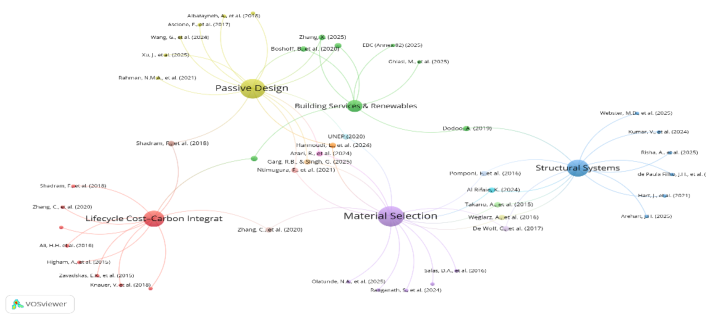
Methodological Fragmentation and the Systems Gap Intervention-specific analysis dominates evaluated domains. Materials, structural systems, passive methods, and building services are often studied without evaluating their lifecycle impact (Pomponi and Moncaster, 2016; De Wolf et al., 2017). Variations in lifetime bounds, modelling techniques, and geographic assumptions hinder cross-study comparability (Takano et al., 2015; Risha, 2025). VOSviewer co-occurrence analysis (Figure 1) confirms structural fragmentation. There are distinct thematic clusters with significant intra-domain links but limited cross-domain integration. Systems-thinking is used in this work to overcome this constraint. Buildings are socio-technical systems whose carbon performance depends on material quantities, operational demand, and evaluation criteria (Pomponi and Moncaster, 2016). Early design stages define these factors simultaneously, making them leverage points. Significant research describes carbon reduction measures within distinct domains, but little synthesis emphasizes their relative importance in an integrated lifecycle system. This unresolved comparison forms the basis for the present review.
Figure 1: Thematic clustering of early-stage lifecycle carbon research (Researchers’ own compilation).
METHODOLOGY
This study adopted a qualitative research design using a Systematic Literature Review (SLR). The objective was to synthesise and interpret existing evidence rather than test statistical relationships, positioning the study within an interpretivist paradigm (Thanh & Thanh, 2015). The guiding research question was: Which early design choices have the most significant impact on a building’s carbon footprint? An SLR was selected instead of a meta-analysis because existing studies vary substantially in lifecycle boundaries, carbon accounting methods, geographic contexts, and reporting metrics (Snyder, 2019). Many studies also report modelling-based or qualitative findings without standardised effect sizes. The SLR approach enabled structured synthesis of heterogeneous evidence and identification of recurring high-impact intervention domains.
Secondary data were collected from peer-reviewed academic publications and selected industry reports. The following databases were searched: Scopus, Web of Science, ScienceDirect, and Google Scholar. Industry and professional publications were consulted to ensure practical relevance, including RICS and green building guidance documents. Search strings included combinations of the following terms: “early design” AND “carbon footprint”, “embodied carbon” AND “commercial buildings”, “life cycle costing” AND “carbon integration”, “LCC” AND “LCA” AND “building design”, “low-carbon construction” AND “feasibility stage”. Searches were limited to English-language publications from mainly 2015–2025 to reflect contemporary carbon accounting standards and regulatory frameworks. The initial search returned 112 publications. Titles and abstracts were screened for thematic relevance to early-stage design and lifecycle carbon analysis. After removal of duplicates and clearly irrelevant studies, 44 articles remained for full-text review. Studies were included if they addressed commercial or non-residential buildings, analysed carbon performance at feasibility or conceptual design stages, incorporated lifecycle assessment (LCA), lifecycle costing (LCC), or integrated cost–carbon evaluation, and reported empirical, modelling, or structured analytical findings. Studies were excluded if they focused exclusively on operational energy without lifecycle consideration, addressed single material performance without early design context, were opinion-based without methodological transparency, and focused solely on residential or infrastructure sectors unrelated to commercial building typologies. The final analytical sample comprised 44 studies.
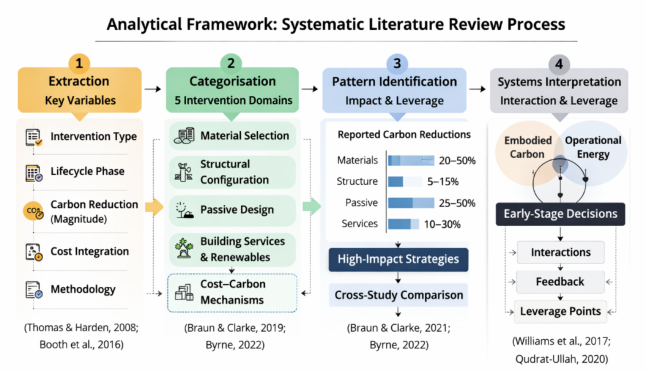
The study employed thematic analysis to synthesise findings across the selected literature. The analytical procedure followed established guidance for reflexive thematic analysis (Naeem, Ozuem and Ranfagni, 2023) and thematic synthesis in systematic reviews (Braun & Clarke, 2008), ensuring transparency, analytical consistency, and interpretive rigour across heterogeneous methodological approaches. Analysis followed four structured steps (see Figure 2 below).
Figure 2: Analytical framework: systematic literature review process (Researchers’ own compilation).
Key variables were extracted from each study, including intervention type, lifecycle phase addressed, reported carbon reduction magnitude (where available), cost integration approach, and methodological design. Extracted data were then grouped into five early-stage intervention domains: material selection, structural configuration, passive design, building services and renewable integration, and lifecycle cost–carbon mechanisms. Recurring high-impact strategies and reported carbon reduction ranges were identified across studies. Cross-study comparison enabled identification of consistent leverage domains and findings were interpreted using a systems-thinking perspective to examine interaction effects, feedback mechanisms, and early- stage leverage points across lifecycle stages.
Thematic analysis synthesized quantitative and qualitative findings across various approaches while retaining analytical consistency. Only publicly available secondary data and peer-reviewed articles were used in this investigation. No humans participated or provided primary data therefore no ethical approval was needed. All sources were properly credited for academic honesty and transparency. The SLR technique cannot measure carbon reduction percentages across contexts since it does not provide new empirical data. Variable carbon accounting assumptions and geographic factors preclude direct comparisons. Structured synthesis improves conceptual clarity and finds high-impact intervention domains.
FINDINGS The review synthesised 44 studies examining lifecycle carbon reduction in commercial buildings. Five recurring early-stage intervention domains were identified: (1) material selection, (2) structural configuration, (3) passive design strategies, (4) building services and renewable integration, and (5) lifecycle cost–carbon evaluation mechanisms. Across the sample, early design decisions were consistently associated with greater reported lifecycle carbon influence than later-stage corrective measures.
Reported embodied carbon reductions included 20–40% for low-carbon concrete substitution, higher ranges for engineered timber systems, and 5–15% reductions through structural material efficiency optimisation (Webster, Arehart, and Ruthwik, 2025; Hart, D’Amico and Pomponi, 2021; Dodoo, 2019). Structural configuration variables such as grid spacing and span length were repeatedly linked to significant material demand variation (Arehart, 2025; Al Rifaie, 2024). Passive design strategies demonstrated 25–50% operational energy reductions when embedded during conceptual design, frequently reducing mechanical system sizing requirements (Garg and Singh, 2025). High-efficiency HVAC systems typically reported 10–30% operational reductions, while renewable integration achieved context-dependent net-zero outcomes under favourable conditions (Rahman, Abdullah, and Lim, 2021). Lifecycle cost–carbon frameworks (LCC, LCCC, MCDA) were identified as enabling mechanisms improving trade-off visibility rather than direct carbon reducers (Kwofie, Aigbavboa, and Thwala, 2020; Knauer and Möslang, 2018, Higham, Fortune, and James, 2015.). Table 1 below summarises recurring early-stage intervention domains and reported impact ranges.
Table 1: Summary of recurring early design interventions and reported carbon impact (Researchers’ own compilation).
Table available in the original PDF paper.
Intervention Domain
LifeCycle Phase Affected
Reported Carbon Reduction Potential
Recurrence Across Studies High
Low-carbon material substitution
Embodied 20–40% (concrete), higher for timber Embodied 5–15% Moderate–High
Structural material efficiency
High
Passive design optimisation
Operational 25–50% energy reduction Moderate
High-efficiency HVAC systems
Operational 10–30% energy reduction Operational Context-dependent Moderate
Renewable energy integration
Increasing
LCC–LCCC integration
Both Enables dual-value evaluation
Three recurring empirical patterns emerged. Firstly, early-stage structural and passive decisions exert greater lifecycle influence than downstream technological optimisation. Secondly, embodied and operational domains interact, with passive demand reduction amplifying systemic carbon benefits. Thirdly, cost–carbon integration mechanisms remain inconsistently applied despite demonstrated decision-support value. Structural configuration, material substitution, and passive design were the most consistently high- impact early intervention domains across the reviewed literature. Furthermore, four recurring barriers were identified namely limited embodied carbon databases, weak interoperability between cost and environmental tools,
Human-Centred Carbon Decision-Making in Early Design 125 limited lifecycle carbon literacy, and procurement systems prioritising lowest capital cost. These constraints were reported across multiple geographic contexts (De Wolf et al., 2017; Kwofie, Aigbavboa and Thwala, 2020; Risha et al., 2025).
RESULTS AND DISCUSSION
This study addressed the question: Which early design choices have the most significant impact on a building’s carbon footprint? The literature shows that early structural configuration, material specification, and passive design methods affect lifetime (Pomponi and Moncaster, 2016; De Wolf et al., 2017). Structural systems can reduce 28–51% (Kumar et al., 2024; Risha, 2025), envelope optimisation 46–50% (Garg and Singh, 2025), and low-carbon concrete substitute 20–40% (Habert, 2020). Building services and renewable integration boost operational decarbonisation, however structural and passive design decisions and contextual restrictions limit their effectiveness (Wang, 2025; Zhang, 2025). Three high-impact domains recur across the reviewed studies: (1) structural configuration and material selection drive embodied outcomes (Hart, D’Amico and Pomponi, 2021; Kumar et al., 2024); (2) passive design generates significant operational reductions when embedded early; and (3) lifecycle cost–carbon frameworks improve trade-off visibility but are inconsistently applied. Bacheva and Raposo Grau (2025) attribute the implementation gap to fragmented decision systems rather than technical capability.
Pomponi and Moncaster (2016) found that feasibility and conceptual design concentrate carbon reduction potential. Structure and materials set baselines that limit downstream interventions (Hart, D’Amico and Pomponi, 2021). Projects risk carbon lock-in after setting cost-driven parameters (Higham, Fortune and James, 2015). Because demand reduction at source reduces mechanical sizing, operational emissions, and lifecycle cost exposure, passive methods display systemic leverage (Ascione et al., 2017; Hafez, 2023). Renewable integration improves operational performance but is context- and integration-sensitive (Wang, 2025; Ghiasi et al., 2025). LCC, LCCC, and MCDA enable carbon reduction, not diminish it. Considering carbon and cost measurements jointly can reveal trade-offs earlier in the design phase (Zavadskas et al., 2016). The data suggest that early design configuration, not downstream technical optimization, determines lifespan carbon performance. These findings support sustainability studies emphasizing early-stage leverage (Pomponi and Moncaster, 2016; De Wolf et al., 2017) and industry recommendations emphasizing feasibility-stage action for decarbonization (UNEP, 2020). Lifecycle thinking is popular, but early design domain comparison is constrained (Bacheva and Raposo Grau, 2025). Organizing fragmented findings into organized intervention themes helps this study prioritize early-stage leverage points.
Many methodological constraints limit interpretation. Lifecycle bounds, carbon variables, and modelling assumptions varied between studies, making a meta-analysis impossible. The review was limited to English- language 2015–2025 articles due to building type and geographic context
heterogeneity. In addition, many reviewed studies use modelling without post- occupancy validation (De Wolf et al., 2017; Wang, 2025), single-intervention scenarios without interaction effects analysis (Pomponi and Moncaster, 2016), or inconsistent lifecycle boundary definitions. More integrated and experimentally validated research is needed due to these constraints. The study has significant benefits despite these limitations. It coordinates fragmented research into early-stage intervention domains (Bacheva and Raposo Grau, 2025), integrates cost and carbon evaluation into a single analytical approach, and promotes a systems-oriented decarbonisation perspective. Incidental literature suggests that structural adaptability may extend building lifespan (de Paula Filho et al., 2023), passive design can generate financial co-benefits (Garg and Singh, 2025), and renewable integration may improve energy resilience. The findings suggests that decarbonization requires early design decision environment reconfiguration. Technical solutions work if integrated into lifecycle evaluation frameworks and institutional decision procedures (Higham, Fortune and James, 2015). Early-stage decision processes combine with structural configuration, energy demand, and evaluation criteria to determine carbon performance. Carbon measurements in feasibility-stage information flows change how options are compared, not just technical performance. By including carbon in cost and performance requirements, decarbonization becomes a systems-level design challenge rather than a technology one.
CONCLUSION AND RECOMMENDATIONS This study explored which early design choices have the most significant impact on a building’s carbon footprint. The review identified three high- leverage domains namely material selection and structural configuration determine embodied carbon baselines that are difficult to offset later, passive design strategies reduce operational energy demand at source and frequently generate cascading reductions in mechanical system requirements, and integrated lifecycle cost–carbon frameworks (LCC, LCCC, MCDA) enable early-stage trade-off visibility and strengthen carbon-informed decision- making. The findings confirm that lifecycle carbon performance is largely shaped during feasibility and conceptual design. Downstream technological optimisation cannot compensate for carbon-intensive structural and spatial decisions made early in the project lifecycle. Decarbonisation therefore requires embedding carbon and energy metrics within early design evaluation processes rather than treating them as compliance tools. For practice, lifecycle carbon assessment should be embedded at feasibility and concept stage alongside cost and performance criteria. Early structural and spatial options should be evaluated using integrated decision-support tools that make carbon trade-offs visible to interdisciplinary teams. For research, future studies should move beyond isolated technical modelling and empirically examine how carbon metrics are embedded within early concept design environments. In particular, studies should investigate how interdisciplinary teams interpret, prioritise, and negotiate carbon, cost, and performance trade-offs during feasibility-stage decision-making. Ultimately,
Human-Centred Carbon Decision-Making in Early Design 127 reducing building-related carbon emissions depends on restructuring early- stage decision systems. When carbon metrics inform structural choices from the outset, sustainability shifts from reactive mitigation to proactive performance optimisation.
AKNOWLEDGEMENT The author gratefully acknowledges the Faculty of Natural and Agricultural Sciences and Department of Quantity Surveying and Construction Management for providing financial support towards this research and conference participation.
REFERENCES
Albatayneh, A., Alterman, D., Page, A. and Moghtaderi, B. (2018) ‘The significance of building design for the climate’, Environmental and Climate Technologies, 22(1). https://doi.org/10.2478/rtuect-2018-0011 Ali, H.H. and Rashid, K.A. (2016) ‘Implementation of life cycle costing in enhancing
value for money of projects’, International Journal of Property Sciences, 6(1). https://doi.org/10.22452/ijps.vol6no1.3 Al Rifaie, K. (2024) Embodied carbon in commercial buildings: assessment and mitigation. Doctoral dissertation. UK Arehart, J.H. (2025) Prestandard for assessing the embodied carbon of structural
systems for buildings. American Society of Civil Engineers (ASCE). Ascione, F., Bianco, N., De Masi, R.F., Mauro, G.M. and Vanoli, G.P. (2017) ‘Design of the building envelope: A novel multi-objective approach for the optimization of energy performance and thermal comfort’, Sustainability, 9(12), https://doi. org/10.3390/su70810809. Azari, R., Kamel, E. and Memari, A.M. (2024) ‘Current developments and
future directions in energy-efficient buildings from the perspective of building construction materials and enclosure systems’, Buildings, 14(x). https://doi. org/10.3390/buildings14071921. Bacheva, T.S. and Raposo Grau, J.F. (2025) ‘Embodied impacts in buildings: A systematic review of life cycle gaps and sectoral integration strategies’, Buildings, 15(10). https://doi.org/10.3390/buildings15101661. Boshoff, B. and Mey, C. (2020) ‘The building emission reduction potential of South
African residential building efficiency tools – A review’, Acta Structilia, 27(1). https://doi.org/10.18820/24150487/as27i2.6. Braun, V. & Clarke, V., 2008. Using thematic analysis in psychology. Qualitative Research in Psychology, 3(2), pp.77–101. https://doi.org/10.1191/1478088706qp063oa de Paula Filho, J.H., D’Antimo, M., Charlier, M. and Vassart, O. (2024) ‘Life- cycle assessment of an office building: influence of the structural design on the embodied carbon emissions’, Modelling, 5(1), pp. 55–70. https://doi.org/10.3390/ modelling5010004 De Wolf, C., Pomponi, F., Moncaster, A. and Allwood, J. (2017) ‘Measuring
embodied carbon dioxide equivalent of buildings: A review and critique of current industry practice’, Energy and Buildings, 140. https://doi.org/10.1016/j. enbuild.2017.01.075. Dodoo, A. (2019) ‘Lifecycle impacts of structural frame materials for multi-storey building systems’, Journal of Sustainable Architecture and Civil Engineering, 24(1). https://doi.org/10.5755/j01.sace.24.1.23229.
Fasi, M.A. and Budaiwi, I.M. (2015) ‘Energy performance of windows in office buildings considering daylight integration and visual comfort in hot climates’, Energy and Buildings, 108. https://doi.org/10.1016/j.enbuild.2015.09.024. Garg, R.B. and Singh, G. (2025) ‘Decarbonizing residential buildings through
envelope optimization’, AIP Advances, 15(8). https://doi.org/10.1063/5.0283968. Ghiasi, M. et al. (2025) ‘Renewable energy integration into industrial and residential buildings: A study across urban, rural and coastal areas’, IET Renewable Power Generation, 19(1). https://doi.org/10.1049/rpg2.70108. Habert, G., Miller, S.A., John, V.M., Provis, J.L., Favier, A., Horvath, A. and Scrivener,
K.L. (2020) ‘Environmental impacts and decarbonization strategies in the cement and concrete industries’, Nature Reviews Earth & Environment, 1, pp. 559–573. Hafez, F.S. et al. (2023) ‘Energy efficiency in sustainable buildings: A systematic review’, Sustainable Cities and Society, 94. https://doi.org/10.1016/j.esr.2022.101013. Hannoudi, L., Saleeb, N. and Dafoulas, G. (2024) ‘The impact of glass properties on
the energy efficiency and embodied carbon of multi-angled façade systems’, Journal of Cleaner Production, 437 (1). https://doi.org/10.1016/j.jclepro.2024.140725. Hart, J., D’Amico, B. and Pomponi, F. (2021) ‘Whole-life embodied carbon in multistory buildings: Steel, concrete and timber structures’, Journal of Industrial Ecology, 25(2). https://doi.org/10.1016/j.jclepro.2024.140725. Higham, A., Fortune, C. and James, H. (2015) ‘Life cycle costing: Evaluating its use
in UK practice’, Structural Survey, 33(1). https://doi.org/10.1108/SS-06-2014-0026. International Energy Agency EBC (2025) Energy flexible buildings towards resilient low carbon energy systems (Annex 82): Summary report. IEA Energy in Buildings and Communities Programme. Knauer, V. and Möslang, K. (2018) ‘The adoption and benefits of life cycle costing’,
Journal of Accounting & Organizational Change, 14(2). https://doi.org/10.1108/ JAOC-04-2016-0027. Kumar, V., Lo Ricco, M., Bergman, R., Nepal, P. and Poudyal, N.C. (2024) ‘Environmental impact assessment of mass timber, structural steel, and reinforced concrete buildings based on the 2021 international building code provisions’, Building and Environment, 251 (1). https://doi.org/10.1016/j.buildenv.2024.111195. Kwofie, T.E., Aigbavboa, C.O. and Thwala, W.D. (2020) ‘Measures to improve the
adoption of life cycle assessment in the South African construction industry’, Journal of Engineering, Design and Technology, 18(2), https://doi.org/10.1108/ JEDT-05-2019-0141. Naeem, M., Ozuem, W. and Ranfagni, S. (2023) ‘A step-by-step process of thematic analysis to develop a conceptual model in qualitative research’, International Journal of Qualitative Methods, 22. https://doi.org/10.1177/16094069231205789 Ntimugura, F., Vinai, R., Harper, A.B. and Walker, P. (2021) ‘Environmental
performance of miscanthus-lime lightweight concrete using life cycle assessment: Application in external wall assemblies’, Sustainable Materials and Technologies, 28. https://doi.org/10.1016/j.susmat.2021.e00253. Olatunde, N.A., Anugwo, I.C. and Awodele, I.A. (2025) ‘Enhancing the use of sustainable construction materials in southwest Nigeria: Exploring the roles of quantity surveyors’, Frontiers in Built Environment, 11(1). https://doi. org/10.3389/fbuil.2025.1547125. Pomponi, F. and Moncaster, A. (2016) ‘Embodied carbon mitigation and reduction in
the built environment – What does the evidence say?’, Journal of Environmental Management, 181, pp. 687–700. Rahman, N.M.A., Abdullah, M.S.I. and Lim, C.H. (2021) ‘Evaluation of green elements and thermal comfort condition of Assyafaah Mosque, Singapore’, Journal of Applied Science and Process Engineering, 8(2), https://doi.org/10.33736/ jaspe.3434.2021.
Human-Centred Carbon Decision-Making in Early Design 129 Ranganath, S., McCord, S. and Sick, V. (2024) ‘Assessing the maturity of alternative
construction materials and their potential impact on embodied carbon for single- family homes in the American Midwest’, Frontiers in Built Environment, 10(1). https://doi.org/10.3389/fbuil.2024.1384191. Risha, A., Bezabeh, M.A., Rogers, C.A., Feng, H. and Salenikovich, A. (2025) ‘Life cycle carbon assessment of reinforced concrete, structural steel, and mass-timber buildings in Canada’, Canadian Journal of Civil Engineering, 52(12). https://doi. org/10.1139/cjce-2025-010. Salas, D.A., Ramirez, A.D., Rodríguez, C.R., Petroche, D.M., Boero, A.J. and Duque-
Rivera, J. (2016) ‘Environmental impacts, life cycle assessment and potential improvement measures for cement production: A literature review’, Journal of Cleaner Production, 113. https://doi.org/10.1016/j.jclepro.2015.11.078. Shadram, F., Mukkavaara, J., Schade, J., Sandberg, M. and Olofsson, T. (2018) ‘Tradeoff optimization of embodied versus operational carbon impact for insulation and window-to-wall ratio design choices’, in Sustainable Built Environment. Springer, http://doi.org/10.1007/978-3-030-04293-6_2. Takano, A., Hafner, A., Linkosalmi, L., Ott, S., Hughes, M. and Winter, S. (2015) ‘Life
cycle assessment of wood construction according to the normative standards’, European Journal of Wood and Wood Products, 73(3), pp. 299–312. UNEP (2020) 2020 global status report for buildings and construction. United Nations Environment Programme. Wang, G., Li, X., Chang, C. and Ju, H. (2024) ‘Multi-objective passive design and
climate effects for office buildings integrating phase change material (PCM)’, Journal of Energy Storage, 82(1). https://doi.org/10.1016/j.est.2024.110502. Wang, S. (2025) ‘Integrating renewable energy into building energy systems: A systematic review of strategies, barriers, and policy interfaces’, Discover Energy, xx(x), xxx. Webster, M.D., Arehart, J. and Ruthwik, C. (2025) Achieving net zero embodied
carbon in structural materials by 2050. Technical report. Xu, J., Yu, G. and Yang, L. (2025) ‘Climate-adaptive passive design strategies for near-zero-energy office buildings’, Sustainability, 17(14). https://doi.org/10.3390/ su17146535. Zavadskas, E.K., Antuchevičienė, J. and Kapliński, O. (2015) ‘Multi-criteria
decision making in civil engineering: Part I – A state-of-the-art survey’, Engineering Structures and Technologies, 7(3). https://doi.org/10.3846/20298 82X.2015.1143204 Zavadskas, E.K., Antuchevičienė, J. and Kapliński, O. (2016) ‘Multi-criteria decision making in civil engineering: Part II – Applications’, Engineering Structures and Technologies, 8(1). https://doi.org/10.3846/2029882X.2016.1139664. Zhang, C., Hu, M., Laclau, B., Garnesson, T. and Yang, X. (2020) ‘Energy-carbon-
investment payback analysis of prefabricated envelope-cladding system’, Conference paper. http://doi.org/10.1016/j.rser.2021.111077. Zhang, X. (2025) ‘Renewable energy integration and energy efficiency enhancement for a net-zero-carbon commercial building’, Buildings, 15(3). https://doi. org/10.3390/buildings15030414.
LISTED IN THE AHFE DIGITAL BOOKSTORE CATALOGUE
Explore the complete digital volume
Sustainable Built Environment
Read this individual research paper free through the original publisher, or explore the full digital proceedings book.
ISBN 979-8-950676-01-7
Explore this ISBN in the AHFE Bookstore ↗Listed in the July 2026 bookstore catalogue; search by ISBN to confirm current availability · Digital book purchase optional