Tascha Bremer, Liezl Le Roux (2026). From Concept to Construction: A Framework for Smart Building Material Innovation in South Africa. In: Intelligent Human Systems Integration (IHSI 2026): Disruptive and Innovative Technologies. AHFE Open Access, vol. 200, pp. 512–524. https://doi.org/10.54941/ahfe1007110
The construction industry is increasingly turning to smart materials as a response to the global demand for energy-efficient, sustainable, and cost-effective infrastructure. In South Africa, recent amendments to SANS 10400-XA have intensified the need for compliant thermal solutions in residential and commercial buildings. This paper follows a qualitative case-study approach, using the development of CemBrick’s new thermal brick, designed to replace traditional cavity wall construction while exceeding regulatory thermal performance benchmarks, as the central example. It incorporates comparative cost analysis, regional construction practices, and regulatory mapping to inform the development of a framework for future smart material applications in South Africa. The case study highlights that the thermal brick offers significant advantages over traditional cavity wall construction, including improved thermal performance, reduced project timelines, simplified labour requirements, and cost savings. Furthermore, the innovation journey exposed systemic gaps in material approval, industry adoption, and labour readiness. The findings are based on a single case study situated within a specific geographic and regulatory context (Free State, South Africa). Broader applicability of the framework may require further validation across material types, regions, and regulatory bodies. This innovation drive however extended beyond material design, involving testing protocols, market adoption hurdles, and alignment with national regulatory bodies. Building on this practical insight, the paper proposes a generalisable framework for smart material innovation in the South African built environment. The framework maps out key stages including problem identification, research and development, regulatory engagement, pilot implementation, and skills development. The aim is to guide future innovators and manufacturers, consultants, and researchers through the systemic pathways required to bring smart materials from concept to mainstream application in a developing country context. This paper contributes in bridging the gap between material science, policy, and practice, offering a blueprint for innovation ecosystems that support smart, sustainable, and scalable construction solutions in South Africa and similar markets. This paper further presents one of the first documented smart masonry case studies from South Africa, and introduces a structured innovation framework tailored to the local built environment. It bridges material science, policy, and construction practice, offering both scholarly and industry value.
Innovation is critical to ensure sustainability in the built environment. The global construction industry is experiencing a significant transformation driven by the increasing adoption of smart materials, which offer enhanced performance characteristics and sustainability benefits (Skibniewski, 2025., Iluyomade & Okwandu, 2024). These materials are integral to advancing energy efficiency, durability, and overall building quality (Patil & Minde, 2022). Within this global shift, South Africa’s construction sector is under going its own evolution, influenced by recent regulatory changes such as the introduction of SANS 10400-XA (Edition 2), which mandates passive design building practices (Van der Bank & Van der Bank, 2014). Despite these reg ulatory drivers, the adoption of smart materials in South Africa faces unique challenges related to market readiness, technical constraints, and regulatory pathway (Oguntona et al., 2023, De Villiers et al., 2018, Jansen et al., 2017). The transition from concept to construction in South Africa remains com plex and insufficiently documented. Material innovation is often hindered by a lack of integrated regulatory pathways, inconsistent interpretation of building standards, and limited knowledge transfer between manufactur ers, regulators, and professionals in the field (Eze, Sofolahan & Omoboye, 2023). This paper examines the CemBrick thermal brick innovation as a case study to explore these challenges and the broader implications for smart material adoption within the South African construction industry. The study synthesises innovation processes, regulatory factors, performance data and labour considerations to propose a roadmap for manufacturers. The paper asks how the CemBrick Thermal Brick case can informs adoption in South Africa and proposes a generalisable model spanning design, approval, and implementation.
LITERATURE REVIEW
Smart Materials in the Build Environment Smart materials are increasingly recognised as a pivotal enabler of the tran sition toward more adaptive and responsive buildings (Skibniewsk, 2024, Rajendra et al., 2023, Brahme and Vyas, 2021). In the construction con text, smart materials often serve as a response to stricter energy and thermal performance regulations. In South Africa, the revision of SANS 10400 XA (Edition 2) demands the need for building envelope systems that meet spec ified U-values and overall heat transfer performance (Van der Bank & Van der Bank, 2014)
Innovation Pathways and Material Adoption in Construction Bringing a new material to market in the construction industry involves not only technical development but also regulatory approval, market acceptance, labour adaptation, and supply chain alignment. In South Africa, research shows the construction industry lags in adoption of innovative technologies
514 Bremer and Le Roux due to barriers such as cost, lack of knowledge, labour skills, organisational resistance and limited government support for innovation (Skibniewski, 2024, Patil & Minde, 2022, Brahme and Vyas, 2021). Globally, literature on innovation in construction materials emphasises the need for frameworks that integrate R&D, testing, standardisation, manufacturing scalability, and regulation (Lin, et al., 2024, Oguntona et al., 2023, Yang, 2023, Oke et al., 2018). However, much of this literature is not specific to the South African built environment, where factors such as labour skill constraints and regional supply chains require particular attention. Frameworks for material inno vation often originate in developed market contexts; there is a shortage of South African specific smart material innovation processes that incorporate regulatory compliance (e.g., SANS), skills/training, and local supply chain realities. This study seeks to fill this gap by focusing on the smart cement unit (CemBrick’s Thermal Brick) developed for South African conditions and proposing a pragmatic innovation framework aligned with local regulation, manufacturing capacity, and industry readiness.
Regulatory Approval Process for Innovative Materials in South Africa In South Africa, innovative or non-standard construction materials that fall outside existing SANS codes must undergo a formal certification process through Agrément South Africa (ASA), a public entity tasked with evaluating whether such products are “fit-for-purpose” in the built environment. The process begins with an application submission by the product developer, fol lowed by ASA’s technical review to confirm the material’s eligibility for cer tification. If accepted, ASA issues an evaluation offer outlining performance assessment conditions and fees. Once contracted, the product is assessed using defined performance criteria, laboratory testing, and expert consulta tion. A Technical Committee reviews the findings and makes a recommenda tion to the ASA Board, which, if favourable, results in a gazetted certificate (Agrément, 2023). This certificate allows the product to be accepted by local municipalities, specifiers, and financial institutions, effectively enabling its market adoption. Certificate holders are subject to annual quality inspec tions and random audits to ensure continued compliance. This pathway, while rigorous, provides a legal mechanism for the institutional acceptance of smart materials, aligning with the National Building Regulations and Building Standards Act (NBRBSA). However, the process is often described as complex, under-resourced, and inconsistently understood, creating bar riers for innovators and slowing down the adoption of building materials (Ampofo Anti, 2017; Jansen et al., 2017).
As such, clearer guidance, inter-agency collaboration, and technical sup port are needed to strengthen the regulatory innovation in South Africa (Agrément SA, 2023; Mbambo et al., 2021; Jansen et al., 2017).
Table 1: Barriers to R&D investment in smart material innovation (researchers’ own compilation).
Table available in the original PDF paper.
Description References
Barrier Category Regulatory complexity Slow and fragmented approval processes discourage upfront investment in research.
Jansen et al., 2017; Oguntona et al., 202 Muigai et al., 2023
Economic constraints
High upfront costs and limited funding for innovation reduce willingness to invest.
Muigai et al., 2023
Immature Supply chains
Lack of established supply networks for new materials increases perceived risk.
Cultural resistance
Muigai et al., 2023; Rajendra et al., 2023
Contractors and professionals prefer traditional methos, limiting demand for innovation products.
Muigai et al., 2023
Skills gap Labour readiness and technical expertise are insufficient to support new technologies.
Muigai et al., 2023
Data deficiency Absence of local performance data undermines confidence in material durability and suitability.
METHODOLOGY
Research Design This study adopts a qualitative case study methodology, which is appropri ate for exploring complex real-world innovation processes within bounded contexts (Yin, 2018; Bowen, 2009). Case studies enable researchers to inves tigate the “how” and “why” of a phenomenon by integrating multiple data sources (Yin, 2018). In this instance, the case of CemBrick’s Thermal Brick innovation was selected due to its unique alignment with South Africa’s reg ulatory shift toward energy-efficient building practices (SANS 10400-XA Edition 2), and the observable stages it traversed from concept to market adoption. The aim was not to evaluate the performance of the thermal brick, but to understand the systemic steps, actors, and enablers/barriers involved in smart material development in a developing country context.
Data Sources and Collection Methods To construct a comprehensive and triangulated case narrative, the study employed four primary sources of qualitative data: Archival documenta tion, a field visit, informal expert consultation and thematic synthesis of peer-reviewed academic literature. Archival documentation were provided by CemBrick, including product development reports, thermal perfor mance comparisons, cost benchmarking studies, and marketing materials. These documents offered insights into the internal development process. A field visit was conducted to CemBrick’s demonstration wall installation in Bloemfontein, where direct non-participant observation was conducted. Observational notes captured details such as installation complexity, work manship implications, and wall behaviour in situ, providing grounded con text to the claims made in archival materials. Informal expert consultation with CemBrick technical and marketing staff was done during the site visit.
516 Bremer and Le Roux Although unstructured, the engagement generated valuable narrative data on the challenges faced during design, testing, and regulatory navigation, as well as on stakeholder engagement with architects, QSs, and contractors. A thematic synthesis of peer-reviewed academic literature (n = 11), focus ing on smart material innovation, regulatory approval pathways, innovation barriers, and institutional dynamics was conducted (see Literature Review Matrix). The literature review served both as a theoretical foundation and a source of comparative data to interpret the CemBrick case and frame the proposed innovation roadmap.
Data Analysis Approach Following Yin’s (2018) case study protocol, a within-case analysis was con ducted. Data from archival sources, observations, expert consultation, and literature were thematically coded and organised according to four emergent sections:
1. Smart Material Innovation Processes. 2. Drivers and Barriers to Adoption. 3. Institutional and Regulatory Pathways. 4. Policy and Market Connections.
These themes informed both the results discussion and the development of the Smart Material Innovation Framework. Triangulation across data types enhanced the validity and transferability of findings, while retaining sensitiv ity to the features of the South African construction environment.
FINDINGS The construction industry’s evolution toward sustainability and digital trans formation has underscored the need for smart building materials that address energy performance, buildability, and lifecycle value. However, in developing contexts like South Africa, the innovation-to-adoption pipeline remains frag mented. This study explores the CemBrick Thermal Brick case study and establishes four core themes relevant to the development and mainstreaming of smart materials: (1) material innovation, (2) adoption drivers and barri ers, (3) institutional pathways and stakeholder alignment, and (4) regulatory approval and policy mechanisms.
Theme 1: Material Innovation/Smart Materials The global transition toward smart construction technologies is increas ingly driven by the integration of materials that adapt to thermal, structural, or environmental demands (Skibniewski, 2023). These materials support energy efficiency, reduced construction time, and improved user comfort. Iluyomade and Okwandu (2024) stress that innovation in materials, such as high-insulation bricks represents a core axis of sustainability and resil ience, especially in climate sensitive regions. In developing economies, how ever, localised innovations (e.g., hybrid clay bricks, geopolymer concrete)
From Concept to Construction: A Framework for Smart Building Material Innovation 517 must contend with constrained R&D ecosystems, under-resourced testing facilities, and weak feedback loops between regulatory bodies and indus try (Lin et al., 2024). It is however evident from this theme that there is a lack of South African context and minimal empirical tracing of how such materials go from R&D to application within a constrained regulatory framework.
Theme 2: Drivers/Barriers to Innovation Adoption Innovation uptake in construction is typically slower than in other sectors due to high capital costs, entrenched practices, and risk aversion. Several studies highlight both enablers and inhibitors of smart material adoption. Nguyen (2023) found that effective policy mandates and green certification schemes significantly increase innovation uptake in China, while Eze et al. (2023) identify cost, skills, and awareness as the dominant barriers in West Africa. Amede et al. (2025) further assert that innovation diffusion is stifled by poorly aligned procurement systems and lack of contractor incentives to switch from traditional materials. Ejidike and Mewomo (2023) demon strate that even when smart materials show cost or time saving advantages, labour uncertainty and client scepticism often obstruct broader implemen tation. These findings reinforce the importance of co-designing solutions with builders and end users, as well as including site level evidence of mate rial feasibility, a key feature of the CemBrick case study. While barriers are well documented, few papers provide actionable pathways or deci sion models to systematically overcome these barriers in fragmented built environments.
Theme 3: Adoption Processes/Institutional & Regulatory Pathways Institutional navigation is increasingly recognised as a central bottleneck in innovation pipelines. Iluyomade and Okwandu (2024) emphasise the role of innovation systems thinking in connecting R&D, testing, and imple mentation phases. Bakhaty, Udeaja aand Levatti. (2024) propose a stake holder integrated framework for modern construction methods that can be extended to material innovation. Their framework includes policy makers, certifiers, contractors, and training institutions, advocating for collaborative regulatory mapping during early design phases. Fred and Renny (2022) also highlight how fragmented governance and limited inter agency cooperation impede even the most technically viable materials. In South Africa, where the SANS 10400-XA (Edition 2) regulations play a pivotal role in mate rial specification, understanding how manufacturers engage with municipal authorities, testing labs, and the South African Bureau of Standards (SABS) becomes crucial. The CemBrick case illustrates the difficulty of navigating these touchpoints, particularly in terms of performance proofing, approvals, and educating construction professionals unfamiliar with novel specifica tions like cavity walls or thermal bricks (Cem Brick, 2025). South Africa is underrepresented; there’s a major opportunity to use the CemBrick case to offer a grounded process model for innovation integration across fragmented approval systems.
Figure 1: Literature review matrix (researchers’ own compilation).
Figure available in the original PDF paper.
From Concept to Construction: A Framework for Smart Building Material Innovation 519 Theme 4: Regulatory Approval/Policy Dimension
Finally, a substantial body of literature critiques the absence of clear path ways for the formal approval of sustainable construction materials. While Nguyen. (2023) call for performance based regulatory frameworks, Eze et al. (2023) stress that lack of regulatory enforcement enables suboptimal prac tices to persist. Fred and Renny (2022) argue that policy uncertainty not only delays adoption but often results in retroactive approvals that disincentivise upfront innovation investment. Few studies offer step-by-step documenta tion of what the approval journey entails for new materials in the built envi ronment. This underscores a major opportunity for the CemBrick case to serve as a real-world process map, capturing how one product attempted to comply with national energy-efficiency standards while navigating practical trade-offs in cost, buildability, and skills. There is minimal procedural insight into what happens between material conception and final approval. This framework addresses these gaps by outlining approval timelines, defining stakeholder roles, and specifying compliance milestones.
RESULTS AND DISCUSSION
The analysis of the CemBrick Thermal Brick integrates findings with relevant themes from the literature to highlight critical barriers, drivers, and oppor tunities for policy-aligned material innovation in the built environment. Five core stages are discussed below, forming the empirical foundation for the framework proposed.
Conception and Design Innovation The CemBrick Thermal Brick was conceptualised in direct response to the revised SANS 10400-XA (Edition 2) regulations, which mandate thermally efficient building envelopes. Instead of adopting cavity walls – a recent reg ulatory standard – CemBrick addressed a local labour mismatch in regions such as the Free State, where cavity wall expertise is limited and prone to errors (Cem Brick, 2025). The firm thus designed a single unit, thermally enhanced cement brick to mimic the performance of cavity wall construc tion while preserving conventional laying methods. This design innovation aligns with insights from Iluyomade and Okwandu (2024), who argue that contextual problem-solving is key to sustainable material adoption in devel oping countries. The product also reflects Skibniewski (2024) notion of com pliance-driven innovation, wherein regulatory shifts stimulate new material development, even in risk-averse markets.
Internal Testing and Proof of Performance CemBrick conducted internal thermal simulations, strength testing, and cost/time analyses to compare the new brick with cavity wall construction (Cem Brick, 2025). Although these tests were not yet third-party certified, they provided a compelling baseline for early stakeholder engagement. For example, time-savings on site were shown to reduce labour and P&G costs,
520 Bremer and Le Roux offering clients a new value proposition. Fred and Renny (2022) emphasize that in developing contexts, access to credible testing and documentation is a prerequisite for innovation legitimacy. The CemBrick case reinforces this by illustrating how even robust internal data may fall short of regulatory and market acceptance without formal endorsement by institutions like the SABS.
Regulatory Navigation and Institutional Misalignment Navigating the approval process proved to be the most complex stage. Multiple institutions were involved, including SABS, for technical com pliance alignment; Municipal building control units, for local approval of plan submissions; Private consultants, for site-based feasibility evaluations (Cem Brick, 2025). The fragmented nature of this ecosystem mirrors gaps identified by Bakhaty et al. (2024), who call for institutionally networked innovation systems. CemBrick’s experience revealed that there is no cen tralised agency to oversee smart material approvals; there is interpretive variability in how different authorities viewed the new product; there is a lack of pre-defined templates for alternative material documentation. This stage shows the urgency of developing clear approval pathways, an issue echoed across nearly all literature sources under the theme of policy and institutional barriers.
Market Engagement and Early Uptake Despite regulatory ambiguities, CemBrick initiated professional engagement by presenting performance and cost comparisons at QS and architect CPD events; creating BoQ-ready item codes and rate analyses and by supporting live trials in selected housing projects. Adoption was cautious but promising. Many contractors cited reduced build time and labour familiarity as key advantages, while professionals remained wary due to the absence of formal regulatory bulletins or endorsed product listings. This reflects the duality noted by Amede et al. (2025) that innovation must be both credible and constructible. Materials that require no behavioural shift on site, yet deliver compliance and cost benefits, are more likely to gain traction especially in fragmented procurement environments.
Process-Based Insights for Framework Development The CemBrick case offers real-world insight into the design- to-adoption lifecycle in the South African built environment. It illustrates that successful innovation requires early regulatory mapping to avoid delays and rework; accessible performance verification templates; stakeholder integration, especially with local authorities and site-level professionals; continuous engagement beyond product launch, to educate and align pro fessions. These findings support the literature’s call for more structured innovation ecosystems in developing contexts (Jaiswal et al., 2024; Ejidike and Mewomo., 2023). Moreover, they justify the need for a generalisable
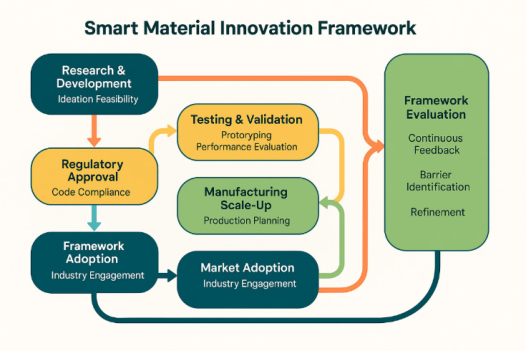
From Concept to Construction: A Framework for Smart Building Material Innovation 521 framework that future innovators can use to avoid common pitfalls and accelerate sustainable adoption. This study therefore presents the Smart Material Innovation Framework which offers a visual, process-driven roadmap to guide material innovators, regulators and consultants in the South African Construction Industry. It draws from both the CemBrick Case Study and broader literature insights grouped across five core phases as shown in Figure 2 below.
Figure 2: Smart material innovation framework (researchers’ own compilation) Phase 1 includes a policy or compliance trigger (e.g., SANS 10400-XA), which necessitates a new solution. Innovators must then clearly define the problem, such as local construction inefficiencies or regulatory gaps, and conceptualise a context-appropriate material that addresses these con straints. Phase 2 involves rigorous in-house performance testing, including thermal and structural validation. Innovators conduct comparative cost and performance analyses (e.g., vs cavity wall systems) and develop formal tech nical documentation such as rate schedules, datasheets, and BoQ descrip tions to prepare for institutional submission. Phase 3 navigates regulatory requirements. This stage involves mapping relevant authorities (e.g., SABS, NHBRC, local councils), initiating stakeholder dialogues, and engaging in iterative approval and feedback cycles to ensure material acceptability and alignment with existing codes. Phase 4 includes engagement with built envi ronment professionals through CPD presentations, case studies, and train ing. The material must be integrated into standard tender documentation (WINQS, BoQs), and ideally piloted on live projects to demonstrate per formance and build credibility. The final phase (phase 5) closes the loop through post-project feedback collection, supporting policy evolution and adjustments to technical standards. This stage also creates the opportunity for framework replication, enabling future material innovators to follow a more structured, informed, and efficient pathway.
CONCLUSION AND RECOMMENDATIONS This study explored the CemBrick Thermal Brick case as a lens through which to understand the complex pathways required to innovate and adopt smart materials within the South African built environment. It demonstrated that while regulatory changes such as SANS 10400-XA (Edition 2) have triggered material innovation, the journey from ideation to mainstream application remains fragmented. Key findings highlighted the importance of navigating regulatory ambiguity, engaging multi-stakeholder ecosystems early, and bridging gaps between product design, technical validation, and institutional approval. The development of a Smart Material Innovation Framework, derived from document analysis, field observations, expert con sultation, and synthesis of ten peer-reviewed studies, offers a generalisable roadmap for future innovators, consultants, and researchers. This framework maps five critical phases: (1) Regulatory Trigger & Ideation, (2) Testing & Internal Validation, (3) Institutional Navigation, (4) Professional Alignment & Piloting, and (5) Market Uptake & Ecosystem Learning. To strengthen South Africa’s capacity for material innovation, the paper recommends that industry bodies and regulatory councils streamline approval processes, offer clearer technical guidance, and invest in knowledge-sharing platforms. Future research should apply this framework across other smart materials to test its adaptability, refine stakeholder roles, and support a more innova tion-responsive policy environment.
REFERENCES
Agrément South Africa, 2023. Certification Guidelines for Non-Standard Building Products. Pretoria: Agrément SA. Amede, E.A., Woldesenbet, A.K., Bahiru, A.K., Tibebu, F.T. & Hailemariam, L.M.,
2025. Transforming construction in emerging economies: overcoming barriers to the adoption of industrialized building systems. Discover Applied Sciences, 7(7), Article 765. https://doi.org/10.1007/s42452-025-06963-w Ampofo-Anti, N.L., 2017. Delivering construction projects using innovative building technologies. In: Proceedings of the 11th Built Environment Conference, Durban, South Africa, 6-8 August 2017. CSIR Built Environment, Pretoria, pp. 1–14. Bakhaty, Y., Udeaja, C. & Levatti, H.U., 2024. A framework to adopt modern methods
of construction in social housing projects in Egypt. Sustainability, 16(17), 7773. https://doi.org/10.3390/su16177773 Bowen, G.A., 2009. Document analysis as a qualitative research method. Qualitative Research Journal, 9(2), pp. 27–40. Brahme, A. and Vyas, A., 2021. Smart materials and construction innovation. In:
N. Dey, A. Joshi, and A. Shankar, eds., Smart Nanoconcretes and Cement-Based Materials: Properties, Modelling and Applications. 1st ed. Elsevier, pp. 333–351. https://doi.org/10.1016/B978-0-12-821886-4.00014-6 Cem Brick. (2025). Cem Brick Thermal Brick Booklet: Redefining the future of construction with strength, innovation, and integrity. Bloemfontein: Cem Brick Pty Ltd. De Villiers, W., Pagel, C.L., Barnardo, C.M., Kruger, J. & Boshoff, W.P., 2018. Thermal
testing of alternative masonry walls. In: Proceedings of the 13th International Masonry Conference. International Masonry Society, London, UK, pp. 1–12.
From Concept to Construction: A Framework for Smart Building Material Innovation 523 Ejidike, C.C. and Mewomo, M.C., 2023. Benefits of adopting smart building
technologies in building construction of developing countries: review of literature. SN Applied Sciences, 5(52). https://doi.org/10.1007/s42452-022-05262-y Eze, E.C., Sofolahan, O. and Omoboye, O.G., 2023. Assessment of barriers to the adoption of sustainable building materials. Frontiers in Engineering and Built Environment, [online] Available at: https://doi.org/10.1108/FEBE-02-2023-0008 [Accessed 22 Sept. 2025]. Fred, T. & Renny, W., 2022. Policy and regulation as drivers of sustainable material
adoption in U.S. construction. [online] Available at: https://www.researchgate. net/publication/394888721_Policy_and_Regulation_as_Drivers_of_Sustainable_ Material_Adoption_in_US_Construction [Accessed 4 Nov 2025]. Iluyomade, T.D. and Okwandu, A.C., 2024. Innovative materials in sustainable construction: A review. International Journal of Science and Research Archive, 12(1), pp.2435–2447. https://doi.org/10.30574/ijsra.2024.12.1.1048 Jaiswal, S.V., Hunt, D.V.L. & Davies, R.J., 2024. Construction 4.0: a systematic
review of its application in developing countries. Applied Sciences, 14(14), p. 6197. https://doi.org/10.3390/app14146197 Jansen, J.J.A., Jordaan, M. & Bornman, P.A.S., 2017. Alternative composite building systems. In: Proceedings of the 21st Annual Pacific Association of Quantity Surveyors Congress, Vancouver, Canada, 2017. Canadian Institute of Quantity Surveyors. Lin, S.-S., Shen, S.-L., Zhou, A. & Chen, X.-S., 2024. Smart Techniques Promoting
Sustainability in Construction. Engineering and Management, 45(2), pp. 262–282. https://doi.org/10.1016/j.eng.2024.08.023 Mbambo, S., Agbola, S.B. & Olojede, O.O., 2021. The introduction, adaption and use of IBTs in South Africa: A case study of AV Light Steel, Potchefstroom, SA. Journal of Inclusive Cities & Built Environment, 1(1), pp. 53-66. Available at: https://journals.ukzn.ac.za/index.php/JICBE/article/view/2041 [Accessed 4 Nov. 2025]. Muigai, R., Musyimi, P., Maringe, G., Abonyo, L. & Gitahi, B., 2023. Assessment of
barriers to the adoption of sustainable building materials. International Journal of Construction Management, pp.1–9. https://doi.org/10.1080/15623599.2023. 2170027 Nguyen, M.V., 2023. Drivers of innovation towards sustainable construction: a study in a developing country. Journal of Building Engineering, 64, 107970. https://doi. org/10.1016/j.jobe.2023.107970 Oguntona, O.A., Ngobeni, F., Mpofu, A., Makwakwa, M. & Aigbavboa, C.,
2023. Barriers to emerging smart solutions adoption for energy efficiency in the construction industry. In: Proceedings of the 11th World Construction Symposium, Colombo, Sri Lanka, 9–10 November 2023. Ceylon Institute of Builders (CIOB), pp. 265–275. https://doi.org/10.31705/WCS.2023.22 Oke, A.E., Aghimien, D.O., Aigbavboa, C.O. & Koloko, N., 2018. Challenges of digital collaboration in the South African construction industry. Paper presented at the 8th International Conference on Industrial Engineering and Operations Management (IEOM 2018), Bandung, Indonesia, 6–8 March. Patil, M., Boraste, S. & Minde, P., 2022. A comprehensive review on emerging
trends in smart green building technologies and sustainable materials. Materials Today: Proceedings, 65, pp. 1813–1822. https://doi.org/10.1016/j. matpr.2022.04.866
524 Bremer and Le Roux Rajendra, A., Jain, M., Das, S., Shekhawat, S.S. and Rajvanshi, M., 2023. Smart
building materials: A review. International Journal of Intelligent Systems and Applications in Engineering, 11(4), pp. 540–545. https://doi.org/10.18201/ ijisae.2023.315 Skibniewski, M.J., 2025. The present and future of smart construction technologies.
Engineering, 44, pp.21–23. https://doi.org/10.1016/j.eng.2024.12.024 Van der Bank, C.M. & Van der Bank, M., 2014. The regulation of renewable resources to promote energy efficiency in sustainable buildings in South Africa: A legal analysis. Mediterranean Journal of Social Sciences, 5(23), pp.2224–2228. https://doi.org/10.5901/mjss.2014.v5n23p2224 Yang, J., 2023. Impact of coupling of technological innovation and standardisation.
International Journal of Organizational Excellence in Manufacturing, 18(11), 4926. https://doi.org/10.1108/IJOEM-18-11-4926 Yin, R.K., 2018. Case Study Research and Applications: Design and Methods. 6th ed. Sage Publications.
LISTED IN THE AHFE DIGITAL BOOKSTORE CATALOGUE
Explore the complete digital volume
Intelligent Human Systems Integration (IHSI 2026): Disruptive and Innovative Technologies
Read this individual research paper free through the original publisher, or explore the full digital proceedings book.
ISBN 978-1-964867-76-2
Explore this ISBN in the AHFE Bookstore ↗Listed in the July 2026 bookstore catalogue; search by ISBN to confirm current availability · Digital book purchase optional