Glory Sefako, Jeffrey Mahachi (2026). Revitalising Indigenous Housing Knowledge for a Sustainable Built Environment: A South African Case Study. In: Sustainable Built Environment. AHFE Open Access, vol. 225, pp. 32–39. https://doi.org/10.54941/ahfe1007896
Indigenous housing traditions in South Africa reflect centuries of environmental adaptation, material efficiency and socio-cultural cohesion—principles increasingly recognised as essential to a sustainable built environment. Yet these traditions have been progressively marginalised through colonial disruption, rapid urbanisation and policy frameworks that prioritise Western construction technologies. This paper investigates how the documentation and revitalisation of indigenous housing design practices can contribute to sustainable, culturally grounded and inclusive development pathways. Using an interpretivist qualitative approach supported by document analysis, the study synthesises insights from academic literature, government policy texts and contemporary project case studies. The findings indicate that indigenous housing demonstrates sophisticated ecological intelligence through responsive siting, passive environmental control, and the use of locally sourced, low-carbon materials. The erosion of these practices is attributed to institutional fragmentation, limited policy recognition and the absence of indigenous knowledge within architectural and engineering curricula. The paper argues that systematic documentation, curriculum transformation and integrated policy support are essential for embedding indigenous design principles into modern practice. Revitalising these traditions presents an opportunity to advance sustainability, strengthen cultural identity and promote more resilient built environments in South Africa.
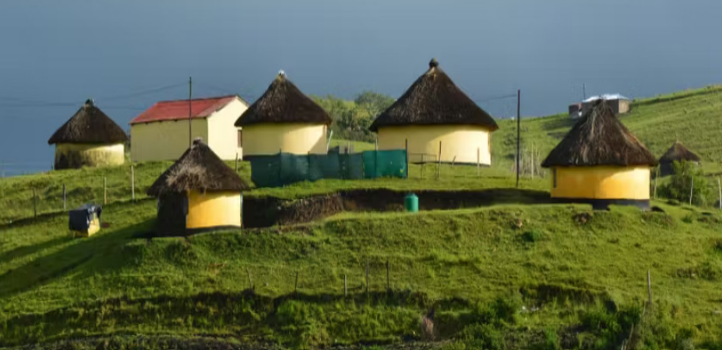
Indigenous housing systems in South Africa are more than functional shelters; they are cultural artefacts shaped by ecological logic, social organisation and symbolic meaning. Traditional forms such as the Zulu umuzi, Sotho courtyard compound and Venda circular homestead evolved through sustained interaction with local climate, materials and communal values (Frescura, 1981). These systems reflect adaptive solutions developed through generations of observation and practice. These characteristics are illustrated through representative indigenous housing typologies found across Southern Africa (see Figure 1).
Despite their sophistication, indigenous housing practices have been increasingly displaced by industrial construction methods and standardised Received February 6, 2026; Revised March 28, 2026; Accepted April 15, 2026; Available online July 20, 2026
Revitalising Indigenous Housing Knowledge for a Sustainable Built Environment 33 housing typologies. South Africa’s housing sector continues to prioritise rapid delivery and uniformity, often at the expense of climatic responsiveness and cultural relevance (Department of Human Settlements, 2019, Mahachi, 2022). Conventional housing models rely heavily on energy intensive materials and layouts that frequently perform poorly in local environmental conditions.
Figure 1: Indigenous circular housing units illustrating earthen wall construction, thatched roofing and symbolic geometric decoration typical of Southern African vernacular architecture. Source: Adapted from Frescura (1981).
This paper responds to the need to re-evaluate indigenous housing knowledge within contemporary sustainability discourse. It proceeds from the premise that indigenous architecture offers adaptive solutions aligned with global sustainability imperatives, including climate resilience, reduced carbon emissions and social inclusion. The study explores how documentation and revitalisation strategies can reposition indigenous housing knowledge within modern built-environment practice. Within the South African context, revisiting indigenous housing knowledge is particularly relevant given ongoing challenges related to housing quality, environmental sustainability and social inclusion. Recognising the value of indigenous design principles offers an opportunity to address these challenges through context-sensitive approaches that respond to local climatic, cultural and material conditions.
LITERATURE REVIEW
Scholarly work on indigenous housing consistently demonstrates that vernacular architectural and engineering systems embody deep environmental intelligence shaped through long-term interaction with local climate, landscape and resource cycles. In the South African context, structures such as rondavels constructed from clay, timber and thatch provide notable thermal efficiency while maintaining extremely low embodied energy. Their circular geometry contributes to uniform structural load distribution and enhanced wind resistance, illustrating how performance-driven design principles were embedded in traditional construction long before the emergence of
34 Sefako and Mahachi contemporary sustainability discourse (Oliver, 2006). Comparative insights from earthen architecture in Egypt further reinforce the value of locally sourced materials and communal building practices in enabling self-reliant and resource-efficient settlement patterns (Fathy, 2010). More broadly, vernacular environments have been interpreted as the outcome of an ongoing dialogue between human habitation and ecological context, reflecting adaptation rather than domination of nature (Rapoport, 1969; Nzimande, 2020). Beyond environmental performance, indigenous housing systems encode complex cultural, spiritual and social meanings that structure community life. Spatial orientation, courtyard organisation and movement sequences frequently correspond with cosmological beliefs, kinship hierarchies and ancestral relationships, positioning construction as both a social and moral act embedded in land-based identity (Mazrui, 1986). In many African societies, the processes of building, maintenance and seasonal renewal are collective practices that reinforce cooperation, reciprocity and social cohesion. Such practices generate forms of social capital inseparable from the physical dwelling itself, highlighting the indivisibility of architecture, culture and community resilience (Frescura, 2015).
Despite these demonstrated environmental and socio-cultural strengths, the continuity of indigenous housing knowledge has been substantially disrupted through colonial and post-colonial transformations. Colonial planning systems and missionary education promoted Western architectural forms as symbols of modernity and progress, marginalising vernacular practices within formal development frameworks (Chipkin, 1993). Post- apartheid housing delivery, while addressing urgent quantitative shortages, largely sustained standardised construction models and material systems that limited contextual responsiveness. Institutional fragmentation between heritage conservation and housing development further constrained integrated recognition of indigenous knowledge within planning and policy environments (Rwelamila and Phiri, 2019). At the same time, shifting social aspirations increasingly associated traditional forms with underdevelopment, while concrete and steel became markers of socio-economic advancement. These perceptions continue to shape professional education and practice, where architectural and engineering curricula remain predominantly Eurocentric in orientation (Ndlovu-Gatsheni, 2020).
International scholarship reveals parallel tensions between vernacular heritage and modern development across diverse regions. Earthen settlements in India’s Kutch region, adobe traditions in Mexico and stone compounds in the Andes demonstrate how locally grounded construction cultures achieve environmental sustainability through climatic adaptation, material efficiency and collective participation (Correia et al., 2014). Yet revitalisation efforts must avoid romanticising the past; indigenous knowledge should operate as a dynamic source of innovation rather than a static cultural artefact (Boussaa, 2017). These global perspectives affirm that vernacular systems function as repositories of resilience with relevance for contemporary sustainable housing transitions.
Revitalising Indigenous Housing Knowledge for a Sustainable Built Environment 35 Although existing literature establishes the environmental performance, cultural significance and historical marginalisation of indigenous housing, limited research has systematically examined how these knowledge systems can be documented, translated and integrated into present-day South African housing policy, professional training and sustainable development practice. The absence of coherent frameworks linking indigenous design principles with modern construction governance, curriculum transformation and implementation pathways represents a critical gap. Addressing this gap is essential for repositioning indigenous housing knowledge as an active contributor to resilient and culturally grounded built environments in South Africa.
METHODOLOGY
Research Design and Paradigm This study followed a qualitative interpretivist approach, recognising that indigenous housing knowledge is shaped by culture, history and social meaning rather than quantifiable variables. The interpretivist paradigm assumes that reality is co-constructed through people’s values and lived experiences (Denzin & Lincoln, 2018).
The focus was therefore on understanding how traditional housing practices are documented, interpreted and positioned within sustainability discourses. The method allowed exploration of diverse textual sources, academic articles, government policy documents and project reports to capture multiple perspectives across disciplines.
Data Collection and Sources Data were gathered through document analysis, a method suited to examining meaning and discourse within written records (Bowen, 2009). The dataset included:
Academic literature: peer-reviewed studies on vernacular architecture, sustainability, and indigenous knowledge.
Policy documents: National Development Plan (2030), Breaking New Ground policy, Indigenous Knowledge Systems Act (2019) and provincial heritage frameworks.
Case studies and reports: community housing projects and digital mapping initiatives from South African provinces of Limpopo and KwaZulu-Natal and other African countries, notably Ghana and Botswana.
Documents were selected for their relevance to the research and coded under three categories derived from the conceptual framework: (1) Knowledge and Cultural Continuity; (2) Environmental and Material Sustainability; and (3) Institutional and Policy Integration.
A thematic analysis was used to identify recurring patterns across the dataset. Codes were first generated inductively and then refined deductively using the conceptual framework. Emerging categories such as cultural symbolism, policy fragmentation and digital documentation were compared and synthesised to reveal relationships among themes.
Reliability and Credibility To enhance credibility, data were triangulated across academic, policy and community sources. Interpretations were checked against multiple texts and direct quotations were used where available to preserve contextual integrity. Reflexive journaling helped minimise researcher bias.
FINDINGS AND DISCUSSIONS Indigenous Design Logic and Spatial Identity
The study reveals that indigenous South African housing is defined by an integrated system of environmental responsiveness, cultural symbolism and social organisation. These dwellings express a dialogue between ecology and identity, an architecture shaped as much by values as by climate.
Structures such as the Zulu umuzi, Sotho courtyard compound and Tswana kgotla are organised around principles of ubuntu;- A social philosophy that sees the individual as part of a collective. Spatial planning mirrors social relationships: circular layouts encourage inclusivity and visual connectivity, while courtyards centralise communal life (Oliver, 2006; Nzimande, 2020).
Material choices reinforce this logic. Locally sourced clay, thatch and timber reduce embodied energy and allow for natural thermal regulation (Frescura, 2015). The circular geometry of huts and radial compound planning enhances air circulation and structural stability; a form of vernacular engineering honed through centuries of observation.
Comparative insights from India, Yemen, and Peru show similar adaptive intelligence where design follows local ecology and social patterning (Correia et al., 2014). These parallels affirm that sustainability is not a recent innovation but an intrinsic feature of traditional architecture worldwide.
Indigenous housing represents more than built form; it is a cultural expression of harmony between people, place and climate. This synthesis of material, meaning and social order provides a foundation for reimagining sustainable architecture in South Africa.
Causes of Knowledge Erosion and Cultural Displacement The decline of traditional housing knowledge stems from structural, cultural and educational disconnections rather than from any technical inadequacy.
At the policy level, colonial and postcolonial housing programmes privileged Western typologies, equating modernity with industrial materials. Even after post-apartheid era (1994), state housing initiatives such as the Reconstruction and Development Programme (RDP) continued to deliver mass produced designs that ignored vernacular wisdom (Department of
Revitalising Indigenous Housing Knowledge for a Sustainable Built Environment 37 Human Settlements, 2019). Heritage and housing institutions operate separately, creating fragmented policy landscapes (Rwelamila and Phiri, 2019). Cultural perception compounds this erosion. Modernisation and media exposure have redefined aspiration “brick and mortar” symbolise progress, while earthen structures are associated with poverty (Chipkin, 1993). This stigma weakens intergenerational transmission of traditional skills.
Educational systems reinforce the divide. Architectural curricula still draw heavily on Eurocentric frameworks that marginalise African spatial knowledge (Ndlovu-Gatsheni, 2020). As a result, graduates often lack exposure to vernacular building logic and communities lose both cultural confidence and technical mentors.
Urban migration also accelerates loss. When rural youth leave for cities, the apprenticeship systems that once maintained indigenous construction skills collapse.
Documentation as a Tool for Sustainable Revitalisation Documentation emerges as both preservation and innovation strategy. It enables communities, researchers and policymakers to visualise and reinterpret traditional design principles in contemporary contexts.
Participatory documentation models, such as the Makgabeng Indigenous Knowledge Mapping Initiative, illustrate the power of co-creation. Engaging local elders, artisans and students in mapping spatial layouts and material techniques strengthens authenticity and ownership (Moremoholo, 2021).
Digital technology enhances precision and accessibility. Photogrammetry, 3D scanning and drone mapping have allowed accurate documentation of traditional structures while retaining cultural meaning (Masenya, 2023). Similar projects in Ghana and Botswana demonstrate how digital archives can inform both conservation and design education (Mwale and Lintonbon, 2020). However, ethical responsibility is paramount. As Harrison (2015) and Ndoro and Pwiti (2001) warn, documentation without consent risks replicating extractive practices. Therefore, any digital preservation must be accompanied by data sovereignty agreements that protect community control.
When coupled with education, documentation becomes transformative. Archival records can feed into curriculum materials, community training and design guidelines for climate-adapted housing.
Integration Strategies for Indigenous Design Principles The revitalisation of indigenous architecture cannot succeed without formal integration into policy, education and community practice, these three mutually reinforcing pillars.
Policy Integration Government frameworks must move from rhetorical recognition to operational inclusion. Integrating indigenous housing standards into the
38 Sefako and Mahachi Breaking New Ground policy and the National Development Plan (2030) would ensure cultural and environmental objectives align. Establishing a National Indigenous Design Unit under the Department of Human Settlements could coordinate interdepartmental programmes and pilot community-based housing initiatives (South Africa DHS, 2019).
Educational Reform Universities and Technical Colleges should embed vernacular architecture within core curricula. Design studios, field schools and internships in heritage projects can cultivate experiential understanding. Professional councils could include indigenous design literacy in accreditation, aligning professional competence with national sustainability needs (Nzimande, 2020).
Community Empowerment Revitalisation must remain community led. Establishing local cooperatives for artisans, promoting participatory design, and connecting housing revitalisation with eco-tourism can create sustainable livelihoods. These models proven successful in Botswana and Ghana turn preservation into a living economic practice (UN-Habitat, 2020).
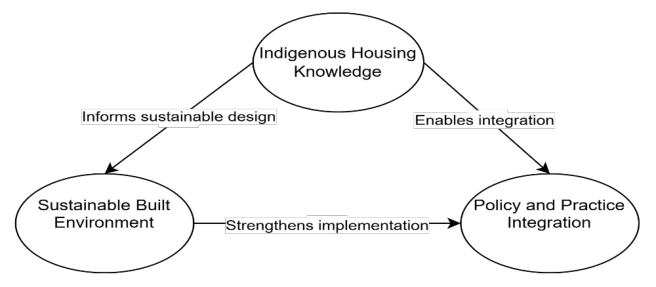
These interconnections between indigenous knowledge, sustainability objectives and institutional mechanisms are synthesised in the integrated conceptual framework presented in Figure 2.
Figure 2: Integrated conceptual framework illustrating how indigenous housing knowledge informs sustainable built-environment outcomes and supports policy and practice integration. Source: Authors own.
CONCLUSION
The study demonstrates that South Africa’s indigenous housing systems are living repositories of environmental and social wisdom. Their marginalisation has resulted from historical prejudice and institutional neglect, not technical weakness. Revitalisation through documentation, education and policy integration offers a path toward housing that is both sustainable and culturally resonant.
Revitalising Indigenous Housing Knowledge for a Sustainable Built Environment 39 Ultimately, traditional architecture provides a blueprint for low-carbon, high-identity design. One that aligns with global sustainability goals while reaffirming local heritage. Reclaiming this knowledge allows South Africa to design its future using the logic of its past.
ACKNOWLEDGMENT
The authors would like to acknowledge the University of Johannesburg for institutional and academic support provided during this research. The support and resources made available through the institution contributed to the successful completion of this study.
REFERENCES
Asante, E. and Afram, S. (2020). ‘Thermal performance of earthen compounds in Ghana’, Journal of Building Performance, 11(2), pp. 54–68. Boussaa, D. (2017). ‘Urban regeneration and the search for identity in historic cities’,
Sustainability, 9(12), pp. 2301–2316. Bowen, G.A. (2009). ‘Document analysis as a qualitative research method’, Qualitative Research Journal, 9(2), pp. 27–40. Chipkin, C. (1993). Johannesburg Style: Architecture and Society 1880s–1960s.
Cape Town: David Philip. Correia, M., Dipasquale, L. and Mecca, S. (2014). Vernacular Heritage and Earthen Architecture. London: CRC Press. Denzin, N.K. and Lincoln, Y.S. (2018). The SAGE Handbook of Qualitative
Research. 5th edn. Thousand Oaks, CA: SAGE. Department of Human Settlements (2019). Revised National Housing Policy.
Pretoria: Government Printer. Fathy, H. (2010). Architecture for the Poor. Cairo: American University in Cairo Press. Frescura, F. (1981). Rural Shelter in Southern Africa: A survey of the architecture,
house forms, and constructional methods of the black rural peoples of Southern Africa. Johannesburg: Ravan Press. Harrison, R. (2015). Heritage: Critical Approaches. London: Routledge. Mahachi, J. (2022). Development of a construction quality assessment tool for houses in South Africa”, Acta Structilia, 28(1), pp. 91–116, ISSN 1023-0564 e-ISSN 2415-0487. http://dx.doi.org/10.18820/24150487/as28i1.4 Masenya, T.M. (2023). ‘Digital preservation of indigenous knowledge systems
for sustainable development in South Africa’, The Serials Librarian, 84(5–8), pp. 86–102. Mazrui, A.A. (1986). The Africans: A Triple Heritage. London: BBC Publications. Ndlovu-Gatsheni, S.J. (2020). Decolonization, Development and Knowledge in Africa. London: Routledge. Oliver, P. (2006). Built to Meet Needs. Oxford: Elsevier. Rapoport, A. (1969). House Form and Culture. Englewood Cliffs, NJ: Prentice Hall. Rwelamila, P.D. and Phiri, M. (2019). ‘Challenges in integrating indigenous
knowledge in modern architecture’, Habitat International, 84, pp. 48–56. UN-Habitat (2020). World Cities Report 2020. Nairobi: United Nations Human Settlements Programme.
LISTED IN THE AHFE DIGITAL BOOKSTORE CATALOGUE
Explore the complete digital volume
Sustainable Built Environment
Read this individual research paper free through the original publisher, or explore the full digital proceedings book.
ISBN 979-8-950676-01-7
Explore this ISBN in the AHFE Bookstore ↗Listed in the July 2026 bookstore catalogue; search by ISBN to confirm current availability · Digital book purchase optional