Posholi Lebusa, Jeffrey Mahachi (2026). Enhancing Connection Performance for a Sustainable Built Environment: A Comparative Investigation of Prying Forces. In: Sustainable Built Environment. AHFE Open Access, vol. 225, pp. 23–31. https://doi.org/10.54941/ahfe1007895
Bolted steel connections play a critical role in structural reliability, material efficiency, and the long-term sustainability of the built environment. This paper investigates prying forces in bolted connections through a comparative evaluation of theoretical models from major international standards and detailed Finite Element Analysis (FEA). The study highlights significant discrepancies between code-based predictions and numerical simulations, with implications for over-design, unnecessary material use, and the overall sustainability of steel construction. Results show that while the Eurocode method provides upper-bound estimates based on full plasticity assumptions, it does not capture prying force evolution across loading stages, potentially leading to conservative—and material-intensive—design outcomes. The AISC method, though simple, underestimates prying due to empirical assumptions, whereas the IS 800 approach exhibited excessive sensitivity to secondary geometric parameters. The SANS 10162 criterion, which considers prying forces acceptable below 30% of the applied tension, demonstrated good alignment with FEA results. Overall, the findings confirm that increasing flange or section thickness effectively mitigates prying action; however, unnecessary thickening can be avoided through improved analytical-numerical alignment. The study therefore supports more accurate prediction methods as a pathway to optimised steel usage, resource efficiency, and sustainable structural design.
Bolted connections are widely used in structural engineering due to their efficiency and reliability (Nassar and Yang, 2013). However, the presence of prying forces significantly affects the behaviour of these connections, leading to additional tensile forces in bolts and altering the expected load distribution (Hantouche and Abboud, 2014). Various international standards such as Eurocode 3 (EN 1993-1-8), AISC 360, IS 800:2007, and SANS 10162, provide methodologies for predicting prying forces. However, discrepancies exist between these standard prediction models and actual behaviour observed in finite element simulations. These inconsistencies
24 Lebusa and Mahachi may lead to either overly conservative designs or unsafe underestimation of prying effects.
In this study, a T-stub steel section model is employed to represent the tensile behaviour of bolted connection components. A comparative evaluation is conducted between prying force predictions from international design standards identified above and nonlinear finite element analysis. The objective is to identify the approach that most accurately captures prying force effects, thereby supporting improved connection performance, material efficiency, and sustainable structural design.
LITERATURE REVIEW
Research Prying forces in bolted steel connections have long been recognised as a critical phenomenon influencing bolt forces, connection stiffness, and ultimate capacity. These additional tensile forces, induced by deformation of connected elements such as end plates or T-stub flanges, can significantly amplify bolt demand and affect both serviceability and ultimate limit states. As a result, prying action has been the subject of extensive experimental, analytical, and numerical investigation over several decades.
Early foundational work by Douty and McGuire (1965) introduced elastic analytical models to describe the development of prying forces in bolted connections. Their work established the basic mechanics of load transfer and flange deformation, forming the basis for subsequent analytical formulations. Building on this framework, Agerskov (1977) extended elastic analysis methods by incorporating the effects of shear deformation and flange bending in conjunction with high-strength bolts. While Agerskov’s model represented an important advancement, it remained limited to elastic behaviour and did not explicitly account for material nonlinearity arising from flange yielding, which becomes significant in practical connection design.
The transition from purely analytical models to experimentally informed understanding was advanced by Borgsmiller (1995), who analysed experimental test data to identify the onset of prying action and its progression with increasing load. This work provided valuable insight into the behavioural thresholds at which prying becomes structurally significant, highlighting the limitations of simplified elastic assumptions when applied to real connections.
With the increased availability of computational tools, numerical modelling became a dominant approach in prying force research. Maggi et al. (2005) conducted a detailed parametric study of bolted end-plate connections using finite element modelling. Their work enabled a comparison between analytical predictions and observed numerical behaviour, particularly with respect to end-plate bending and bolt force redistribution. This marked a shift towards more realistic representations of contact interaction, plate deformation, and stress concentration effects.
Subsequent studies further strengthened the role of numerical methods. Huang et al. (2017) proposed theoretical approaches based on equilibrium analysis of T-stub connections, offering refined analytical insight into force distribution mechanisms. Complementing this, Farajpour and Sabouri (2018)
Enhancing Connection Performance for a Sustainable Built Environment 25 demonstrated that finite element analysis provides a robust framework for accurately predicting prying forces, capturing nonlinear material behaviour, bolt–plate contact, and localised deformations that are difficult to address using closed-form solutions.
More recent investigations have focused on the spatial development and governing parameters of prying forces. Kombate and Taşkın (2022) showed that the maximum prying force does not necessarily occur at the flange edge, as commonly assumed, but rather at a specific distance from the flange tip, depending on connection geometry. Khani et al. (2023) further identified key parameters influencing prying force magnitude, highlighting the ratio between flange thickness and bolt gauge as the most influential factor. Their study compared code-based predictions with numerical results, reinforcing the sensitivity of prying action to geometric proportions.
Despite this substantial body of work, existing studies predominantly focus on mechanistic understanding, parameter sensitivity, and numerical prediction of prying forces, often benchmarking analytical models against experimental or finite element results. While some comparisons between numerical predictions and individual design provisions are presented, there is no comprehensive and systematic comparative review of how prying forces are treated across major international steel design codes, particularly Eurocode 3 (EN 1993-1-8), AISC 360, IS 800:2007, and SANS 10162.
This absence represents a critical gap in the literature. Design codes adopt different assumptions, simplifications, and safety philosophies when accounting for prying action, which can lead to significant variation in predicted bolt forces, connection dimensions, and material usage. From a sustainability perspective, such inconsistencies may result in either conservative overdesign—leading to increased material consumption and embodied carbon—or unconservative assumptions that compromise durability and structural reliability.
Therefore, a systematic comparative investigation of prying force formulations embedded within international design standards is necessary to assess their relative conservatism, efficiency, and implications for sustainable steel construction. Addressing this gap enables a clearer understanding of how code-based prying force models influence connection performance, material optimisation, and long-term sustainability of the built environment.
METHODOLOGY
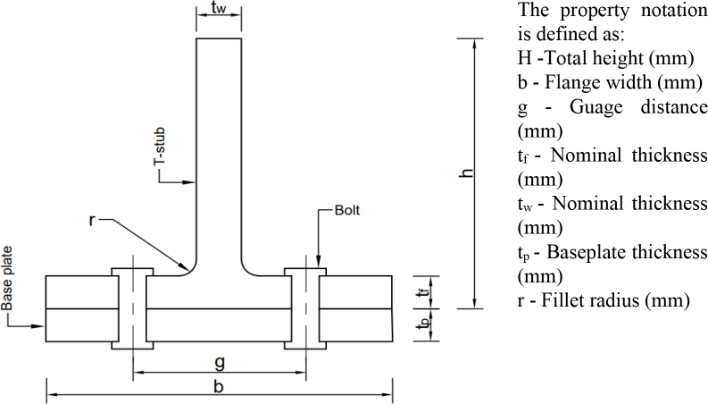
The study employed a comparative analytical and numerical methodology combining finite element modelling (FEM) with code-based design calculations. The study assessed prying forces by employing both analytical and numerical approaches. Theoretical predictions from Eurocode 3, AISC 360, IS800:2007 and SANS 10162 standards were compared with FEA simulations obtained from Abaqus finite element software (2022). The FEA models incorporate nonlinear material properties, contact conditions, and realistic boundary constraints to ensure accurate results. A parametric analysis was conducted to evaluate the effects of varying bolt configurations and flange thicknesses. Table 1 below shows three different sections that
26 Lebusa and Mahachi were used in the models, based on the configuration presented in Figure 1, to analyse prying force effect on a typical T-stub connection.
Table 1: Dimensions and properties for T-stubs cut from I-sections.
Figure 1: Cross sectional area properties of a T-stub.
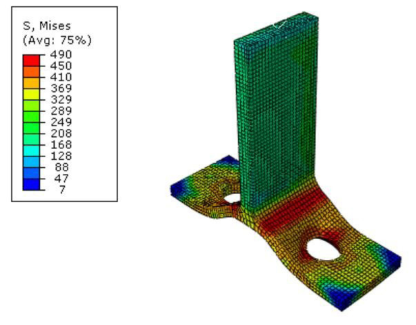
Finite Element Analysis Approach The Abaqus software (2022) was used for finite element modelling. Its analysis considered material nonlinearity, geometric imperfections, and contact interactions between the flange, bolts, and base plate. A 3D solid model approach was adopted for the connection assembly. The flange plate, bolt, and base plate were all modelled as continuum elements (C3D8R) to capture stress distribution and localised yielding accurately. The contact surfaces between the bolt head and flange, as well as between the flange and base plate, were defined using surface-to-surface contact with hard normal behaviour to simulate realistic interaction and load transfer. The FEA von Mises stress (MPa) distribution results are presented in Figure 2 is of a typical T-stub connection subjected to tensile loading, it also shows the distribution of stresses along the T-stub and bolt.
Enhancing Connection Performance for a Sustainable Built Environment 27 Design Approaches of International Standards
Design procedure of Eurocode 3 EN 1993-1-8 was applied in accordance with its prescribed T-stub model, in which prying forces were incorporated through equilibrium relationships based on full plastic resistance of the flange and the defined bolt–flange failure modes.
Figure 2: Variation of stresses along a T-stub and bolt.
Design Procedure of American Standard AISC 360 was applied using the prying force provisions specified in the standard, where bolt tensile forces were increased using code-defined geometric parameters derived from experimental calibration.
Design Procedure of Indian Standard IS 800:2007 was applied as prescribed, with prying forces calculated explicitly using the analytical expressions provided in the code, based on bolt spacing, plate thickness, and lever arm geometry.
Design Procedure of SANS 10162 SANS 10162 was applied using its specified acceptability criterion, in which prying forces were considered acceptable when they did not exceed the code- defined proportion of the applied tensile force, without requiring explicit prying force calculation.
RESULTS AND DISCUSSIONS The results presented demonstrate that prying forces have a significant influence on the tensile response of the bolted T-stub connection, particularly after the onset of flange yielding. Across all configurations analysed, the magnitude of prying force obtained through FEM was found to depend primarily on flange thickness and bolt spacing, while secondary geometric parameters had a comparatively smaller influence. International code-based
28 Lebusa and Mahachi approaches exhibited varying levels of conservatism when compared to the numerical results, with some methods consistently overestimating prying forces and others underestimating their contribution at higher load levels.
Table 2 presents typical Eurocode 3 results obtained at each section maximum loading capacity and Table 3 compares prying forces predicted by various codes (EN 1993-1-8, AISC 360, IS 800:2007, SANS10162) and finite element analysis on three different bolt-connected sections.
Table 2: Summary of obtained results from Eurocode 3.
Table available in the original PDF paper.
Yield Force
Failure Mode Max. Praying
Section Designation
(kN)
Force (kN)
Ratio of Praying Force to Applied Load (-) Section 1 79.46 Mode 1 19.87 0.25
Table 3: Comparison between predictions from various international design codes and Abaqus finite element results. Abaqus Sections 1, 2, and 3 were analysed under applied loads of 80 kN, 90 kN, and 150 kN, respectively, due to convergence limitations encountered at higher load levels.
Failure Modes The finite element analyses indicate that failure initiates with localised yielding in the flange plate near the bolt line, followed by the development of plastic hinges at the flange–web junction. As loading increases, flange separation at the plate edge becomes more pronounced, leading to an increase in prying forces transferred to the bolts. In all cases, bolt forces increased nonlinearly once flange plasticity developed, confirming that prying action is closely associated with post yield deformation of the flange. No premature bolt fracture was observed; instead, the dominant failure mechanism was governed by flange yielding and plastic hinge formation, consistent with a ductile response.
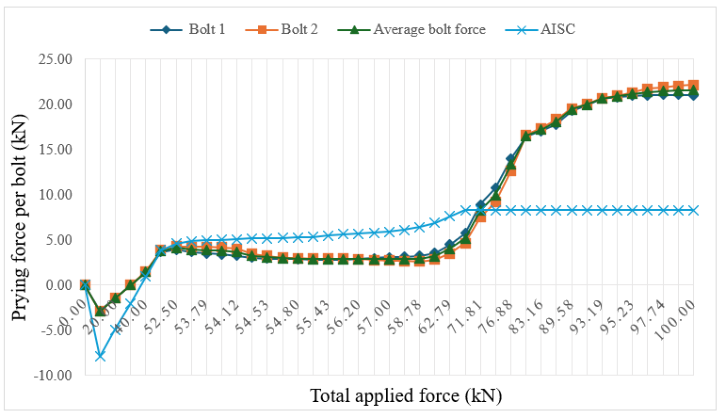
Prying Force Behaviour The typical evolution of prying forces is illustrated in Figure 3, it shows the relationship between the applied tensile force and the prying force obtained from the finite element analysis. It also demonstrates the comparison between FEA results and predictions of AISC 360. The graph highlights an initial linear response prior to flange yielding. The negative portion preceding the positive phase represents a seating phase during which the system begins to engage. At the plateau region the load per bolt remains relatively constant. In
Enhancing Connection Performance for a Sustainable Built Environment 29 this region, local plastic yielding develops in the T-stub flanges, after which a rapid increase in prying force is observed as plastic deformation progresses.
Comparative Summary: Code-Based Results vs Abaqus (2022) Results Key observations are that EN 1993-1-8 and SANS 10162 generally predict higher prying forces than AISC, which gives the lowest estimates. IS 800:2007 code values are consistently higher than AISC and often close to SANS 10162, indicating moderate conservativeness. The Abaqus software results exhibit nonmonotonic behaviour with prying force sometimes exceeding and sometimes falling below code-predicted values, depending on the applied load level and the referenced code of practice.
Figure 3: Total applied tension force vs prying force per bolt.
CONCLUSION AND RECOMMENDATIONS This study presented a comparative investigation of prying forces in bolted T-stub connections using international design standards and nonlinear finite element analysis. The results confirm that prying action is strongly governed by flange thickness and bolt spacing, with prying forces becoming significant only after the onset of flange yielding. Finite element simulations demonstrated that prying force development is inherently nonlinear and load-dependent, reflecting progressive flange plasticity and stiffness degradation that are not explicitly captured by most code-based approaches.
Among the standards considered, EN 1993-1-8 provides conservative upper-bound estimates due to its full plasticity assumption, which does not permit evaluation of prying force evolution across different loading stages. AISC 360 consistently predicts lower prying forces and fails to capture peak
30 Lebusa and Mahachi behaviour associated with changes in system stiffness. The IS 800:2007 predictions were found to be sensitive to baseplate thickness, a parameter not considered in the study, which influenced the level of conservatism observed. In contrast, the finite element results showed that prying forces remained below 30% of the applied tensile force for all cases considered, consistent with the acceptability criterion of SANS 10162.
The finite element analysis offered a more comprehensive representation of connection behaviour by accounting for material nonlinearity, contact interactions, and localised deformation. This improved accuracy highlights the limitations of simplified analytical methods when assessing prying forces in connection components. The findings indicate that while increasing section thickness effectively reduces prying action, excessive conservatism in design codes may lead to unnecessary steel usage. Overall, the study demonstrates that improved alignment between numerical analysis and design provisions can support more material-efficient and sustainable steel connection design without compromising structural safety.
While this study successfully investigated prying forces in bolted T-stub connections through comparison of international standards and finite element modelling, further research is recommended through experimental testing using locally available steel grades to validate the numerical findings. Future analyses could incorporate bolt pretension as well as cyclic and fatigue loading conditions. The inclusion of contact friction and multi-bolt interaction is also necessary as it could improve the accuracy of stress transfer representation. In addition, simplified prying force expressions calibrated using regional data could be developed to support potential updates to SANS 10162.
ACKNOWLEDGMENT
The authors would like to acknowledge the University of Johannesburg for institutional and academic support provided during this research. The support and resources made available through the institution contributed to the successful completion of this study.
REFERENCES
Agerskov, H. (1977). Analysis of bolted connections subject to prying. Journal of the Structural Division, American Society of Civil Engineers, 103(ST11), pp. 2145–2163. American Institute of Steel Construction (AISC). (2022). Steel Construction Manual
(16th ed.). Chicago, IL: American Institute of Steel Construction. Bureau of Indian Standards (BIS). (2007). IS 800: General construction in steel – Code of practice. New Delhi: BIS. Dassault Systèmes Simulia Corp. (2014) Abaqus 6.14 User’s Manual. Providence,
RI: Dassault Systèmes. Douty, R., McGuire, W. (1965). High-strength bolted moment connections. Journal of the Structural Division, ASCE, 91(ST2), 101–128. European Committee for Standardization (CEN). (2005). EN 1993-1-8: Eurocode 3:
Design of steel structures – Part 1-8: Design of joints. Brussels: CEN.
Enhancing Connection Performance for a Sustainable Built Environment 31 Hantouche, E.G., Abboud, N.H. (2014). Stiffness modelling of bolted thick built-up
T-stub connections including secondary prying effect. J. Constr. Steel Res. 95, 279–289. Huang, X., Wang, Z., & Li, J. (2017). Prediction of moment–rotation characteristic of top- and seat-angle bolted connection incorporating prying action. International Journal of Advanced Structural Engineering, 9, pp.79–93. Khani, R., Hosseinzadeh, Y., Hoseinzadeh Asl, M. (2023). Investigating the prying
force magnitude and location in the T-stub connection based on the energy method. Eng. Struct. 280, 115655. Kombate, T.J. de la C., Taşkın, K. (2022). State-of-the-art review on the behaviour of T-stubs and prying action. J. Constr. Steel Res. 191, 107203. Maggi, Y.I., Gonçalves, R.M., Leon, R.T., Ribeiro, L.F.L. (2005). Parametric analysis
of steel bolted end plate connections using finite element modelling. J. Constr. Steel Res. 61, 689–708. Nassar, S.A., Yang, X. (2013). Bolted connections, in: Wang, Q.J., Chung, Y.-W.
(Eds.), Encyclopaedia of Tribology. Springer US, Boston, MA, pp. 233–242. South African Bureau of Standards (SABS). (2011). SANS 10162-1: The structural use of steel – Part 1: Limit-state design of hot-rolled steelwork. Pretoria.
LISTED IN THE AHFE DIGITAL BOOKSTORE CATALOGUE
Explore the complete digital volume
Sustainable Built Environment
Read this individual research paper free through the original publisher, or explore the full digital proceedings book.
ISBN 979-8-950676-01-7
Explore this ISBN in the AHFE Bookstore ↗Listed in the July 2026 bookstore catalogue; search by ISBN to confirm current availability · Digital book purchase optional