Josef Pavlicek, Petra Pavlíčková, Irena Štrausová, Martin Molhanec (2026). Approache to User Interface Usability Driven by Changing Mental Models: A Comparative Analysis of Boomers and Generation Z. In: Human Systems Engineering and Design (IHSED2026): Future Trends and Applications. AHFE Open Access, vol. 237, pp. 200–209. https://doi.org/10.54941/ahfe1008160
1 University of South Bohemia in České Budějovice, Faculty of Economics, Department of Applied Mathematics and Informatics, Branišovská 1645/31a, České Budějovice, Czech Republic ↗
2 Faculty of Information Technology, CTU, Thákurova 9, Prague 6, 160 00, Czech Republic
3 University of South Bohemia in Č eské Bud ě jovice, Faculty of Economics, Department of Applied Mathematics and Informatics, Brani š ovsk á 1645/31a, Č esk é Bud ě jovice, Czech Republic ↗
This paper explores generational differences in user mental models and their impact on user interface usability. The study compares behavioral patterns of Boomers and Generation Z through an experimental task using an interactive graphical tool based on the Chord Wheel Diagram. The application visualizes musical tones within a defined scale using a circular layout complemented by a simple chord progression process visualization. The task was designed to combine a familiar context with a cognitive challenge. Music provides a generally recognizable domain, while the visual representation encourages users to rely on their own reasoning and interaction strategies rather than prior theoretical knowledge. This approach enables observation of how users from different generations interact with visually structured systems. User interactions were observed during exploratory tasks focused on identifying tonal relationships and navigating harmonic structures within the interface. The results indicate noticeable differences in navigation preferences, visual orientation, and interaction behavior between the two groups. Boomers tended to prefer sequential exploration, explicit guidance, and stable navigation structures, while Generation Z users demonstrated more exploratory and visually adaptive interaction patterns. The study also highlights the importance of adaptive visual feedback and interaction simplicity when designing interfaces intended for cognitively diverse user groups. The findings suggest that usability is closely connected to users’ cognitive expectations and interaction habits. The paper discusses practical implications for designing more human-centered visual interfaces that better reflect generational diversity in user behavior.
Received May 12, 2026 Revised June 22, 2026 Accepted July 3, 2026 Available online September 25, 2026
INTRODUCTION
Digital technologies continuously reshape the ways users interact with information systems, educational applications, and visual interfaces. As user groups become increasingly diverse, differences in cognitive expectations, interaction habits, and navigation strategies become more visible across generations. Human-centered design therefore requires not only technically functional interfaces but also interaction models that reflect varying user experiences and mental representations (Nielsen, 1993).
Traditional usability approaches often assume relatively stable interaction behavior among users. However, the rapid evolution of digital environments suggests that usability may also depend on changing cognitive habits shaped by technology exposure, media consumption, and visual communication patterns (Prensky, 2001). In particular, generational differences between older and younger users can significantly influence how information is interpreted, explored, and navigated within graphical systems.
Visual musical interfaces provide an interesting environment for studying behavioral differences in interaction strategies. Music represents a broadly familiar domain, while circular harmonic visualizations introduce non- traditional navigation structures that require users to interpret spatial and visual relationships. Previous research demonstrated that process-oriented visualizations and BPMN-based representations can support understanding of harmonic progression and musical structure (Pavlicek et al., 2024). Further studies introduced the Chord Wheel Diagram as a visual framework for representing guitar harmony and tonal relationships (Pavlicek et al., 2025). Recent work also explored human-centered harmonic analysis and visual interaction using eye-tracking observations in musicoriented interfaces (Pavlicek et al., 2026).
The experimental interface used in this study builds upon these previous approaches by focusing specifically on generational differences in interaction behavior and cognitive expectations. The interface combines tonal representation with interactive exploration, allowing observation of user interaction strategies in a visually structured environment.
This paper presents a comparative usability study focused on Boomers and Generation Z users interacting with an experimental graphical music interface. The study investigates differences in navigation behavior, visual orientation, and interaction preferences during exploratory tasks. The findings contribute to the broader discussion of human-centered interface design and highlight the importance of adapting visual systems to diverse cognitive expectations across generations.
RELATED WORK
Generational Differences in Interface Interaction Previous research has demonstrated that different generations often exhibit distinct interaction strategies, navigation expectations, and visual interpretation behaviors when working with digital systems. (Mao et al., 2025) applied prototype theory to analyze generational differences in usability perception and showed that users from different age groups may interpret graphical interface elements in substantially different ways.
Similarly, (Knogler, 2020) compared viewing behavior between Generation Y users and Baby Boomers and identified measurable differences in navigation patterns and task performance in visually structured web environments. The concept of digital natives and digital immigrants introduced by (Prensky, 2001) further suggests that prolonged exposure to digital technologies influences cognitive habits, exploratory behavior, and expectations regarding interaction simplicity and visual feedback. Earlier studies by (Marchionini, 1989) also demonstrated that novice users often employ exploratory and non-linear information-seeking strategies when interacting with unfamiliar systems. These findings indicate that usability cannot be understood as a universal interface property independent of user background and cognitive expectations.
Visual Educational Interfaces and Cognitive Load Visual representation techniques are widely used to reduce cognitive load and improve comprehension in educational and interactive systems. (Mayer, 2009) demonstrated that multimodal and visually structured learning environments can improve conceptual understanding by supporting visual reasoning processes. Several studies have specifically explored how visualization techniques affect interpretation of complex structures and abstract relationships. (Bunks et al., 2022) investigated visualization of harmonic structures in jazz progressions and showed that graphical representation can significantly reduce cognitive load during harmonic analysis tasks. (Read et al., 2003) also demonstrated that interaction behavior and interpretation of visual interfaces strongly depend on users’ prior cognitive models and expectations. Recent studies additionally explored adaptive and AI-driven interface design approaches capable of dynamically adjusting interaction structures according to user behavior and context (Xu et al., 2024; Zhou et al., 2024). These approaches highlight the growing importance of cognitively adaptive visual systems in human-centered interface design.
Music-Oriented Visual Interaction Systems Music-oriented visualization systems provide a particularly suitable environment for studying exploratory interaction behavior because they combine spatial reasoning, sequential interpretation, and abstract symbolic structures. Previous work explored probabilistic harmonization models (Paiement et al., 2006) computational approaches to tonal representation (Chew, 2014), and real-time tonal visualization systems such as midiVERTO (Harasim et al., 2022). Research on process-oriented representations of harmonic progression also demonstrated that BPMN-based visualizations can support understanding of musical structure and harmonic movement (Pavlicek et al., 2024). Subsequent studies introduced the Chord Wheel Diagram as a circular visual framework for displaying tonal relationships and guitar harmony (Pavlicek et al., 2025). Recent work further explored usability and eye-tracking analysis in BPMN-oriented visual systems and music-centered educational interfaces (Pavlicek et al., 2021; 2025). Despite these developments, relatively little research has focused specifically on how
Approache to User Interface Usability Driven by Changing Mental Models 203 different generations interact with visually structured harmonic systems and how changing mental models influence usability expectations in exploratory music-oriented interfaces.
EXPERIMENTAL DESIGN Experimental Interface
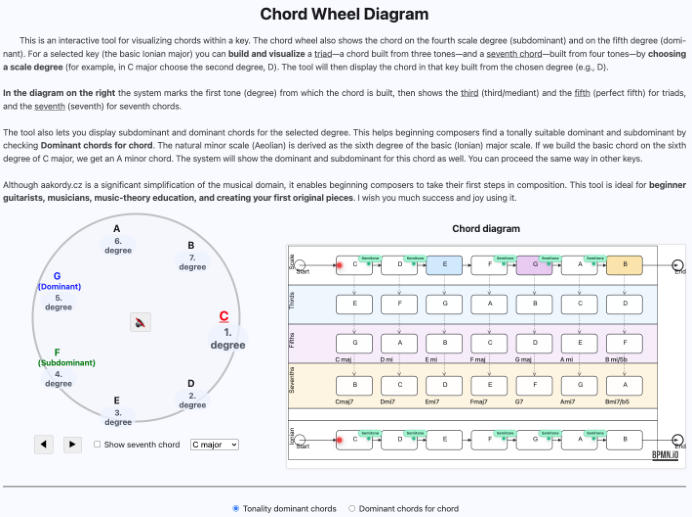
The experimental environment was implemented as an interactive graphical application combining circular harmonic visualization with simplified progression-oriented interaction elements. The interface was intentionally designed to minimize textual instructions and encourage visual exploration in order to reveal natural interaction strategies across different user groups. The central element of the application was the Chord Wheel Diagram, which displayed tones and harmonic relationships within a selected musical scale using a circular arrangement. Users could interact with individual elements of the diagram and visually explore relationships between tones, chords, and harmonic transitions. The circular structure intentionally differed from conventional linear navigation models commonly used in traditional graphical interfaces. In addition to the harmonic wheel itself, the interface also incorporated simplified progression-oriented visualization inspired by BPMN-based harmonic representations introduced in previous studies (Pavlicek et al., 2024). This additional component allowed users to observe sequential harmonic movement while simultaneously interacting with spatial tonal structures. The visual design emphasized simplicity, contrast, and direct manipulation principles in order to reduce unnecessary interface complexity during experimental observation.
Figure 1: Presents the experimental interface used during the study. Source https:// www.aakordy.cz.
Participants The study involved participants from two generational groups: Boomers and Generation Z users. The groups were selected in order to compare differences in navigation behavior, interaction expectations, and visual interpretation strategies across significantly different technological and cognitive backgrounds.
Participants did not require advanced musical education or formal theoretical knowledge. This approach was intentionally chosen to ensure that observed interaction behavior primarily reflected visual reasoning and exploratory interaction patterns rather than expert musical competence.
Experimental Tasks Participants were asked to complete exploratory tasks focused on identifying tonal relationships, navigating harmonic structures, and interpreting chord progression patterns within the graphical interface.
The tasks intentionally combined a familiar conceptual domain with a non- traditional visual structure. Music was selected because most users possess at least basic intuitive familiarity with musical concepts, while the circular harmonic representation required participants to rely on visual orientation and interaction reasoning rather than memorized procedural workflows.
The experiment focused particularly on how users approached:
navigation,
visual exploration,
interaction sequencing,
interpretation of spatial relationships,
and recovery from incorrect interaction decisions.
Observation Criteria The experimental observations focused primarily on qualitative behavioral characteristics associated with interaction strategies and usability perception. The monitored interaction parameters included:
preference for sequential or exploratory navigation,
reaction to visual feedback,
hesitation during interaction,
visual orientation patterns,
interaction speed,
error recovery behavior,
and adaptability to non-linear interface structures.
Special attention was given to differences between explicit guidance expectations observed among Boomers and more exploratory interaction tendencies observed among Generation Z participants.
RESULTS AND DISCUSSION
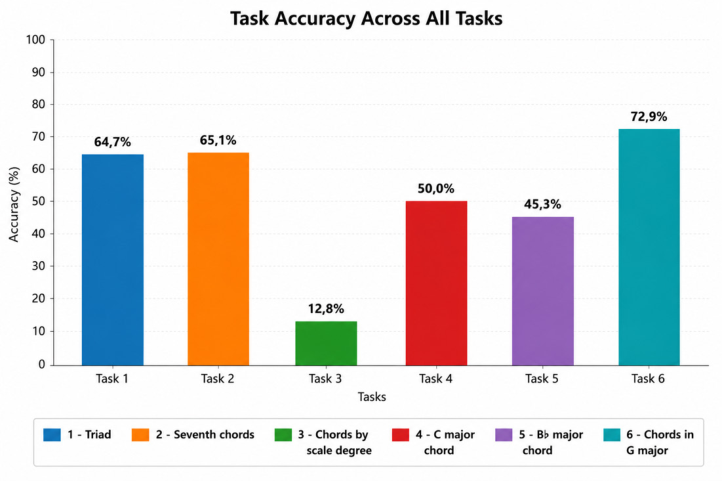
Overall Task Performance The experimental results revealed substantial differences in performance across individual tasks. Tasks supported by strong visual representation achieved the highest accuracy, particularly Task 6 focused on chord identification in G major (72.9%) and Tasks 1–2 involving standard harmonic structures.
In contrast, Task 3, which required abstract theoretical reasoning without strong visual guidance, achieved significantly lower accuracy (12.8%). This result suggests that users strongly depend on visual scaffolding when navigating unfamiliar conceptual structures.
Tasks involving standard major chord identification achieved moderate accuracy levels, while tasks containing accidentals and less familiar tonal structures introduced additional cognitive difficulty for non-musically trained participants.
Table 1: Summarizes overall task accuracy.
Table available in the original PDF paper.
Task Description Accuracy (%) 64,7% 1 - Triad In C major, when you move to the V degree, which chord do you build? Define tones.
65,1%
2 - Seventh chords In C major, when you move to the V degree, which chord do you build? Define tones.
In A major, build chords on degrees II and III 12,8%
3 - Chords by scale degree
4 - C major chord In C major, the chord on degree VII is… 50.0 % 5 - B♭ major chord In B♭ major, the chord on degree VII is… 45.3%
6 - Chords in G major Identification of chords in the key of G major 72.9%
Generational Differences The comparison between generational groups revealed noticeable differences in interaction strategies and task performance. Senior participants and Boomers/Gen X users generally achieved higher accuracy in analytically structured tasks requiring symbolic reasoning and sequential interpretation.
Generation Z participants demonstrated substantially stronger performance in visually guided exploratory tasks, particularly in Task 6, where the circular harmonic visualization provided direct visual orientation support. However, this group achieved very low accuracy in Task 3, which relied primarily on abstract theoretical reasoning without explicit visual scaffolding.
These findings suggest that older participants relied more strongly on analytical and rule-based reasoning strategies, while younger users depended more heavily on visual navigation cues and exploratory interaction patterns.
Figure 2: Illustrates the performance differences across age groups.
DISCUSSION
The experimental results indicate measurable differences between generational groups in navigation behavior, task-solving strategies, and interpretation of visually structured information. The observed differences between Boomers, Seniors, and Generation Z participants are consistent with previous studies describing generational variation in interface interaction and usability perception (Mao et al., 2025; Knogler, 2020).
The lowest performance was observed in Task 3, which required abstract theoretical reasoning without strong visual support. In contrast, tasks based on direct visual representation achieved substantially higher accuracy across most participant groups. These findings correspond with previous research showing that visual representation can improve understanding of abstract structures and reduce cognitive complexity during problem solving (Mayer, 2009; Bunks et al., 2022). The experiment also revealed differences in preferred interaction strategies. Older participants more frequently applied sequential and rule-based reasoning approaches, while Generation Z participants performed better in tasks supported by direct visual orientation and exploratory interaction. At the same time, younger participants achieved significantly lower accuracy in tasks requiring symbolic interpretation without visual assistance.
This behavior corresponds with the interaction patterns described in studies focused on digitally conditioned cognitive habits and exploratory navigation behavior (Prensky, 2001; Marchionini, 1989).
Approache to User Interface Usability Driven by Changing Mental Models 207 From the perspective of human-centered design, the results suggest that interface usability depends not only on technical correctness or interface consistency but also on the relationship between interface structure and users’ cognitive expectations. The findings indicate that different user groups may require different levels of visual guidance, interaction simplicity, and structural explicitness when working with complex visual systems.
The study also confirms that music-oriented graphical environments can be used as suitable experimental systems for observing interaction behavior and usability differences across generations. The Chord Wheel Diagram combines spatial organization, symbolic interpretation, and exploratory interaction within a single visual structure, making differences in navigation behavior relatively easy to observe.
Future work may extend the study through larger participant groups, statistical evaluation, eye-tracking analysis, and adaptive interface mechanisms capable of responding dynamically to different interaction patterns.
CONCLUSION
This paper presented a comparative usability study focused on generational differences in interaction behavior and mental models using an experimental visual music interface based on the Chord Wheel Diagram. The study investigated how Boomers, Seniors, and Generation Z users interact with visually structured harmonic systems and how these differences influence task-solving strategies and interface usability.
The experimental results demonstrated that participants achieved substantially better performance in tasks supported by direct visual representation than in tasks requiring abstract symbolic reasoning without explicit visual guidance. The findings also revealed noticeable generational differences in interaction behavior. Older participants more frequently applied sequential and rule-based reasoning strategies, while younger users relied more strongly on exploratory interaction and visual orientation.
From the perspective of human-centered design, the study suggests that usability cannot be considered a universally fixed property of an interface. Instead, usability appears to depend significantly on the relationship between interface structure, visual representation, prior experience, and users’ cognitive expectations. These findings indicate that future interactive systems may benefit from adaptive interface approaches capable of responding to different cognitive and navigational preferences across user groups.
The study also demonstrated that music-oriented visual systems provide a suitable experimental environment for observing interaction behavior in cognitively demanding exploratory tasks. The Chord Wheel Diagram combines symbolic interpretation, spatial organization, and visual navigation within a compact graphical structure, making interaction differences relatively easy to observe and compare.
Although the study was intentionally designed as an exploratory usability experiment, the obtained results indicate several directions for future research. Future work may include larger participant groups, statistical
validation, eye-tracking analysis, and adaptive interface mechanisms capable of dynamically modifying visual interaction structures according to user behavior and cognitive preferences.
REFERENCES
Bunks, C., Weyde, T., Slingsby, A., Wood, J., 2022. Visualization of Tonal Harmony for Jazz Lead Sheets. EuroVis 2022 - Short Pap. 109–113. https://doi.org/10.2312/ EVS.20221102 Chew, E., 2014. Mathematical and Computational Modeling of Tonality: Theory
and Applications, International Series in Operations Research & Management Science. Springer US, Boston, MA. https://doi.org/10.1007/978-1-4614-9475-1 Harasim, D., Affatato, G., Moss, F.C., 2022. midiVERTO: A Web Application to Visualize Tonality in Real Time, in: Montiel, M., Agustín-Aquino, O.A., Gómez, F., Kastine, J., Lluis-Puebla, E., Milam, B. (Eds.), Mathematics and Computation in Music, Lecture Notes in Computer Science. Springer International Publishing, Cham, pp. 363–368. https://doi.org/10.1007/978-3-031-07015-0_31 Knogler, V., 2020. Viewing Behaviour and Task Performance on Austrian Destination
Websites: Comparing Generation Y and the Baby Boomers, in: Rainoldi, M., Jooss, M. (Eds.), Eye Tracking in Tourism, Tourism on the Verge. Springer International Publishing, Cham, pp. 225–241. https://doi.org/10.1007/978-3-030-49709-5_14 Mao, J., Lyu, B., Lin, K., Pan, X., 2025. Applying Prototype Theory to Assess Generational Divide in Usability of Icons Depicting Product Appearance. Int. J. Human–Computer Interact. 41, 13151–13174. https://doi.org/10.1080/1044731 8.2025.2470281 Marchionini, G., 1989. Information-seeking strategies of novices using a full-text
https://doi.org/10.1017/CBO9780511811678 Nielsen, J., 1993. Usability Engineering, Interactive Technologies. Morgan Kaufmann Publishers, San Francisco, CA, USA. https://doi.org/10.1016/C2009-0-21512-1 Paiement, J.-F., Eck, D., Bengio, S., 2006. Probabilistic Melodic Harmonization, in:
Tawfik, A.Y., Goodwin, S.D. (Eds.), Advances in Artificial Intelligence, Lecture Notes in Computer Science. Springer Berlin Heidelberg, Berlin, Heidelberg, pp. 218–229. https://doi.org/10.1007/11766247_19 Pavlicek, J., Molhanec, M., Pavlíčková, P., 2025. THE CHORD WHEEL DIAGRAM: A VISUAL FRAMEWORK FOR GUITAR HARMONY SUPPORTED BY BPMN. Presented at the 18th annual International Conference of Education, Research and Innovation, Seville, Spain, pp. 5747–5755. https://doi.org/10.21125/ iceri.2025.1584 Pavlicek, J., Pavlickova, P., Brnka, M., Rydval, J., 2024. BPMN for Displaying the
Progression of Musical Harmony and Chords - Case Study, in: Almeida, J.P.A., Di Ciccio, C., Kalloniatis, C. (Eds.), Advanced Information Systems Engineering Workshops, Lecture Notes in Business Information Processing. Springer Nature Switzerland, Cham, pp. 264–274. https://doi.org/10.1007/978-3-031-61003- 5_23 Pavlicek, J., Pavlickova, P., Strausova, I., 2026. Human-Centered Harmonic Analysis of the Beatles’ Yesterday: Chord Wheel, Process Diagrams, and Eye-Tracking Insights. Presented at the 9th International Conference on Human Intelligent Systems Integration (IHSI 2026): Disruptive and Innovative Technologies. https:// doi.org/10.54941/ahfe1007097
Approache to User Interface Usability Driven by Changing Mental Models 209 Pavlicek, J., Rod, M., Pavlickova, P., 2021. Usability Evaluation of Business Process
Modeling Standards – BPMN and BORM Case Study, in: Polyvyanyy, A., Rinderle-Ma, S. (Eds.), Advanced Information Systems Engineering Workshops, Lecture Notes in Business Information Processing. Springer International Publishing, Cham, pp. 93–104. https://doi.org/10.1007/978-3-030-79022-6_9 Prensky, M., 2001. Digital Natives, Digital Immigrants Part 1. Horiz. 9, 1–6. https:// doi.org/10.1108/10748120110424816 Read, J.C., MacFarlane, S., Casey, C., 2003. What’s going on?: discovering what
children understand about handwriting recognition interfaces, in: Proceedings of the 2003 Conference on Interaction Design and Children. Presented at the IDC03: Interaction Design and Children, ACM, Preston England, pp. 135–140. https:// doi.org/10.1145/953536.953555 Xu, Y., Liu, Y., Xu, H., Tan, H., 2024. AI-Driven UX/UI Design: Empirical Research and Applications in FinTech. Int. J. Innov. Res. Comput. Sci. Technol. 12, 99–109. https://doi.org/10.55524/ijircst.2024.12.4.16 Zhou, S., Zheng, W., Xu, Y., Liu, Y., 2024. Enhancing User Experience in VR
Environments through AI-Driven Adaptive UI Design. J. Artif. Intell. Gen. Sci. JAIGS ISSN3006-4023 6, 59–82. https://doi.org/10.60087/jaigs.v6i1.230
FIND THE COMPLETE VOLUME IN THE AHFE DIGITAL BOOKSTORE
Explore the complete digital volume
Human Systems Engineering and Design (IHSED2026): Future Trends and Applications
Read this individual research paper free through the original publisher, or explore the full digital proceedings book.