Mizuki Yamawaki, Yoshiki Sakamoto, Rieko Yamamoto, Kimi Ueda, Hirotake Ishii, Hiroshi Shimoda, Kyoko Ito (2022). Investigation of experimental methods for clarifying the mechanism of consensus building. In: Intelligent Human Systems Integration (IHSI 2022): Integrating People and Intelligent Systems. AHFE Open Access, vol. 22. https://doi.org/10.54941/ahfe1001079
From risk communication for solving social issues such as global warming and nuclear power problems to everyday situations such as deciding where to go out to eat among friends, we are engaged in consensus building on a daily basis. In consensus building, conflicts may occur due to the clash of opinions, sensibility communication is important for such problems. By examining the influence of emotional aspect in consensus building, suggestions on how to achieve amicable consensus building may be obtained. However, methods for observing and analyzing consensus building with high temporal resolution from the viewpoint of emotional aspect have not been established. Therefore, the purpose of this study was to examine the appropriate experimental method for clarifying the consensus formation mechanism. Specifically, through preliminary experiments, we examined: whether the method of measuring emotional aspect is appropriate, and what kind of themes are appropriate for consensus building . With regard to the theme, since it is important to deal with conflicts in actual consensus building, it was especially important that the theme be such that conflicts would occur. Six graduate students participated in the experiment, working in pairs to conduct the experiment in three groups. Consensus building was done twice for each pair. Four consensus-building themes were prepared: (A) Planning to entertain friends from overseas, (B) Devising a way to convince people who distrust science, (C) Devising a motto to promote tourism in Kyoto and (D) Guessing the favorite flower from a woman's profile. These themes were randomly applied to each consensus building. To facilitate later analysis of the content of the dialogue, the text chat tool was used for the consensus-building dialogue. The items to be measured were: satisfaction with the entire discussion up to that point, satisfaction with the other person's statement, and compromise with one's own statement and so on. During the dialogue, the modal for measurement appeared on the screen at regular intervals, and the dialogue could be resumed by responding to it. After the consensus-building was completed, the participants were asked to answer a questionnaire about their impressions of the experiment. Not much conflict was observed in themes (A), (B) and (D). Representative opinions about those themes are as follows: (A) "There was a lot to think about, and I couldn't fully express what I wanted to say", (B) "Too difficult”, and (D) "It was difficult to have my own opinion, so I did not have to give a counterargument". The most conflicts were observed in (C). This may be due to the appropriate level of difficulty and the fact that it was a theme where it was easy to have one's own opinion. In other words, the above factors are considered to be important for the task of observing consensus building. However, some participants mentioned that their thinking was interrupted by the appearance of the modal in the middle of the chat. Therefore, the future task is to devise and implement a measurement method that is less likely to interfere with consensus building.
Intelligent Human Systems Integration (IHSI 2022): Integrating People and Intelligent Systems https://openaccess.cms-conferences.org/#/publications/book/978-1-7923-8988-7
INTRODUCTION
We are building consensus every day, from discussions about solving social problems to everyday conversations. Consensus building is defined as a process of seeking unanimous agreement(Susskind et al., 1999). In recent years, with the spread of chat tools such as Whatsapp(WhatsApp LLC, 2022) and Facebook Messenger(Meta, 2022), there are more and more opportunities for consensus building through text chat as well as face-to-face. Although text chat is highly convenient and popular as a means of communication, misunderstandings often occur because it is difficult to express actual emotions(Minakuchi et al.). In particular, since consensus building requires moving toward unanimity even when there are conflicting opinions, conflicts, which are clashes of opinions, may occur in the process. For this reason, this study focused on consensus building through text chat.
For the problem of conflicts in consensus building, Hamada et al. have described the importance of Kansei communication(Hamada and Shoji, 2017). By investigating the influence of Kansei on consensus building, suggestions on how to achieve amicable consensus building may be obtained. Here, in this study, "Kansei" was defined as "the intuitive ability to respond to the multifarious and ambiguous information contained in an object."
RELATED WORKS AND PURPOSE With regard to consensus building, Inoue et al. videotaped a class in an elementary school that included whole-class consensus building, and interviewed the teacher after the consensus building(Inoue et al., 2019). Through this, they examined the actions that teachers should take in order to make consensus building effective. Francesca et al. also cited the lack of consensus building as the cause of problems in the construction of bicycle lanes in Italian cities(Pagliara and Biggiero, 2014). Thus, there are many studies that investigate the methodology and usefulness of consensus building. In addition, Kwon et al. proposed and implemented an algorithm to shorten the time to reach a consensus by considering the preferences and values among users(Kwon, 2009). In this way, there are some studies that consider Kansei in consensus building. However, there have not been many studies that have acquired and analyzed real-time Kansei with high temporal resolution in the actual consensus building process. Therefore, a method for observing and analyzing consensus building with high temporal resolution from the viewpoint of Kansei has not been established. Therefore, the purpose of this study was to examine an appropriate experimental method for clarifying the consensus formation mechanism. Specifically, through preliminary experiments, we examined: whether the method of measuring emotional aspect is appropriate, and what kind of themes are appropriate for consensus building. With regard to the theme, since it is important to deal with conflicts in actual consensus building, it was especially important that the theme be such that conflicts would occur.
Intelligent Human Systems Integration (IHSI 2022): Integrating People and Intelligent Systems https://openaccess.cms-conferences.org/#/publications/book/978-1-7923-8988-7
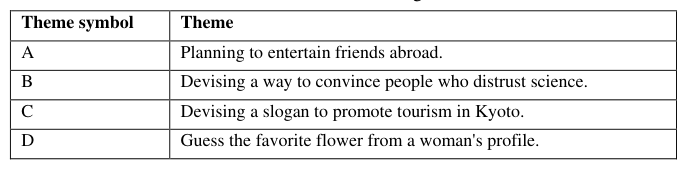
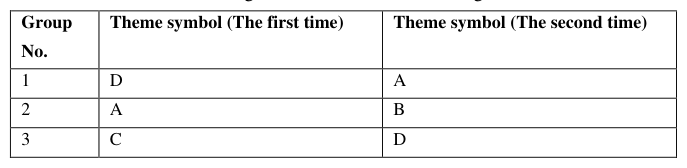
EXPERIMENTAL METHOD AND ITS DESIGN Six graduate students belonging to the author's graduate school participated in the experiment, working in pairs to conduct the experiment in three groups. The participants know each other, but the consensus building takes place in a separate room, and neither knows who the other is. Consensus building was done twice for each pair. The consensus building themes and their assignments are shown in Table 1 and Table 2.
Table 1: Consensus building themes
D Guess the favorite flower from a woman's profile. Theme A was chosen because by assuming a third party, a friend, it is thought that others will evaluate the conclusions reached through consensus building, and they would engage in active discussions. It is thought that this would be effective because the more active the discussion, the longer the dialogue would be and the more data would be obtained. Theme B was chosen because thinking about how to persuade people who distrust science would require us to share our scientific knowledge with each other, which would deepen the discussion. In addition, it is thought that it would be easy for graduate students to discuss science because it is a relatively familiar topic to them. The motivation for choosing Theme C was that in order to come up with a motto, participants needed to discuss the attractiveness of the region, and we thought that this would stimulate discussion. Since it requires knowledge of the area, this study chose Kyoto, the location of participant's laboratory, as the stage. The motivation for choosing Theme D was that, unlike Themes A to C, it had prepared answers. In Themes A to C, there was no right or wrong answer, no matter what the answer was. Therefore, it was possible that the motivation for consensus building would not be high and the discussion would not be active. For this reason, we also prepared a theme for guessing the correct answer.
Table 2: Assignment of consensus building themes Group Theme symbol (The first time) Theme symbol (The second time)
Intelligent Human Systems Integration (IHSI 2022): Integrating People and Intelligent Systems https://openaccess.cms-conferences.org/#/publications/book/978-1-7923-8988-7
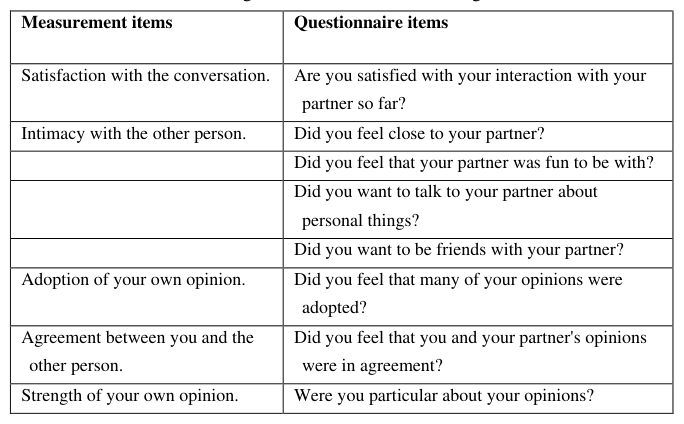
Table 3: Assignment of consensus building themes Measurement items Questionnaire items
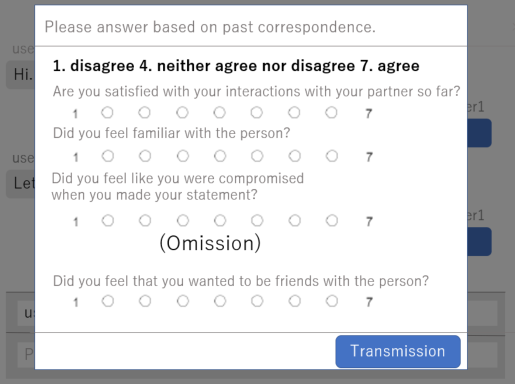
Measurement items and questionnaire items are shown in Table 3. We measured satisfaction because it is believed to be important in consensus building because satisfaction determines whether stakeholders accept a proposal or not(Robertson and Choi, 2012). We measured the sense of compromise because compromise is often necessary to resolve conflicts and disagreements in planning, and is especially important when consensus cannot be reached immediately(Chan and Protzen, 2016). Since preliminary experiments prior to this experiment showed that it was difficult to see changes using the 5-case method, the 7-case method (1~7) was used. Several other items were measured in order to broadly examine what factors are associated with consensus building mechanisms.
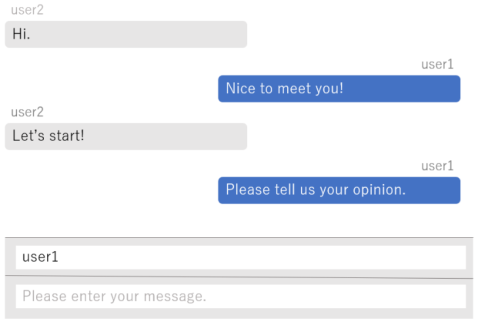
In this study, one-on-one dialogue was conducted because the dialogue relationship is easy to understand and analyze. The chat tools used in this study are shown in Figure 1.
During the dialogue, the pop-up window shown in Figure 2 appeared every 90 seconds, and the dialogue could be restarted by answering to measurement items. After the consensus building was completed, the participants were asked to answer a questionnaire about their impressions of the experiment.
Intelligent Human Systems Integration (IHSI 2022): Integrating People and Intelligent Systems https://openaccess.cms-conferences.org/#/publications/book/978-1-7923-8988-7
Figure 1: Screenshot of the text chat system.Figure 2: Screenshot of pop-up window.
RESULT AND DISCUSSIONS Consensus Building Themes
Not much conflict was observed in themes (A), (B) and (D). Representative opinions about those themes are as follows: (A) "There was a lot to think about, and I couldn't fully express what I wanted to say", (B) "Too difficult”, and (D) "It was difficult to have my own opinion, so I did not have to give a counterargument". The most conflicts were observed in (C). This can be attributed to the moderate level of
Intelligent Human Systems Integration (IHSI 2022): Integrating People and Intelligent Systems https://openaccess.cms-conferences.org/#/publications/book/978-1-7923-8988-7 difficulty and the fact that the topic was easy to have one's own opinion on. In other words, the above factors are considered important in the task of observing consensus building. Measurement Method and Items
In the questionnaires, some people said that it was difficult to understand the intention of the questions such as "Did you want to talk to the person about personal things?" It was also mentioned that it was difficult for them to feel that they wanted to be friends only by building consensus through text chatting because of the short time. Another opinion was that it was difficult to answer many question items because the frequency of questions was as high as every 90 seconds. Therefore, it is considered necessary to reduce the number of questions by cutting items that are considered to have little relevance to consensus building as described above. Another comment was that the appearance of a pop-up window in the middle of a chat interrupted thinking. Therefore, it is necessary to devise and implement a measurement method that is less likely to interfere with consensus building.
CONCLUSION
This study examined the appropriate experimental method for clarifying the consensus building mechanism. As a result, it was found that it was necessary to reduce the amount of items to be measured so as not to burden the participants in the experiment. In addition, it became clear which experimental themes were important for stimulating discussion. However, with regard to the themes mentioned in this report, "I don't know if this is consensus building. I think it's more like cocreation." In actual consensus building, as represented by risk communication in nuclear power plants, there are often conflicts of interest among participants in consensus building. None of the research themes this time had any conflicts of interest among the participants. Consensus building themes can be made more appropriate by considering the setting of themes that generate interest relationships.
In the future, it is important to devise a method that can cause more conflicts, which is considered to be a problem in consensus building, by setting themes in which participants have interests, or by considering extrinsic incentives such as financial incentives.
ACKNOWLEDGMENTS
This work was supported by JSPS KAKENHI Grant Number 20H01748.
Intelligent Human Systems Integration (IHSI 2022): Integrating People and Intelligent Systems https://openaccess.cms-conferences.org/#/publications/book/978-1-7923-8988-7
REFERENCES
Chan, J.K.H., and Protzen, J-P. (2016), “Between conflict and consensus: Searching for an ethical compromise in planning.” Planning Theory, 17, 170-189. Hamada, Y., and Shoji, H. (2017), “A study on the feature analysis of the success
pattern of consensus building processes. ” Transactions of Japan Society of Kansei Engineering, 16, 43-50. Inoue, N., Asada, T., Maeda, N., and Nakamura, S. (2019), “Deconstructing teacher expertise for inquiry-based teaching: Looking into consensus building pedagogy in Japanese classrooms.” Teaching and Teacher Education, 77, 366-377. Kwon, O. (2009), “A two-step approach to building bilateral consensus between
agents based on relationship learning theory.” Expert Systems with Applications, 36, 11957-11965. Meta, https://www.messenger.com (Last accessed: 2022-01-12) Minakuchi, M., Kinoshita, S., and Suzuki, Y. (2012), “Yusabutter: a messaging tool that generates animated text.” Advances in Computer Entertainment, 541- 544. Pagliara, F., and Biggiero, L. (2014), “Decision Support Systems and Consensus
Building: The Case Study of the First Bike Lane in the City of Napoli in Italy. ” Procedia - Social and Behavioral Sciences, 111, 480-487. Robertson, P., and Choi, T. (2012), “Deliberation, Consensus, and Stakeholder Satisfaction” Public Management Review, 14, 83-103. Susskind, L.E., McKearnen, S., and Thomas-Lamar, J. (1999), “The consensus
building handbook: A comprehensive guide to reaching agreement.” Sage publications. WhatsApp LCC, https://www.whatsapp.com (Last accessed: 2022-01-12)
Intelligent Human Systems Integration (IHSI 2022): Integrating People and Intelligent Systems https://openaccess.cms-conferences.org/#/publications/book/978-1-7923-8988-7
LISTED IN THE AHFE DIGITAL BOOKSTORE CATALOGUE
Explore the complete digital volume
Intelligent Human Systems Integration (IHSI 2022): Integrating People and Intelligent Systems
Read this individual research paper free through the original publisher, or explore the full digital proceedings book.
ISBN 978-1-7923-8988-7
Explore this ISBN in the AHFE Bookstore ↗Listed in the July 2026 bookstore catalogue; search by ISBN to confirm current availability · Digital book purchase optional