Clemence Drogoul, Berenice Delwiche, Fabrice Drogoul, Olivier Mairesse (2026). Assessing Signal Detection Performance Under Operational Fatigue in Air Traffic Controllers. In: Advances in Human Factors of Transportation. AHFE Open Access, vol. 224, pp. 73–85. https://doi.org/10.54941/ahfe1007835
Fatigue and sleepiness are critical safety issues for air traffic controllers (ATCOs) that impair cognitive performance and vigilance (Bendak & Rashid, 2020; Wingelaar-Jagt et al., 2021). They typically result from insufficient or disrupted sleep, extended duty periods, and work schedules misaligned with circadian rhythms, common in ATCO operations (Bendak & Rashid, 2020 ; Eastman & Smith, 2012 ; Wingelaar-Jagt et al., 2021). This study quantified signal detection performance in ATCOs compared to healthy controls and examined how performance varies across day and night shifts and evolves over a shift. Seventeen licensed ATCOs working rotating shifts completed a 3-minute Behavioural Sleep Resistance Task (BSRT) before their shift, during a break, and after the shift. A laboratory reference group of 36 healthy young adults following 20 hours of wakefulness served as a fatigue benchmark. The BSRT measured processing speed, attentional lapses, neurobehavioral stability, and omission errors, completed by Karolinska Sleepiness Scale (KSS) ratings. Results showed progressive cognitive slowing, increased reaction times and reduced optimal responses. Attentional lapses accumulated over time and neurobehavioral stability declined, particularly during night shifts. Despite these effects, omission errors remained low, indicating maintained task engagement. Subjective sleepiness increased across shifts and was higher at night. Comparison with laboratory benchmarks indicated that some impairments were present pre-shift, suggesting sustained baseline fatigue from cumulative sleep restriction and incomplete recovery. Findings highlight the combined influence of time-on-task and circadian vulnerability on vigilance, with ATCOs employing compensatory strategies that trade speed for accuracy to maintain operational safety.
Air traffic control (ATC) is a high-stakes socio-technical system where cognitive functions such as vigilance, divided attention, conflict anticipation, and rapid decision-making are critical for safety (Arico et al., 2017; Yazgan et al., 2021). Even minor attentional lapses can therefore trigger a cascade of operational failures (Hu & Lodewijks, 2020; Yazgan et al., 2021).
Fatigue is a major contributor to performance degradation in safety- critical domains, including aviation. Human factors are estimated to account for approximately 70–75% of aviation incidents, with fatigue implicated as a contributing factor in a substantial proportion of major accidents (Bendak & Rashid, 2020; Pan et al., 2024; Wingelaar-Jagt et al., 2021; Yazgan et al., 2021). In ATC, 24/7 operations and irregular shifts exacerbate fatigue risk by disrupting circadian rhythms and restricting sleep, increasing homeostatic sleep pressure (Boivin et al., 2021; Caldwell et al., 2018; Chang et al., 2019 ; Eastman & Smith, 2012; Ganesan et al., 2019; Peukert et al., 2025). Performance impairments associated with fatigue such as slower reaction times, increased attentional lapses, impaired judgment, and reduced accuracy, tend to worsen with time-on-task and are amplified during night shifts (Bendak & Rashid, 2020; Caldwell et al., 2018; Chang et al., 2019; Peukert et al., 2025; Williamson et al., 2010). However, despite extensive laboratory research on sleep deprivation and vigilance, field studies conducted under real operational conditions remain limited, particularly regarding vigilance performance across shifts.
Traditional fatigue assessment in ATC relies on subjective self-report scales, such as the Karolinska Sleepiness Scale or the Samn–Perelli Scale. While practical, these tools are vulnerable to reporting bias and may underestimate impairment (Pan et al., 2024; Peukert et al., 2025). Objective physiological methods, including electroencephalography or eye-tracking, provide greater sensitivity but are impractical for field use (Pan et al., 2024). Behavioural tasks, such as the Behavioural Sleep Resistance Task (BSRT) and the Psychomotor Vigilance Test (PVT), offer a feasible alternative, providing robust indices of sustained attention, reaction time slowing, and attentional lapses under sleep pressure (Mairesse et al., 2009; Basner et al., 2011). Shortened versions of these tasks are particularly well suited for field use, as they can be repeatedly administered during work shifts with minimal disruption (Basner et al., 2011).
The objective of the present study was to quantify vigilance in licensed ATCOs using a brief BSRT administered under real operational conditions. To contextualize performance, ATCO results were compared with laboratory reference data obtained from healthy participants following extended wakefulness. Based on existing literature, we hypothesized that (1) vigilance performance would deteriorate progressively across the shift, reflecting time- on-task effects (Hudson et al., 2019; Vieten et al., 2026), and (2) night shifts would be associated with greater subjective sleepiness, slower reaction times, and increased attentional lapses compared to daytime shifts (Bendak & Rashid, 2020; Chang et al., 2019; Ganesan et al., 2019; Härmä et al., 2002; Hudson et al., 2019; Peukert et al., 2025; Vieten et al., 2026).
METHODS
Participants Seventeen licensed en-route ATCOs participated in the study (mean age = 42.1 years, SD = 8.67; median = 41). All participants were employed at an operational area control centre and worked rotating shift schedules including
Assessing Signal Detection Performance Under Operational Fatigue 75 daytime and nighttime duties. Participation was voluntary, and all data were anonymized prior to analysis.
Study Design and Procedure The study employed a repeated-measures field design to assess fatigue-related vigilance performance under real operational conditions. ATCOs completed a brief vigilance task at multiple time points across different shift types. Task sessions were scheduled to minimize disruption to operational duties and were completed on standard workstations. A total of 513 BSRT sessions were collected. After exclusion of sessions with incomplete recordings or technical failures, 471 valid measurements were retained for analysis.
Shift Type and Session Timing Shifts were categorized based on scheduled start and end times. Morning (approximately 04:00–12:00) and day shifts (approximately 09:00–18:00) were grouped as daytime shifts (332 measurements). Evening (approximately 16:00–00:00) and night shifts (approximately 22:00–06:00) were grouped as nighttime shifts (139 measurements). Each BSRT session was classified according to its timing relative to the shift: before the shift (within one hour prior to start; 158 sessions), during a scheduled break (165 sessions), or after the shift (within one hour following shift completion; 148 sessions).
Vigilance Task: Behavioural Sleep Resistance Task Vigilance was assessed using a shortened, 3-minute version of the BSRT, a computerized sleep resistance paradigm derived from the Oxford SLEep Resistance (OSLER) test (Mairesse et al., 2009). The BSRT presents visual stimuli at fixed 3-second intervals, creating a monotonous signal-detection environment that challenges sustained attention and resistance to sleep onset. Participants responded as quickly and accurately as possible to target stimuli using a single button while maintaining fixation on the screen. The effective task duration was 2 minutes 57 seconds, as the final stimulus was not recorded. The abbreviated version was chosen based on prior validation showing that shortened vigilance tasks remain sensitive to fatigue-related impairments in operational settings (Basner et al., 2011; Benderoth et al., 2021).
Outcome Measures BSRT performance metrics were grouped into four functional domains:
1. Cognitive and Processing Speed, assessed using mean and median reaction times (RTs) and the proportion of responses within the optimal response domain (ORD). 2. Attentional Lapses, assessed using lapse count and lapse rate (RT > 500 ms).
3. Neurobehavioral Stability, assessed using reaction time variability measures, including standard deviation (SD) and interpercentile range (IPR). 4 Omission Errors, assessed using misses (RT > 1000 ms) and error profile indices (EP1–2, EP3–6).
Subjective Sleepiness Subjective sleepiness was assessed in conjunction with each BSRT session using the Karolinska Sleepiness Scale.
Laboratory Fatigue Benchmark To contextualize operational performance, ATCO results were compared with a laboratory reference dataset of 36 healthy young adults (21 males, 15 females; mean age = 23.41, SD = 3.66) who underwent 14–20 hours of wakefulness under controlled conditions. Objective sleepiness was assessed during the biological night using an EEG-monitored fixation task (Karolinska Drowsiness Test) and a 40-minute BSRT, while subjective sleepiness was measured with the KSS and a visual analogue scale. For comparability, the reference condition at 20 hours of wakefulness was selected, and only the first 3 minutes of the BSRT were analysed. ATCO performance was interpreted under the assumption that trained controllers should perform at least as well as healthy adults after controlled sleep deprivation.
Statistical Analysis Effects of shift type (daytime vs. nighttime) and session timing (pre-shift, break, post-shift) on BSRT outcome measures were analysed using repeated- measures analyses of variance (ANOVAs). When sphericity assumptions were violated, Greenhouse–Geisser corrections were applied. Holm-adjusted post hoc tests were used to control for multiple comparisons. To contextualize operational performance against laboratory benchmarks, one-sample Student’s t-tests were conducted comparing ATCO performance in each condition with the reference values obtained after 20 hours of continuous wakefulness. All analyses were conducted using Jamovi (version 2.6.45) and JASP (version 0.95.4).
Ethics This study involved a retrospective analysis of operational data collected prospectively as part of routine safety and human performance activities within EUROCONTROL. Data collection and analysis were reviewed and approved by the internal review board of EUROCONTROL and conducted in accordance with its safety management and human performance mandate. All data were anonymized prior to analysis.
RESULTS
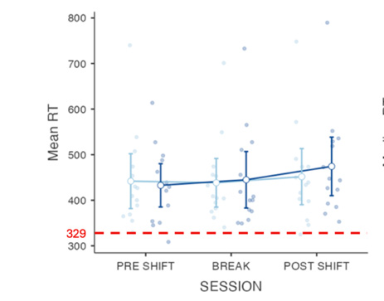
Cognitive and Processing Speed Reaction times increased significantly across sessions, reflecting fatigue- related cognitive slowing (Figure 1). Mean RT showed a significant main effect of Session, F(1.54, 20.04) = 6.85, p = .009, η²p = .345. Post-shift RTs were significantly slower than pre-shift RTs (p = .020), whereas pre- shift and break sessions did not differ. No significant main effect of Shift Type was observed, nor a Session × Shift Type interaction. Nevertheless, descriptively greater RT slowing was observed following Evening/Nighttime shifts compared to Daytime shifts.
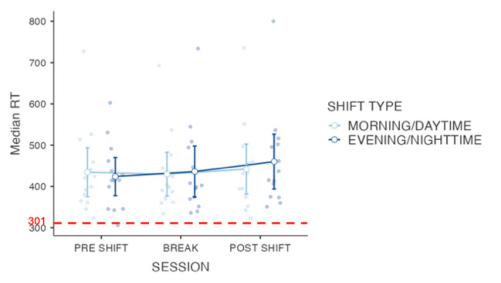
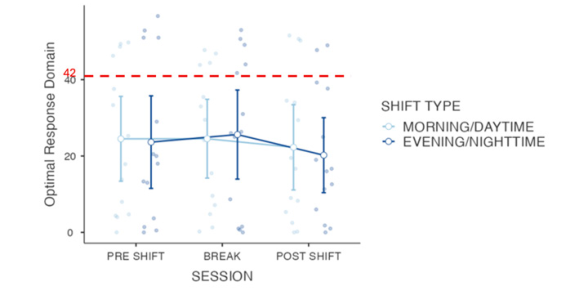
Median RT showed a comparable pattern, with a significant main effect of Session, F(1.59, 20.66) = 5.31, p = .019, η²p = .290, indicating progressive slowing across the shift (Figure 2). Effects of Shift Type and interaction were not significant, although median RT increases were descriptively larger during Evening/Nighttime shifts. The proportion of responses within the ORD showed a marginal main effect of Session, F(1.70, 22.13) = 3.34, p = .061, η²p = .205, indicating a tendency toward reduced optimal performance by the end of the shift (Figure 3). No main effect of Shift Type or interaction was observed. Descriptively, ORD declined more markedly after Evening/ Nighttime shifts.
Figure 1: Mean RT across sessions (dashed line = benchmark value).Figure 2: Median RT across sessions.Figure 3: ORD across sessions.
Comparison with Laboratory Sleep-Deprivation Benchmark Mean and median RTs were consistently longer than reference values (all ps < .001), with large effect sizes, indicating global slowing of processing speed across operational conditions. Similarly, the proportion of optimal responses was significantly reduced in all conditions, particularly following Evening/ Nighttime shifts.
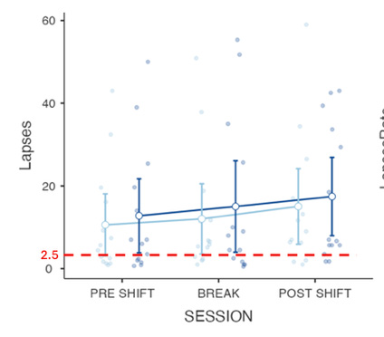
Attentional Lapses Lapse count increased across sessions, F(1.50, 19.47) = 4.21, p = .040, η²p = .245, peaking post-shift (Figure 4). No significant main effect of Shift Type or interaction was observed. Evening/Nighttime shifts exhibited descriptively higher lapse counts at all sessions.
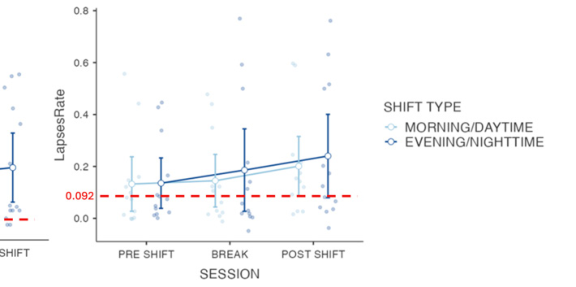
Lapse rate showed a marginal main effect of Session, F(1.19, 15.44) = 3.71, p = .067, η²p = .222, with the highest rates observed post-shift (Figure 5). Shift Type and interaction effects were non-significant. Exploratory post-hoc analyses revealed a significant pre- to post-shift increase in lapse rate during Daytime shifts (Holm-corrected p = .026).
Figure 4: Lapses across sessions.Figure 5: Lapse rate across sessions.
Comparison With Laboratory Sleep-Deprivation Benchmark Attentional lapses exceeded reference levels across most sessions, peaking post-shift, especially at night.
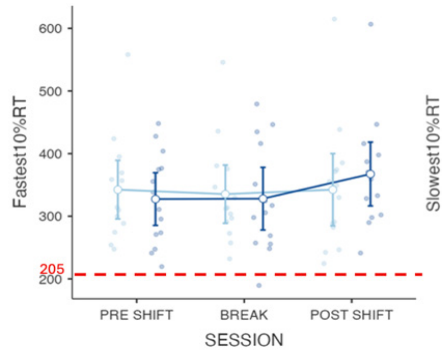
Neurobehavioral Stability Fastest 10% RTs showed a marginal Session effect, F(1.45, 18.88) = 3.90, p = .050, η²p = .231 and a significant Session × Shift Type interaction, F(1.76, 22.87) = 4.57, p = .025, η²p = .260, with Evening/Nighttime post- shift slowing (Figure 6).
Figure 6: Fastest 10% RT across sessions.
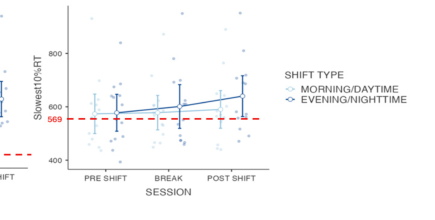
Slowest 10% RTs showed a significant Session effect, F(1.69, 21.98) = 6.96, p = .006, η²p = .349, reflecting progressive extreme slowing across the shift (Figure 7). The effect of Shift Type and the interaction were not significant, although Evening/Nighttime workers showed descriptively larger increases from pre- to post-shift.
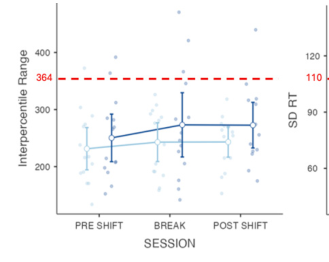
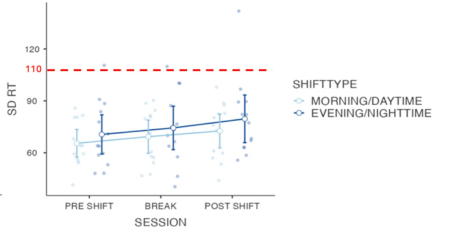
Neither IPR nor SD showed significant main effects of Session (Figures 8&9). However, both showed trends toward greater variability in Evening/Night shifts.
Figure 7: Slowest 10% RT across sessions.Figure 8: IPR across sessionsFigure 9: SD RT across sessions Comparison With Laboratory Sleep-Deprivation Benchmark
Fastest responses were slower than reference across all conditions, whereas slowest RTs emerged mainly post-night shift, indicating reduced stability.
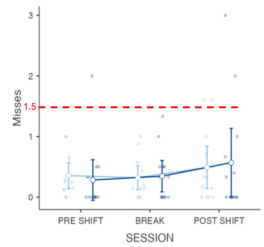
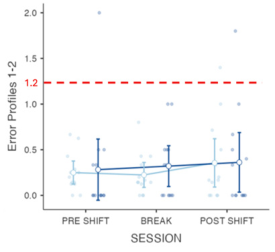
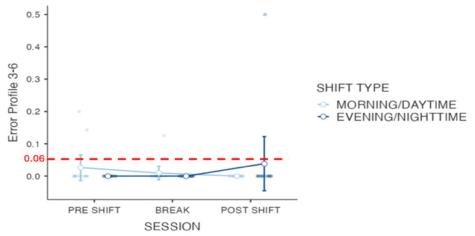
Errors of Omission Misses and error profiles remained low overall, with no significant effects of Session, Shift Type, or interactions (Figures 10, 11&12). Results were unchanged after removal of extreme values.
Figure 10: Misses across sessions.Figure 11: EP1-2 across sessions.Figure 12: EP3-6 across sessions.
Comparison With Laboratory Sleep-Deprivation Benchmark Omission errors were generally lower than laboratory benchmarks.
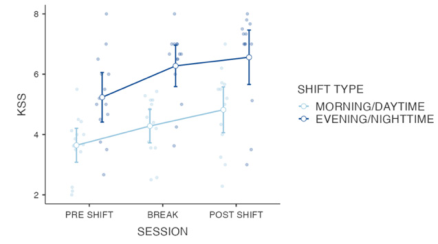
Subjective Sleepiness KSS scores showed a strong main effect of Session, F(1.49, 19.40) = 28.90, p < .001, η²p = .690, with sleepiness increasing across the shift (Figure 13). Significant increases were observed from Pre-shift to Break and from Pre- shift to Post-shift. A strong main effect of Shift Type was also observed, F(1, 13) = 42.34, p < .001, η²p = .765, with higher sleepiness reported during Evening/Nighttime shifts.
No significant Session × Shift Type interaction was observed, though Daytime workers reported moderate increases in sleepiness, whereas Nighttime workers reported consistently high levels throughout the shift.
Figure 13: KSS across sessions.
DISCUSSION
This study assessed ATCOs’ vigilance across day and night shifts, using laboratory benchmarks for context. Findings supported our hypotheses: (1) performance deteriorated progressively across the shift, reflecting time- on-task effects, and (2) night shifts showed greater subjective sleepiness, slower RTs, and more lapses than daytime shifts.
Time-on-Task Effects and Progressive Fatigue RTs slowed across the shift, with mean and median RTs increased from pre- to post-shift, reflecting reduced processing efficiency. In parallel, subjective sleepiness rose, supporting progressive fatigue. Lapse count and rate provided converging evidence for time-on-task effects as they increased across sessions, peaking post-shift. Compared to global RTs, lapse metrics were more sensitive to late-stage fatigue, suggesting discrete failures emerge once generalized slowing is established. This pattern aligns with vigilance decrement models, where sustained effort first reduces efficiency, then increases instability and lapses (Hudson et al., 2019).
Distributional analyses clarified this progression. Fastest RTs were slower than laboratory benchmarks across all sessions, indicating reduced peak processing capacity even at shift onset, while extreme slowing in the slowest responses appeared mainly after night shifts. These results support two-stage fatigue models: optimal performance declines first, followed by destabilization and episodic attentional failures under higher fatigue load (Hudson et al., 2019).
Shift Timing and Circadian Influences Nighttime shifts showed descriptively slower RTs, more lapses, and reduced optimal performance, though many of these effects were not statistically significant in isolation. However, circadian vulnerability emerged in interaction effects. Fastest RTs remained relatively stable early in night shifts but deteriorated post-shift, indicating a selective degradation of maximal alertness toward the end of nighttime operations. Subjective sleepiness was
Assessing Signal Detection Performance Under Operational Fatigue 83 also consistently higher during night shifts across all sessions. This suggests circadian factors may amplify fatigue-related impairments late in the shift, when homeostatic sleep pressure and circadian misalignment coincide (Peukert et al., 2025).
Evidence for Sustained Baseline Fatigue ATCO performance was worse than laboratory benchmarks across nearly all RT metrics, even pre-shift. This pattern suggests that observed impairments cannot be attributed solely to acute shift-related fatigue. Instead, the findings point toward sustained baseline fatigue, likely due to cumulative sleep restriction, circadian misalignment, or insufficient recovery between shifts. Elevated lapse counts even at pre-shift assessments further support the presence of chronic attentional vulnerability rather than purely transient fatigue effects.
Error Patterns and Compensatory Control Strategies While ATCOs showed slower RTs and more attentional lapses, they maintained high accuracy. This suggests they compensated for fatigue by prioritizing precision over speed. Even as their optimal performance declined, they avoided critical errors likes misses or microsleeps which were rare and less frequent than relative to laboratory benchmarks. The pattern of response variability supports this interpretation. Rather than showing highly fluctuating performance, ATCOs exhibited reduced dispersion around a slower mean. This conservative strategy appears to be an adaptive response to fatigue, allowing operators to maintain accuracy at the expense of speed.
CONCLUSION
This study shows that air traffic controllers experience measurable vigilance degradation across shifts, with cognitive slowing, reduced stability, and accumulating attentional lapses, particularly at shift end and during nighttime operations, reflecting both time-on-task and circadian effects. Accuracy remained largely preserved, suggesting compensatory strategies trading speed for precision. Comparisons with laboratory benchmarks indicate that many deficits were present pre-shift, pointing to sustained baseline fatigue from cumulative sleep restriction, circadian misalignment, and incomplete recovery.
Several limitations should be acknowledged. The modest sample size may have limited sensitivity to some effects, and the behavioural task, while sensitive to vigilance and processing speed, does not capture the full complexity of air traffic control activities. Sleep history, circadian phase, and workload variability were not objectively controlled, and individual differences in fatigue susceptibility were not explicitly modelled.
Future research should integrate objective sleep monitoring, longitudinal designs spanning multiple scheduling cycles, and multimodal fatigue indicators that combine behavioural, physiological, and contextual measures.
Such approaches are essential for characterizing cumulative fatigue and informing human-centred interventions to enhance safety and resilience in complex socio-technical systems.
REFERENCES
Arico, P., Borghini, G., Di Flumeri, G., Bonelli, S., Golfetti, A., Graziani, I., Pozzi, S., Imbert, J., Granger, G., Benhacene, R., Schaefer, D., & Babiloni, F. (2017). Human Factors and Neurophysiological Metrics in Air Traffic Control : A Critical Review. IEEE Reviews In Biomedical Engineering, 10, 250 263. https://doi.org/10.1109/ rbme.2017.2694142 Basner, M., Mollicone, D., & Dinges, D. F. (2011). Validity and sensitivity of a brief
psychomotor vigilance test (PVT-B) to total and partial sleep deprivation. Acta Astronautica, 69(11 12), 949 959. https://doi.org/10.1016/j.actaastro.2011.07.015 Bendak, S., & Rashid, H. S. (2020). Fatigue in aviation: A systematic review of the literature. International Journal of Industrial Ergonomics, 76, 102928. https:// doi.org/10.1016/j.ergon.2020.102928 Benderoth, S., Hörmann, H., Schießl, C., & Elmenhorst, E. (2021). Reliability and
validity of a 3-min psychomotor vigilance task in assessing sensitivity to sleep loss and alcohol: fitness for duty in aviation and transportation. SLEEP, 44(11). https://doi.org/10.1093/sleep/zsab151 Boivin, D. B., Boudreau, P., & Kosmadopoulos, A. (2021). Disturbance of the Circadian System in Shift Work and Its Health Impact. Journal of Biological Rhythms, 37(1), 3 28. https://doi.org/10.1177/07487304211064218 Caldwell, J. A., Caldwell, J. L., Thompson, L. A., & Lieberman, H. R. (2018). Fatigue
and its management in the workplace. Neuroscience & Biobehavioral Reviews, 96, 272 289. https://doi.org/10.1016/j.neubiorev.2018.10.024 Chang, Y., Yang, H., & Hsu, W. (2019). Effects of work shifts on fatigue levels of air traffic controllers. Journal of Air Transport Management, 76, 1 9. https://doi. org/10.1016/j.jairtraman.2019.01.013 Eastman, C., & Smith. (2012). Shift work : health, performance and safety
problems, traditional countermeasures, and innovative management strategies to reduce circadian misalignment. Nature And Science of Sleep, 4, 111. https://doi. org/10.2147/nss.s10372 Ganesan, S., Magee, M., Stone, J. E., Mulhall, M. D., Collins, A., Howard, M. E., Lockley, S. W., Rajaratnam, S. M. W., & Sletten, T. L. (2019). The Impact of Shift Work on Sleep, Alertness and Performance in Healthcare Workers. Scientific Reports, 9(1), 4635. https://doi.org/10.1038/s41598-019-40914-x Hu, X., & Lodewijks, G. (2020). Detecting fatigue in car drivers and aircraft pilots
by using non-invasive measures: The value of differentiation of sleepiness and mental fatigue. Journal Of Safety Research, 72, 173 187. https://doi.org/10.1016/j. jsr.2019.12.015 Hudson, A. N., Van Dongen, H. P. A., & Honn, K. A. (2019). Sleep deprivation, vigilant attention, and brain function: a review. Neuropsychopharmacology, 45(1), 21 30. https://doi.org/10.1038/s41386-019-0432-6 Härmä, M., Sallinen, M., Ranta, R., Mutanen, P., & Müller, K. (2002). The effect of
an irregular shift system on sleepiness at work in train drivers and railway traffic controllers. Journal of Sleep Research, 11(2), 141 151. https://doi.org/10.1046/ j.1365-2869.2002.00294.x
Assessing Signal Detection Performance Under Operational Fatigue 85 Mairesse, O., Neu, D., Rosseel, Y., Van Acker, F., Cluydts, R., & Theuns, P. (2009).
Comparative Sensitivity of Outcome Variables of a Software-based Behavioral Sleep Resistance Task. Industrial Health, 47(1), 80 88. https://doi.org/10.2486/ indhealth.47.80 Pan, H., Hu, Y., Wang, Y., & Duong, V. (2024). Fatigue Detection in Air Traffic Controllers: A Comprehensive Review. IEEE Access, 1. https://doi.org/10.1109/ access.2024.3513292 Peukert, M., Claus, L., & Meyer, L. (2025). Subjective and objective fatigue dynamics
in air traffic control. Industrial Health, 63(5), 431 442. https://doi.org/10.2486/ indhealth.2024-0206 Van Weelden, E., Alimardani, M., Wiltshire, T. J., & Louwerse, M. M. (2022).
Aviation and neurophysiology: A systematic review. Applied Ergonomics, 105, 103838. https://doi.org/10.1016/j.apergo.2022.103838 Vieten, L., Arlinghaus, A., Sobisch, M., Brenscheidt, F., Fischer, S., & Gärtner, J. (2026).
Work schedule characteristics and sleepiness – a meta-analysis. Scandinavian Journal of Work Environment & Health. https://doi.org/10.5271/sjweh.4273 Williamson, A., Lombardi, D. A., Folkard, S., Stutts, J., Courtney, T. K., & Connor, J. L. (2010). The link between fatigue and safety. Accident Analysis & Prevention, 43(2), 498 515. https://doi.org/10.1016/j.aap.2009.11.011 Wingelaar-Jagt, Y. Q., Wingelaar, T. T., Riedel, W. J., & Ramaekers, J. G. (2021).
Fatigue in Aviation: Safety Risks, Preventive Strategies and Pharmacological Interventions. Frontiers In Physiology, 12, 712628. https://doi.org/10.3389/ fphys.2021.712628 Yazgan, E., Sert, E., & Şimşek, D. (2021). Overview of Studies on the Cognitive Workload of the Air Traffic Controller. International Journal of Aviation Science And Technology, vm02(is01), 28 36. https://doi.org/10.23890/ijast. vm02is01.0104
LISTED IN THE AHFE DIGITAL BOOKSTORE CATALOGUE
Explore the complete digital volume
Advances in Human Factors of Transportation
Read this individual research paper free through the original publisher, or explore the full digital proceedings book.
ISBN 979-8-950676-00-0
Explore this ISBN in the AHFE Bookstore ↗Listed in the July 2026 bookstore catalogue; search by ISBN to confirm current availability · Digital book purchase optional