Rui Lin, Pei Wang (2024). Driver Cognitive Distraction Classification While Using Eco-driving Applications. In: Advances in Human Factors of Transportation. AHFE Open Access, vol. 148, pp. 354–363. https://doi.org/10.54941/ahfe1005226
Onboard eco-driving systems that provide speed guidance and encourage fuel and emission reduction have become increasingly popular. However, such systems may cause driver distraction, highlighting the need for cognitive attention monitoring capabilities. This study investigates how to accurately detect cognitive distraction when drivers interact with an eco-driving system in both acceleration and deceleration scenarios. Using the random forest algorithm, driving and glance features were extracted to classify drivers’ cognitive attentional states. Results showed that the glance feature was the most effective factor for detecting cognitive distraction, achieving 90.8% accuracy in the acceleration scenario. This study contributes to the design of effective eco-driving systems that can accurately monitor drivers' cognitive attention and enhance safety.1.BackgroundWith the advancement of connected-vehicle technologies, the onboard eco-driving systems may provide drivers with real-time information about their driving behavior and traffic conditions, encouraging them to optimize their driving speed and thus reduce fuel consumption and greenhouse gas emissions. A growing body of research has examined the impact of these systems and discovered that implementing these systems could result in an average of 6.6% reduction in fuel consumption (ranging from 1% to 30%), making eco-driving an appealing option to protect the environment. In our study, we concentrate on examining drivers' cognitive distractions while interacting with eco-driving systems and identifying effective methods to detect and mitigate such distractions, with a specific focus on scenarios involving both acceleration and deceleration.2.Method Twenty-one drivers (15 males, 6 females), between 18 and 48 years of age (Mean = 26.11, SD =9.11), were recruited for a driving simulator experiment. All participants wore masks throughout the experiments for COVID-19 protection. All of them had normal or corrected-to-normal vision (using contact lenses). One female participant did not finish the experiment due to motion sickness. Her data were excluded from further analysis. Therefore, 20 valid users’ data remained for the rest of the analysis. They had an average of 8.5 years of driving experience (SD = 9.7). Pupil-Labs eye tracker was used to record participant’s eye movements during the experiment. The device captures video and audio streams, detects pupils, tracks gaze, tracks surface tracker, and records the data in an open format.3.Results and FindingsWe utilized the random forest algorithm, a machine learning approach, to analyze the comprehensive dataset comprising both driving and gaze metrics. The intent was to classify the cognitive attentional states of drivers. The analysis yielded a notable finding. The glance behavior emerged as a highly effective indicator of cognitive distraction, particularly in acceleration scenarios, where it demonstrated a remarkable detection accuracy of 90.8%. This key discovery underscores the criticality of visual attention as a metric in driver behavior and cognitive engagement, especially in the context of interactions with eco-driving systems.
With the advancement of connected-vehicle technologies, the onboard eco- driving systems may provide drivers with real-time information about their driving behavior and traffic conditions, encouraging them to optimize their driving speed and thus reduce fuel consumption and greenhouse gas emission. A growing body of research has examined the impact of these systems (see, for example, Allison and Stanton, 2019) and discovered that implementing these systems could result in an average of 6.6% reduction in fuel consumption (ranging from 1% to 30% in Sanguinetti et al., 2020), making eco-driving an appealing option to protect the environment.
However, using in-vehicle systems, such as eco-driving systems, is usually associated with driving distractions. Previous studies have demonstrated that in-vehicle systems usage can involve visual, cognitive, and sometimes manual distractions (Creaser and Manser, 2013; Liang et al., 2007; Masood et al., 2020), as using these systems may require drivers to look away from the roadway to visually obtain information (visual distraction), to take a hand off the steering wheel and manipulate a device (manual distraction), or to think about something other than the driving task (cognitive distraction).
Driver Cognitive Distraction Classification While Using Eco-Driving Applications 355
Thus, there are two specific objectives of this study: 1) to examine driver cognitive distraction from the standpoint of feature selection in the machine learning model, and 2) to evaluate the model’s accuracy in detecting driver cognitive distraction when they interact with an eco-driving system in both acceleration and deceleration scenarios. Using the random forest algorithm and extracting driving and glance features, this study aims to accurately clas- sify drivers’ cognitive attentional states and, ultimately, contribute to the design of more effective eco-driving systems that can monitor drivers’ cogni- tive attention status and provide visual information only when drivers have sufficient mental resources to manage it.
METHODS
Participants Twenty-one drivers (15 males, 6 females), between 18 and 48 years of age (Mean = 26.11, SD =9.11), were recruited for the driving simulator experi- ment. Due to the COVID-19 restrictions, all participants were affiliates of the University of California at Berkeley. The experimenter and all participants wore masks throughout. All participants had a normal or corrected-to- normal vision (using contact lenses). One female participant did not finish the experiment due to motion sickness. Her data were excluded from further analysis. Therefore, 20 valid users’ data remained for the rest of the analy- sis. They had an average of 8.5 (SD = 9.7) years of driving experience. The testing protocol of this study was approved by the university’s Committee for Protection of Human Subjects (CPHS).
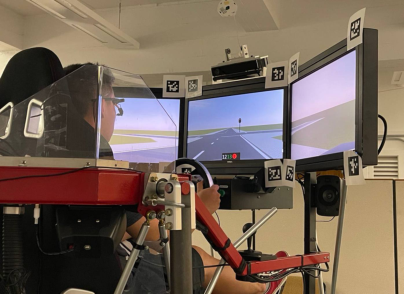
Apparatus Driving Simulator. The simulator used in this study was Force Dynamics 401cr, a three-monitor, four-axis fully interactive driving simulator (as shown in Figure 1).
Figure 1: Driving simulator used in the experiment.
Eye Tracker. Pupil-Labs eye tracker was used to record participant’s eye movement during the experiment (Pupil Labs, 2023).
356 Lin and Wang
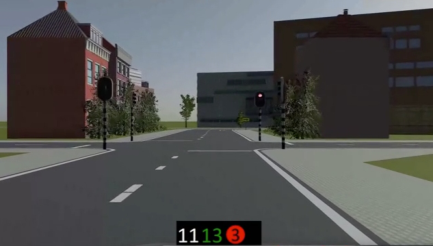
Figure 2: Driving simulator scenario with eco-driving interface. On the left of the inter- face, it displayed drivers’ current driving speed (in mph). In the middle, it shows the suggested speed (in mph). If the suggested speed was larger than the driver’s current speed, it would be shown in green color. Otherwise, it would be shown in red color. On the right-hand side of the interface, it was a color state of the current traffic light with a timer indicating the remaining time of the current state.
Eco-driving system. A velocity planning algorithm (VPA) model (See details in Mintsis et al., 2021; Xia et al., 2013) was used as a reference to implement the eco-driving system’s function. The Python program used for implementing the algorithm and interface of the eco-driving system was based on the study by Mintsis (2022). Screenshot of the driving scenario is shown in Figure 2.
Cognitive Distraction Task The cognitive distraction task in the loaded drives is an N-back task. The N-back task is a delayed number recall task based on Mehler et al. (2011) research, which has been frequently used in driving studies as a method to induce cognitive distraction to drivers.
Experimental Designs The driving scenarios simulated urban two-lane streets, with a speed limit of 25 miles per hour. The experiment included four drives. The first drive was the baseline, which was designed for drivers to get familiar with operating the driving simulator and investigate drivers’ baseline driving performance. In this drive, we collected participants’ driving performance data before approaching traffic signal-controlled intersections. The second drive was a training session in which drivers learned how to follow the speed guidance from an eco-driving system and perform the N-back task while driving. Par- ticipants were instructed to drive on a straight two-lane road during this training section. The third and fourth drives were either the attentive con- dition or distracting condition. In the attentive condition, participants were only required to follow the eco-driving system speed guidance. In the distract- ing condition, participants were required to follow the eco-driving system’s guidance and perform the N-back task at the same time. The order of the attentive and distracting conditions was counterbalanced across all partici- pants, which means a participant’s experiment procedure for the driving part is either like Group 1 or Group 2 as shown in Table 1.
Driver Cognitive Distraction Classification While Using Eco-Driving Applications 357
Table 1. Experimental design.
Table available in the original PDF paper.
Drive Group 1 Group 2 1st Baseline (Learn to use the simulator and Explore the baseline driving condition) Baseline (Learn to use the simulator and Explore the baseline driving condition) 2nd Training (Practice of Eco-driving + N-back)
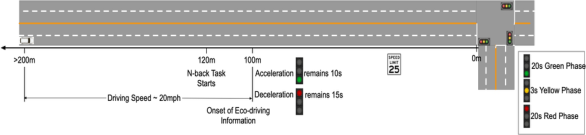
Each of the third and fourth drives included both acceleration and deceler- ation scenarios when approaching the intersections. Each traffic signal had a 20-second green, a 3-second yellow, and a 20-second red phase. Acceleration began with 10 seconds remaining in a green phase, while deceleration began with 15 seconds remaining in a red phase (as shown in Figure 3).
Figure 3: Driving scenarios in which the eco-car was either accelerating or decelerating as it approached a traffic light intersection.
Experimental Procedure Upon arriving at the driving simulator lab, participants were given a brief introduction of the study. They were asked to read and sign the consent form and complete a screening questionnaire. Then they were asked to be seated in the driving simulator and complete the four drives. After complet- ing the baseline drive and the last two drives, participants were also asked to complete a Raw NASA-TLX (Hart, 2006) questionnaire, in which the subjective workload for six items (perceived mental, physical, and tempo- ral demands, frustration, effort, and performance) was rated on a 20-point scale. The detailed experimental procedure is shown in Figure 4, with the four drives highlighted in light blue.
Figure 4: Experimental procedure.
Figure available in the original PDF paper.
358 Lin and Wang
Data Processing In the N-back driving condition, an overlapping sliding window technique was used to segment the epoch of driving. A recent study found that overlap- ping sliding windows were as effective as non-overlapping sliding windows (Dehghani et al., 2019). A total of 557 attentive epochs and 537 distract- ing epochs were obtained in the acceleration case, 1501 attentive epochs and 1606 distracting epochs were obtained in the deceleration case. Following data processing, the Time Series Feature Extraction based on Scalable Hypothesis tests (TSFRESH) package was used to complete feature extraction and reduction in Python (Christ et al., 2017). The data of 16 (out of 20) participants were used for feature selection and algorithm training, and the data of the remaining 4 (out of 20) participants were used for algorithm testing. The number of epochs in the training and test sets is listed in Table 2. The participants in both the training and testing sets were balanced by age and gender. A hierarchical clustering based on their Spearman correlations was adopted to the glance and driving training sets separately. Then one fea- ture from each cluster was selected to handle the multicollinearity in training sets. In the end, there were 17 glance features and 51 driving features for the acceleration scenarios; 24 glance features and 61 driving features were selected for the deceleration scenarios.
Table 2. Number of attentive and distracting epochs in the training and testing sets.
Table available in the original PDF paper.
Driving Scenario Training Testing Attentive Distracting Attentive Distracting
Acceleration 425 437 120 112 Deceleration 1248 1342 253 264 We utilized a random search with 10-fold cross-validation to determine the optimal hyperparameters for every feature set in both manual and automated driving scenarios. Python 3.8 was used to conduct all data analyses.
RESULTS
The optimal hyperparameters for different feature sets were located using random search in multiple training, which are listed in Table 3.
Table 3. Hyperparameters of the random forest by each feature set.
Driver Cognitive Distraction Classification While Using Eco-Driving Applications 359
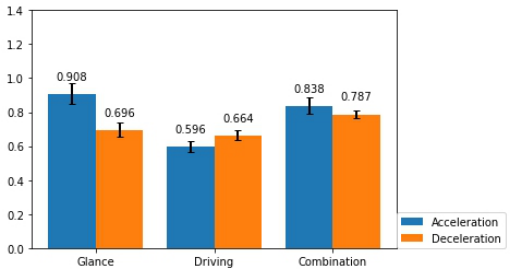
Figure 5 shows the classification accuracy for each feature set in accel- eration and deceleration scenarios. McNemar’s test showed that in the acceleration scenario, the combined feature set led to significantly higher accuracy than the driving feature set (p <0.001), but no significant differ- ence with the glance feature set (p = 0.210). In the deceleration scenario, the combined feature set led to significantly higher accuracy than the driving set (p <0.001) and the glance set (p = 0.005).
Figure 5: The accuracy of random forests based on each feature set. (The error bars represent the bootstrap 95% confidence intervals.)
The permutation importance analysis was used to discover the top 10 most important features for random forests using the combination feature set (as shown in Table 4). Glance features were among the most important features in both acceleration and deceleration scenarios. Several glance fea- tures were among the top 10 most important features in both acceleration and deceleration scenarios.
Table 4. The top 10 most important features for combination sets.
Table available in the original PDF paper.
Driving scenario
Feature set
Relevant Features Reduced Accuracy (%) Acceleration Glance norm position y (quantile 0.4) 6.79 Glance norm position y (quantile 0.6) 6.56 Glance eyes on the interface (cwt coefficients) 4.96 Glance norm position y (fft aggregated) 4.90 Glance norm position y (count below mean) 3.08 Glance norm position x (skewness) 3.06 Glance norm position y (count above mean) 2.83 Driving acceleration (change quantiles) 2.53 Driving compliance (fft coefficient) 2.52 Glance eyes on the interface (quantile) 2.41 Deceleration Glance norm position y (quantile 0.4) 4.52 Glance fixation duration (fft coefficient) 4.31
(Continued)
360 Lin and Wang
Table 4. Continued Driving scenario Feature set
Table available in the original PDF paper.
Relevant Features Reduced Accuracy (%) Glance norm position x (quantile) 4.03 Glance norm position x (range count) 3.47 Driving steering (approximate entropy) 3.17 Glance fixation duration (cwt coefficients) 3.02 Glance norm position x (skewness) 2.84 Glance eyes on the interface (c3) 2.79 Glance eyes on the interface (variation coefficient) 2.59 Glance norm position y (count below mean) 2.46
Table 5. The accuracy, sensitivity, and specificity of glance-based classifiers for each testing participant.
The McNemar’s test results showed that there was no significant differ- ence between the accuracy of the glance feature and combination feature sets for the acceleration scenario, but the combination set showed higher accu- racy than the glance feature set in the deceleration scenario. Therefore, we evaluated the combination set model using each testing participant’s data to explore the accuracy, sensitivity (i.e., true positive rate), and specificity (i.e., true negative rate). The results are shown in Table 5.
DISCUSSION
The current study established the value of using machine learning in capturing drivers’ cognitive distractions during interactions with an eco-driving system. Twenty drivers practiced eco-driving under the guidance of an eco-driving system. Their eye glance and driving performance features were recorded. This study proved that in the context of eco-driving, the random forest model demonstrated its efficacy in identifying drivers’ cognitive distractions. The results showed the glance features’ importance in the random forest classi- fier. Among the top 10 most important features in the combination set, norm gaze position for y-axis direction, eyes on the interface, and norm gaze posi- tion for x-axis direction provided the most important features to determine drivers’ attention status in the acceleration scenario; norm gaze position for x-axis direction, norm gaze position for y-axis direction and the gaze duration accounted for most three important features in deceleration scenario. These findings were consistent with the findings in previous driver distraction classi- fication studies, for example Yang et al. (2020). Previous studies also showed
Driver Cognitive Distraction Classification While Using Eco-Driving Applications 361
that driving features led to lower cognitive distraction classification accuracy (54.4% for support vector machine) than glance features (Liang et al., 2007). Drivers’ steering control, acceleration, and speed compliance were among the top 10 most important features in the combination set. The steering control and acceleration features were also among the most important fea- tures in Iranmanesh et al. (2018) classification model. This proposed method may alleviate the distraction and safety concerns associated with using an onboard information system, thereby improving in-vehicle human-machine interaction. To our knowledge, this is the first time that a driver’s cogni- tive distraction has been detected using machine learning techniques while they are operating an eco-driving system capable of providing real-time road information and speed guidance in an urban driving environment.
As self-driving technology advances, a camera-based driver monitoring system has become critical for driving safety. However, this technology should not be limited to traditional manual driving conditions but should also be considered in the context of connected and automated vehicle technology. The eco-driving system is just one instance of these applications. Given that connected vehicle technology has the potential to provide drivers with a wide range of real-time road information and driving guidance with a vari- ety of different objectives (e.g., fuel efficiency, speed harmonization, route recommendations), we propose that a connectivity-based eco-driving system should thoroughly consider whether drivers’ cognitive status is sufficient to perceive and process this information without impairing their driving perfor- mance. In this study, we demonstrated that a machine learning model such as the random forest classifier could handle this challenge by leveraging a lim- ited collection of eye-movement data paired with multiple driving features. Additional effort will be required to refine the driver monitoring system in conjunction with the integration of connected vehicle technology so that this advanced technology can truly assist in achieving the goal of reducing fuel consumption without impairing driving safety.
Due to the limited sample size and the large number of model parame- ters, there is a risk of overfitting in this study despite our efforts to prevent it. To address this issue, a larger dataset with participants of varying ages and driving experience levels would be beneficial to improve the algorithm’s accuracy. Additionally, despite our pre-cautious efforts, there is a risk of over- fitting in this study due to the limited sample size and the large number of model parameters. To address this issue, a large data set with more par- ticipants of varying ages and driving experience levels would be beneficial for improving the algorithm’s accuracy. Third, the cognitive distraction was triggered by the N-back task. Additional cognitive distraction tasks, such as peripheral detection tasks or mind-wandering conditions, or more practical cognitive distraction tasks, such as phone calls, should be investigated in the future. Thirdly, the driving scenarios used in our study were simplified, sug- gesting that their ecological validity may be limited. In future studies, it will be beneficial to expand the experiment to more complex driving scenarios or real-world driving conditions.
362 Lin and Wang
CONCLUSION
This study extended drivers’ cognitive distraction detection into the con- text of the presence of an in-vehicle information system based on connected vehicle technology. We evaluated the effectiveness of different driver fea- tures in cognitive distraction detection when using an eco-driving system in both acceleration and deceleration scenarios. The findings showed that the eye glance features played a more important role than the driving fea- tures in cognitive distraction classification when drivers were using the eco-driving system, especially under the acceleration scenario. Additionally, these glance features revealed the fluctuations of drivers’ cognitive workload and variations of cognitive distraction performance in the context of using the eco-driving system. Results in our study also demonstrated the practical values of using the driver features in detecting drivers’ cognitive distraction for the design and safe implementation of eco-driving applications. In the future, a real-time cognitive distraction detection system with dynamic eco- driving guidance based on drivers’ attentional status should be developed, and further tested.
REFERENCES
Allison, C. K., Stanton, N. A., 2019. Eco-driving: the role of feedback in reducing emissions from everyday driving behaviours. Theoretical Issues in Ergonomics Science 20, 85–104. https://doi.org/10.1080/1463922X.2018.1484967 Christ, M., Kempa-Liehr, A. W., Feindt, M., 2017. Distributed and parallel time series
feature extraction for industrial big data applications. arXiv:1610.07717 [cs]. Creaser, J., Manser, M., 2013. Evaluation of driver performance and distraction during use of in-vehicle signing information. Transportation Research Record. https://doi.org/10/gnp448 Dehghani, A., Sarbishei, O., Glatard, T., Shihab, E., 2019. A Quantitative Compari-
son of Overlapping and Non-Overlapping Sliding Windows for Human Activity Recognition Using Inertial Sensors. Sensors 19, 5026. https://doi.org/10.3390/ s19225026 Hart, S. G., 2006. Nasa-Task Load Index (NASA-TLX); 20 Years Later. Proceedings of the Human Factors and Ergonomics Society Annual Meeting 50, 904–908. https://doi.org/10.1177/154193120605000909 Iranmanesh, S. M., Mahjoub, H. N., Kazemi, H., Fallah, Y. P., 2018. An adaptive
forward collision warning framework design based on driver distraction. IEEE Transactions on Intelligent Transportation Systems 19, 3925–3934. https://doi.or g/10.1109/TITS.2018.2791437 Liang, Y., Reyes, M. L., Lee, J. D., 2007. Real-time detection of driver cognitive distraction using support vector machines. IEEE Transactions on Intelligent Transportation Systems 8, 340–350. https://doi.org/10.1109/TITS.2007.895298 Masood, S., Rai, A., Aggarwal, A., Doja, M. N., Ahmad, M., 2020. Detecting distrac-
tion of drivers using Convolutional Neural Network. Pattern Recognition Letters 139, 79–85. https://doi.org/10.1016/j.patrec.2017.12.023 Mehler, B., Reimer, B., Dusek, J. A., 2011. MIT AgeLab Delayed Digit Recall Task. Mintsis, E., Vlahogianni, E. I., Mitsakis, E., Ozkul, S., 2021. Enhanced speed advice for connected vehicles in the proximity of signalized intersections. European Transport Research Review 13, 2. https://doi.org/10.1186/s12544-020-00458-y
Driver Cognitive Distraction Classification While Using Eco-Driving Applications 363
Mintsis, E. (2022). Mathematical models for dynamic eco-driving in signalized intersections in the context of cooperative intelligent transportation systems (Doctoral dissertation). Pupil Lab. (2023, June 1). “Pupil Capture”. https://docs.pupil- labs.com/core/software/pupil-capture/#pupil-detection Sanguinetti, A., Queen, E., Yee, C., Akanesuvan, K., 2020. Average impact and
important features of onboard eco-driving feedback: A meta-analysis. Trans- portation Research Part F-Traffic Psychology and Behaviour 70, 1–14. https: //doi.org/10.1016/j.trf.2020.02.010 Xia, H., Wu, G., Boriboonsomsin, K., Barth, M. J., 2013. Development and Evaluation of an Enhanced Eco-Approach Traffic Signal Application for Connected Vehi- cles, in: 2013 16th International Ieee Conference on Intelligent Transportation Systems - (Itsc). Ieee, New York, pp. 296–301. Yang, S., Kuo, J., Lenné, M. G., 2020. Effects of Distraction in On-Road Level
2 Automated Driving: Impacts on Glance Behavior and Takeover Performance. Hum Factors 0018720820936793. https://doi.org/10/gg9zkn
LISTED IN THE AHFE DIGITAL BOOKSTORE CATALOGUE
Explore the complete digital volume
Advances in Human Factors of Transportation
Read this individual research paper free through the original publisher, or explore the full digital proceedings book.
ISBN 978-1-964867-24-3
Explore this ISBN in the AHFE Bookstore ↗Listed in the July 2026 bookstore catalogue; search by ISBN to confirm current availability · Digital book purchase optional