Pei Wang, Benjamin Yi (2025). Accessibility of Shared Automated Vehicles for the Visually Impaired Travelers. In: Advances in Human Factors of Transportation. AHFE Open Access, vol. 186, pp. 399–409. https://doi.org/10.54941/ahfe1006529
In this study, we conducted semi-structured interviews with 15 visually impaired individuals. We first explored their perspectives regarding their current travel behaviors and transportation experience. We then explored the potential of using Shared Automated Vehicles (SAVs) to enhance their travel experiences and address their existing transportation challenges. Results of the first part of the study revealed that most participants primarily worked from home, while those who commute largely relied on public transit. For doctor's appointments, rideshare was the most common method of transportation followed by public transit and riding with family. Ridesharing also emerged as the dominant mode of transportation for other essential activities such as visiting family, socializing, attending events, or work-related travel. Results of the second part of the study revealed a range of expectations and concerns related to SAVs, particularly in the areas of accessibility, safety, communication, and affordability. Most participants expressed enthusiasm for the potential benefits of SAVs to increase independence and access to underserved areas. They also highlighted critical accessibility needs, such as reliable means to identify assigned vehicles, accurate drop-off locations, and accessible interfaces. Affordability emerged as the key factor influencing potential adoption, with many participants indicating a preference for SAVs if they were priced competitively with existing transportation options, especially in comparison with traditional rideshare services. Findings of this study provide valuable insights for policymakers, transportation planners, and SAV developers to ensure that future automated transportation solutions are fully inclusive and meet the diverse needs of all visually impaired travelers.
Automated vehicles (AVs) are one of the most significant technological advances to happen to our transportation systems, promising to provide enhanced mobility for all. This has allowed the emergence of novel business models such as shared automated vehicles (SAVs), in which ridesharing companies (like today’s Uber or Lyft) offer driverless on-demand mobility services. Existing research finds that maximizing the benefits of AV technologies requires integrating AV use with high-capacity transit systems, increasing vehicle occupancy levels through pooling and ridesharing, and
promoting multimodality (Harb et al., 2021). In this context, SAVs hold potential to provide more accessible on-demand mobility services and play a crucial role in sustainable transportation (Krueger et al., 2016). For large-scale deployment of SAVs, there is still a long way to go considering safety assurance, evolving business models, and the need for comprehensive governmental regulations. On the other hand, time also presents an opportunity to proactively address accessibility needs, ensuring inclusive vehicle designs and operation regulations.
LITERATURE REVIEW
Conceptual models have been developed to determine users’ beliefs and perceptions of technology. These models predict users’ intentions and then translate these into actual usage behavior. One widely used conceptual model is the technology acceptance model (TAM) (Davis, 1985). In Brewer and Kameswaran (2019), the authors interviewed visually impaired travelers about their active use of ride-hailing services and discovered that while people with visual impairments value independence, it requires building trust towards the service and technologies. In Bennett et al. (2020), the authors investigated the attitudes of AVs from 211 blind people in the UK, and the determinants of their willingness to travel in AVs. Three of the mediating variables, namely hope for future independence, safety concerns, and affordability, had a significant influence on willingness to travel in an AV. According to Al-Rashid et al. (2021), physical and psychological barriers play critical roles in the acceptance of SAVs.
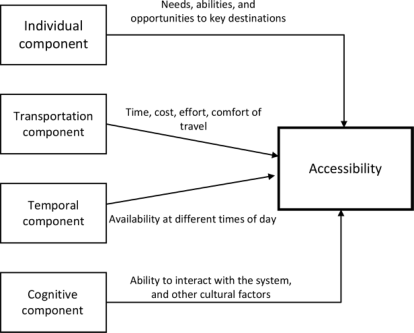
Our research team developed a revised TAM model to predict SAV adoption by the public, which reveals that safety, trust, compatibility with daily life, perceived ease-of-use, and perceived usefulness all play important roles in the intentions of using SAVs (Motamedi et al., 2020). Drawing on existing research in accessibility and transportation equity, we evaluate the accessibility of existing transportation for visually impaired travelers through a four-component framework as shown in Figure 1.
Figure 1: Four accessibility components for transportation.
Accessibility of Shared Automated Vehicles for the Visually Impaired Travelers 401
METHODS: IN-DEPTH INTERVIEWS Interview Procedures
The interview guide was developed based on the four accessibility components outlined in Figure 1 and tailored to address the research questions. The objectives of the interviews were to gain a comprehensive understanding of participants’ travel needs, transportation challenges (regarding using public transit and ridesharing services), expectations for SAVs, and overall attitudes toward this emerging technology. We recruited most of the participants through the snowball sampling method, started with a visually impaired colleague at the university. For all participants, the researcher contacted them and confirmed their answers to the following two questions before scheduling the interviews: (1) whether they are legally blind; and (2) whether they have used ridesharing services. The answers to both questions should be yes. The interviews took place through the University licensed Zoom. The interview process was audio recorded and then transcribed through Zoom. Each interview took about 1.5 hours. All participants were compensated with an Amazon gift card sent to their email upon completion of the interview.
Participants and Their Demographic Information In total, we interviewed 12 participants. The sample consisted of 8 females (53.3%) and 7 males (46.7%), with the mean age of 41.7 years old (range: 20 – 67). Most of the participants were middle-aged with 50% of participants between 35 and 50 years old. Worth to note that 3 out of the 15 participants were college students who were in their early 20s. All participants had at least a high school degree. Participants resided in diverse areas, including rural, suburban, urban, and downtown locations with easy access to public transportation and shops. The top two modes of transportation were riding with family and friends (40.0%) and using public transportation (33.3%). In contrast, only 2 (13.3%) participants use ridesharing services as their primary mode of transportation.
We also asked participants about their prior knowledge or experience with vehicle automation (SAE level 1 to level 4 driving automation). 12 out of 15 participants had prior knowledge of fully automated vehicles and had heard of Cruise, Waymo, or even Uber’s Robotaxi concepts. It is worth noting that 4 out of the 15 participants had even experienced fully automated rides with either Waymo or Cruise Automation in San Francisco. Another 3 participants had experience riding automated vehicles with emergency drivers onboard.
RESULTS
The results are presented in two sections: the first focusing on current travel behavior and experiences, and the second exploring perspectives on SAVs.
Current Travel Behavior and Experiences Pattern of Current Travel Behavior As the first question, we asked participants about patterns of their current travel behavior. Specifically, destinations they go to, and how do they access
402 Wang and Yi
essential services and activities? And what transportation modes do they use for different destinations? The essential activities identified fell into 4 categories: going to work/school, going to doctor’s appointments, grocery shopping, and other activities.
Most participants (46.67%) primarily work from home. Among those who commute, most of them (40.00%) rely on public transportation (bus, subway, or an equivalent system such as -Bay Area Rapid Transit - BART). One participant rode with co-workers to work. Another participant is retired and hence does not commute.
For doctor’s appointments, rideshare was the most common mode of transportation (37.50%), which is usually faster and preferred over riding public transits when the person was feeling unwell. Still, in 31.25% of cases, participants used public transit to go to doctor’s appointments. Another important mode (25.00%) for seeing doctors was to ride with family members. One participant, as mentioned in the demographic information section, residing in a rural area, depended on asking for rides from friends or church members to access medical care.
For grocery shopping, the top three transportation options were walking (29.41%), going with family (23.53%), and using grocery delivery services (23.53%). Participants frequently mentioned the grocery delivery services by Instacart, Walmart, Target, and Amazon. Two participants (11.76%) used rideshare for grocery shopping. The other 2 participants (11.76%) either asked for a ride from friends or used public transit for their grocery shopping.
For other essential activities, which may include visiting family members, socializing with friends, watching live sporting events, or traveling to unfamiliar places, rideshare was the predominant transportation mode (52.38%). As repeatedly mentioned by participants, when they travel to unfamiliar places, they prefer to use rideshare over public transportation because they don’t feel comfortable learning a new transit system. Following rideshares, it was riding with friends (23.81%), and using public transit (19.05%). Only one participant primarily walked to these activities.
Experience of Using Public Transportation The researcher asked participants about their experiences and associated challenges with using public transit. Results indicate that no matter whether their experience of using public transit was positive, neutral, or negative, they all shared similar challenges, which include:
Difficulty locating a bus stop was the most mentioned challenge for all participants: The problem is multifaceted. Firstly, when using online maps (on computers or mobile devices) to look up a transit route, it typically provides the intersection information (A Street & B Avenue), but not the precise location of the bus stop. The existing navigation technology and applications have yet to address this issue effectively. Secondly, there is a lack of accessible design. There are not always
Accessibility of Shared Automated Vehicles for the Visually Impaired Travelers 403
braille or tactile pathways, or other markers to indicate a bus stop. Even after finding a bus stop, usually there is a lack of accessible means for them to know what stop it is for or which bus stop there. Thirdly, bus stations often change places or undergo construction, which is usually not updated in a timely manner. Because of the same reasons, it is always challenging to transfer between buses.
Difficulty associated with getting off at the correct stop: Sometimes the bus stop announcement system did not work. Other times, the bus driver fails to warn the passenger even when notified in advance. In such cases, participants may end up getting off at unfamiliar places, facing difficulties returning to their intended routes, or even end up in a stranded situation.
Difficulty navigating and exiting subway stations: To exit the subway, participants usually look for elevators. However, they must walk around to look for it, as the placement and signage are not always intuitive to follow. Additionally, a subway station usually has multiple exits. Taking the wrong exit would lead them to a different street or different part of the street that they are not familiar with, contributing to the challenge of navigating subway stations. Consequently, several participants mentioned that they resorted to seeking help from the public.
Compromised timeliness with public transit especially with buses: most participants reported that they encountered more delays with buses compared to subway systems. Some participants described buses in their cities as “notorious” for not coming on time. From another standpoint, participants also noted that by and large using public transit, particularly buses, takes them much longer to get to places. This time disparity was cited as the key reason for the preference of rideshare for medical appointments.
Challenges of using transit in bad weather conditions. Particularly, rain and high winds pose significant challenges for them to use public transit. It impacts their mobility and their ability to maintain orientation.
Safety and security concerns while using public transit. Many of them expressed concerns about safety and security, particularly during late- night hours, both within stations and on trains.
Experience of Using Rideshare Like the experience of using public transit, we interviewed participants about their experiences with using rideshare, mostly Uber and Lyft. Rideshare was the predominant mode of transportation for going to doctor’s appointments, and other essential activities. Participants chose to use rideshare over other modes of transportation when the weather conditions were not favorable, or when they had time constraints and needed to get to their destination faster, or when they needed to conserve effort/energy for more important things. Regarding the frequency of using rideshare, it varies among the 15 participants. 14 out of 15 used rideshare at least once a month, with frequencies ranging from 4–5 times per week to a few times per month. One participant, living in a rural area, did not use rideshare on a regular basis. Overall, participants had positive experiences using rideshare. They valued the convenience and timesaving benefits these services could offer, especially
404 Wang and Yi
when compared to public transportation. However, several associated challenges of using rideshare were also identified.
The most significant challenge is drivers’ denial of service due to their guide dogs, despite the legal requirement to transport them. Six participants reported experiencing this issue. According to one participant, it occurred 30–40% of the time when using rideshare. This issue led some participants to leave their guide dogs at home when using rideshare.
The second most significant challenge is associated with extra assistance needed for pick up and drop off. The visually impaired riders often struggle to pinpoint their exact location during pick up, especially in areas like townhouse complexes or busy streets. They struggle to identify their designated vehicle or communicate their location to the driver. For most participants, they would leave a note on the rideshare app or try to call the driver in advance to let the driver know they are blind and need the driver to identify them. During drop-off, the riders need the drivers to tell them where the drop-off location is relative to their destination. Other times, they would rely on their friends or other app services (e.g., Be My Eyes) to understand their surroundings of the drop-off location. However, to further complicate this issue, drivers occasionally would drop them off at incorrect or inconvenient locations.
The third challenge is communication with rideshare drivers, particularly with drivers who do not speak English. This challenge was reported by 8 participants and made it almost impossible to communicate for pickup and drop-off.
To cope with these challenges, participants developed strategies to mitigate. They often communicated with drivers in advance, providing details of their location and appearance. Some participants used phone apps to translate and communicate with drivers and used phone apps to navigate to their final destinations.
Perception and Expectation of SAVs After questions about participants’ existing transportation behavior, the interview progressed to the 2nd phase, which was about SAVs.
Access Needs and Requirements for SAVs? To delve deeper into accessibility concerns, we asked the participants “Let’s envision that you are using the SAV services. What access needs do you have while using SAVs?” Based on the data, the requirements can be categorized into areas of pick-up, drop-off, in-vehicle experience, and interface accessibility.
Pick-up Locating the vehicle: All 15 participants emphasized the need for clear and accessible ways to locate the SAV upon pick-up, especially at busy places. They need reliable ways to figure out which SAV is assigned for their ride.
Accessibility of Shared Automated Vehicles for the Visually Impaired Travelers 405
Suggestions included audio cues (honking, unique sounds), or precise turn- by-turn directions to the vehicle through the mobile app.
Confirmation: Participants also desired confirmation mechanisms to ensure that they were entering the correct vehicle, like using the existing rideshare services.
Communication: Participants would need a way to communicate with a human operator or the car itself if needed, especially in unfamiliar locations or crowded situations where assistance might be required for the pick-up.
In-vehicle experience: Information and control: Eight participants (53.33%) wanted access to real-time information about the route and current location. Some expressed a desire for more control over the in-vehicle environment, such as adjusting temperature, and the ability to communicate with the vehicle or a remote operator if necessary.
Safety and security: Participants also wanted to feel safe during the ride. Four participants expressed the need for features like emergency buttons and clear communication channels in case of unexpected events. As mentioned by one participant “having a call button where you could call an operator if you needed help or something”. Another participant raised concerns about the security and potential for hacking and therefore they would require security protocols.
Drop-off: Accurate drop-off location: Ensuring accurate drop-off at the correct location was a significant concern for all participants. This was articulated by one participant stating that “I think the challenge of being dropped off in the wrong place is still present, because again, the vehicle is using the same, much of the same technology, much of the same GPS, you know, the same maps that the driver of an Uber is using.”
Participants suggested features like verbal confirmation of the drop-off point, detailed descriptions of the surroundings. Most participants requested to avoid obstacles or unsafe drop-off points. Two participants expressed that they want the ability to guide the vehicle to a desired drop-off location.
Navigation: Participants wanted to have clear instructions on how to reach their destination from the drop-off point.
Potential Travel Behavior Changes Envision Having Access to SAVs We asked participants with SAVs would they go to some places that they usually don’t go, would they go to certain places more frequently, or change the usage of other transportation modes?
Four participants (26.7%) indicated that there would be a great change in their travel behavior. They would likely go out more often, travel more, and take spontaneous trips that they were currently unable to do due to lack of transportation.
The other 11 participants (73.3%) did not foresee a somewhat change in their travel behavior. They mainly view SAVs as an additional
406 Wang and Yi
transportation option. As commented by one participant who took the Waymo rides “…it is not different from Uber or Lyft, I guess it mainly seemed like kind of a novelty to me, just because, oh, it’s a car that drives by itself. This is cool. But that’s really the only thing that impacted me…” Participants repeatedly mentioned they may use SAVs to go to destinations currently inaccessible by public transportation or by rideshare. These areas included:
Smaller towns or rural areas: Two participants expressed interest in moving out of the city they were currently living in if SAVs were available. With SAVs, living in smaller towns or rural areas becomes a more viable option. Participants highlighted how SAVs could provide them with easier access to essential services that they currently rely on public transportation for.
Nature and parks: Eight participants mentioned wanting to visit parks, taking their children to play in the parks, going to the nature areas easily with SAVs, and visiting places such as wineries that are inaccessible for them.
Longer trips: Four participants mentioned wanting to use SAVs for longer trips, such as traveling from the Bay Area to Los Angeles, as an alternative to air travel. Or rent the SAV for a prolonged period (e.g., a full day) traveling to different places without worrying about the driver.
Data indicates that most participants (11 out of 15) anticipated changing their use of other transportation modes if they have access to SAVs. These changes primarily involve reducing or eliminating the use of rideshare. Three of them mentioned that they would use SAVs exclusively or primarily for local transportation, replacing their current reliance on rideshare or assistance from others (friends or church members). However, the other 4 (out of 15) participants indicated that they would not change the use of other transportation, citing a preference for walking or a continued need for public transportation in certain situations.
Overall, data suggests that SAVs have the potential to significantly change the transportation habits of the visually impaired riders, particularly by reducing dependence on the traditional rideshare services. However, several participants reiterated that their use of SAVs would depend on many other factors, such as the reliability of the technology, affordability of the service, and the availability of SAVs throughout their area.
Willingness to Pay In the final question, we asked participants their willingness to pay for the SAVs rides. Data revealed that:
Majority of the participants (9 out of 15) explicitly expressed a desire for SAVs to be cheaper than current rideshare services, citing one participant “I would say that I would probably use them (the SAVs) more, if and especially if they were less expensive than rideshare.” If the SAVs are not
Accessibility of Shared Automated Vehicles for the Visually Impaired Travelers 407
cheaper or significantly cheaper, many participants would likely continue using the existing transportation methods due to financial reasons.
We found that even the participants with high household incomes (e.g., over $200K/year) expressed concerns about the high costs of using existing rideshare services. It highlights a broad sensitivity to transportation costs across participants from all income levels. One participant mentioned they avoid using rideshare if the trip is longer than 30 minutes. In those cases, they would use rideshare to friend’s house and ride with friends to go further places to save on transportation cost. Another participant specifically mentioned that “I would probably still take the buses and walk and that kind of thing mostly because of the cost. I don’t want to spend $100 to $200 a day on transportation.” The feedback implies that they would only use SAVs if the cost were lower, highlighting the importance of affordability of SAVs for future wide adoption.
Only two participants, both of whom have household income over $200K a year, see the perceived value of SAVs outweighing the cost and they would use SAVs exclusively if they are available.
DISCUSSION
The interview data reveals a variety of critical accessibility needs that must be addressed for SAVs to effectively serve visually impaired riders. These needs span the entire journey, from pick-up to drop-off, and include both in-vehicle and interface considerations.
Participants emphasized the importance of reliable methods to locate and identify their assigned SAV, especially in busy or unfamiliar environments. This could be achieved through audio cues, precise app-based directions, and clear vehicle labeling. Additionally, participants require the confirmation mechanisms (e.g., verbal confirmations or unique identifiers) to ensure they are entering the correct vehicle. Further, clear communication channels with a human operator or the SAV itself would become necessary to address the potential challenges in crowded areas and provide an extra layer of assistance.
The accessible in-vehicle experience is important for rider comfort, and a sense of equity. It includes access to real-time information about the route, arrival time, and current location. The ability to control the environment (e.g., temperature, music), and communicate with an operator in case of emergencies further enhances the user experience. Additionally, participants highlighted safety concerns, requesting features like emergency buttons and robust security protocols to protect against potential threats.
Accurate drop-off locations are critical, as highlighted by participants’ concerns about potential GPS and mapping errors. Verbal confirmation from the vehicle, detailed descriptions of the surroundings, and the possibility to guide the vehicle to a precise drop-off location were among the suggested solutions. Additionally, ensuring safe and accessible drop-off points with clear navigation instructions to the final destination is essential.
A fully accessible interface, both within the SAV and through the mobile app, is a fundamental requirement for visually impaired riders. Voice
408 Wang and Yi
commands, screen reader compatibility, and clear audio cues are crucial for seamless interaction. This aligns well with the study done by Fink et al. (2021) which noted that many individuals feel the usefulness of building accessibility features of AVs directly into smartphones.
The study indicates that access to SAVs could lead to changes in travel behavior among visually impaired individuals. While some participants envision a significant increase in spontaneous trips, others see SAVs as an additional rather than a transformative option. But access to SAVs is likely to encourage more frequent travel and exploration of new destinations, especially those that are currently difficult to reach, including the remote or inaccessible areas such as parks and recreational areas. Most participants expressed that they would reduce their use of traditional rideshare services if SAVs were available. Considering the affordability of rideshare or SAVs, not many participants expressed the potential to reduce their use of public transit. According to Othman (2022), people are not willing to pay more for SAVs than for traditional rideshare or other methods of transportation. Thus, unless prices of AVs drop below those of traditional services, there most likely won’t be huge impacts on the usage of public transit.
Based on feedback from the participants, affordability is a critical factor in the adoption of SAVs. Many participants expressed a willingness to use SAVs if they are cheaper than existing rideshare. However, if the cost remains high, travelers will likely continue to rely on traditional modes of transportation. According to McKinsey & Company (2024), established autonomous-vehicle players mainly believe in pay-per-use models, just as Waymo is operating. Start-ups and other entities believe in subscription models. On the supply side the technology can have either lower or higher operating costs (Harb et al., 2021). Therefore, while there is an interest in the convenience and autonomy that SAVs could provide, the determining factor for adoption of SAVs among this population (likely many others) heavily depends on the establishment of affordable pricing models.
CONCLUSION
This study underscores the complexity of various factors that will influence the adoption and success of SAVs among visually impaired individuals and ensure the equity of this new technology. Ensuring affordability, addressing accessibility concerns, and building trust in technology are paramount. Future research should focus on developing and refining SAV technology to meet the specific needs of visually impaired riders, as well as investigating the long-term impacts of SAVs on travel behavior changes.
REFERENCES
Al-Rashid, M. A., Goh, H. C., Harumain, Y. A. S., Ali, Z., Campisi, T., & Mahmood, T. (2021). Psychosocial barriers of public transport use and social exclusion among older adults: Empirical evidence from Lahore, Pakistan. International Journal of Environmental Research and Public Health, 18(1), 185.
Accessibility of Shared Automated Vehicles for the Visually Impaired Travelers 409
Bennett, R., Vijaygopal, R., & Kottasz, R. (2020). Willingness of people who are blind to accept autonomous vehicles: An empirical investigation. Transportation Research Part F: Traffic Psychology and Behaviour, 69, 13–27. Brewer, R. N., & Kameswaran, V. (2019). Understanding Trust, Transportation, and
Accessibility through Ridesharing. Proceedings of the 2019 CHI Conference on Human Factors in Computing Systems, 1–11. Davis, F. D. (1985). A technology acceptance model for empirically testing new enduser information systems: Theory and results [Thesis, Massachusetts Institute of Technology]. Fink, P. D. S., Holz, J. A., & Giudice, N. A. (2021). Fully Autonomous Vehicles for
People with Visual Impairment: Policy, Accessibility, and Future Directions. ACM Transactions on Accessible Computing, 14(3), 1–17. Harb, M., Stathopoulos, A., Shiftan, Y., & Walker, J. L. (2021). What do we (Not) know about our future with automated vehicles? Transportation Research Part C: Emerging Technologies, 123, 102948. Krueger, R., Rashidi, T. H., & Rose, J. M. (2016). Preferences for shared autonomous
vehicles. Transportation Research Part C: Emerging Technologies, 69, 343–355. McKinsey & Company. (2024). Autonomous vehicles moving forward: Perspectives from industry leaders. https://www.mckinsey.com/features/mckinsey-center-for- future-mobility/our-insights/autonomous-vehicles-moving-forward-perspectives -from-industry-leaders Motamedi, S., Wang, P., Zhang, T., & Chan, C.-Y. (2020). Acceptance of Full Driving
Automation: Personally Owned and Shared-Use Concepts. Human Factors, 62(2), 288–309. Othman, K. (2022). Exploring the implications of autonomous vehicles: A comprehensive review. Innovative Infrastructure Solutions, 7(2), 165. SAE International. (2021). J3016C: Taxonomy and Definitions for Terms Related to Driving Automation Systems for On-Road Motor Vehicles. https://www.sae.org/ standards/content/j3016_202104/
LISTED IN THE AHFE DIGITAL BOOKSTORE CATALOGUE
Explore the complete digital volume
Advances in Human Factors of Transportation
Read this individual research paper free through the original publisher, or explore the full digital proceedings book.
ISBN 978-1-964867-62-5
Explore this ISBN in the AHFE Bookstore ↗Listed in the July 2026 bookstore catalogue; search by ISBN to confirm current availability · Digital book purchase optional