Prakriti Rai, Gail Hopkins (2026). Developing an Assistive Mobile Application for Elderly Nepali Migrants in the UK. In: Human Interaction and Emerging Technologies (IHIET 2026). AHFE Open Access, vol. 236, pp. 99–110. https://doi.org/10.54941/ahfe1008086
Over 77,000 Nepal-born residents live in England, many of whom are elderly Gurkha veterans who arrived following the 2009 Gurkha Justice Campaign. Despite over 200 years of military service to the British Crown, this population continues to face significant challenges adapting to daily life due to limited English proficiency, low digital literacy, and a lack of technology designed with their needs in mind. This study adopted a Human-Centred Design (HCD) methodology to design, implement, and evaluate Jana, a mobile application tailored to support older Nepali migrants in the UK. A survey with 68 participants identified complex navigation and literacy difficulty as the two primary barriers to mobile technology use, informing iterative low and high-fidelity prototyping evaluated by seven target demographic participants using the think-aloud protocol. Jana combined Nepali-English translation via camera and voice input, one-touch emergency service access, a community feed, and a Bikram Sambat calendar, built using React Native. A heuristic audit and summative task-based evaluation identified three recurring themes: translation, linear navigation, and icon comprehension, with measurable usability improvements across iterations. Six of seven participants confirmed they would use the application daily. The study produced six transferable design principles offering practical guidance for developers creating digital tools for migrant communities facing overlapping cognitive, literacy, and cultural barriers to digital inclusion.
The UK hosts a rising Nepali population with over 77,000 Nepal-born residents recorded in England alone (ONS, 2023). A substantial proportion of this diaspora comprises Gurkhas, Nepali soldiers who have served the British Crown since 1814 (Wu & Zhu, 2017). The 2009 Gurkha Justice Campaign secured settlement rights for Nepali veterans and their dependents but did so without providing the cultural or linguistic support infrastructure necessary for integration (Kochhar-George, 2010). Over a decade later, this demographic has aged further while the underlying conditions of exclusion remain unaddressed. Although assistive communication technologies have been demonstrated to improve the wellbeing and daily life of other elderly migrant communities (Ekoh et al., 2023), there is no bespoke solution for Received June 30, 2026; Revised July 9, 2026; Accepted July 22, 2026; Available online August 25, 2026
100 Rai and Hopkins the Nepali community. This research therefore aims to investigate how a culturally informed digital tool can support Nepali migrants and other communities facing similar barriers to inclusion. The primary researcher is of Nepali descent with strong ties to the UK Nepali community, and so has an insider positionality.
Three research objectives guide this work: (RO1) to identify and validate the obstacles preventing elderly Nepali migrants from using digital technology independently; (RO2) to design and implement a mobile application that addresses the identified barriers through accessible, culturally informed design; and (RO3) to evaluate the application’s effectiveness through usability testing and construct transferable design principles applicable to similarly marginalised communities.
LITERATURE REVIEW
Historical Context and Case for Digital Intervention What distinguishes the UK Nepali diaspora from other migrant communities is their age and linguistic profile upon arrival. The 2009 Gurkha Justice Campaign caused the Nepal-born population in the United Kingdom to more than double from approximately 19,000 in 2007 to 43,000 by 2009 (95% CI ± 9,000) (ONS, 2021). Many arrivals were retired veterans and their dependents who had spent their service overseas with limited exposure to the English language or British civilian life (Pariyar, 2020). For other older migrants facing cultural and linguistic barriers, consistent technology has been shown to improve wellbeing and overall quality of life through providing immediate, on-demand support for daily tasks such as translating correspondence, accessing emergency services, and maintaining community ties (Ekoh et al., 2023). However, the Nepali legal settlement rights were not accompanied by the support infrastructure necessary for integration (Kochhar-George, 2010) and no suitable digital intervention exists to support them.
Cognitive and Motor Accessibility Requirements Gurkha retirees who arrived following the 2009 settlement are now in their mid-sixties and beyond, placing them within the bracket where cognitive shifts impair ability to navigate unfamiliar digital interfaces (Salthouse, 2010). Ramscar et al. (2014) frame this as information overload rather than decline, shifting the digital design priority towards clear navigational aids that promote self-efficacy. Furthermore, age-related motor deterioration presents an additional barrier as button sizes below 10mm significantly increase operation time and error rates (Xiong et al., 2014), consistent with Fitts’ Law (Fitts, 1954), necessitating touch targets of at least 48dp × 48dp (Google, 2025). Together, these findings require a linear navigation model, persistent navigational aids, and large touch targets.
Developing an Assistive Mobile Application for Elderly Nepali Migrants in the UK 101 Designing for Low Literacy
Nepal recorded an adult literacy rate of 69% in 2019, with women 21% less likely to be literate than men (World Bank, 2019). As first language literacy provides the critical foundation for second language acquisition (Feinauer et al., 2013), the assumption most digital tools make, that users can read and type in English, represents a fundamental barrier to access (Vigh et al., 2025). Smit et al. (2025) found that non-written communication strategies such as text-to-speech and iconography were more effective for low-literacy groups with Medhi et al. (2011) confirming that task completion was highest with audio-guided rather than text-guided interfaces. Together, these demonstrate the need for an audio-first interface with literal iconography that does not assume reading or typing ability.
Cultural and Community Context Older migrant communities frequently rely on family members as warm experts to mediate technology use, constituting important learning opportunities that develop digital skills over time (Martínez & Olsson, 2022). However routing technology access consistently through a younger family member risks fostering digital dependency rather than autonomy and family-assisted onboarding should function as a temporary scaffold rather than ongoing mediation (Duque & Otaegui, 2023). Cultural familiarity is also important for technology adoption as cross-cultural interfaces can serve as crucial bridges between diverse user groups (Wang, 2025). For Nepalis, therefore, cultural anchors such as the Bikram Sambat calendar would carry value in establishing trust that generic platforms cannot provide.
Requirements for Digital Intervention In summary, there are a number of requirements for technology support for UK-based Nepali migrants. A mobile app should provide an audio-first interface with clear navigational aids, touch targets of at least 48dp × 48dp, literal iconography and cultural anchors. It should provide on-demand support for daily tasks such as translating correspondence, access to emergency services and support the user to maintain community ties. Three platforms commonly used by the target demographic are Google Translate, Hamro Patro and Facebook but each satisfies only two or three of these eight requirements. None provide persistent navigational aid or audio guidance. There is, therefore, a need for appropriate digital technology that supports the Nepali migrant population in the UK, alongside a family-assisted onboarding pathway. This paper presents the design and development of Jana, an assistive mobile platform tailored to older Nepali migrants in the UK.
METHODOLOGY
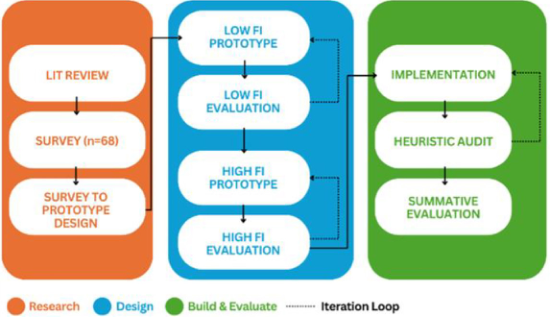
This study adopted a Human Centred Design (HCD) framework in accordance with ISO 9241-210 Principle 5.3 (ISO, 2019), following a recursive design and development process as illustrated in Figure 1. A mixed-methods
102 Rai and Hopkins approach was adopted, combining quantitative survey data and qualitative usability evaluations (Creswell, 2009). All participants provided informed consent prior to participation, and the study received ethical approval from the University of Nottingham School of Computer Science Ethics Committee.
Figure 1: Flowchart of design and development process.
Survey A 27-item survey was designed and distributed using Microsoft Forms, selected for its cross-platform accessibility and immersive reader feature to support respondents with low reading proficiency, to collect insights into older Nepali migrants’ digital literacy, language proficiency, and feature prioritisation. Branching logic directed respondents to either a self-report pathway for target users aged 45 or older (Q2-14), or a proxy-report pathway for family members responding on behalf of a relative (Q15-27). Both pathways collected demographic data, followed by home language and English confidence rated on a ten-point scale (Q5-7, Q18-20), smartphone usage habits (Q10, Q23), and feature preferences (Q13, Q26). Open-ended questions captured qualitative context including specific apps used and situations requiring family assistance. Due to the difficulty in reaching the target demographic, a snowball sampling strategy was employed (Sadler et al., 2010).
Iterative Prototyping and Formative Evaluation Two phases of prototyping and usability evaluation were conducted. Low- fidelity wireframes were created in Procreate, focusing on navigation flow and structural layout (Rettig, 1994). High-fidelity interactive prototypes were subsequently developed in Figma, enabling participants to complete realistic tasks prior to development (Walker et al., 2002). Both prototypes were evaluated using the think-aloud protocol with seven participants from the target demographic (Nielsen, 2012), consistent with Nielsen’s heuristic that five participants are sufficient to uncover 85% of usability problems for a single user group (Nielsen, 2000).
Developing an Assistive Mobile Application for Elderly Nepali Migrants in the UK 103 Implementation
Jana was implemented using React Native with Expo SDK, written in TypeScript, enabling a single codebase to compile to both iOS and Android. Translation, Optical Character Recognition (OCR), Speech-To-Text (STT), and Text-To-Speech (TTS) features were powered by four Google Cloud APIs.
Summative Evaluation of Final App Prior to participant testing, a heuristic audit was conducted against Nielsen’s ten usability heuristics (Nielsen, 1994) to resolve issues detectable through inspection. A final task-based evaluation was then conducted with the same seven participants, combining the think-aloud protocol with task completion rate, error count, and time-on-task metrics.
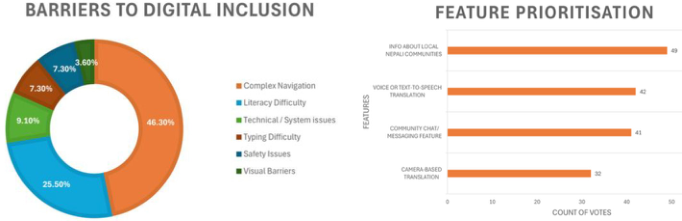
SURVEY RESULTS A total of 68 valid responses were retained after data cleaning with 17 self- reporting target users and 51 family proxies. Approximately 80.5% of target users spoke Nepali as their primary home language, with only 15% using any English at home, confirming the need for a bilingual interface. Complex navigation was identified as the primary barrier by 46.3% of respondents, consistent with the cognitive accessibility literature. A further 25.5% identified literacy difficulty, validating the requirement for a translation interface that does not assume the ability to type in English (Medhi et al., 2011). These two barriers accounted for over 70% of reported difficulties (Figure 2a).
Figure 2: (a) Barriers to digital inclusion and (b) Feature prioritisation.
A significant gap emerged between need and behaviour as, despite literacy difficulty being a primary barrier, only 8.5% of respondents reported using smartphone translation tools, confirming that these are too complex for habitual use. Google Translate appeared only in responses from family members translating on behalf of their relative, confirming that these tools are mediated through family members rather than used independently. The English confidence data revealed survivorship bias in the self-reporting group, validating the requirement for a family-assisted onboarding mode. Responses regarding feature prioritisation rated community information
104 Rai and Hopkins as the most in demand (49), followed by voice and TTS translation (42), community messaging (41), and camera translation (32) (Figure 2b). Four open-ended responses additionally requested a Bikram Sambat calendar.
PROTOTYPING Low-Fidelity Prototype
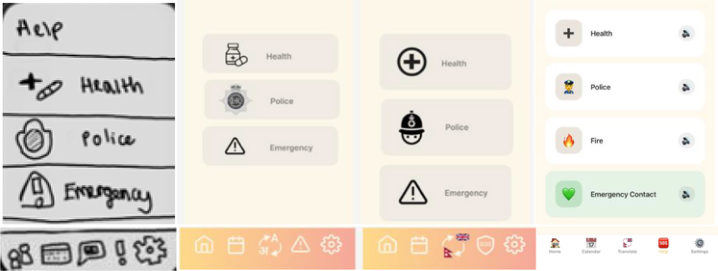
The low-fidelity prototype incorporated screens for emergency services, community, translation, account settings, and calendar. During the evaluation all participants could understand each page layout and navigate between pages without difficulty, confirming a flat navigation structure as appropriate for the target demographic. Iconography was the primary point of friction: three participants could not identify the community page icon, and four misinterpreted the translation icon as a messaging application, with one participant stating it “looks like Facebook Messenger.” This confirmed that reusing Western interface conventions produces confusion for migrant users (Tsai, 2024), prompting a redesign towards more literal imagery in the high- fidelity prototype (Figure 3).
Figure 3: Emergency services page development (left to right) - low-fidelity wireframe, initial high-fidelity prototype, revised high-fidelity prototype, and final implemented application.
High-Fidelity Prototype The Figma high-fidelity prototype was designed with interactive elements at a minimum size of 48 × 48dp. Table 1 shows the Task completion outcomes.
Developing an Assistive Mobile Application for Elderly Nepali Migrants in the UK 105 Participants aged 60 and above struggled to read default text sizes, validating the requirement for a font size slider. The updated literal iconography was received more positively, though two participants still found the translation icon ambiguous, prompting further revision. Three participants required intervention to locate emergency services, with one stating they did not recognise the police icon, prompting a redesign of the emergency page (Figure 3). Five participants were unable to complete initial onboarding independently, directly validating the importance of a family setup mode. All participants responded positively to the Bikram Sambat calendar - several stated they would use Jana specifically for this.
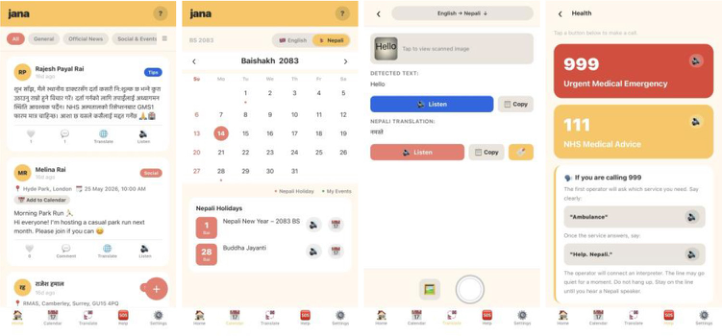
Figure 4: Selected screens from the developed app.
The Final App
Figure 4 shows the developed app. The heuristic audit identified four violations resolved before evaluation: the absence of a loading indicator during translation API requests, no confirmation step before account deletion, missing back navigation arrows on two screens, and the absence of an interpreter card on the emergency page. The final user evaluation tested four core tasks: camera translation, emergency calling, adjusting font size, and community posting. Findings revealed three recurring themes: Translation. Task 1 recorded a mean of 46 seconds (range 28-98s) and a 6/7 completion rate, improving from 5/7 at prototype stage. The single error corresponded to an unclear image capture that triggered the quality-check prompt, confirming the mechanism functioned as intended. All participants appreciated the TTS output, consistent with research findings that task completion is highest when interfaces provide audio guidance (Medhi et al. 2011). Linear navigation. Task 2 had a 100% completion rate and the lowest mean completion time (18 seconds, range 12-26s), improving from 4/7 at prototype stage. Significantly, all seven participants located the emergency tab and selected the ambulance button without hesitation. The interpreter
106 Rai and Hopkins card introduced following the heuristic audit further supported completion, confirming the value of audio-supported guidance for low-literacy users. This validates linear navigation as the most successfully implemented design requirement.
Icon comprehension. Tasks 3 and 4 had the greatest mean times (63s and 58s respectively), widest ranges (23-182s and 24-196s respectively), and lowest completion rate (4/7 and 3/7 respectively). For both the failure point was identifying secondary action icons within pages rather than navigating to the correct tab. Therefore, although the linear navigation model was validated, icon literacy for secondary actions remained unresolved. This accords with other observations of Western product unreliability for migrant users (Tsai, 2024).
Overall, all participants found the finished application easier to use than the high-fidelity prototype. Six of seven confirmed they would download and use the application daily, with one participant stating it was the first application they had used that felt tailored for them, directly reflecting Wang’s argument that cross-cultural interfaces serve as a bridge between diverse user groups (Wang, 2025).
DISCUSSION AND CONCLUSION Transferable Design Principles
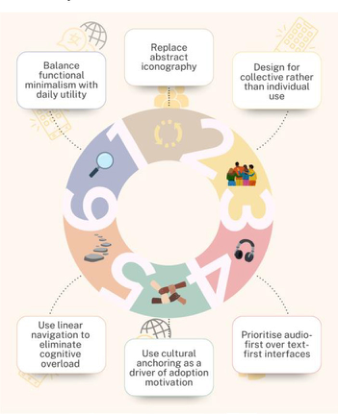
The iterative design process and summative evaluation informed six transferable design principles (Figure 5) for developers of tools for migrant communities facing overlapping cognitive, literacy, and cultural barriers. These are discussed below.
Figure 5: Six transferable design principles for tools supporting migrant communities with overlapping cognitive, literacy and cultural barriers.
1. Replace abstract iconography with literal imagery. Although all participants navigated to the correct tab in Tasks 3 and 4, secondary action icons within pages remained a consistent failure point. Literal imagery must be applied not only to primary navigation elements but to all interactive components, consistent with Tsai’s observation that Western conventions are unreliable for migrant communities (Tsai, 2024). 2. Design for collective rather than individual use. Seventy-five percent of survey respondents were family proxies, confirming that digital interaction for this demographic is rarely a solitary task. Family onboarding must be framed as a supportive handover, not ongoing supervision, as one participant described it as feeling like parental control, consistent with Duque & Otaegui’s (2023) warning against dependency. 3. Prioritise audio-first over text-first interfaces. Task 2 recorded a 100% completion rate and the lowest mean time of 18 seconds, supported by the bilingual interpreter card. Audio output should be treated as a primary interaction mode rather than an optional accessibility feature (Medhi et al., 2011). 4. Use cultural anchoring as a driver of adoption. The Bikram Sambat calendar was among the most positively received features across both evaluation phases. Cultural familiarity actively motivates engagement with the platform rather than simply reducing friction, extending Wang’s (2025) argument that cross-cultural interfaces improve accessibility. 5. Implement linear navigation to reduce cognitive overload. The 100% completion rate and narrowest time range in Task 2 confirm that a persistent bottom navigation bar with no nested menus effectively supports older, less experienced users. Removing hidden navigation structures directly reduces the search cost described by (Ramscar et al., 2014). 6. Balance functional minimalism with daily-life utility. Participants requested additional features including saved posts, direct messaging, and in-app tutorials in Nepali. Simplicity must not come at the cost of functionality, as accessibility must be balanced with functional richness (Eytam et al., 2021).
Contributions, Limitations and Future Work This work contributes to the research area through the proposed set of design principles for tools that support migrant communities with overlapping cognitive, literacy and cultural barriers. The primary author’s insider positionality has further enabled an open and honest dialogue resulting in improved validity in the findings.
There are some limitations to the work. The participants were recruited through personal networks and the local university area, limiting geographic diversity given that the Nepali diaspora is concentrated in garrison towns across the UK (Pariyar, 2020). Additionally, the literature review was
108 Rai and Hopkins restricted to English-language sources, meaning relevant Nepali academic literature may have been missed, and the online survey methodology may have introduced survivorship bias.
Future research should use paper-based methods in Nepali to reach the most digitally excluded members of the target population and involve Nepali community researchers in the design and evaluation process.
CONCLUSION
Despite the 2009 Gurkha Justice Campaign securing the legal right to reside in the UK, older Nepali migrants continue to face digital inclusion barriers that mainstream platforms have consistently failed to address. Jana demonstrated that a culturally informed, human-centred approach can meaningfully reduce these barriers, achieving a 100% task completion rate for emergency service access and with six of seven participants confirming they would use the application daily. Considering Ekoh et al.’s finding that technology use improves quality of life in older migrant populations (Ekoh et al., 2023), the six transferable design principles derived from this work offer a practical blueprint for developers working with similarly marginalised communities. The work also confirms that digital inclusion requires tools built specifically for users’ linguistic, cultural, and cognitive needs rather than adapted from platforms designed for a younger, Western audience.
ACKNOWLEDGMENT
The authors extend sincere thanks to all participants who took part in this study, and to the members of the Nepali community whose lived experiences provided the foundation on which Jana was built.
REFERENCES
Creswell, J. W. (2009). Research design : qualitative, quantitative, and mixed methods approaches. Sage. Duque, M., & Otaegui, A. (2023). Digital Dependency as a Burden: Impact of Active
Aging for Technology Adoption in Brazil and Chile. Anthropology and Aging, 44(2), 28–44. Ekoh, P. C., Okolie, T. J., Nnadi, F. B., Oyinlola, O., & Walsh, C. A. (2023).
Understanding the impact of digital technology on the well-being of older immigrants and refugees: A scoping review. DIGITAL HEALTH, 9. Eytam, E., Lowengart, O., & Tractinsky, N. (2021). Effects of visual simplicity in product design and individual differences in preference of interactive products. Review of Managerial Science, 15(5), 1347–1389. Feinauer, E., Hall-Kenyon, K. M., & Davison, K. C. (2013). Cross-Language Transfer
of Early Literacy Skills: An Examination of Young Learners in a Two-Way Bilingual Immersion Elementary School. Reading Psychology, 34(5), 436–460. Fitts, P. M. (1954). The information capacity of the human motor system in controlling the amplitude of movement. Journal of Experimental Psychology, 47(6), 381–391. Google. (2025). Layout basics - Density. Material Design 3. https://m3.material.io/
foundations/layout/understanding-layout/density
Developing an Assistive Mobile Application for Elderly Nepali Migrants in the UK 109 ISO. (2019). Ergonomics of human-system interaction - Part 210: Human-centre
design for interactive systems. Kochhar-George, C. S. (2010). Nepalese Gurkhas and their battle for equal rights.
Race and Class, 52(2), 43–61. Martínez, C., & Olsson, T. (2022). The warm expert—A warm teacher? Learning about digital media in intergenerational interaction. Convergence, 28(6), 1861–1877. Medhi, I., Patnaik, S., Brunskill, E., Gautama, S. N. N., Thies, W., & Toyama, K.
(2011). Designing mobile interfaces for novice and low-literacy users. ACM Transactions on Computer-Human Interaction, 18(1). Nielsen, J. (1994). 10 Usability Heuristics for User Interface Design. Nielsen Norman Group. https://www.nngroup.com/articles/ten-usability-heuristics/ Nielsen, J. (2000, March 18). Why you only need to test with 5 users. Nielsen
Norman Group. https://www.nngroup.com/articles/why-you-only-need-to- testwith-5-users/ Nielsen, J. (2012, January 15). Thinking Aloud: The #1 Usability Tool. Nielsen Norman Group. https://www.nngroup.com/articles/thinking-aloud-the-1- usability-tool/ ONS. (2021, November 25). Population of the UK by country of birth and
nationality: individual country data. Office for National Statistics. https:// www.ons.gov.uk/peoplepopulationandcommunity/populationandmigration/ internationalmigration/datasets/populationoftheunitedkingdombycountry ofbirthandnationalityunderlyingdatasheets ONS. (2023, March 28). Census 2021: Country of birth (extended). Office for National Statistics. https://www.ons.gov.uk/datasets/create/filter-outputs/83825f2c-26fe- 4220-869e-24b979100279 Pariyar, M. (2020). Caste, military, migration: Nepali Gurkha communities in Britain.
Ethnicities, 20(3), 608–627. Ramscar, M., Hendrix, P., Shaoul, C., Milin, P., & Baayen, H. (2014). The myth of cognitive decline: Non-linear dynamics of lifelong learning. Topics in Cognitive Science, 6(1), 5–42. Rettig, M. (1994). Prototyping for tiny fingers. Communications of the ACM, 37(4),
21–27. Sadler, G. R., Lee, H.-C., Lim, R. S.-H., & Fullerton, J. (2010). Recruitment of hardto-reach population subgroups via adaptations of the snowball sampling strategy. Nursing & Health Sciences, 12(3), 369–374. Salthouse, T. A. (2010). Selective review of cognitive aging. Journal of the International
Neuropsychological Society, 16(5), 754–760. Smit, A., Swart, J., & Broersma, M. (2025). Bypassing digital literacy: Marginalized citizens’ tactics for participation and inclusion in digital societies. New Media and Society, 27(6), 3127–3145. Tsai, N. (2024). Cultural ergonomics in localization. Digital Translation, 11(1), 1–24. Vigh, E., Weir, E., Tcherdakoff, N. A. P., Stangroome, G. J., Gu, Y., Metatla, O.,
Watanabe, M., Schäfer, R., Hahn, S., Krawczyk, K. M., Godoy, M., Cossovich, R., Morin, R., Dreaver-Charles, K., Koole, M., & Lewis, F. B. W. (2025, April 26). Lost in Translation: A Cross-Cultural Examination of Linguistic Inaccessibility in HCI. Conference on Human Factors in Computing Systems - Proceedings. Walker, M., Takayama, L., & Landay, J. A. (2002). High-Fidelity or Low-Fidelity, Paper or Computer? Choosing Attributes when Testing Web Prototypes. Proceedings of the Human Factors and Ergonomics Society Annual Meeting, 46(5), 661–665.
110 Rai and Hopkins Wang, H. P. (2025). Adaptive fusion of multi-cultural visual elements using deep
learning in cross-cultural visual communication design. Scientific Reports, 15(1). World Bank. (2019). Literacy rate, adult total (% of people ages 15 and above)
- Nepal. World Bank Open Data https://data.worldbank.org/indicator/SE.ADT. LITR.ZS?locations=NP Wu, X., & Zhu, K. (2017). The Gurkhas and Great Inequalities in Their Lives. Asian Social Science, 13(9), 119. Xiong, J., Muraki, S., & Fukumoto, K. (2014). The Effects of Touch Button Size on
Touchscreen Operability. In Journal of Mechanics Engineering and Automation (Vol. 4).
SEARCH THE AHFE DIGITAL BOOKSTORE BY ISBN
Explore the complete digital volume
Human Interaction and Emerging Technologies (IHIET 2026)
Read this individual research paper free through the original publisher, or explore the full digital proceedings book.