Sumona Sen, Patrick Poetters (2025). Leveraging Exoskeletons to Reduce Musculoskeletal Disorders in Aluminum Forging: A Case Study. In: Accessibility, Assistive Technology and Digital Environments. AHFE Open Access, vol. 162, pp. 88–94. https://doi.org/10.54941/ahfe1006016
Musculoskeletal disorders (MSDs) are a long-term challenge in Germany, leading to significant sick leave and financial losses across industries. To address these issues, a German automotive supplier specializing in aluminum forging and cold forming initiated a pilot project to explore the potential of exoskeleton technology. The project, conducted in collaboration with exoIQ GmbH, a Hamburg-based start-up specializing in intelligent support systems, aimed to improve employee health, alleviate workplace strain, and enhance overall working conditions.The necessity for this intervention was underscored by findings from a company-wide survey conducted in collaboration with a health insurance provider. This survey revealed high levels of sick leave attributed to MSDs, confirming the need for immediate ergonomic solutions. Additionally, the Key Indicator Method (Leitmerkmalmethode) was employed to evaluate ergonomic risks at selected workstations. This method, used as both an assessment and benchmarking tool, identified critical tasks with significant biomechanical strain, providing a foundation for targeted interventions.To address these challenges, three exoskeletons designed by exoIQ GmbH were integrated into the production environment for a four-week trial. The devices were selected for their ability to reduce strain in physically demanding tasks and were tested under realistic working conditions. Employees with diverse body types and physical profiles participated in the study, ensuring a comprehensive evaluation of the technology’s adaptability and eTectiveness.The trial incorporated multiple methods to assess the impact of the exoskeletons. Observational data and ergonomic assessments were gathered alongside employee feedback collected through structured interviews and surveys. The Key Indicator Method was applied to compare risk levels before and after exoskeleton implementation. Quantitative data included metrics such as muscle activation, joint stress, and task completion times, while qualitative data captured user experiences, including perceived comfort, ease of use, and mobility challenges.Preliminary findings demonstrated a marked reduction in physical strain, particularly for tasks involving overhead work, heavy lifting, and repetitive motions. Ergonomic risk assessments indicated notable improvements, with reductions in key strain markers. Employees reported lower levels of fatigue, greater task eTiciency, and improved well- being while using the exoskeletons. However, some limitations, such as the weight and mobility of the devices, were identified, suggesting areas for future refinement.This case study highlights the potential of exoskeleton technology as an eTective ergonomic intervention in high-strain industrial environments. By combining innovative technology with robust evaluation methods, including health insurance data, the Key Indicator Method, and direct user feedback, this approach provides a replicable model for industries seeking to reduce MSD-related sick leave and improve workplace conditions.The findings also emphasize the importance of involving employees in the evaluation process to identify practical challenges and opportunities for optimization. Lessons learned from this pilot project will inform future research and the development of tailored exoskeleton solutions for diverse industrial applications.
The advancement of automation and technologization in manufacturing brings numerous benefits, but also poses new challenges for the health and safety of employees. Particularly in areas with repetitive and physically demanding activities, such as aluminum production, musculoskeletal disorders (MSDs) are widespread and can lead to considerable downtime and a reduced quality of life for employees (Heinrich et al., 2022).
It is in this context that the project to integrate exoskeletons in a aluminum forging plant was launched. The aim of the interdisciplinary project is to research the potential benefits of exoskeletons in order to reduce the physical strain on employees and improve ergonomic working conditions. By systematically recording the current situation, conducting employee surveys and applying the key feature method, a sound basis is to be created for evaluating the acceptance and effectiveness of exoskeletons. In the long term, the project aims to promote the health and safety of employees and increase productivity within the company.
EXOSKELETONS Exoskeletons are wearable devices designed to augment, assist, or enhance the physical capabilities of the human body. By mimicking and supporting the movement of the musculoskeletal system, they reduce the strain placed
Leveraging Exoskeletons to Reduce Musculoskeletal Disorders in Aluminum Forging 89
on muscles and joints during physically demanding tasks. These systems typically consist of mechanical frameworks integrated with actuators, sensors, and sometimes advanced control systems, enabling them to provide targeted assistance for specific movements or body parts (Groß et al., 2023, Afolabi et al., 2024).
There are two primary categories of exoskeletons: active and passive. Active exoskeletons utilize powered actuators, often driven by motors or pneumatics, to provide substantial force assistance. These are commonly used in tasks requiring repetitive lifting or sustained overhead work. Passive exoskeletons, on the other hand, rely on non-powered mechanisms such as springs or elastic materials to redistribute or reduce loads, offering a simpler and cost-effective alternative for less intensive tasks (Groß et al., 2023).
The applications of exoskeletons span various fields. In healthcare, they are used for rehabilitation, aiding patients with mobility impairments or supporting recovery from injuries. Military and defense sectors deploy them to enhance soldier endurance and load-carrying capacity. In industrial settings, exoskeletons are increasingly recognized as tools to reduce the risk of musculoskeletal disorders (MSDs), improve worker productivity, and mitigate the physical demands of labor-intensive jobs (Heinrich et al., 2022).
One of the most promising applications of exoskeletons is in industries characterized by high ergonomic risks, such as manufacturing, construction, and logistics. Workers in these sectors often perform repetitive tasks, heavy lifting, or awkward postures that significantly increase the likelihood of MSDs. By reducing the biomechanical load on the body, exoskeletons can alleviate these risks and create a safer, more sustainable work environment (Lopota et al., 2024).
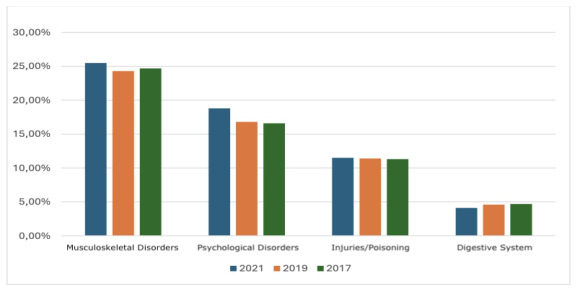
ANALYSING THE PROBLEMS IN THE COMPANY The analysis of the internal problem in the aluminum forging plant focuses on identifying and analyzing the physical stresses that employees experience during their work. One key aspect is the high prevalence MSDs, which are responsible for a significant proportion of days of incapacity to work in Germany. Older employees are particularly affected, which underlines the urgency of preventive measures.
Figure 1: Proportion of disease types in Germany (Statista, 2024).
90 Sen and Poetters
Various methods were used to record the current situation. Employee surveys: Specific questions were asked of employees, particularly the foreman, to gather information on the ergonomic design of the workplace, physical strain and preventative measures already implemented. These surveys helped to obtain a comprehensive picture of current working conditions.
Key indicator method: This method was used to record the physical strain in the individual work systems. It serves as a tool for the employer to identify the stresses and strains and, if necessary, to take measures to improve them.
Observations at the workplace: By analyzing the work processes and the physical demands placed on employees in aluminum production, the repetitive and monotonous nature of the work was identified, which indicates a high level of physical strain.
In addition, an investigation by the health insurance company supported the analysis. The investigation included an employee survey in which the physical strain in the various work areas was assessed. Employees were asked to share their experiences and assessments of physical strain during their work. The results were recorded in scores from 0 to 100, with lower scores indicating higher levels of strain. In particular, the focus was placed on repetitive and monotonous work processes that pose an increased risk of musculoskeletal disorders. The employees in the aluminum production area rated their physical strain with only 4 out of a possible 100 points. This was the lowest score in the entire company and indicated significant physical strain. Due to the high physical demands and repetitive tasks, employees were at increased risk of musculoskeletal disorders. This was a key concern that underlined the need for interventions such as the introduction of exoskeletons. The results of the investigation served as the basis for the development of measures to improve working conditions. The introduction of exoskeletons was identified as a promising solution to reduce physical strain and promote employee health.
Due to the findings, the pilot workplace selected for the study was characterized by repetitive and monotonous work processes. The employees frequently performed the same movements, which led to a high level of physical strain, particularly in the arm and shoulder area. As mentioned, this type of work posed a long-term risk of musculoskeletal disorders.
The pilot workplace at an aluminum press in the line includes the following work steps:
1. The aluminum workpiece with a weight of 2.74 kg is positioned in the die by arobot arm is positioned in the die from the right from the employee’s perspective. 2. The workpiece is aligned by an employee. This process isrequired by the movement tolerance of the robot arm in order to reduce reduce waste. 3. The first pressing process is triggered by the employee. 4. The employee lifts the workpiece from right to left into the finishing unit using tongs with a length of 53.5 cm from right to left into the finishing die. 5. The second pressing process is triggered by the employee.
Leveraging Exoskeletons to Reduce Musculoskeletal Disorders in Aluminum Forging 91
6. The employee lifts the workpiece again from the right to the left using the tongs from the finishing die into the trimming die. 7. The employee triggers the third pressing process and the workpiece is separated from the burr. The burr is removed while the workpiece is conveyed on a conveyor belt. 8. The workpiece is conveyed through a water bath to cool down. 9. Another employee removes the workpiece, punches a hole in it and then hangs it up.
The following movement sequences are given for the use of the exoskeleton in the area of the working leg:
1. With the arm extended at an angle of approx. 40
, the employee positions the workpiece. The employee usually positions the workpiece with one hand using pliers and triggers the automated pressing process. 2. The employee usually places the workpiece into the subsequent die with both hands, holding the workpiece with the pliers over the die for a brief moment for more precise positioning and repeating the pressing process.
METHODOLOGY
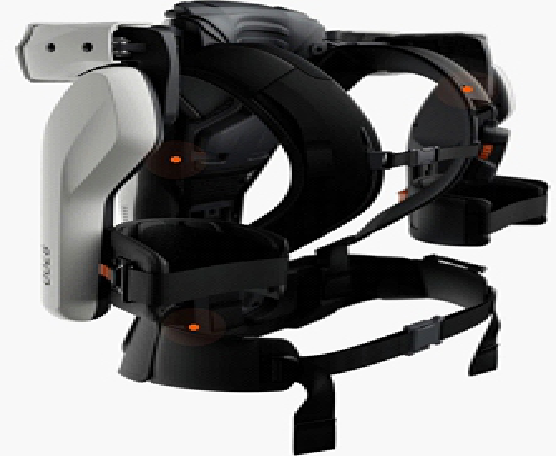
One month was planned for the test phase in which the exoskeleton from exoIQ (Figure 2) was to be used at the selected workplace. The aim was to reduce the physical strain on the employee due to the use of the exoskeleton.
Figure 2: Exoskeleton exoIQ.
Before the exoskeletons were introduced, training courses were held for all employees. The aim of this training was to familiarize employees with how the exoskeletons work and how to use them correctly. One responsible
92 Sen and Poetters
person per shift was appointed to provide support in the event of questions or problems.
The employees were divided into the following categories for the study: Small/Slim, Average and Tall/Muscular.
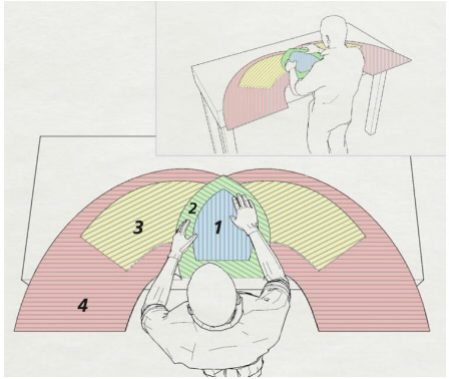
The work area was also divided into different zones (refer to Figure 3), as the force required differs for each zone.
Figure 3: Working zones.
Zone 1: work center/ assembly site, both hands work close together and are in the are in the center of the field of vision.
Zone 2: Extended work center, both hands reach all points of this zone. Zone 3: One-handed zone, zone for placing objects that are gripped/operated with one hand.
Zone 4: Extended one-handed zone, outermost usable zone, e.g. for placing small parts in gripping containers. With a heavy load, the strain has a negative effect on the musculoskeletal system after a short time (Daub et al., 2018). As can be seen from the colors, zone 1 is ergonomically safe according to the guiding characteristics method, while zones 4 and 3 are very bad for posture and effort.
RESULTS
The key indicator method was first carried out before the deployment and then during the deployment. The improvements in posture and effort are shown as a percentage in Table 1.
Leveraging Exoskeletons to Reduce Musculoskeletal Disorders in Aluminum Forging 93
Table 1: Improvement of key indicators in percentage.
Table available in the original PDF paper.
Zone 1 Zone 2 Zone 3 Zone 4 Small/Slim 5,11 % 3,20 % 30,42 % 50,36 % Average 8,43 % 1,32 % 18,98 % 41,67 % Tall/Muscular 0,44 % 0,21 % 10,42 % 22,25 %
The insights gained from the evaluation correspond with the individual feedback from the employees. The employee from the small/slim category emphasized the personal evaluation particularly emphasized the positive support and was generally very satisfied with the exoskeleton. The only negative aspect he mentioned was that the support for the arms cannot be adjusted independently. The assessment of the employee in the average category also emphasized the positive support and was also satisfied overall, although this employee negatively employee negatively mentioned the heat development at the contact points of the straps. Overall, the employees in the small/slim and average categories would recommend the exoskeleton in their day-to-day work. The employees in the tall/muscular category mentioned the heat generated by the belts at the contact points in their assessment. The support was mentioned as positive, but the negative aspects outweigh the positive ones in this category. Negative aspects, which is why the employees in this group would rather not use the exoskeleton in their everyday work.
CONCLUSION
The results of the study on the implementation of exoskeletons in the aluminum forging plant are based on comprehensive data collection and analysis of the physical strain on employees. The survey regarding the ergonomic strains showed that employees are exposed to significant ergonomic stress, particularly during repetitive movements and heavy lifting activities. The analysis of work processes revealed that many activities are carried out in forced postures, which increases the risk of musculoskeletal disorders. In the interviews, employees gave predominantly positive feedback on the support provided by the exoskeletons. Employees in the “small/slim” and “average” categories in particular reported noticeable relief at work. They emphasized that the exoskeletons reduce physical strain and increase efficiency. The evaluation of the test results also showed that the exoskeletons are able to significantly increase the physical performance of employees. The support of the joints and muscles led to a reduced risk of injury, particularly during heavy physical work.
Overall, employees showed a high level of acceptance for the use of exoskeletons in their day-to-day work. It can therefore be concluded that exoskeletons are a promising tool for improving working conditions and supporting employees in physically demanding occupations.
94 Sen and Poetters
REFERENCES
Afolabi, A., Yusuf, A., Akanmu, A. (2024). Human-in-the-Loop Digital Twin Framework for Ergonomics of Exoskeletons in Construction. Journal of Information Technology in Construction. Volume 29. Daub, U., Gawlick, S., Blab. F. (2018). Ergonomische arbeitsplatz-gestaltung.
Fraunhofer–Institut für Produktionstechnik und Automatsierung IPA – Stuttgart. Groß, M., Hennig, B., Kappel, S., Wallhoff, F. (2023). Assistive Technologien, technische Rehabilitation und Unterstützte Kommunikation. Heidelberg: Springer Berlin. Heinrich, K., Johns, J., Ralfs, L. (2022). Exoskelette: Aktueller Kenntnisstand. ASU
Volume 12. Lopota, A., Pavlov, N., Varlashin, V., Agalakov, V., Shmakov, O. (2024).
Industrial exoskeletons: A review and development trends. Robotics and Technical Cybernetics. Volume 12.
LISTED IN THE AHFE DIGITAL BOOKSTORE CATALOGUE
Explore the complete digital volume
Accessibility, Assistive Technology and Digital Environments
Read this individual research paper free through the original publisher, or explore the full digital proceedings book.
ISBN 978-1-964867-38-0
Explore this ISBN in the AHFE Bookstore ↗Listed in the July 2026 bookstore catalogue; search by ISBN to confirm current availability · Digital book purchase optional