Simay Tanrıverdi, Ekrem Cem Alppay (2026). Exploring the Anticipated User Experience of Autonomous Delivery Robots: A Mixed-Methods Study on Visual Appearance. In: Usability and User Experience. AHFE Open Access, vol. 232, pp. 249–259. https://doi.org/10.54941/ahfe1008053
The rapid advancement of digitalization and automation has transformed urban logistics, leading to the widespread integration of Autonomous Delivery Robots (ADRs). As these robots transition into semi-public spaces, they function not merely as logistical tools but as dynamic touchpoints within Product-Service Systems (PSS). The successful adoption of such novel technologies relies significantly on the Anticipated User Experience (AX)—the cognitive and emotional expectations formed prior to actual physical interaction. This study aims to investigate the AUX of ADRs operating in semi-public environments from a human factors and industrial design perspective. Employing a mixed-methods approach, the research initially utilizes a quantitative online survey to assess general public expectations regarding perceived safety, legibility of intent, and privacy risks. Subsequently, a qualitative study is conducted using in-depth video-elicitation interviews. Participants are presented with simulated, video-based delivery scenarios to deeply explore their anticipatory reactions and mental models regarding the robot's physical appearance, spatial footprint, and motion behavior. The findings aim to bridge the gap between user expectations and system design, providing actionable design guidelines for the form-giving, behavioral cues, and interaction interfaces of ADRs. Ultimately, this research contributes to the development of emotionally resonant, intuitive, and highly accepted autonomous service systems
With the rapid advancement of digitalization and automation, human-robot interaction (HRI) is becoming increasingly ubiquitous, while Autonomous Delivery Robots (ADRs) are driving a significant transformation in urban logistics (Patel, 2024; Riener et al., 2025). ADRs can be evaluated within the Product-Service Systems (PSS) framework, which combines service delivery with direct user interaction (Goedkoop et al., 1999; Wirtz et al., 2018).
The user-ADR relationship is shaped not only by performance during use but also by perceptions, emotions, and pre-interaction expectations. In this context, user experience must be evaluated before and after the interaction under Anticipated User Experience (AUX) (Desmet & Hekkert, 2007; Roto et al., 2010). Prior research suggests that perceived usefulness (PU), ease of use (PEOU), and reliability influence the adoption of last-mile technologies.
250 Tanriverdi and Alppay Accordingly, the visual and interactive design of ADRs plays an important role in user acceptance (Patel, 2024).
Grounded in AUX and the Technology Acceptance Model (TAM) (Davis, 1989), this study examines how ADRs’ visual appearance shapes user expectations. Consequently, the following research questions remain unanswered:
RQ1: How does the visual appearance of autonomous delivery robots serving in open public spaces affect users’ AUX?
SQ1: Which UX dimensions do users prioritize when evaluating ADRs?
SQ2: How do different visual appearances of ADRs create variations in users’ evaluations of trust, understandability, social acceptance, and preference?
SQ3: How does a video-supported scenario experience alter or clarify users’ pre-experience expectations regarding ADRs?
To this end, a mixed-methods research study was conducted. First, an online survey with 324 participants in Turkey collected AUX evaluations of market-available ADR visuals, together with demographic data and attitudes toward technology and services. Based on these findings, interviews were conducted with 12 participants. These interviews evaluated a video- supported public ADR delivery scenario.
SERVICE ROBOTS AS SMART PSS TOUCHPOINTS According to ISO 8373, service robots perform useful tasks for people or equipment in personal or professional contexts (International Organization for Standardization [ISO], 2021). Beyond task execution, such systems are also considered autonomous interfaces, and ADRs are a prominent example of robots designed for contactless package delivery (Chen & Ryu, 2025; Wirtz et al., 2018). As ADRs become more widespread, understanding how their appearance sways acceptance and user expectations has become a pivotal field (Nakanishi et al., 2020; Noble & Mende, 2023).
Smart PSS are products and services that are specialized for users (Lerch & Gotsch, 2015; Zheng et al., 2019). In the context of delivery services, ADRs do not operate as standalone products. Rather, they are embedded in a broader system that includes digital ordering, tracking, arrival notification, and package retrieval. Within this system, autonomous service robots supported by AI, IoT, and mobile technologies function as critical user touchpoints (McLeay et al., 2021).
HUMAN-ROBOT INTERACTION (HRI) Proliferation of ADRs requires HRI to be evaluated by task success as well as users’ perception of the interaction. The brevity of the interaction and outdoor distractions such as crowds, noise, and movement, and willingness to interact affect the user’s trust in ADRs along with its appearance, behavior, and communication style (Hancock et al., 2020; Kundinger et al., 2019;
Exploring the Anticipated User Experience of Autonomous Delivery Robots 251 Nahavandi, 2017). For example, communication cues that convey the robot’s state and next action reduce uncertainty and encourage trust and acceptance (Riener et al., 2025), all of which are factors of AUX.
AUX AND VISUAL APPEARANCE OF PRODUCTS Expectations formed before product evaluation can sway later assessments, highlighting the importance of AUX (McCarthy & Wright, 2004; Kujala & Miron-Shatz, 2015). According to Desmet and Hekkert (2007), expectation is a crucial stage of the experience process and encompasses physical/non- physical interactions, such as recalling, predicting, or imagining the product use. Users evaluate products through functional, aesthetic, symbolic, and ergonomic expectations influenced by form and appearance (Jourabchi Amirkhizi et al., 2023; Pakanen et al., 2020). Therefore, visual appearance can be considered a powerful design input that triggers pre-interaction evaluation, making ADR appearance a critical topic.
METHODOLOGY
This study investigated how the visual appearance of autonomous delivery robots serving in public spaces regulates users’ AUX, via a methodology that consists of an online survey and follow-up video-supported interviews.
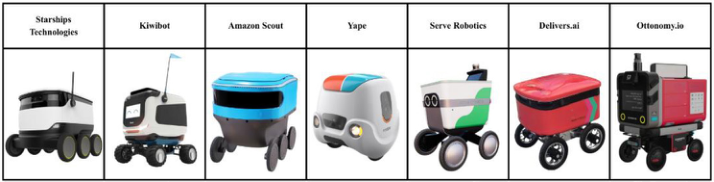
Online Survey (First Phase) In the first phase, an online survey with 324 participants from all age groups (the majority of which being between 18 and 34) from Turkey was conducted to examine their perceptions, attitudes, and expectations regarding service robots. The survey includes questions that cover demographics, attitudes toward technology use and delivery services, and UX dimensions related to ADR appearance based on the sRAM model (Lewis & Hf, 2019; Wirtz et al., 2018). To support the evaluation of ADR appearance, participants were shown images of ADRs from seven companies together with a short video depicting the delivery process (Figure 1).
Figure 1: Images of ADRs from seven companies.
Survey data were analyzed by a Python script, and internal consistency was assessed using Cronbach’s alpha. 12 participants aged 18–34 with high and consistent technology use were selected for the second phase.
In the second phase, a video-supported scenario was shown to participants to gauge their expectations and evaluations of ADRs. The scenario is based on the Delivers.ai ADR operating in Turkey, and scenes of the delivery process were created using AI tools.
The 12 participants were uniformly divided into 4 groups: high/low online ordering frequency and high/low attitudes toward service robots. Participants answered questions before, during, and after the video. The interview questions were structured within the AUX and PSS frameworks to examine perceived safety, comprehensibility, interaction quality, task success, social acceptance, aesthetic evaluation, and word-of-mouth intention. Some questions were answered through 7-point Likert-scale items, while others required open-ended responses.
RESULTS
First Phase During the first (online survey) phase, despite the high frequency of technology use and online ordering behavior reported by the participants, 73.5% and 66.4% of them reported having never interacted with a robot and an ADR, respectively. These results indicate that even with a tech-savvy sample, direct experience with ADRs was limited. This indicates that, rather than direct experience, anticipated experiences largely influence participants’ evaluations.
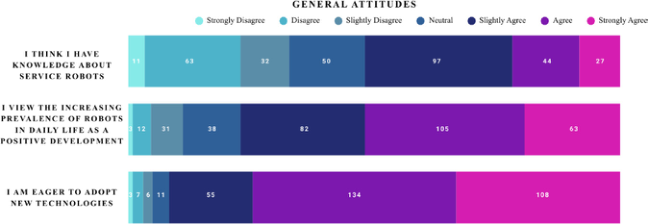
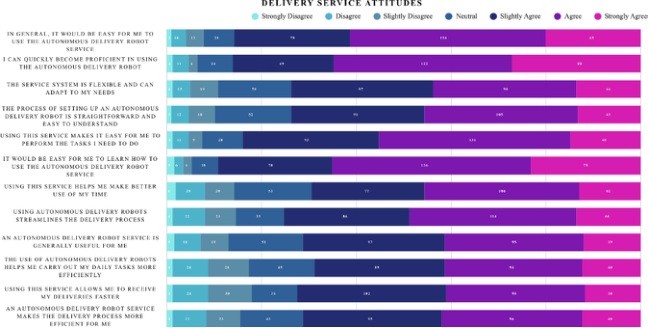
Analyses conducted within the TAM framework showed that participants were willing to adopt new technologies and viewed the increasing presence of robots in daily life positively (Figure 2). Participants also perceived ADRs as useful systems that could optimize time management and streamline daily tasks (PU). However, most participants also reported limited knowledge about ADRs, indicating that positive attitudes toward ADRs were possible even without retroactive knowledge (Figure 3). Participants responded particularly positively to the ADR service in terms of learnability, ease of use, and overall benefit. However, responses were more skeptical regarding the service’s flexibility, speed, and efficiency. Overall, the ADR service was perceived as easy-to-grasp and potentially functional.
Figure 2: General attitudes and openness to technology.Figure 3: Delivery-service attitudes (PU / PEOU-related items).
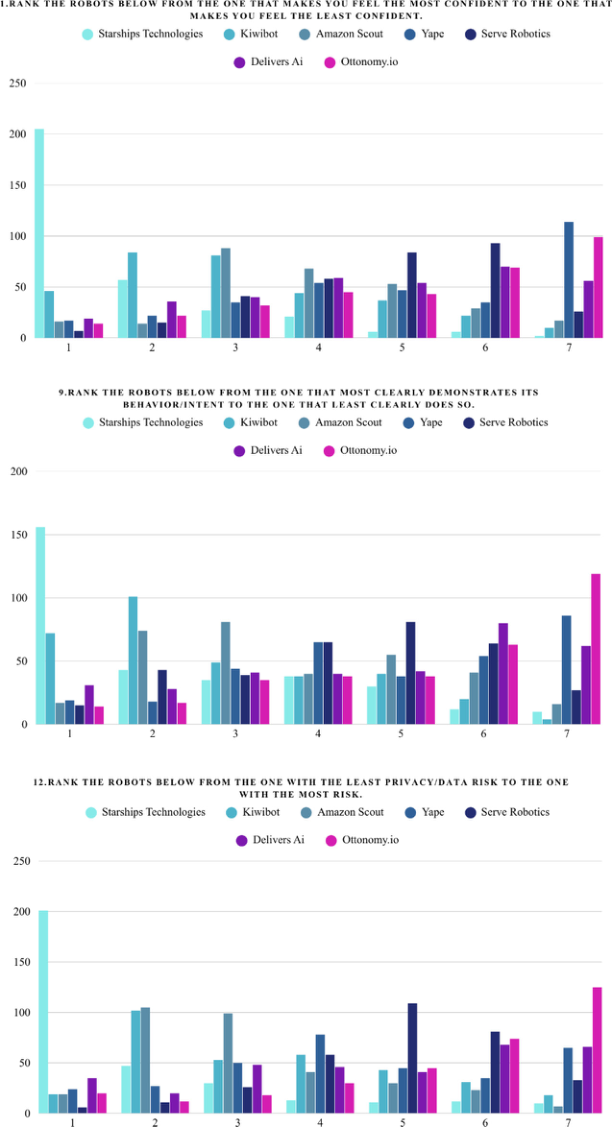
Visual evaluations clearly showed that appearance affected the expected user experience. Participants perceived some robots as safer, more user- friendly, and more favorable, whereas others were seen as more distant, ambiguous, and less favorable. This suggests that beyond just aesthetics, ADR’s appearance functioned as a cue for trust, legibility, and expected performance. The Starship robot, characterized by its compact, low-to-the- ground form and rounded lines, received the highest ratings in the trust, friendliness, and legibility of intent categories. In contrast, larger, more angular designs, such as Ottonomy, received the most negative evaluations in the physical safety and data privacy categories (see Appendix 1).
Finally, results of the first phase showed high internal consistency overall (α = 0.935), with strong reliability for the PU (α = 0.946) and PEOU (α = 0.906) dimensions. The mean values, standard deviation, and factor loadings of participants’ answers on the Likert scale are presented in Table 1, which shows TAM-related service attitudes and the most salient appearance-based evaluation outcomes.
Table 1: TAM-related service attitudes scale in the first-phase survey.
Table available in the original PDF paper.
M SD λ
Equation reproduced from the original PDF.
5.006 1.431 0.827
Q1 The ADR service makes the delivery process more efficient for me.
4.975 1.448 0.780
Q2 Using this service allows me to receive my deliveries faster.
4.953 1.461 0.831
Q3 Using ADRs helps me manage my daily tasks more effectively.
Q4 The ADR service is generally beneficial for me. 5.030 1.385 0.872 Q5 Using ADRs simplifies the delivery process. 5.138 1.432 0.862
5.040 1.453 0.824
Q6 Using this service allows me to use my time more efficiently.
(Continued)
Table 1: Continued.
Table available in the original PDF paper.
M SD λ
TAM/Service Attitudes
5.672 1.200 0.710
Q7 Learning how to use the ADR service is easy for me.
5.407 1.239 0.839
Q8 Using this service to perform the tasks I want is easy for me.
5.169 1.302 0.732
Q9 Interacting with the ADR is clear and straightforward.
5.141 1.323 0.766
Q10 The service system is flexible and can adapt to my needs.
Q11 Q12
5.657 5.546 1.298 1.249 0.663 0.781
I can become proficient in using the ADR in a short time. Overall, using the ADR service will be easy for me.
Equation reproduced from the original PDF.
Second Phase In the second (video-supported) phase, the pre- and post-experience Likert- scale responses showed acceptable internal consistency in both stages. Furthermore, second-phase results demonstrate an increase in Cronbach’s alpha from 0.7655 to 0.8458. Raw averages of the answers also show an improvement: from 5.5417 to 5.9479, corresponding to a 7.33% increase (Table 2).
Table 2: Cronbach’s alpha before vs after use.
Table available in the original PDF paper.
Questions Pre Mean Post Mean Change %Change 6.2500 6.2500 +0.0000 +0.00% Q1 I believe interacting with the robot will be safe.
6.2500 6.1667 –0.0833 –1.33%
Q2 I am not bothered by the robot moving around me.
5.8333 6.0833 +0.2500 +4.29%
Q3 I think I will be able to easily figure out how the robot works.
5.3333 6.3333 +1.0000 +18.75%
Q4 I think I will be able to easily understand how to communicate with the robot.
Q5 I trust that the robot will deliver my
5.0833 5.4167 +0.3333 +6.56%
order correctly.
5.2500 6.0000 +0.7500 +14.29%
Q6 I believe the delivery process will go smoothly.
5.2500 5.4167 +0.1667 +3.17%
Q7 I find the robot’s appearance modern and user-friendly.
5.0833 5.9167 +0.8333 +16.39%
Q8 I believe this robot will be readily accepted by society.
AVG 5.5417 5.9479 +0.4063 +7.33%
Exploring the Anticipated User Experience of Autonomous Delivery Robots 255 The interviews further showed that participants did not perceive ADRs merely as a technical delivery vehicle, but also as a product whose appearance conveys meaning. Some participants described the Delivers.ai robot as “clean,” “modern,” “safe,” and “friendly” thanks to its white color, rounded shape, and simple design. However, others compared it to a “shopping cart”, “picnic basket”, or “toilet seat” and described it as a “cheap and ambiguous object” (Table 3).
Table 3: Main qualitative themes identified in the video-supported interviews.
Table available in the original PDF paper.
Theme Main Finding Example Expressions Appearance-based meaning attribution
Participants interpreted the robot’s visual form not only aesthetically but also in terms of service quality, trust, and reliability.
concerns about the “thin lid,” “opening from the outside,” vulnerability to environmental conditions
Safety was evaluated not only in terms of physical collision risk but also in relation to external interference, lid security, lock visibility, and package exposure.
Interface visibility and communication cues
Participants expected clearer interface elements such as screens, lights, written instructions, voice prompts, and visible status indicators to support clarity and trust.
requests for “screen,” “lights,” “voice prompts,” “written instructions,” and a clearer status display
Feedback, legibility of intent, and retrieval process
Participants wanted the robot to communicate its movement and delivery status more clearly and expected the retrieval stage to be secure and seamless through QR/app integration.
Safety was discussed mainly in relation to vandalism, external interference, and the robot’s adaptability to public spaces. Many participants stated that the robot’s slow and controlled movement did not constitute a direct physical threat. However, some participants with prior robot interaction experience interpreted this movement style as a technical fault, which reduced confidence in the robot’s delivery performance. Other safety concerns were the thin lid, the obscured visibility of the lock mechanism, the perceived possibility of an unauthorized opening of the robot by a third party, and the package’s exposure to environmental risks. These concerns appeared repeatedly in both pre- and post-video evaluations.
One of the most prominent themes was the nonexistence of a tangible interface on the ADR and communication cues. Participants frequently emphasized that an auxiliary screen, lights, written instructions, voice prompts, or a more visible status indicator would enhance the clarity and reliability of the interaction. Eye-like headlights, rounded contours, and vibrant colors were also seen as features that reduced the robot’s industrial appearance and increased empathy. However, participants emphasized that
256 Tanriverdi and Alppay although the robot could be “cute,” it also needed to convey technological reliability and remain easily noticeable on the sidewalk through its size and color.
Participants also frequently noted the lack of feedback during the robot’s movement. They expected the robot to provide audible warnings when approaching, use signal lights when changing direction, and display delivery- related messages on an on-body screen, all of which supported legibility of intent. During package retrieval, participants expected the lid mechanism to feel secure and be accessed seamlessly via a QR code or mobile application, which was identified as a critical Smart PSS touchpoint.
CONCLUSION
This study examined AUX before physical interaction and its role within the Smart PSS context of ADRs operating in public spaces. The mixed-methods study showed that pre-interaction mental models and the robot’s physical appearance affect users’ attitudes toward ADRs.
During the online survey phase, participants showed an open attitude toward technology and digital service systems. However, due to a lack of direct experience with ADRs, their evaluations were largely based on appearance, general service concepts, and intuitive expectations. The interview phase helped identify the specific design and contextual factors. Together, the quantitative and qualitative findings showed that AUX was shaped not only by the robot’s visual appearance but also by intent readability, trust in the system and environment, and clear feedback mechanisms such as screens, sounds, and lights. Compact forms that convey physical durability without appearing threatening emerged as more appropriate Smart PSS touchpoints.
Furthermore, the findings suggested that the PU and PEOU dimensions examined within the TAM framework were closely related to visual form. Participants interpreted robots with human-like size and angular, industrial forms as more complex and unpredictable systems that entail privacy and error risks. Conversely, compact, low-to-the-ground designs with rounded contours generated a more reliable, “friendly,” and approachable mental model. This underscores the notion that industrial design decisions are not merely aesthetic preferences, but strategic factors shaping social acceptance and psychological safety. The findings also highlighted the strong influence of on-site context on expectations in the AI-supported video-elicitation process. Participants were often more concerned about the robot being harmed by people, but not the other way around. This suggests that perceived safety should be approached as a multidimensional concept.
In conclusion, ADRs are not mere transport vehicles; they are key touchpoints in a Smart PSS cycle that begins with a digital application and concludes with physical package delivery. In this context, the effectiveness of AUX depends particularly on two factors: the robot’s ability to clearly communicate its movement intent to pedestrians (i.e., legibility of intent), and the harmony between physical and digital interfaces.
ACKNOWLEDGMENT
This research is supported by Istanbul Technical University Scientific Research Projects Coordination Unit (BAP) within the heading of Thesis Projects (Project Title: A Study on Discovering the Anticipated User Experience of Autonomous Delivery Robots; Project ID: 47063; Project Code: MYL- 2025-47063). The authors would like to acknowledge and thank Istanbul Technical University Scientific Research Projects Coordination Unit for their support and contribution.
REFERENCES
Chen, Y., & Ryu, M. H. (2025). Sustainable Logistics: Exploring the Determinants of Consumer Attitudes and Intention to Use Toward Autonomous Delivery Services. Sustainability (Switzerland), 17(8). https://doi.org/10.3390/su17083290 Davis, F. D. (1989). Perceived usefulness, perceived ease of use, and user acceptance
of information technology. MIS Quarterly: Management Information Systems, 13(3). https://doi.org/10.2307/249008 Desmet, P., & Hekkert, P. (2007). Framework of product experience. International Journal of Design, 1(1), 57–66. Goedkoop, M. J., van Halen, C. J. G., te Riele, H. R. M., & Rommens, P. J. M.
(1999). Product Service Systems, ecological and economic basics. In Report for Dutch Ministries of Environment and Economic Affairs. Hancock, P. A., Kessler, T. T., Kaplan, A. D., & Szalma, J. L. (2020). Evolving Trust in Robots: Specification Through Sequential and Comparative Meta-Analyses. International Organization for Standardization. (2021). Robotics—Vocabulary (ISO
Standard No. 8373:2021). ISO. Jourabchi Amirkhizi, P., Pourtalebi, S., & Anzabi, N. (2023). Emotional Effects of Product Form in Individualist and Collectivist Cultures. Journal of Marketing Communications, 29(5), 476–490. https://doi.org/10.1080/13527266.2022.2037 009 Kujala, S., & Miron-Shatz, T. (2015). The evolving role of expectations in long-term user
experience. ACADEMICMINDTREK 2015 - Proceedings of the 19th International Academic Mindtrek Conference. https://doi.org/10.1145/2818187.2818271 Kundinger, T., Riener, A., & Wintersberger, P. (2019). (Over)trust in automated driving: The sleeping pill of tomorrow? Conference on Human Factors in Computing Systems - Proceedings. https://doi.org/10.1145/3290607.3312869 Lerch, C., & Gotsch, M. (2015). Digitalized product-service systems in manufacturing
firms : A case study analysis. Research Technology Management, 58(5). https:// doi.org/10.5437/08956308X5805357 Lewis, J. R., & Hf, S. (2019). Comparison of Four TAM Item Formats: Effect of Response Option Labels and Order. In Journal of Usability Studies (Vol. 14). McCarthy, J., & Wright, P. (2004). Technology as experience. Interactions, 11(5).
https://doi.org/10.1145/1015530.1015549 McLeay, F., Osburg, V. S., Yoganathan, V., & Patterson, A. (2021). Replaced by a Robot: Service Implications in the Age of the Machine. Journal of Service Research, 24(1). https://doi.org/10.1177/1094670520933354 Nahavandi, S. (2017). Trusted Autonomy Between Humans and Robots: Toward
Human-on-the-Loop in Robotics and Autonomous Systems. IEEE Systems, Man, and Cybernetics Magazine, 3(1). https://doi.org/10.1109/msmc.2016.2623867
258 Tanriverdi and Alppay Nakanishi, J., Baba, J., Kuramoto, I., Ogawa, K., Yoshikawa, Y., & Ishiguro, H.
(2020). Smart speaker vs. social robot in a case of hotel room. IEEE International Conference on Intelligent Robots and Systems. https://doi.org/10.1109/ IROS45743.2020.9341537 Noble, S. M., & Mende, M. (2023). The future of artificial intelligence and robotics in the retail and service sector: Sketching the field of consumer-robot-experiences. In Journal of the Academy of Marketing Science (Vol. 51, Number 4). https://doi. org/10.1007/s11747-023-00948-0 Pakanen, M., Alavesa, P., Arhippainen, L., & Ojala, T. (2020). Stepping out of the
classroom anticipated user experiences of web-based mirror world like virtual campus. International Journal of Virtual and Personal Learning Environments, 10(1). https://doi.org/10.4018/IJVPLE.2020010101 Patel, S. (2024). Human Interaction with Autonomous Delivery Robots: Navigating the Intersection of Psychological Acceptance and Societal Integration. Human Factors in Design, Engineering, and Computing, 159. https://doi.org/10.54941/ ahfe1005649 Riener, K., Patel, V., Jiang, L., Elahi, B., Suresh, M., Papa, L., & Luo, Y. (2025).
Human-Robot Communication: Utilizing Light-Based Signals to Convey Robot Operating State. Human Factors in Robots, Drones and Unmanned Systems, 179. https://doi.org/10.54941/ahfe1006382 Roto, V., Law, E., Vermeeren, A., & Hoonhout, J. (2010). User Experience White Paper: Bringing clarity to the concept of user experience. … Seminar on Demarcating User Experience. Wirtz, J., Patterson, P. G., Kunz, W. H., Gruber, T., Lu, V. N., Paluch, S., & Martins,
A. (2018). Brave new world: service robots in the frontline. Journal of Service Management, 29(5). https://doi.org/10.1108/JOSM-04-2018-0119 Zheng, P., Wang, Z., Chen, C. H., & Pheng Khoo, L. (2019). A survey of smart productservice systems: Key aspects, challenges and future perspectives. In Advanced Engineering Informatics (Vol. 42). https://doi.org/10.1016/j.aei.2019.100973
APPENDIX
Figure 4: Evaluation of ADR appearance.
LISTED IN THE AHFE DIGITAL BOOKSTORE CATALOGUE
Explore the complete digital volume
Usability and User Experience
Read this individual research paper free through the original publisher, or explore the full digital proceedings book.
ISBN 979-8-950676-08-6
Explore this ISBN in the AHFE Bookstore ↗Listed in the July 2026 bookstore catalogue; search by ISBN to confirm current availability · Digital book purchase optional