Sena Semizoğlu, Ekrem Cem Alppay (2021). Transdisciplinary Approach in Social Robots: A Repertory Grid Analysis on Perception and Anticipated User Experience. In: Human Systems Engineering and Design (IHSED2021): Future Trends and Applications. AHFE Open Access, vol. 21. https://doi.org/10.54941/ahfe1001112
Social robot can be defined as a physical robot with capabilities of interacting with their surrounding in a social manner. Social robots should be designed both physically and socially. Designing them requires more than technical knowledge and should be taken as a transdisciplinary process in which engineers, program-mers, behavioral scientists and designers co-work. This study aims to explore the transdisciplinary nature of social robots as an emerging social artefact.A repertory grid study is conducted with 13 participants from different back-grounds to reveal the perceptual keywords about social robots. 50 potential users contributed to an anticipated user experience survey to understand their percep-tions. Outcomes of these two studies are compared. Results show that different professions involved have their own approach and way of understanding that cover varying aspects of social robotic field. This highlights the position of this study which supports transdisciplinary work, and believes transdisciplinarity’s positive contributions in the future research.
As Information and Communication Technologies (ICTs) such as smart phones, computers etc. merge into daily life and tasks, the way of interaction gained im- portance. These technologies gave life to a new, digital and virtual world, and sup- ported with physical tools to act in this world. Although initially, the user-interaction was limited to physical entities such as screens, keyboards etc. and to basic Graphical User Interfaces (GUIs), with developments in hardware and software – such as in sensors, actuators, artificial intelligence etc. – the way of interaction changed substantially. Even though GUIs offered valuable ways of interaction, these cannot be com-pared with the diverse human skills and senses gained in the physical world (Ishii & Ullmer, 1997). Further developments and research led to Tangible User Interfaces (TUIs) and Natural User Interfaces (NUIs), but with the developments in the artificial intelligence (AI) field the interaction between physical and digital changed drastically as the capabilities in the digital domain go way beyond basic calculations and codes.
Developments in the AI field are used in many products such as personal assistants on mobile devices, driving assistance in automobiles etc. (Wang, Weiyu & Keng Siau, 2019). There are also several AIs that are able to recognize and differ between human emotions. AIs are also embedded in robots which have been in the industry for several decades but with AIs’ emerging social skills and understanding, social robots become a reality.
Human Systems Engineering and Design (IHSED 2021) https://openaccess.cms-conferences.org/#/publications/book/978-1-7923-8987-0
In the last years several social robots emerged as consumer products but it is not possible to say that these products are widely used and integrated into daily life. As stat-ed in Rogers’ Diffusion of Innovation Theory, an innovation’s, trend’s or a new product’s acceptance is closely related to 6 perceived attributes: relative advantage, compatibility, observability, trialability, complexity (Rogers, 2003). He also categorizes users in 5: innovators, early adopters, early majority, late majority and laggards. The first two user group is not actually determinant in the major acceptance of a new product as they are technology enthusiasts and tend to use technology even it has negative at-tributes such as low relative advantage, low observability etc. After the first two group there is the Chasm, where failed trends – which are not accepted by early majority and late majority – fall. Similarly to Rogers’ theory, Moggridge quotes Liddle as he states that there are 3 stages of a new technology: enthusiast stage, professional stage and consumer stage (Moggridge, 2007). In enthusiast stage, enthusiastic people use the technology/product regardless of its usability. In professional stage users mostly does not have a choice, as their employers force them to use the technology/product. The last stage is where consumers begin to use it with freewill. When social robots are examined regarding to perceived attributes, their observability, trialability, compatibility are very low, they don’t have a huge relative advantage or compatibility as they are new products to the market. They are also complex in their technologies which may make them intimidating to many users. When these robots are examined regarding to its users, it can be stated that they are mostly used by enthusiasts, and recently entering the consumer stage as consumer products. Regarding to the process of new products’ diffusion, it is important to consider user related aspects of social robots.
The definition of a social robot can be stated as a physical entity that is able to communicate with humans in a personal and social manner (Breazeal, 2002). The nature of robotics in general is transdisciplinary (Arkin et al, 2003; Glas et al, 2012); mechanical, software, electronical engineers work in collaboration to create a working robot. When it comes to social robots this transdisciplinarity widens, as social robots have social skills and they are entering the market as consumer products. Therefore, along with engineers, behavioural scientists, product designers and user experience (UX) designers should participate in production process. Similarly, involvement of design fields and possible contributions of such associations are addressed in (Bartneck et al, 2009; Sabanović, 2010).
Human Systems Engineering and Design (IHSED 2021) https://openaccess.cms-conferences.org/#/publications/book/978-1-7923-8987-0
Design problems are accepted as “wicked problems”, as they are not straightforward and hard to define due to human involvement. Social dynamics and human characteristics play an important role in defining design problems. Similarly, these dynamics play important roles in the interaction between humans and social robots. Šabanović (2010) states that social robots can be considered as wicked problems as well. Therefore, considering the whole development process as a design process would be beneficial to the field. Design process is accepted as an iterative process. Both in education and practice, designers are given a design brief that sets the aim, target group and market, defining most of the functionality of the expected result. Then designers interpret this information along with corporate identity, target group’s desires and wants, and other technical requirements to create a design. Then after evaluations, they design the product again if needed. In practice it is not common to give the same design brief to different design teams except on competitions, but in design education a class is given same or similar design briefs. These classes result in a wide variety of final products answering the same design brief, which means that even though the context, aim etc. is set, different final designs might answer these. In Buchanan’s paper about the wicked nature of design problems (Buchanan, 1992), it is explained that in the actual practice de-signers work on matters of existing issues and problems of specific situations, and they design varying end products within the possibilities of these situations. All these show that each designer will interpret the information differently and result in varying designs. Also, one designer might create several designs that answer to the brief properly, while some of these are liked by users more than others. Interaction design field emerged after ICTs became common to answer user needs and wants. It is also an iterative process very similar to design process. User experience design cycle con-sists of 4 key elements: analyse, design, implement and evaluate (Alenljung et al, 2019). It begins with clarifying what users want and need, then continues with analysis. After analysis comes the design solutions. These solutions are interpreted into prototypes and tested afterwards which ends with either redesign or implementation and deploy. User experience evaluations are made regarding to the first two steps to check if a designed product/service/system is proper to this information. All these statements indicate that design is both subjective and objective, and user plays a crucial part to decide if a design is proper and successful. Both product design and interaction design fields offer valuable insights about design process and user related issues such as acceptance. Therefore, it is important to benefit from these professions to create social robots that are loved and accepted by majority of users.
The aim of this study is to explore the transdisciplinary nature of social robots as an emerging social artefact by determining keywords used by different actors who play a role in the design and development process. Also, principle keywords of prospective users were investigated in order to generate a holistic keyword framework of the field.
Human Systems Engineering and Design (IHSED 2021) https://openaccess.cms-conferences.org/#/publications/book/978-1-7923-8987-0
METHODOLOGY
We hold a repertory grid (RG) study with 12 social robots. Repertory Grid Technique was emerged from psychology in 1950s as a part of George Kelly’s Personal Con- struct Theory (Fay et al, 2004). According to this theory (Kelly, 1991) it is not possible to understand the whole perceptual construct of an individual from their statements about situations as not all constructs reflect into words and direct questions might result in biased answers. Repertory Grid technique is offered to reveal the is mostly used in psychology area and it is used for revealing constructs and semantic space of individuals (Kelly, 1991). Therefore, this technique is used in our study to reveal disciplinary constructs about social robots. As social robots are new to the market, and not many of the participants truly know what they meant, each participant was shown a short clip of the mentioned 12 social robots. After that the study continued with up to 28 visuals including 3 of these 12 social robots in random combinations. Participants were asked to group 2 out of 3 social robots in each visual, and state the reason of their selection. After revealing the keywords from each participant, the keywords are grouped regarding to their references – physical attributes (size, mobility, limbs, human or animal likeliness etc.), interactive attributes (way of interaction, communication levels etc.), and emotional attributes (cuteness, ugliness, warmth, creepiness etc.). While in general, repertory grid studies continue with scaling the assets in regard of the keywords, the findings of the second phase of the RG is not a subject of this study, therefore it is not concluded.
First phase of the RG study was conducted with total 13 participants from different backgrounds: 2 Computer/Software engineers, 2 mechanical engineers, 2 product designers, 2 User Experience (UX) designers, and 5 potential users. Each participant was first given an emotional state scale, and a technology attitude scale. Potential users are selected according to their positive attitudes towards technology and their backgrounds are different than other participant groups.
As the second phase of our study, we conducted interviews and online surveys to understand users’ anticipations about social robots. Potential users were asked to define a social robot that will be used by them. They were asked to consider resemblance, functionality, appearance, interaction and affective meaning and state their preferences. The statements are then compared with the keywords of the RG study. 50 participants contributed to the second phase.
Human Systems Engineering and Design (IHSED 2021) https://openaccess.cms-conferences.org/#/publications/book/978-1-7923-8987-0
REPERTORY GRID STUDY AND ANTICIPATED USER EXPERIENCE First Phase: Repertory Grid Study
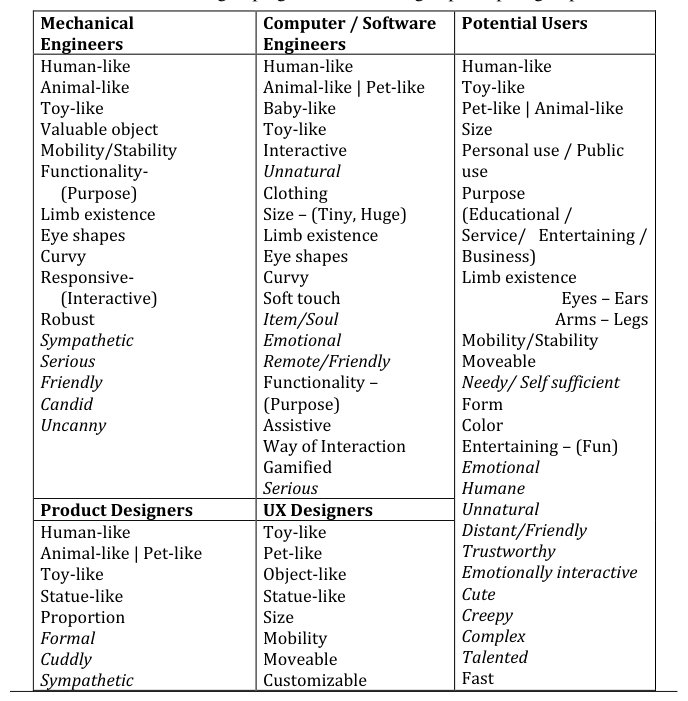
As mentioned in the section 2, a repertory grid study with 12 social robots was held. Mechanical engineers, Computer/Software engineers, UX designers, Product designers and potential users are participated in this study. Table 1 shows the stated grouping criteria of each participant group.
Table 1: Stated grouping criteria according to participant groups.
Human Systems Engineering and Design (IHSED 2021) https://openaccess.cms-conferences.org/#/publications/book/978-1-7923-8987-0
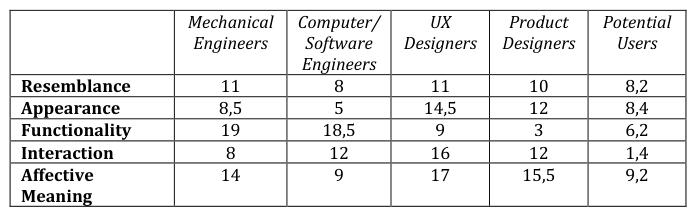
These criteria can be placed under 5 categories: resemblance, appearance, functionality, interaction, and affective meaning. While some keywords might be placed under several categories, they are categorized with their primary objectives. Human – animal/pet – toy resemblance, as can be seen from the Table 1, is stated by all the participant groups and in every RG interview resemblance is mentioned in the first couple slides. Therefore, it should be an important part of the design brief taking into consideration of the robot’s aim. Resemblance is closely related but not limited to appearance, vice versa. Appearance related criteria cover physical features such as size, form, colour, facial and bodily features. These all can be in countless different styles and designs, and they all result as an interpretation of the designer according to the design brief. Robots’ purpose, mobility and aim are considered under functionality, while interaction is about interaction channels, responsiveness, existence of expressions etc. Lastly, affective meaning is related to emotional perception as can be seen from Table 1, participants assigned properties such as cute, creepy, social, friendly, trustworthy, distant etc. Table 2 shows the average mentions in each category by each participant group. Regarding to table it is possible to state engineers (both mechanical and computer) mention functionality the most, while UX designers and product designers mention it the least. On the other hand, UX designers and product designers refer affective meaning most, following with interaction category. Potential Users mostly mention affective meanings and have an average of 9,2 answers for this category. The lowest mention rate for prospective users is interaction with 1,4. We believe this is a result of the study’s nature, as participants don’t get a chance to interact with these robots and are only shown visuals. Other participant groups might previously worked or familiar with interaction and its elements, while users know little of interaction dynamics and served with improved interfaces that are designed to be natural.
Human Systems Engineering and Design (IHSED 2021) https://openaccess.cms-conferences.org/#/publications/book/978-1-7923-8987-0
Table 2. Average number of mentions in categories by each participant group.
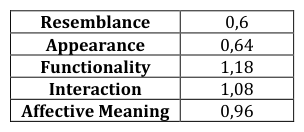
Anticipated User Experience techniques are used for gathering information about future products as they offer to reach the insight knowledge, expectations and perceptions of potential users. In this study we conducted online interviews and surveys to get to these data. 50 potential users were given a short definition and explanation of social robots and asked to define their anticipations from social robots regarding to the mentioned 5 categories in chapter 3.1. (Table 3).
Table 3. Average rate of mentions in AUX interviews and surveys (per person).
Resemblance 0,6 Appearance 0,64 Functionality 1,18 Interaction 1,08 Affective Meaning 0,96 Users mostly assigned expected functions to social robots, while some mentioned resemblance. Some participants state human resemblance as a positive feature, though some claim that this resemblance is unnatural and uncanny. Also expected functions differ in a wide range. This situation highlights the importance of designers’ participation in the field, as design process requires a design brief that can be interpreted by designers to achieve different results. The way of handling the design brief is very crucial to achieve product goals. While there are different views on resemblance and functionality, on interaction and affective meaning categories majority of potential users want to have a friendly, trustworthy and easy to communicate social robot. Some stated they want a companion in daily life that they can share their feelings, daily tasks etc. easily. Some stated that it should understand their mood and act as an assistant during troubled times. On directly about the appearance there are only few entries. One is a participant who stated that if a robot is large in size, it reminds him of service robots and feels like the robot is a public one. And if it is small than it resembles toys too much and can’t take
Human Systems Engineering and Design (IHSED 2021) https://openaccess.cms-conferences.org/#/publications/book/978-1-7923-8987-0 it seriously. He claimed that medium sized robots are most likely to be accepted as personal social robots. The outcomes of the anticipated user experience work we conducted indicate that users tend to refer interaction elements and affective meanings along with expected functionalities of a social robot, which also supports the idea of needing transdisciplinary teams to achieve successful social robots. Though, an important point that should not be missed is the suitability of the aim as explained in the first chapter. If a consumer stage product does not properly actualize its aims and functions, their other properties such as appearance, affective meaning etc. will have less influence on users’ acceptance.
DISCUSSION
Social robots are becoming consumer products and several professions are involved in the developing process. As mentioned earlier it is crucial to acknowledge the social in social robotics. Both their social abilities and being consumer products, these robots require different processes than conventional industrial products or industrial robots. The outcomes of the Repertory Grid and Anticipated User studies show that potential users tend to assign affective meanings to social robots more frequently than other participant groups, and also mention affective meanings more than appearance, functionality and interaction.
Responses for the question of a desired social robot indicate natural interaction is important along with nicely designed appearance, even though first phase results indicate lower mention rates for interaction.
When RG study participant groups are examined, it is possible to state that product designers and UX designers mention affective meanings and interaction more than mechanical engineers and computer/software engineers. This is a result of each professions’ nature. While product designers and UX designers foreground needs, requirements and wants of the users, engineers deal primarily with technical issues such as mechanics and coding. They both ask the question “how”, though their answer depends on their medium: the user or the machine. Our study supports the idea that each profession has its own understanding of social robots, and can work on different areas of social robotics. Therefore, we believe UX designers and product designers should also contribute to the area. Social robotics is a transdisciplinary field and re- quires transdisciplinary teams to achieve successful consumer products.
Human Systems Engineering and Design (IHSED 2021) https://openaccess.cms-conferences.org/#/publications/book/978-1-7923-8987-0
REFERENCES
Alenljung, Beatrice, et al. "User experience in social human-robot interaction."
Rapid auto-mation: Concepts, methodologies, tools, and applications. IGI Global, 2019. 1468-1490. Arkin, Ronald C., et al. "An ethological and emotional basis for human–robot interaction." Robotics and Autonomous Systems 42.3-4 (2003): 191-201. Bartneck, Christoph, et al. "Does the design of a robot influence its animacy and
perceived intelligence?." International Journal of Social Robotics 1.2 (2009): 195-204. Breazeal, C. L.: Designing sociable robots. MIT press (2002). Buchanan, Richard. "Wicked problems in design thinking." Design issues 8.2 (1992): 5-21. Fransella, Fay, Richard Bell, and Don Bannister. A manual for repertory grid
technique. John Wiley & Sons, 2004. Glas, Dylan, et al. "An interaction design framework for social robots." Robotics: Science and Systems. Vol. 7. 2012. Ishii, H., & Ullmer, B.: Tangible bits: towards seamless interfaces between people,
bits and atoms. In Proceedings of the ACM SIGCHI Conference on Human factors in computing systems, pp. 234-241, ACM (1997). Kelly, George Alexander. The Psychology of Personal Constructs. Routledge in Association with the Centre for Personal Construct Psychology, 1991. Moggridge, Bill.: Designing interactions. Vol. 17. Cambridge, MA: MIT press,
2007. Rogers, E. M.: Diffusion of Innovations. New York: Free Press, 2003. Šabanović, Selma. "Robots in society, society in robots." International Journal of Social Robotics 2.4 (2010): 439-450. Wang, Weiyu, and Keng Siau. "Artificial intelligence, machine learning,
automation, robotics, future of work and future of humanity: A review and research agenda." Journal of Database Management (JDM) 30.1 (2019): 61-79.
Human Systems Engineering and Design (IHSED 2021) https://openaccess.cms-conferences.org/#/publications/book/978-1-7923-8987-0
LISTED IN THE AHFE DIGITAL BOOKSTORE CATALOGUE
Explore the complete digital volume
Human Systems Engineering and Design (IHSED2021): Future Trends and Applications
Read this individual research paper free through the original publisher, or explore the full digital proceedings book.
ISBN 978-1-7923-8987-0
Explore this ISBN in the AHFE Bookstore ↗Listed in the July 2026 bookstore catalogue; search by ISBN to confirm current availability · Digital book purchase optional