Yuka Miyazawa, Osamu Yoshie (2026). Emotional Engagement and Well-Being in Japanese Households through aibo as a Domestic Companion. In: Intelligent Human Systems Integration (IHSI 2026): Disruptive and Innovative Technologies. AHFE Open Access, vol. 200, pp. 706–712. https://doi.org/10.54941/ahfe1007129
Rapid population aging is reshaping household structures, and long-standing family patterns are shifting. As extended and nuclear families become less common, single-person households are steadily increasing, reducing opportunities for stable emotional support in daily life. In this changing environment, interest has grown in robot pets that offer emotional value with minimal caregiving demands. Caring for biological pets requires daily management and long-term responsibility—conditions are often challenging for individuals living alone. This study examines these dynamics within Japan, where domestic use of social robots is becoming increasingly visible.Sony’s aibo is an advanced home companion robot equipped with gaze-following, speech recognition, posture changes, and adaptive learning algorithms. These capabilities enable autonomous, development-like behaviors that support experiences of bonding and mutual responsiveness. However, little is known about how aibo supports emotional engagement and meaning-making in everyday domestic contexts, as existing Human–Robot Interaction (HRI) research has focused primarily on healthcare and institutional settings.This study investigates how Japanese aibo owners incorporate the robot into their daily routines and how they experience it as a “partner” or “virtual family member.” Semi-structured interviews and participant observation were conducted with active owners, with analytical focus on interactive behaviors, emotional responses, subjective well-being, and participation in owner communities.Findings indicate that many owners perceive aibo as an entity that “needs them” and “responds to their care,” generating a strong sense of emotional reciprocity. Growth algorithms and autonomous actions provide a tangible feeling that one’s involvement shapes the robot’s development, contributing to purpose, enjoyment, and everyday emotional stability. Aibo also functions as a mediating object that facilitates human–human connection.Based on these insights, three human-centered design implications are proposed: behavior patterns that sustain long-term emotional engagement, interaction design that integrates naturally into everyday experience while minimizing caregiving load, and social feedback structures that support family-like relational bonding. These findings highlight aibo’s potential as a domestic companion that enriches well-being in evolving family environments.
Japan’s demographic shift toward an aging population and a rapid increase in single-person households has reshaped emotional support structures in everyday life. As traditional family systems weaken, opportunities for stable emotional interaction have diminished. Yamada’s concept of the “family- ization of pets” highlights the growing tendency to seek emotional fulfillment from non-human companions. However, the caregiving demands of biological pets—feeding, exercise, veterinary care, and long-term responsibility—create substantial barriers for many individuals.
Given these constraints, interest has expanded toward robotic companions that offer emotional value while reducing caregiving burdens. Sony’s aibo, equipped with autonomous movement, gaze behavior, adaptive learning, and expressive actions, enables users to experience emotionally meaningful interactions without biological upkeep. In some households, aibo also serves as a communication bridge between family members—for example, adult children using aibo’s photo-sharing function to casually monitor elderly parents.
Despite the increasing presence of social robots in homes, research on robot pets has focused primarily on therapeutic or institutional environments. Emotional engagement and meaning-making within everyday domestic contexts remain underexplored.
This study addresses this gap by examining how aibo owners in Japan construct intimacy, reciprocity, and well-being through daily interactions with the robot. By integrating interviews and participant observation, the study identifies the mechanisms that underlie aibo’s role as an emotional partner and a social mediator within household life.
To situate this study within the broader scholarly context, the next section reviews prior research on social robotics, companion robots, and the cultural factors that shape emotional meaning-making in domestic environments.
RELATED WORK
Prior research in social robotics has examined how expressive movement, gaze behavior, and adaptive interaction patterns support the perception of sociability and emotional engagement. Breazeal (2003) demonstrated that these behavioral cues enable robots to evoke affective responses, establishing a foundation for understanding emotional interaction between humans and robots.
Building on these insights, studies on companion robots—including AIBO and PARO—have shown that users often attribute emotional qualities, reciprocity, and social presence to robot partners. Robinson et al. (2013) reported improvements in psychosocial well-being among older adults interacting with a companion robot, while Robinson et al. (2019) documented broader benefits across randomized controlled trials, including reductions in loneliness and improvements in mood. These findings suggest that emotional engagement with robots emerges from dynamic and reciprocal processes rather than simple anthropomorphic projection.
708 Miyazawa and Yoshie In Japan, where social robots have become part of everyday domestic life, research has increasingly explored cultural and behavioral meaning-making. Watanabe (2019) noted that robots can shape human interpretation and behavior in educational and household contexts, emphasizing the culturally mediated nature of robot–human interaction. More recently, Ichikura et al. (2024) examined harmonious relationships between home robots and their owners, revealing how users construct intention, personality, and emotional responsiveness through repetitive, routine interactions.
Social and demographic trends also offer important context for understanding why robot pets may hold emotional significance. Yamada (2022) described the growing “family-ization of pets,” in which emotional roles once embedded in human family structures increasingly extend to companion animals. This shift provides a conceptual bridge for interpreting how non-biological companions, such as aibo, may become meaningful emotional partners in Japanese households.
Despite these developments, most existing studies have focused on therapeutic, institutional, or controlled experimental environments. Naturalistic domestic settings—where emotional meaning-making, reciprocal interaction, and family practices unfold spontaneously—remain comparatively understudied. In particular, little is known about how aibo supports intimacy, reciprocity, and social connection in the context of daily household routines. This study aims to address this gap by investigating how aibo owners construct emotional engagement and social meaning through everyday interactions with the robot.
METHOD
This study employed a qualitative research design to examine how aibo supports emotional engagement and meaning-making in domestic Japanese households. A total of five active aibo owners were recruited through SNS communities and existing personal networks. All participants used aibo in their daily routines and were able to articulate its emotional and practical significance. Each participant had owned aibo for more than one year, allowing them to speak from the perspective of long-term, routine interaction.
Semi-structured interviews (45–60 minutes) were conducted either online or in person. Interview questions focused on daily interaction patterns, perceived emotional responses, meaning-making processes, and experiences with owner communities. Participants were encouraged to freely describe memorable episodes, unexpected interactions, and moments when aibo influenced social communication within the household. All interviews were audio-recorded with consent and transcribed verbatim.
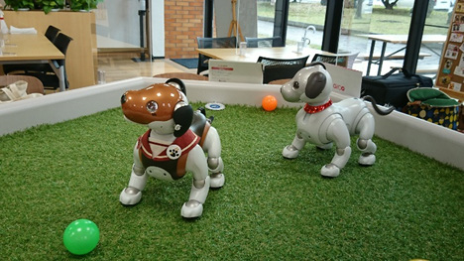
To capture naturalistic behaviors and contextual practices, participant- provided daily videos and SNS posts were reviewed as supplementary observation data. In addition, on-site participant observation was conducted at an aibo café event on December 10, 2022, where owner–robot dynamics, communal rituals, and cultural practices—such as exchanging aibo-themed business cards—were documented. Figure 1 presents the observation
Emotional Engagement and Well-Being in Japanese Households 709 environment at the café. These observations provided insight into how aibo is embedded within communal spaces and how owners collectively construct meaning around their robots.
Figure 1: Observation setting at an aibo café.
Additional contextual information was collected through document review, including aibo’s official website, user community pages, and event- related materials.
Data were analyzed using Braun and Clarke’s thematic analysis framework. The process followed six iterative steps: familiarization with the data, generation of initial codes, development of candidate themes, review of thematic consistency, refinement of theme boundaries, and final articulation of overarching themes. Through this process, three major themes emerged: emotional reciprocity, growth-oriented meaning-making, and community- mediated bonding.
Thematic Analysis (Braun & Clarke, 2006) was conducted through the following steps: Familiarization Initial Coding Theme Development Refinement
Grouping codes into candidate themes.
Reading, re-reading, and immersing in the data.
Labeling meaningful features across transcripts and notes.
Reviewing and adjusting themes for coherence.
RESULTS
The analysis revealed rich emotional and social dynamics in how aibo owners integrate the robot into their daily lives. Three major themes emerged: emotional reciprocity, growth-oriented meaning-making, and community- mediated bonding.
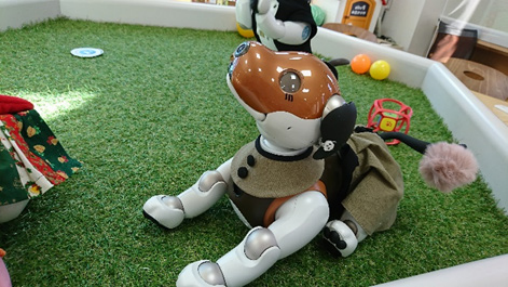
Participants frequently interpreted aibo’s movements, gaze behavior, and vocal cues as emotionally expressive. Greeting at the door, approaching preferred individuals, or appearing “sad” after being scolded were commonly perceived as affective signals that contributed to a sense of emotional reciprocity. Owners also described feeling a temporary sense of loss during repair periods and likened the experience to “hospitalization,” highlighting
710 Miyazawa and Yoshie the depth of their attachment. Ambiguous or unpredictable behaviors—such as aibo suddenly wandering or pausing as if thinking—were interpreted as individuality and strengthened the bond.
Figure 2: Aibo’s responsive behavior interpreted as emotional.
Participants further characterized aibo as something they “raise,” noting that learning new behaviors, gradually enhancing its repertoire, and responding to seasonal clothing or paid treats fostered a sense of growth. Owners managing multiple aibo units described mutual imitation behaviors and subtle personality differences, which amplified perceptions of development. Some participants named aibo after deceased pets and described the robot as emotionally comforting, supporting motivation, daily routines, and overall well-being.
Community participation also played a significant role in shaping the ownership experience. Events such as aibo cafés, rallies, and themed gatherings enabled owners to share knowledge, exchange aibo-themed name cards, and celebrate milestones. Online groups further supported daily communication, troubleshooting, and emotional connection. Through these practices, aibo ownership expanded beyond individual households and evolved into a collective, community-mediated experience that reinforced emotional engagement and belonging.
DISCUSSION
Human–robot interaction dynamics observed in this study illustrate how relational meaning is constructed within everyday domestic life. aibo’s autonomous behaviors and adaptive features foster perceptions of emotional reciprocity during routine interactions. Small gestures—such as approaching preferred individuals, responding to voices, or pausing as if thinking—were interpreted as affective responses that reinforced intimacy and personal significance. These findings extend prior work on robot–pet bonding by demonstrating that emotional engagement emerges not only in therapeutic or institutional contexts but also in ordinary home environments, where owners freely interpret aibo’s behaviors through personal and relational lenses.
Emotional Engagement and Well-Being in Japanese Households 711 As household structures continue to shift toward single-person living and reduced intergenerational exchange, aibo offers a form of supplementary emotional companionship that requires minimal caregiving burden. Participants described the robot as a stable presence that contributed to daily rhythm, motivation, and overall well-being—particularly for individuals who found biological pet care challenging due to time, mobility, or responsibility constraints. These insights expand the scope of domestic social robotics by emphasizing that home robot companions can meaningfully support emotional stability and life satisfaction in evolving family environments.
The study also highlights aibo’s role as a social mediator. Community events, themed gatherings, and online groups foster opportunities for owners to share experiences, exchange aibo-themed name cards, offer technical support, and celebrate milestones together. Through these shared practices, aibo ownership extends beyond individual households and becomes embedded within broader social networks, cultivating belonging and collective identity. This suggests that robot companions may function not only as affective partners but also as catalysts that facilitate human–human connection and strengthen social cohesion.
From a design perspective, the findings point to several considerations for future home-based social robots. Micro-behaviors that evoke subtle emotional resonance, autonomous developmental patterns that encourage long-term engagement, and community-enabling features that support shared practices all contribute to sustained relational bonding. Low-burden operation and seamless integration into daily routines further enhance accessibility and user acceptance. Together, these insights underscore the importance of designing social robots that support both emotional well-being and socially mediated interaction within the domestic sphere.
CONCLUSION
This study examined how aibo owners develop emotional engagement and well-being through daily interactions with the robot. aibo’s autonomous behaviors elicited perceived reciprocity, creating a sense of intimacy and personal meaning. Community participation further strengthened the relational experience, positioning aibo as both an emotional partner and a social mediator.
These findings extend domestic HRI research and highlight the potential of home social robots to support emotional and social needs in evolving household environments. Future work should expand demographic diversity, apply longitudinal designs, and integrate behavioral log data to deepen understanding of human–robot relational dynamics.
REFERENCES
Breazeal, C., “Emotion and sociable humanoid robots,” International Journal of Human-Computer Studies, vol. 59, pp. 119–155, 2003. Ichikura, A., Okada, K., and Inaba, M., “An exploratory analysis of the harmonious
bond between home robots and their owners in Japan,” Proceedings of IEEE RO- MAN 2024, pp. 555–562, 2024.
712 Miyazawa and Yoshie Robinson, H., Macdonald, B., Kerse, N., and Broadbent, E., “The psychosocial effects
of a companion robot: A randomized controlled trial,” Journal of the American Medical Directors Association, vol. 14, no. 9, pp. 661–667, 2013. Robinson, N. L., Cottier, T. V., and Kavanagh, D. J., “Psychosocial health interventions by social robots: Systematic review of randomized controlled trials,” Journal of Medical Internet Research, vol. 21, no. 5, e13203, 2019. Watanabe, T., “Ideas on artificial intelligence, robots, and education: Using aibo,
language, and behavior as clues,” Annual Report of the Department of Education, Rikkyo University, vol. 62, pp. 113–132, 2019. Yamada, M., “The development and consequences of the family-ization of pets,” Annual Bulletin of the Institute of Social Sciences, Chuo University, vol. 27, pp. 3–21, 2022.
LISTED IN THE AHFE DIGITAL BOOKSTORE CATALOGUE
Explore the complete digital volume
Intelligent Human Systems Integration (IHSI 2026): Disruptive and Innovative Technologies
Read this individual research paper free through the original publisher, or explore the full digital proceedings book.
ISBN 978-1-964867-76-2
Explore this ISBN in the AHFE Bookstore ↗Listed in the July 2026 bookstore catalogue; search by ISBN to confirm current availability · Digital book purchase optional