Yuka Miyazawa, Osamu Yoshie (2026). Exploring Digital Support for Pet-Loss Grief: Community Narratives as Supportive Resources for Emotional Resilience. In: Affective and Pleasurable Design. AHFE Open Access, vol. 204, pp. 266–271. https://doi.org/10.54941/ahfe1007352
In Japan, animals such as dogs and cats kept within households have increasingly been regarded as family members and recognized as companion animals. As pets have come to share everyday living spaces with humans, emotional attachment has deepened, and experiences of pet-loss grief have become more profound. However, social recognition and sustainable frameworks for supporting such grief remain limited. This study investigates how community-mediated grief narratives function as socio-technical resources that support emotional resilience in experiences of pet loss, and explores how these functions may be extended through digital transformation. Focusing on a community-based case in Japan, the research examines memorial essays published in a temple-run newsletter that serves as an archive of shared mourning practices.A qualitative case study design was adopted, drawing on two data sources: memorial essays voluntarily contributed by bereaved pet owners and semi-structured interviews with selected authors. The data were analyzed using reflexive thematic analysis to explore how grief experiences are articulated, shared, and socially acknowledged within a communal context. The analysis identified recurring themes of loss, gratitude, continuing bonds, and meaning-making through remembrance. The mediated sharing of these narratives fosters emotional recognition and a sense of shared experience without requiring direct interpersonal interaction. Building on these findings, the study discusses implications for affective digital design, highlighting how digitally archiving and circulating grief narratives may contribute to more sustainable and accessible forms of emotional support for individuals experiencing pet loss.
In contemporary Japan, companion animals—primarily small animals such as dogs and cats kept within households (Kimura, 2009)—have come to occupy an increasingly intimate position in everyday life and are often regarded as members of the family. The widespread adoption of indoor cohabitation has intensified daily interaction between humans and animals, deepening emotional attachment (Anderson & Anderson, 2006). As a result, the loss of a
Exploring Digital Support for Pet-Loss Grief: Community Narratives as Supportive 267 companion animal has become an experience accompanied by profound grief (Risley-Curtiss et al., 2006; Cohen, 2002), while social frameworks capable of adequately acknowledging and sustainably supporting such pet-loss grief remain insufficiently developed (Coren, 1997; Morley & Fook, 2005).
Alongside this situation, digitally mediated environments characterized by anonymous and non-face-to-face relationships have emerged as informal spaces in which grief can be expressed and shared among people connected by their affection for animals. While such platforms may provide moments of reassurance or recognition, the support they offer is often unstable and difficult to sustain over time. This gap between the depth of pet–human attachment and the fragility of available support highlights the need for socially and emotionally sustainable systems that can address grief without imposing excessive interpersonal demands on emotionally vulnerable individuals (Yamada, 2022).
Against this background, the present study examines how community- mediated grief narratives function as socio-technical resources that support emotional resilience in experiences of pet loss. Rather than focusing on individualized psychological interventions, this research adopts a community- oriented perspective to explore how grief is articulated (Ebenstein & Wortham, 2001), shared, and socially acknowledged through mediated narrative practices (Faver & Strand, 2003b). By doing so, it seeks to clarify the mechanisms through which emotional support can emerge without direct interpersonal interaction (Sharkin & Knox, 2003).
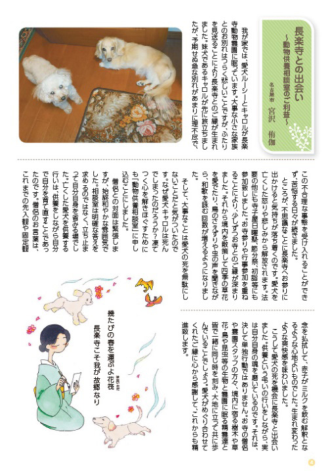
To address this aim, the study focuses on a community-based case in Japan: a temple-run memorial newsletter in which bereaved pet owners voluntarily contribute written reflections on loss and remembrance. These narratives form a naturally occurring archive of shared mourning practices embedded within a local cultural context. Through qualitative analysis of both the memorial essays and interviews with selected contributors, this study investigates how such mediated narrative spaces may inform the design of emotionally sustainable digital systems for individuals experiencing pet- loss grief.
METHOD
This study adopts a qualitative case study approach to explore community- mediated grief narratives in pet-loss experiences. Two types of qualitative data were analyzed. The first data source consists of memorial essays published in a temple-run animal cemetery newsletter located in Nagoya, Japan. These essays were voluntarily submitted by bereaved pet owners and describe experiences of loss, gratitude, continuing bonds, and spiritual meaning-making related to their deceased companion animals. A total of 15 memorial essays (n = 15) published between 2018 and 2021 were included in the analysis.
The second data source comprises semi-structured interviews conducted with bereaved pet owners who had experienced the loss of a companion animal. Five participants (n = 5) were interviewed to gain deeper insights into personal grief processes and perceptions of community-based support.
268 Miyazawa and Yoshie Interview data were used as supplementary material to contextualize and triangulate themes identified in the written narratives.
All data were analyzed using reflexive thematic analysis (RTA). The analytical process involved repeated reading of the texts, initial coding, and iterative theme development. Themes were refined through continuous comparison across data sources to ensure analytical coherence and depth. Throughout the research process, personal identifiers were anonymized, and informed consent was obtained from all interview participants.
Figure 1: A page from a temple-run memorial newsletter illustrating a community- based archive of pet-loss narratives (Omokage, Chorakuji Temple, July 2019, p. 4).
FINDINGS The reflexive thematic analysis identified four recurring themes across the memorial essays and interview data: loss, gratitude, continuing bonds, and meaning-making through remembrance. These themes were consistently observed across contributors, indicating shared narrative patterns within the community-based mourning practice.
Loss Narratives of loss focused on the disruption of everyday life following the death of a companion animal. Participants described feelings of emptiness, changes in daily routines, and difficulty adjusting to the absence of the animal within domestic spaces previously shared. Rather than emphasizing the moment of death itself, these narratives highlighted how loss continued to be experienced through ordinary activities and familiar environments.
Exploring Digital Support for Pet-Loss Grief: Community Narratives as Supportive 269 Gratitude
Alongside expressions of grief, many contributors articulated a sense of gratitude toward their deceased pets. These narratives reflected on companionship, emotional support, and the perceived role of the animal within the household. Gratitude functioned as a narrative resource through which bereaved owners acknowledged the value of the relationship while confronting the pain of loss.
Continuing Bonds Many narratives suggested that the relationship with the companion animal did not end at death but continued in altered forms. Contributors described ongoing connections through memories, habitual thoughts, and written addresses to the deceased animal. Such expressions indicate that emotional bonds were maintained through everyday reflection and narrative practices rather than through physical presence.
Meaning-Making Through Remembrance Processes of meaning-making emerged through acts of remembrance, including writing memorial essays and reflecting on shared experiences. By narrating loss within a communal context, contributors were able to situate their experiences within a broader framework of shared understanding. These narratives provided a way to organize emotions and reinterpret loss as part of an ongoing personal history rather than an isolated event.
Across these themes, the mediated sharing of narratives enabled grief to be expressed in socially recognizable forms. Emotional experiences were not confined to private reflection but were articulated within a communal narrative space that supported acknowledgment and validation without requiring direct interpersonal interaction.
Table 1: Thematic overview of community-mediated pet-loss grief narratives.
Table available in the original PDF paper.
Theme Description Loss Disruption of everyday life following pet loss
Gratitude Reframing loss through appreciation of shared experiences Continuing bonds Emotional bonds maintained through memory and reflection
Meaning-making through remembrance Organizing grief through narrative practices
DISCUSSION
The findings of this study highlight how community-mediated narrative practices can support emotional experiences of pet-loss grief without relying on direct interpersonal interaction. Unlike anonymous digital platforms where emotional exchanges are often transient and unstable, the temple-run
270 Miyazawa and Yoshie memorial newsletter provides a structured narrative environment that allows grief to be articulated, acknowledged, and preserved over time. This suggests that durability and continuity are critical design qualities for emotionally supportive systems (Adrian et al., 2009).
From a design perspective, the act of writing and sharing memorial narratives functions as a low-pressure form of participation. Contributors are not required to engage in real-time interaction or respond to others directly, reducing the emotional burden often associated with reciprocal communication. Such asynchronous and narrative-based engagement enables individuals to express grief at their own pace while still being situated within a recognizable communal context.
The results also indicate that meaning-making emerges through remembrance practices embedded in culturally familiar frameworks. Rather than offering explicit emotional guidance or therapeutic intervention, the memorial newsletter supports users by providing a shared structure within which personal experiences can be organized and interpreted. This points to the importance of designing systems that facilitate emotional organization through narrative continuity rather than immediate emotional feedback (Turner, 2003).
In contrast to social media environments that prioritize visibility, immediacy, and reaction-based interaction, community-oriented narrative archives emphasize reflection and accumulation (Barnard-Nguyen et al., 2016), as well as temporal depth. Integrating these characteristics into digital systems may help address the fragility of emotionally supportive interactions observed in anonymous online spaces. Designing for affective support in emotionally vulnerable contexts therefore requires balancing accessibility with stability, and immediacy with preservation (Coren, 1997).
CONCLUSION
This study examined how community-mediated grief narratives function as socio-technical resources for supporting emotional resilience in experiences of pet loss. Focusing on a temple-run memorial newsletter in Japan, the analysis demonstrated that narrative practices centered on loss, gratitude, continuing bonds, and remembrance enable bereaved pet owners to articulate and organize grief within a shared communal context.
The findings suggest that emotionally supportive environments do not necessarily require direct interpersonal interaction or immediate emotional feedback. Instead, structured and enduring narrative spaces can provide low-pressure forms of emotional recognition that are particularly suited to individuals in emotionally vulnerable situations. Such environments offer stability, continuity, and temporal depth, addressing limitations observed in anonymous and reaction-driven digital platforms.
By highlighting the design value of narrative continuity and communal archiving, this study contributes to discussions on affective and pleasurable digital systems for emotional support. While the findings are based on a single community-based case, they point to broader design implications for developing sustainable digital environments that support grief without imposing excessive emotional demands. Future research may explore how
Exploring Digital Support for Pet-Loss Grief: Community Narratives as Supportive 271 similar narrative-based approaches can be adapted to other forms of loss and digitally mediated care contexts.
ACKNOWLEDGMENT
The author would like to thank the temple community and the bereaved pet owners who generously shared their experiences and narratives for this study. Gratitude is also extended to the individuals who provided support and assistance during the research process. All personal information has been anonymized to protect participants’ privacy.
REFERENCES
Adrian, J. A. L., Deliramich, A. N., & Frueh, B. C. (2009). Complicated grief and posttraumatic stress disorder in humans’ response to the death of pets/animals. Bulletin of the Menninger Clinic, 73(3), 176–187. Barnard-Nguyen, S., Breit, M., Anderson, K. A., & Nielsen, J. (2016). Pet loss and
grief: Identifying at-risk pet owners during the euthanasia process. Anthrozoös, 29(3), 421–430. Cohen, S. P.(2002). Can pets function as family members? Western Journal of Nursing Research, 24(6), 621–638. Coren, S. (1997). Allergic patients do not comply with doctor’s advice to stop owning
pets. British Medical Journal, 314, 517. Ebenstein, H., & Wortham. J.(2001). The value of pets in geriatric practice: A program example. Journal of Gerontological Social Work, 35 (2), 99–115. Faver, C. A., & Strand, E. B.(2003b). To leave or to stay? Battered women’s concern
for vulnerable pets. Journal of Interpersonal Violence, 18(12), 1367–1377. Kimura, Y., “Grief reactions associated with pet loss and approaches to support,” Japanese Journal of Psychosomatic Medicine, vol. 49, no. 5, pp. 357–362, 2009. Morley, C. & Fook, J.(2005). The importance of pet loss and some implications for
services. Mortality, 10(2), 127–143. Risley-Curtiss, C., Holley, L. C., & Wolf, S.(2006). The animal-human bond and ethnic diversity. Social Work, 51(3), 257–268. Sharkin, B. S. & Knox, D.(2003). Pet loss: Issues and implications for the psychologist.
Professional Psychology: Research and Practice, 34(4), 414–421. Turner, W. G.(2003). Bereavement counseling: Using a social work model for pet loss. Journal of Family Social Work, 7(1), 69–81. Yamada, M., “The development and consequences of the family-ization of pets,”
Annual Bulletin of the Institute of Social Sciences, Chuo University, vol. 27, pp. 3–21, 2022.
LISTED IN THE AHFE DIGITAL BOOKSTORE CATALOGUE
Explore the complete digital volume
Affective and Pleasurable Design
Read this individual research paper free through the original publisher, or explore the full digital proceedings book.
ISBN 978-1-964867-80-9
Explore this ISBN in the AHFE Bookstore ↗Listed in the July 2026 bookstore catalogue; search by ISBN to confirm current availability · Digital book purchase optional