Tiisetso Dube, Partson Paradza, Benita Zulch (2026). Evolution of Retail Space in Bulawayo: The Rise and Impact of Small Lettable Unit Shops. In: Creativity, Innovation and Entrepreneurship. AHFE Open Access, vol. 206, pp. 50–56. https://doi.org/10.54941/ahfe1007382
Urban deindustrialisation in Zimbabwean cities has created vacant commercial spaces alongside expanding informal economic activity. In Bulawayo, this has contributed to the emergence of Small Lettable Units (SLUSs), informal micro-retail spaces inserted into former industrial and commercial buildings. This paper examines the evolution, benefits, and challenges of SLUs using a qualitative case study approach based on field observations and semi-structured interviews in selected inner-city locations. The findings show that SLUs enable the adaptive reuse of underutilised buildings, provide affordable retail space for informal traders, and contribute to inner-city economic activity. However, regulatory ambiguity, infrastructure strain, and tensions with formal planning standards remain. The paper argues for more flexible planning and governance approaches that recognise informal retail as a permanent feature of deindustrialising cities.
Urban informality is a defining characteristic of many African cities, manifesting in informal trade, housing, and employment systems that operate alongside, and often outside, formal regulatory frameworks (McFarlane, 2012; Rigon, Walker, & Koroma, 2020). Rather than being a temporary or transitional phenomenon, informality has demonstrated resilience and adaptability, leading scholars to argue that it should be understood as a structural component of African urban economies (Magwaro-Ndiweni et al., 2018; Mosha et al., 2022). Persistent reliance on Eurocentric planning models has limited the capacity of urban authorities to accommodate this reality, resulting in regulatory frameworks that are misaligned with local socio-economic conditions (Van Eeden, 2011; Tanyanyiwa, Marais, & du Plessis, 2023).
Informal trade has expanded rapidly across African cities due to unemployment, economic restructuring, and rapid urbanisation (Rogerson, 2016; Kiaka et al., 2021). While informal trading provides critical livelihood Received January 19, 2026; Revised April 4, 2026; Accepted April 18, 2026; Available online July 20, 2026
Evolution of Retail Space in Bulawayo: The Rise and Impact 51 opportunities, it is frequently framed by authorities as disorderly and incompatible with formal urban environments, especially within central business districts (CBDs). This perception has justified exclusionary practices such as evictions, confiscations, and restrictive zoning regulations (Bandauko & Arku, 2024; Magwaro-Ndiweni et al., 2018). Such approaches have proven largely ineffective, as informal traders continue to adapt and reoccupy strategic urban spaces (Moyo, 2018).
Zimbabwe represents one of the most informalized economies globally, a condition intensified by prolonged economic decline and deindustrialisation since the early 2000s (Nani, 2020; Magidi, 2023). The collapse of formal manufacturing and retail sectors has resulted in widespread commercial vacancies, particularly in inner-city areas (Magidi, 2023). As formal employment opportunities diminished, informal and small-scale retail activities expanded to fill the economic void (Rogerson, 2016). However, urban planning systems in Zimbabwe have historically failed to accommodate small and medium enterprises (SMEs), prioritising large-scale formal retail uses within CBDs (Njaya, 2015; Tanyanyiwa et al., 2023).
Recent scholarship suggests that adaptive land-use and zoning policies can play a critical role in revitalising declining commercial areas and integrating small-scale enterprises into formal urban environments (Nishida, 2014; Hangebruch, 2020). International studies demonstrate that subdividing large retail spaces and permitting mixed-use and multi-tenancy arrangements can stimulate economic activity and reduce urban vacancy rates (Peiffer-Smadja & Torre, 2018; Lee, Chung, & Kim, 2020). However, evidence from African cities remains limited, particularly regarding stakeholder perceptions of such interventions under conditions of economic contraction.
In Bulawayo, the introduction of SLUSs represents a locally grounded policy response to deindustrialisation, retail vacancy, and informal street trading. While existing studies have examined informal trade governance and SME accommodation in Zimbabwe (Rogerson, 2016; Magwaro- Ndiweni et al., 2018; Nani, 2020), none have explicitly focused on SLUSs as a planning and retail innovation. This study addresses this gap by examining the evolution of SLUSs in Bulawayo and analysing stakeholder perceptions of their benefits and challenges as a mechanism for integrating small-scale enterprises into the formal urban landscape.
RESEARCH METHODOLOGY The study adopted a qualitative case study approach focusing on selected SLU clusters in Bulawayo’s inner city. Data collection methods included field observations, semi-structured interviews, and photographic documentation. Key informants comprised informal traders, property owners, and municipal officials involved in land-use management.
Field observations were conducted to document the physical characteristics of SLUSs, patterns of occupancy, and interactions between traders and customers. Interviews explored motivations for SLU development, perceived benefits, regulatory challenges, and operational constraints. Photographs were used to support spatial analysis and illustrate typical SLU configurations.
Data were analysed thematically, with recurring patterns grouped under emergence drivers, benefits, and challenges. Ethical considerations included informed consent and anonymity of participants.
FINDINGS Emergence of SLUSs in Bulawayo
Since the late 2000s, Bulawayo has seen the emergence of SLUSs in the Central Business District (CBD), primarily through special consent procedures. These units were established to accommodate retrenched industrial workers and small entrepreneurs, responding to high commercial vacancies, economic decline, and shrinking disposable income (Bulawayo City Council, 2021). Smaller spaces became viable as large premises were uneconomical to operate, with tenants sharing overheads and adjusting to the limited availability of goods.
Early developments, such as Stand 439A (Geddes Building) and Stand 341-345 (Haddon & Sly), converted large commercial spaces into units for informal sector traders. Post-2020 SLUSs include partitioned units with proper displays, ablution facilities, and individual development permits. Initially, lettable shop boundaries were restricted to the area between 6th Avenue, Robert Mugabe Way, 4th Avenue, and Joshua Mqabuko Nkomo Street. Still, growing demand led to a policy revision in 2023, expanding SLUs to cover the entire CBD and other commercial centres (Bulawayo City Council, 2021).
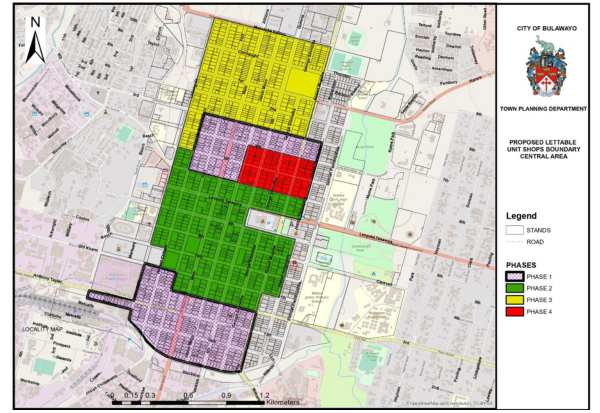
The COVID-19 pandemic further accelerated SLU demand by limiting operational capacity for large businesses and increasing unemployment, as informal traders displaced from the streets sought space in these units. Property owners responded by partitioning large buildings, often converting them into small shopping malls to accommodate multiple tenants. Figure 1 shows the spatial distribution and phased implementation of SLUSs in Bulawayo.
Figure 1: The spatial distribution and phased implementation of SLUs in Bulawayo.
Evolution of Retail Space in Bulawayo: The Rise and Impact 53 BENEFITS OF SLUSs
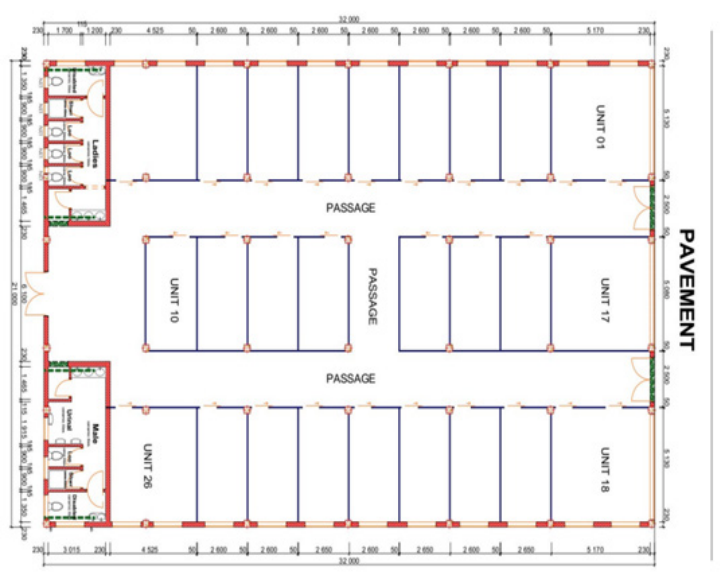
SLUSs have generated employment through renovations, partitioning, and the supply of construction materials, supporting the local construction sector and its value chain. Redevelopment of previously vacant or dilapidated buildings has revitalised the CBD, improving its aesthetic appeal and functionality. SLUSs also enable small and medium enterprises to access formal commercial space, providing informal traders with legal avenues to operate and reach customers. Local authorities have experienced increased revenue from licensing, plan approvals, and inspections, although property developers often gain the most considerable financial benefit. Figure 2 shows a typical SLUS development plan, highlighting individual partitions, circulation corridors, and service areas
Figure 2: An example of an approved building plan for an SLUS in Bulawayo.
The layout in Figure 2 demonstrates how multiple units fit into a previously single commercial property, optimising space for various tenants.
Overall, SLUSs have enhanced urban vibrancy, supported entrepreneurship, and contributed to economic resilience in Bulawayo.
CHALLENGES AND CONSTRAINTS OF SLUSs Despite these benefits, SLUSs face significant challenges. High rental costs remain a barrier for many informal traders, limiting the intended impact of formalisation and leaving some businesses on the streets. Infrastructure constraints, including limited ablution facilities, inadequate ventilation
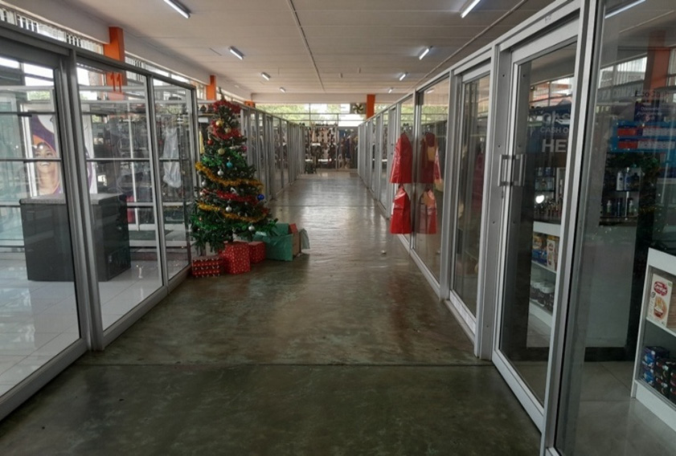
for inward-facing units, and potential strain on the sewer system, raise concerns about long-term sustainability. Rapid expansion and property partitioning have also prompted urban planning and regulatory issues, as some developments proceed without proper consent. Figure 3 provides photographic examples of a partitioned commercial building, showing the density of SLUSs within former large stores.
Figure 3: A pictorial example of an SLU.
Figure 3 highlights both the efficient use of space and potential overcrowding, emphasising infrastructure and accessibility challenges.
Furthermore, findings from key informants indicated that the replacement of established formal businesses with small units may compromise city development standards and economic stability. These challenges suggest that while SLUSs address space needs, additional support and careful regulation are necessary to ensure equitable and sustainable outcomes.
POLICY IMPLICATIONS The emergence of SLUSs reflects the link between deindustrialisation, economic decline, and the growth of the informal sector (McFarlane, 2012; Webb et al., 2013; Magwaro-Ndiweni et al., 2018). Policy revisions by the Bulawayo City Council demonstrate recognition of SLUSs’ economic importance and represent a shift toward inclusive urban governance. However, to ensure long-term sustainability, policymakers must address affordability, infrastructure, and regulatory compliance.
SLUSs illustrate how adaptive retail strategies can formalise informal activities while revitalising urban spaces. Yet their rapid expansion requires careful management to avoid over-saturation, strain on services, and
Evolution of Retail Space in Bulawayo: The Rise and Impact 55 economic displacement, emphasising the need for context-specific planning and support mechanisms.
CONCLUSION
This study provides empirical evidence of the emergence and impact of SLUSs in Bulawayo’s CBD. SLUSs have arisen as an adaptive response to deindustrialisation, economic decline, and the growth of the informal sector, providing smaller, manageable commercial spaces for entrepreneurs while formalising previously informal activities. The findings highlight multiple benefits of SLUSs, including employment creation, revitalisation of dilapidated buildings, increased local authority revenue, and enhanced opportunities for small and medium enterprises.
At the same time, the study identifies key challenges associated with SLUSs, including high rental costs, infrastructure limitations, and potential regulatory and urban planning issues. The rapid proliferation of SLUSs raises concerns about market saturation, service strain, and the displacement of established formal businesses, emphasising the need for careful regulation and support mechanisms to ensure sustainability.
Policy revisions by the Bulawayo City Council demonstrate recognition of the economic significance of SLUSs and reflect a gradual shift toward inclusive urban governance. However, long-term success will require attention to affordability, infrastructure, and compliance with planning standards.
This research contributes to understanding how informal economic practices can adapt within formal urban frameworks, illustrating the potential for context-specific interventions to support entrepreneurship, urban revitalisation, and economic resilience. The findings underscore the importance of balancing commercial opportunity with urban sustainability, offering insights for policymakers, planners, and researchers seeking to manage informal sector formalisation in rapidly changing urban environments.
REFERENCES
Bandauko, E., & Arku, G. (2024). “It is no longer the sunshine city, it is now a dump site city”: Discursive construction of urban space and street trading in Harare, Zimbabwe. Cities, 155, 105488. Hangebruch, N. (2020). The clue is the mix: Multifunctional re-uses in former retail
real estate properties. Proceedings of the Institution of Civil Engineers: Urban Design and Planning, 173(5), 171–181. Kiaka, R., Chikulo, S., Slootheer, S., & Hebinck, P. (2021). “The street is ours”: Street trading, Covid-19 and new street geographies in Harare and Kisumu. Food Security, 13, 1–19. Lee, H. S., Chung, J., & Kim, W. (2020). Economic effect of zoning regulations
on Korea’s small and medium-sized retailers. Asian Economic Journal, 34(2), 185–211. Magidi, M. (2023). Small towns as research sites: The impacts of deindustrialisation on urban livelihoods in Norton, Zimbabwe. South African Geographical Journal, 105(2), 179–199.
Magwaro-Ndiweni, L., Madiro, V., Nyamande, T., & Ndiweni, M. (2018). The relationship between informal street trading and city space. In T. Ngwenya (Ed.), Bulawayo Informal Sector Policy Research Findings. Bulawayo: BVTA. McFarlane, C. (2012). Rethinking informality: Politics, crisis, and the city. Planning
Theory & Practice, 13(1), 89–108. Mosha, A. C., Sungirirai, L., Dick, B. A., & Paradza, P. (2022). The paradox of informality and sustainable human settlement in Botswana. Property Management, 40(5), 629–657. Moyo, I. (2018). Resistance and resilience by informal traders in Bulawayo,
Zimbabwe. Urban Forum, 29(3), 299–313. Nani, V. (2020). Trading space rivalry between street vendors and shop-based traders in Bulawayo. Academic Journal of Interdisciplinary Studies, 9(4), 168–176. Nishida, M. (2014). The costs of zoning regulations in retail chains. Journal of
Regulatory Economics, 45(3), 305–328. Peiffer-Smadja, O., & Torre, A. (2018). Retail decentralization and land use regulation policies. Habitat International, 72, 27–38. Rigon, A., Walker, J., & Koroma, B. (2020). Beyond formal and informal:
Understanding urban informalities from Freetown. Cities, 105, 102848. Rogerson, C. M. (2016). Responding to informality in urban Africa: Street trading in Harare, Zimbabwe. Urban Forum, 27, 229–251. Tanyanyiwa, V. I., Marais, L., & du Plessis, L. (2023). Informal sector counterpower
in Harare, Zimbabwe. GeoJournal, 88(6), 5931–5941. Van Eeden, A. (2011). The geography of informal arts and crafts traders in South Africa’s city centres. Town and Regional Planning, 59, 34–40.
LISTED IN THE AHFE DIGITAL BOOKSTORE CATALOGUE
Explore the complete digital volume
Creativity, Innovation and Entrepreneurship
Read this individual research paper free through the original publisher, or explore the full digital proceedings book.
ISBN 978-1-964867-82-3
Explore this ISBN in the AHFE Bookstore ↗Listed in the July 2026 bookstore catalogue; search by ISBN to confirm current availability · Digital book purchase optional