Danie Hoffman, Tebogo Hellen Ngele, Benita Zulch (2023). Contrasting the profiles of Female vs Male quantity surveyors in South Africa. In: Human Factors, Business Management and Society. AHFE Open Access, vol. 97, pp. 292–302. https://doi.org/10.54941/ahfe1003906
Quantity surveying in South Africa is a well-established professional discipline providing consulting services to the construction industry. The continued prosperity of a professional discipline such as quantity surveying is closely linked to sound management and efficient strategic leadership. The leaders and managers of the profession require accurate and up-to-date information on the profile of their members to integrate that information into future strategies and planning.Young democracies and developing countries such as South Africa often have demographics and financial industries, including the construction industry, that are much more dynamic than first-world countries such as the United States or Great Britain. Local government upliftment policies such as black economic empowerment changed the economic landscape. The membership profile of the quantity surveying profession is also seeing rapid change, presenting additional management challenges. A profession with a stable profile is easy to manage using past knowledge of membership makeup and preferences. However, a changing membership may cause strategies based on the knowledge of 5 to 10 years ago to be found wanting today.The recent COVID-19 pandemic disrupted economies and industries and did not spare the construction industry or the quantity surveying profession. During this time, the South African Association of Quantity Surveyors (ASAQS), assisted by the University of Pretoria, analysed the profile of its members employing a questionnaire forwarded to all ASAQS members on the database. This data confirmed significant changes to the age and racial makeup of the profession. However, the changed gender profile was amongst the study’s most significant findings. In the past, the typical South African quantity surveyor was a middle age to older male of European descent. This study will contrast the older members of the profession against the more recent entrants by comparing the profile of female members to that of male members. The analysis will include age, race, locational spread, academic qualifications, nationality, registration status with the Council of South African Quantity Surveyors, and length of the current employment term to provide a reasonably detailed comparison of the gender profile of quantity surveyors in South Africa.The above information will be valuable to the Association of South African Quantity Surveyors and to the management of quantity surveying firms and institutions such as universities that offer accredited academic programmes to train quantity surveyors. The findings can also be shared with quantity surveying professionals across international borders to compare against the profiles of their millennial cohorts of quantity surveyors.
Contrasting the Profiles of Female vs Male Quantity Surveyors in South Africa 293
INTRODUCTION
South Africa experienced constant and significant change since the first democratic election in 1994 in virtually all aspects of society, including the political, legal, and socio-economic environments. The construction indu- stry and the quantity surveying profession did not escape the effects of this change. The new South Africa’s diverse and rapidly changing labour force presents management challenges. Corporate South Africa has to manage the diversity found in the workplace (Goslin and Kluka, 2006). New legisla- tion was promulgated into law to transform workplaces, provide access to equal opportunities for all and address inequalities from the past. Exam- ples of such legislation are the Constitution of the Republic of South Africa section 9(3), the Employment Equity Act of 1998, the Promotion of Equality and Prevention of Unfair Discrimination Act of 2000, the Black Economic Empowerment Act of 2003 (Mazibuko and Govendar, 2017; Haupt and Madikizela, 2009).
Workplace diversity speaks to people of different backgrounds in an orga- nisation. Diversity entails aspects such as race, gender, ethnic groups, age, and education. This diversity requires management to ensure a coherent working environment (Patrick and Kumar, 2012). Campbell (2021) proposed that a dynamic world characterised by rapid and constant change needs agile orga- nisations and institutions geared to adapt to change. Research by Bordeleau and Felden (2019) on change management supports a structured management approach, while Iyengar, Durham, and Katz (2016) supported a rapid ada- ptive change model. Berman, Quinn, and Paavlo (2012) agreed that managers would have to prioritise the development of their organisation’s adaptive capacity to cope with constant change.
Quantity surveyors (QS’s) advise on cost and contractual matters of construction projects, which includes preparing contract documents. The quantity surveying (QS) profession is an established construction industry stakeholder that needs to adapt to change to ensure the profession’s future success (Maritz and Sigle, 2010; SACQSP, 2022). Patrick and Kumar (2012) posit that the diversity in organisations will continue to increase in the coming years, thereby requiring management.
The change in diversity inherent in current organisations requires the QS profession to be well-informed about the profile of its members and their needs and challenges to adapt successfully. The ASAQS’s need to contrast the profiles of male and female quantity surveyors in South Africa provided the context for this study. The study’s comparisons include gender, race, age, location, SACQSP registration, and ASAQS membership status. Conclusions are drawn, and recommendations for future research are part of this study.
FEMALE VERSUS MALE QUANTITY SURVEYORS Quantity Surveying Practice
More than two decades ago, Nkado (2000) identified matters facing the quantity surveying profession today: to grow the significance and visibility of the profession’s services in the built environment and grow the variety of
business expansion capabilities and prospects. Nkado (2000) found that the skills required for current and future quantity surveying services are; mar- keting, advanced financial management, leadership, general management, stakeholder management, macroeconomic perspective, and managing joint venture appointments with other quantity surveying firms. Towey (2012) highlighted the need for the QS’s time and self-management. Effective time and self-management incite work ethic and develop the capacity to overcome obstacles that are especially important to meet construction project deadlines.
Females in Construction Despite the government’s best intentions and preferential policies put in place for the career promotion of women, women-owned construction entities are marginalised in the construction industry in South Africa (Haupt and Madikizela, 2009; Haupt and Fester, 2012). The dynamic and fragmen- ted nature of the construction industry continuously confronts the stake- holders with new and changing organisations (Harinarain, Bornman, and Botha (2013). Martin and Barnard (2013) stated that women who work in male-dominated industries encounter challenges different from mainstream industries. Organisations need to validate women’s natural behaviours and give them sufficient opportunities as they do for men.
Ndweni and Ozumba (2021) find that there is growth in women’s role in the workplace, globally and in South Africa. Particularly in South Africa, preferential legislation and policies increase women’s economic participation opportunities. However, women in the workplace encoun- ter challenges like marginalisation, work-life balance, and promotions to higher positions, more strategic positions. Haupt and Madikizela (2009) agreed that the situation is similar in the construction industry. The nature of the workplace culture in construction is a significant factor in cla- rifying the poor performance of women in construction careers. This culture makes it difficult for women to be promoted equally through the exclusionary and discriminatory environment inherent in the industry (Haupt and Madikizela, 2009).
Females vs Males in Quantity Surveying From 2007 to 2009, Bowen, Cattell, and Distiller (2007, 2008, 2009) repor- ted on a series of findings around the job satisfaction of quantity surveyors in South Africa. The study revealed, amongst other things, the profile of registered South African quantity surveyors.
The findings of sample analysis of the studies Bowen, Cattell, and Distil- ler (2007, 2008, 2009) were that the majority (83.3%) of the total sample is White, male South African citizens, most report working in the private sector, in professional quantity surveying firms, and holding a four-year full- time degree or equivalent. The biggest age category (45% of the total sample) for both males and females is the 45 and older age group. This age cate- gory makes up 49% of all male QS’s but only 26% of all female QS’s. Race diversity exists (Bowen, Cattell, and Distiller, 2008).
Contrasting the Profiles of Female vs Male Quantity Surveyors in South Africa 295
THE MERIT OF THE STUDY This study aims to compare the profiles of female vs male QS’s to assist the ASAQS in gaining more comprehensive insight into the changing pro- file of South African QS’s. Previous research by Bowen, Cattell, and Distiller (2007, 2008, 2009) indicates that the number of female quantity surveyors is increasing. The number of first-year female students registering for quan- tity surveying at UP has increased from 35,9% from 2010 to 2015 to 42,3% for 2016 – 2021 (University of Pretoria, n.d.). The study profiles South Afri- can female vs male QS’s based on their numbers, age, location, race, sex, qualifications, SACQSP registration, and ASAQS membership.
METHODOLOGY
The data for the quantitative research originated from a questionnaire distri- buted by the ASAQS to all South African QS’s on their database. The management of the ASAQS wanted to update their knowledge of the current profile of their members. This profile included age, location, race, sex, quali- fications, SACQSP registration, and ASAQS membership of the QS’s on their database. The University of Pretoria (UP) assisted the ASAQS in compiling the research instrument and analysing the data. The fact that lecturers from UP who participated in the study, also have many years of industry experie- nce and are serving on the board and committees of the ASAQS, also allowed for the necessary context to link the ASAQS’s requirements with compiling the questionnaire.
The questions included in the questionnaire and the structure of the opti- ons available to each question allowed the respondents to provide meaningful data for the study. A questionnaire compiled on Survey Monkey was forwar- ded electronically to all QS’s on the database. A total of 626 QS’s responded, representing approximately 14% of registered QS’s in South Africa. A signed agreement between the ASAQS and UP secured the access to and use of the above study data. The returned questionnaires were captured in Excel and analysed using a detailed Pivot table.
FINDINGS Female vs Male QS Numbers
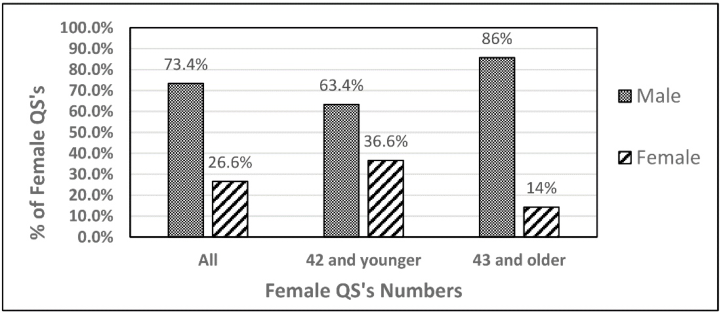
Figure 1 confirmed that 26,6% of all QS’s are female. Amongst QS’s younger than 43 years, 36,6% are females compared to only 14,3% of QS’s older than 42 years. This finding confirms that new cohorts of QS profession entrants contain much larger percentages of females. The ASAQS should take note of this finding, and ensure that the specific needs or challenges of female QS’s are included in the ASAQS’s future planning and strategies.
Age
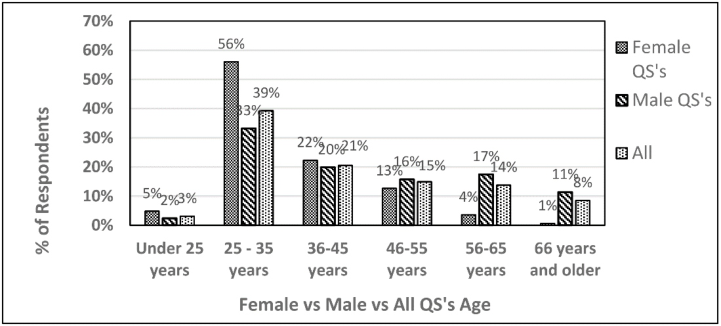
Figure 2 confirmed that South African female QS’s are relatively young, with 61% not older than 35 years. For male QS’s, this number is only 35%. A total of 83% of female QS’s are younger than 46 years, while for male QS’s, the number drops to 55%. However, only 5% of female QS’s are older than
Figure 1: Number of female vs male QS’s. (Source: authors, 2023.)Figure 2: Age of female vs male QS’s. (Source: authors, 2023.)
55 years compared to 28% of male QS’s. The study indicates that although many female QS’s enter the profession, their numbers drop off far quicker than their male counterparts, specifically for QS’s older than 55 years.
Race and Age
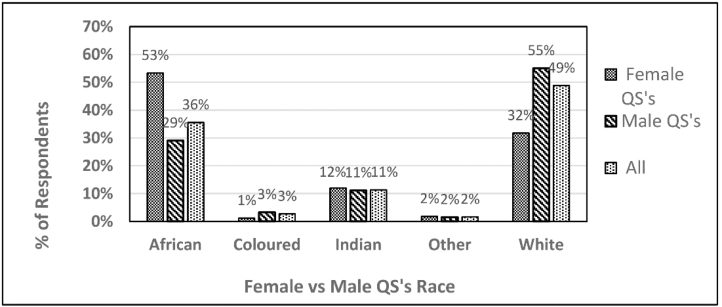
Figure 3 confirms a significant change in the gender profile of South African QS’s, specifically when race is considered. Black QS’s make up 53% of all female QS’s but only 29% of all male QS’s. White QS’s account for 55% of all male QS’s but only 32% of female QS’s. For QS’s of Indian descent, these numbers are relatively stable at 11-12%.
Employment Industry
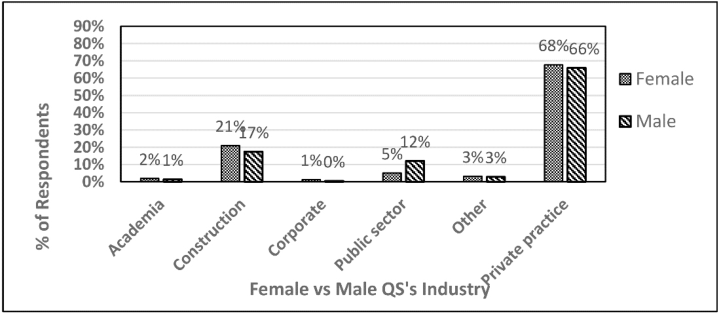
Figure 4 details the employment industry of female QS’s. The majority of 68% of female QS’s work for consulting firms in the private sector, while 21% are employed as construction QS’s. The numbers are slightly lower at
Contrasting the Profiles of Female vs Male Quantity Surveyors in South Africa 297
Figure 3: Gender and race of QS’s. (Source: authors, 2023.)Figure 4: Employment industry of QS’s. (Source: authors, 2023.)
66% and 17% for male QS’s. Only 5% of female QS’s are employed in the public sector compared to 12% of male QS’s.
Qualification Level
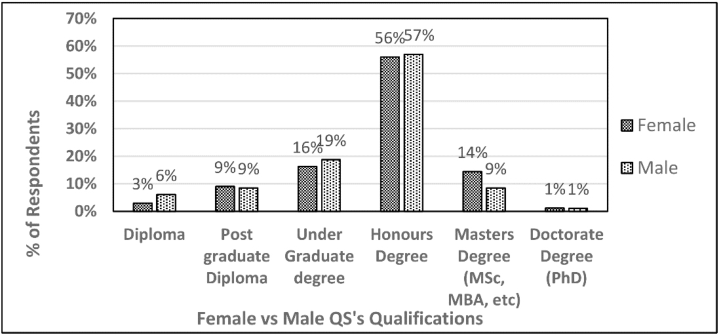
Figure 5 confirms that female and male QS’s have achieved relatively similar tertiary qualifications. Male QS’s have slightly higher numbers of Diplo- mas (6%) and B-degrees (19%) (compared to 3% and 16%, respectively, for female QS’s). Female QS’s have achieved more master’s degrees (14% versus 9%).
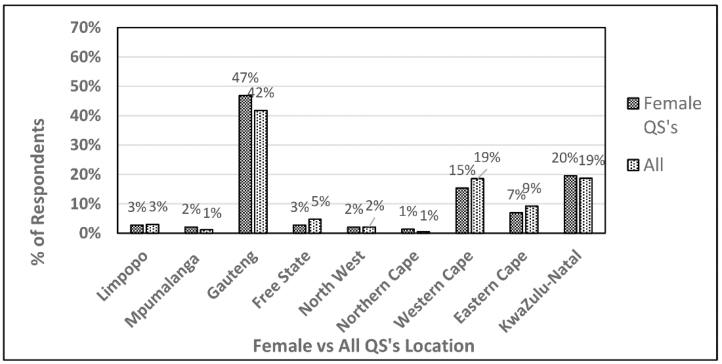
Location The large majority of QS’s in the study are located in the three provinces with the largest economies. The findings include female QS’s. A total of 82% of female QS’s and 80% of all QS’s are located in either Gauteng (47% vs 42%), KwaZulu-Natal (20% vs 19%), or the Western Cape (15% vs 19%) respectively (see Figure 6).
Figure 5: Qualification level of QS’s. (Source: authors, 2023.)Figure 6: Location of QS’s. (Source: authors, 2023.)
SACQSP Registration
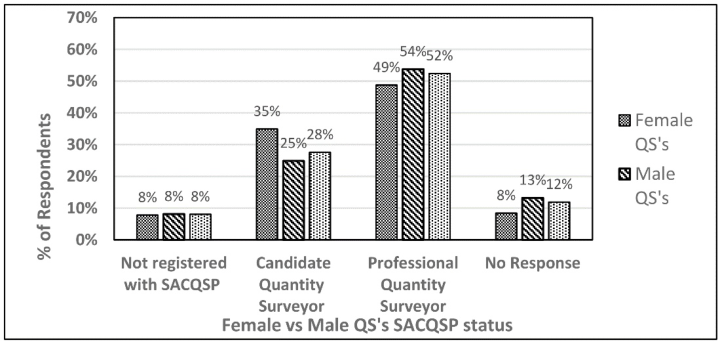
Figure 7 confirms that 84% of female QS’s are registered with the SACQSP (79% of all male QS’s), of which 49% achieved registered QS (PrQS) status (54% for male QS’s). A large number of 35% of female QS’s are registered as candidate QS’s compared to only 25% of male QS’s. Only 8% of female and male QS’s have responded that they are not registered with the SACQSP.
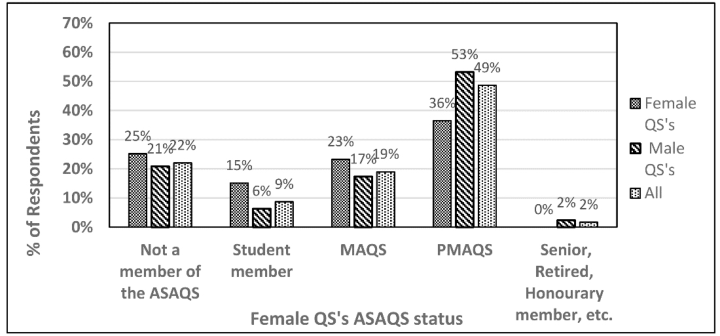
ASAQS Membership The study found that 25% of female QS’s are not ASAQS members (21% of male QS’s). Figure 8 also confirms that 74% of female QS’s are currently ASAQS members compared to 76% of male QS’s. Only 36% of female QS’s are, however, practising members (PMAQS) of the ASAQS compared to 53% of male QS’s.
Contrasting the Profiles of Female vs Male Quantity Surveyors in South Africa 299
Figure 7: SACQSP status of female vs all QS’s. (Source: author, 2023.)Figure 8: ASAQS membership of female vs male QS’s. (Source: authors, 2023.)
CONCLUSION
The study made several findings relevant to the ASAQS and the QS profession in general.
The first finding is that the number of female QS’s is increasing significan- tly. A total of 26,6% of all QS’s and 36,6% of QS’s younger than 43 years are female; indications are that these numbers will increase in the future. The ASAQS is advised to consider gender-specific needs that female QS’s may have.
The second finding is that female QS’s are relatively young, with 61% not older than 35 years compared to 35% for male QS’s and 83% of female QS’s being younger than 46 years compared to 55% for male QS’s. However, regarding older QS’s, only 5% of female QS’s are older than 55 years compa- red to 28% of male QS’s. Indications are that large numbers of female QS’s are entering the profession, and after the age of 55 years their numbers drop
off far quicker than their male counterparts. Professional consultants betw- een the ages of 55 – 65 can generally be considered highly experienced and well-established. As such, these seasoned practitioners provide very impor- tant leadership roles to the profession and the ASAQS. If the number of female QS’s keeps increasing, but female QS’s also tend to leave the profession after 50 years of age, this will create a dearth of future leadership for the profession. The ASAQS should carefully note this trend.
The aspect of race also added more perspective to the gender profile of South African QS’s. Black QS’s form 53% of all female QS’s but only 29% of male QS’s. White QS’s account for 55% of all male QS’s but only 32% of female QS’s. For QS’s of Indian descent, these numbers are relatively stable at 11-12%.
Regarding their employment, 89% of female QS’s and 83% of male QS’s work for consulting firms or as construction QS’s. Only 5% of female QS’s find employment in the public sector compared to 12% of male QS’s.
The study found that all QS’s are well educated, with more than 70% of them with a bachelor’s or honours degree and only minor differences between the gender groups.
80% and more of male and female QS’s are located in the country’s major economic hubs. QS’s will, therefore, not have to relocate if the ASAQS’s future strategies may target areas of major economic activity currently unattended by or not serviced by QS’s.
The seventh finding is that most female QS’s (84%) and male QS’s (79%) are registered with the SACQSP. A statistic to note is that a much larger percentage of registered female QS’s are only registered as Candidate QS’s compared to their male counterparts. The ASAQS should carefully monitor this trend.
The eighth and last finding is that 74% of female QS’s are ASAQS mem- bers. This strong support of the ASAQS from a growing sector of the profession indicates that the ASAQS may be well advised to focus on any spe- cific needs and challenges that female QS’s may experience. It should be noted that only 36% of female QS’s are practising members (PMAQS) compared to 53% of their male counterparts.
RECOMMENDATIONS Based on the above findings, the ASAQS is advised to keep themselves well informed of the changing profile of QS’s. The growing number of female QS’s means their specific needs or challenges will become more important. Future ASAQS strategies will have to accommodate these identified changes.
The ASAQS has admirably served the needs and interests of older QS’s for many decades. However, younger and female QS’s needs and interests may be quite different, and the ASAQS should inform themselves in this regard.
The study’s findings also suggest that this study be repeated every 2nd or 3rd year to keep the profession and the ASAQS informed of trends and changes amongst QS’s. New, updated, and accurate information about the profession and its members will be essential components of the change management plans of the ASAQS to keep the organisation focused on the current and future needs of the profession.
Contrasting the Profiles of Female vs Male Quantity Surveyors in South Africa 301
ACKNOWLEDGMENT
The authors would like to acknowledge the support of the ASAQS in distributing the questionnaire and providing access to the questionnaire data.
REFERENCES
Berman, R., Quinn, C., Paavola, J. (2012). The role of institutions in the transformation of coping capacity to sustainable adaptive capacity. Envi- ronmental Development, Volume 2, April 2012, Pages 86–100. Elsevier. https://doi.org/10.1016/j.envdev.2012.03.017 Bordeleau, F and Felden, C. (2019). Digitally transforming organisations: a Review of Change Models of Industry 4.0. Proceedings of the 27th European Conference on Information Systems (ECIS), Stockholm & Upp- sala, Sweden, June 8-14, 2019. ISBN 978-1-7336325-0-8 Research Papers. https://aisel.aisnet.org/ecis2019_rp/49 Bowen, P, Cattell K, Distiller, G and Michell, K. 2007. Job satisfaction of South Afri-
can quantity surveyors: a racial analysis. Journal of Contemporary Management, Volume 4, pages 86–115. Bowen, P, Cattell K and Distiller, G. 2008. South African quantity surveyors: issues of gender and race in the workplace. Acta Structilia, Volume 15 Issue 1. Bowen, P, Cattell K, Distiller, G and Mark, J, T. 2009. Job satisfaction of South
African quantity surveyors: Does age make a difference? Campbell, J. L. 2021. Institutional Change and Globalisation. Princeton University Press. Goslin, A. and Kluka, D. 2006. Affirmative action as a dimension of diversity mana-
gement: Perceptions of Sports Federation. Journal of Global Initiatives: Policy, Pedagogy, Perspective. Volume 1 Issue 2. Harinarain, N., Bornman, C., and Botha, M. 2013. Organisational culture of the South African Construction Industry. Acta Structilia Volume 20 Issue 1. Haupt, T and Madikizela, K. 2009. Why do South African women choose constru-
ction? Acta Structilia Volume 16 Issue 2. Haupt, T and Fester, F. 2012. Women-owned construction enterprises: A South Africa assessment. Journal of Engineering, Design, and Technolgy Volume 10 Issue. Iyengar, S., Durham, J. and Katz, A. (2016) What strategies are used by institutional
entrepreneurs to build adaptive capacity in non-profit organisations? A rapid rea- list review. In 2nd International Conference on Realist Evaluation and Synthesis: Advancing Principles, 2 – 6 October 2016. Maritz, M. J., & Sigle, H. M. (2010). Quantity surveying practice in South Africa.
Pretoria: Construction Economics Associates (Pty) Ltd. Martin, P., and Barnard, A. 2013. The experience of women in male-dominated occupations: A constructivist grounded theory inquiry. SA Journal of Industrial Psychology/SA Tydskrif vir Bedryfsielkunde, 39(2), Art. #1099, 12 pages. https:// dx.doi.org/10.4102/sajip. v39i2.1099 Mazibuko J, V and Govendar K, K. 2017. Exploring workplace diversity and orga-
nisational effectiveness. A South African exploratory case study. SA Journal of Human Resource Management. Ndweni, M., P., and Ozumba, A, O., U. 2021. The need to investigate the career progression of female professional employees in the South African construction industry IOP Conf. Ser.: Earth Environ. Sci. 654 012011. Nkado, R., N. 2000. Competencies required by quantity surveyors in South Africa.
In: Akintoye, A (Ed.), 16th Annual ARCOM Conference, 6–8 September 2000,
Glasgow Caledonian University. Association of Researchers in Construction Management, Vol. 1, 11–20. Patrick, H, A., and Kumar V, R. 2012. Managing workplace diversity: Issues and Challenges. April-June 2012: 1–15. Sage Open. SACQSP. 2022. Select your registration category. [Online} Available from https://ww
w.sacqsp.org.za/general/register_member_type.asp? Accessed on 3 June 2022. Towey, D. 2012. Construction Quantity Surveying: A practical guide for the Contractor’s quantity surveyor. Wiley & Sons, Proquest. University of Pretoria, No date. Department of Construction Economics. SACQSP
Annual Reports, 2010 – 2021. Unpublished Council reports, Pretoria, South Africa.
LISTED IN THE AHFE DIGITAL BOOKSTORE CATALOGUE
Explore the complete digital volume
Human Factors, Business Management and Society
Read this individual research paper free through the original publisher, or explore the full digital proceedings book.
ISBN 978-1-958651-73-5
Explore this ISBN in the AHFE Bookstore ↗Listed in the July 2026 bookstore catalogue; search by ISBN to confirm current availability · Digital book purchase optional