Danie Hoffman, Elzane Van Eck (2022). Millenials: Profiling the South African quantity surveyors of the future. In: Social and Occupational Ergonomics. AHFE Open Access, vol. 65, pp. 139–144. https://doi.org/10.54941/ahfe1002668
The future growth and prosperity of an organisation or in this case of the professional discipline of quantity surveying in South Africa have strong links with effective succes-sion planning. The next generation will be measured on how well they will be able to build on the successes and stature of the preceding generations. The success and prosperi-ty that the South Africa quantity surveying profession will enjoy during the next decade or more rests on the shoulders of the current generation of new entrants and young profes-sionals recently established in the profession. This younger generation of professionals also belongs to the age group often referred to as millennials.Millennials are people born between 1980 – 2000 and who are therefore currently be-tween 21 to 41 years of age. In 2020, approximately 60% of all registered quantity sur-veyors in South Africa were millennials. This cohort will become the future leaders and visionaries to carry the profession of quantity surveying into the future.Contrasting to previous generations the millennials have grown up and were educated and trained in the electronic and digital age. Their differing roots may carry with it chal-lenges that may hamper effective communication with the current leadership of the pro-fession. The better the current leaders are able to know and understand the millennials in their fold, the more likely a successfull passing of the batten to the next generation will become. This study is based on a questionnaire from the Association of South African Quantity Surveyors, assisted by the University of Pretoria. The questionnaire was distributed on a national bases to all the South African quantity surveyors on the data base. The study will evaluate various aspects that describe the profile of South African mil-lennial quantity surveyors. The aspects that will be compared include the age, gender, race, and locational spread of the millenails who participated in the survey. Additional aspects such as their academic qualifications, nationality, registration status with the Council of South African Quantity Surveyors, and their length of term of current em-ployment will be used to provide a reasonably detailed description of the younger genera-tion of South African quantity surveyors.The above information will be of value to the Association of South African Quantity Surveyors, to the management of quantity surveying firms and also to institutions such as universities that offer accredited academic programmes for the training of quantity sur-veyors. The findings can also be shared with quantity surveying professions across inter-national borders to compare against the profiles of their millennial cohorts of quantity surveyors.
According to the South African Council for the Quantity Surveying Profes- sion (2021), more than 70% of all quantity surveyors in South Africa were younger than 45 years in 2021. The majority of this younger generation is often referred to as millennials or the cohort of people born between 1980 – 2000 (Axten, 2015; Barnett, 2014; Bussin, 2014; Kultalahti & Viitala, 2014; Van Eck, Burger, 2018).
In contrast to previous generations, Millennials have grown up and were educated and trained in the electronic and digital age. Their differing roots may carry with it challenges that may hamper effective communication with the current leadership of the profession. The better the current leaders know
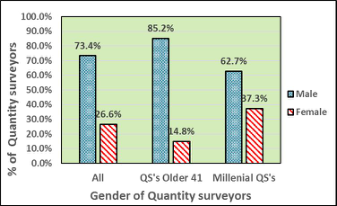
Figure 1: Gender of Millennial QS’s (Source: Author, 2022).
and understand the millennials in their fold, the more likely the current leaders will be to pass the batten to the next generation successfully.
MILLENNIALS IN SOUTH AFRICAN CONSTRUCTION Quantity surveyors act as the financial consultants of the construction indu- stry (Maritz & Siglé, 2010). The future success and prosperity of the QS profession rest largely with the cohort of millennial QS’s. The motivation and job satisfaction of millennial QS’s will be important factors to consider. Very little research has yet been conducted on the job satisfaction of millennial QS’s (Asad & Dainty, 2005; Bowen & Cattell, 2008). Herbison and Boseman (2009) stated that organisations unable to embrace millennial employees and whose management style and culture reflect that what has worked before will be unable to attract and retain millennial employees. Companies that recruit and retain young professionals will gain a competitive advantage (Lassen, 2015).
METHODOLOGY
The study follows a quantitative research approach based on data secured utilising questionnaires. The University of Pretoria assisted the Association of South African Quantity Surveyors (ASAQS) to compile the research instru- ment and analysing the data. The ASAQS distributed the questionnaire to all South African quantity surveyors (QS’s) on their database. A total of 626 valid responses were received from respondents, representing approximately 14% of registered QS’s in South Africa.
FINDINGS Age and Gender
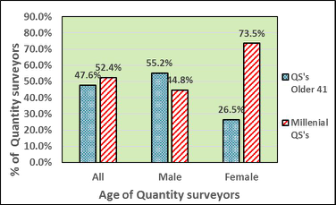
Figure 1 confirmed that the gender of millennial QS’s differed substantially from QS’s older than 41 years. Only 14.8% of QS’s older than 41 are female, but females make up 37.3% of millennial QS’s. According to figure 2, mil- lennial QS’s make up 52.4% of South African QS’s, 44.8% of male QS’s and 73.5% of female QS’s.
Millennials: Profiling the South African Quantity Surveyors of the Future 141
Figure 2: Age of Millennial QS’s (Source: Author, 2022).Table 1. Locational spread of Millennial QS’s (Source: Author, 2022)
Table 1 details the spread of QS’s amongst the country’s nine provinces. The spread of millennial QS’s in some Provinces with large urban areas and major national economic hubs increased (Gauteng from 41.3% to 44.3%; KwaZulu-Natal from 16.4% to 17.8%), but others such as the Western Cape declined (20.8% to 16.0%).
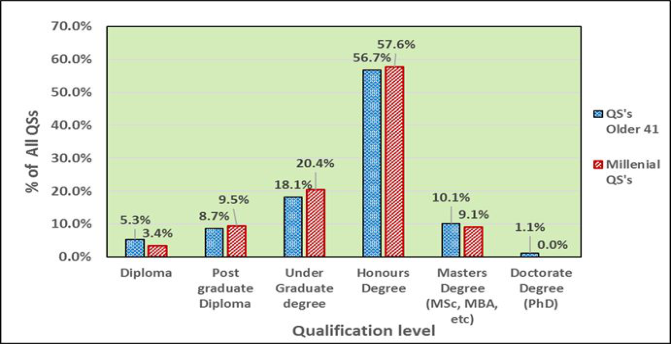
Qualification Level Millennial QS’s were found to, compared to QS’s older than 41, hold sli- ghtly larger portions of postgraduate diplomas, undergraduate degrees and honours degrees (see Figure 3). Due to their relatively younger age, fewer millennial QS’s had master and doctorate qualifications than QS’s older than 41.
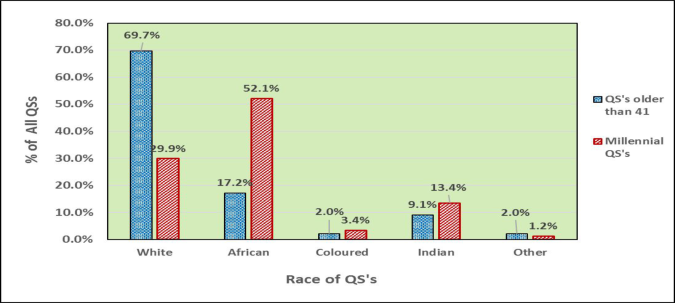
Race The racial compilation of QS’s showed the most dramatic change amongst all the study’s findings. Figure 4 confirmed that White QS’s decreased from 69,7% for QS’s older than 41 to 29,9% amongst millennial QS’s while Afri- can QS’s increased from 17.2% to 52.1%. Indian QS’s also increased from 9.1% to 13.4%.
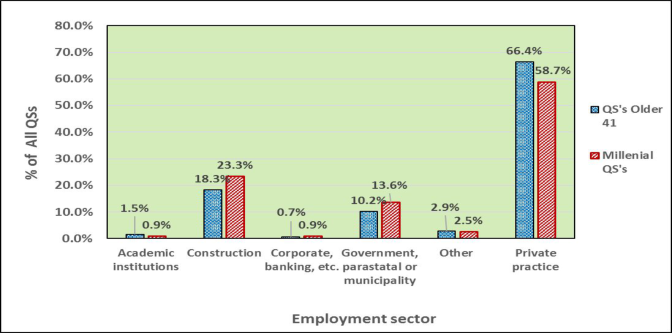
Employment Sector The employment sectors preferred by millennial QS’s also showed some chan- ges. Some 23.3% work for construction companies, compared to 18.3% of
142 Hoffman and van Eck
Figure 3: Qualification level of Millennial QS’s (Source: Author, 2022).Figure 4: Racial makeup of Millennial QS’s (Source: Author, 2022).
QS’s older than 41. Likewise, the public sector also employs 13.6% of millen- nial QS’s and only 10.2% of QS’s older than 41. However, fewer millennial QS’s are employed in private practices (58.7% vs 66.4%) (see Figure 5). These employment changes may be linked to the significantly larger number of Africans amongst millennial QS’s.
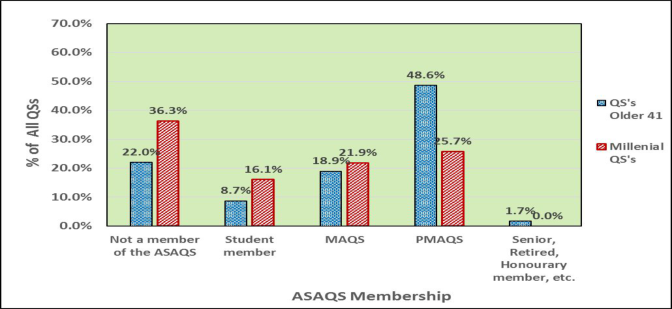
ASAQS Membership The study found that a much larger portion of 36.3% of millennial QS’s is not ASAQS members compared to 22.0% for QS’s older than 41 (see Figure 6). The changes in the portions of student members or PMAQS can be largely attributed to the younger age of millennial QS’s.
CONCLUSION AND RECOMMENDATIONS The study made several important findings that will be of particular impor- tance to the ASAQS. Companies and firms employing QS’s and academic
Millennials: Profiling the South African Quantity Surveyors of the Future 143
Figure 5: Employment sector of Millennial QS’s (Source: Author, 2022).Figure 6: ASAQS membership of Millennial QS’s (Source: Author, 2022).
institutions involved with training QS’s will also benefit from these findings. Some of the most important findings were the large increase in females amongst millennials QS’s, the decrease in White and the increase in African millennial QS’s and the fact that a larger number of millennial QS’s are not ASAQS members.
The study should be repeated regularly to assist the ASAQS in kee- ping track of the demographical changes in the dynamic South African construction and socio-economic landscapes.
ACKNOWLEDGMENT
The authors would like to acknowledge the support of the ASAQS in distributing the questionnaire and providing access to the questionnaire data.
144 Hoffman and van Eck
REFERENCES
Asad, S., & Dainty, A. R. J. (2005). Job motivational factors for disparate occupational groups within the UK construction sector: A comparative analysis. International Journal of Construction Research, 6(2), 223–236. Axten, C. (2015). Millennials at work. Defense AT&L, 44(2), 50–54. Barnett, N. (2014, December). Inspiring generation Y employees. Training &
Development, 41(6), 14–15. Bowen, P., & Cattell, K. (2008). Job satisfaction of South Africa quantity surveyors.
Engineering, Construction & Architectural Management, 15(3), 260–269. Bussin, M. (2014). Remuneration and talent management. Randburg: Knowres Publishing (Pty) Ltd. Herbison, G., & Boseman, G. (2009, May). Here they come – Generation Y. Are you
ready? Journal of Financial Service Professionals, 63(3), 33–34. Kultalahti, S., & Viitala, R. L. (2014, July). Sufficient challenges and a weekend ahead – Generation Y describing motivation at work. Journal of Organisational Change Management, 27(4), 569–582. Lassen, K. (2015). Retaining generation Y employees. Accountancy SA, June, p. 42. Maritz, M. J., & Sigle, H. M. (2010). Quantity surveying practice in South Africa.
Pretoria: Construction Economics Associates (Pty) Ltd. SACQSP. 2021. Annual Report: April 2020 – March 2021. South Africa: South African Council for the Quantity Surveying Profession. Van Eck, E. & Burger, M. (2018). Millennial quantity surveyors as workforce
in the Built Environment, International Journal of Construction Education and Research, 15(4), pp. 241–255.
LISTED IN THE AHFE DIGITAL BOOKSTORE CATALOGUE
Explore the complete digital volume
Social and Occupational Ergonomics
Read this individual research paper free through the original publisher, or explore the full digital proceedings book.
ISBN 978-1-958651-41-4
Explore this ISBN in the AHFE Bookstore ↗Listed in the July 2026 bookstore catalogue; search by ISBN to confirm current availability · Digital book purchase optional