Liwen Zhang (2026). Mitigating Urban Emotional Alienation through Multisensory Design: A Human Factors Evaluation of an Installation-Based Intervention. In: Affective and Pleasurable Design. AHFE Open Access, vol. 204, pp. 236–244. https://doi.org/10.54941/ahfe1007349
High-density urbanization often prioritizes efficiency at the expense of emotional well-being, creating homogeneous environments that lack affordances for sensory restoration and reinforce urban alienation. This study applies a human factors lens to the problem of affective ergonomics, examining how multisensory cues can be embedded within existing infrastructure to mitigate stress and foster emotional connection. In contrast to research focused on accessing "real nature," this project investigates low-cost interventions utilizing material reuse and phased sound modulation in resource-constrained contexts. The prototype integrates three coupled mechanisms—material agency (discarded glass, plaster, and wire), sonic narrative (an industrial-to-natural transition), and spatial choreography—to structure attentional sequencing. A mixed-methods evaluation was conducted employing an in-situ exposure protocol, behavioral tracking (dwell time), and semi-structured interviews. Results reveal three key patterns: (1) participants consistently reported feeling "settled" following the auditory transition, aligning with a stress-reduction trajectory; (2) material contrasts were interpreted as "painful yet hopeful," indicating the system's capacity to support complex narrative construction beyond aesthetic preference; and (3) increased dwell time during low-arousal phases provided behavioral evidence of sustained engagement and attentional restoration. These findings inform design guidelines for multisensory urban interventions, demonstrating how phase-based sensory cues can be strategically employed to regulate affective load in dense urban environments.
Urban infrastructure is increasingly optimised for speed and control, while the human factors that support emotional ease and recovery are harder to measure and easier to overlook. This can leave high-density environments functioning smoothly yet feeling perceptually thin or emotionally draining. This experience is referred to here as urban affective alienation (Bayırbağ and Penpecioğlu, 2017; Helander and Po Tham, 2003).
Mitigating Urban Emotional Alienation Through Multisensory Design 237 Although affect and wellbeing are now widely discussed in human- centred urban research, much of the evidence remains correlation-based or is tied to access to parks and other forms of “real nature” (Kaplan, 1995; Ulrich, 1983). In dense contexts where space and budgets are limited, the gap is more practical: what can be done inside existing infrastructure, and how it can be evaluated in human factors terms rather than as an aesthetic response.
This study evaluates a multisensory installation prototype as an evaluative interface (Gaver, 2012). The design couples material contrast with a phase-based soundscape and spatial sequencing (Payne, 2013; Diamantopoulou and Christidou, 2019), allowing reportable and observable responses to be documented. The mixed-methods assessment tracks perceived affective change, behavioural engagement (dwell time), and meaning-related narrative construction, while explicitly excluding aesthetic preference as an outcome. Crucially, this study distinguishes affective ergonomics from aesthetic appreciation; it measures functional restoration rather than preference.
THEORETICAL FRAMEWORK: TOWARDS AN AFFECTIVE ERGONOMICS OF SPACE Affective ergonomics extends human factors beyond physical fit and task efficiency to consider how environments shape affective load over time (Helander and Po Tham, 2003; Mehrabian and Russell, 1974). In this study, the framework is used to guide observation and interpretation rather than to predict outcomes a priori; within this framework, positive affect is operationalized not as generic ‘happiness,’ but as reported comfort, cognitive release, and moments of re-attachment that may coexist with ambivalence.
Material agency frames materials as active cues that organise perception and interpretation. Features such as sharpness, fragility, and reflectivity can influence approach–avoidance behaviour, pacing, and attention allocation (Jung et al., 2017; Faraj and Azad, 2012). Here the emphasis is on metaphorical affordance: architectural residues retain legible “life histories” and, when reconfigured, can prompt narratives that participants negotiate rather than receive as fixed messages. In the present study, material agency is examined through participants’ interpretive language and recurring themes, rather than as an independently manipulated factor.
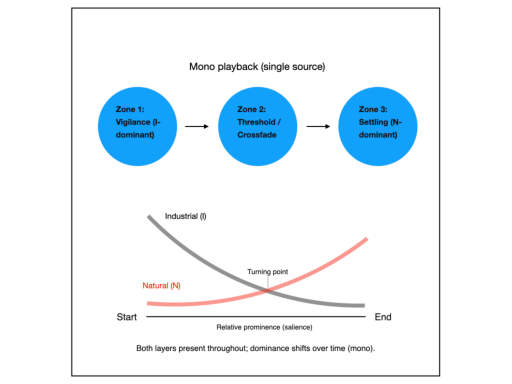
Sonic narrative treats sound as a time-based interface that can modulate arousal through density, predictability, and temporal patterning (Payne, 2013; Ratcliffe, 2021). In this study, the soundscape is structured as a sequence in which higher-arousal industrial textures transition into lower- arousal, nature-associated layers. This sonic boundary serves as a shared reference point for examining self-reported arousal shifts and engagement across phases (Zhang et al., 2017). Figure 1 illustrates the phase structure used for comparison.
Figure 1: Soundscape sequencing (mono playback): industrial-to-natural transition across three zones. Industrial and nature-associated layers run continuously while their relative dominance shifts across Zones 1–3. The “turning point” indicates the crossfade boundary used as the shared reference point in analysis.
Spatial choreography frames space as an affective-support structure, where sequencing—pathways, sightlines, proximity, and lighting stability—shapes when cues are encountered and whether attention settles over time (Rubidge, 2012; Diamantopoulou and Christidou, 2019). In the present study, spatial choreography is interpreted in relation to observed engagement patterns rather than treated as an independently manipulated factor.
EVALUATION: A MIXED-METHODS HUMAN FACTORS STUDY Ten participants (N = 10) were recruited through peer networks at Slade and personal contacts. Participation was voluntary and anonymous, and no identifying data were collected. Participants ranged in age from 20 to 25 and included individuals with and without art/design backgrounds. To contextualize response variability, and acknowledging the exploratory nature of the sample, we asked participants to indicate their prior experience with installation art and self-identified noise sensitivity. All participants provided informed consent and could withdraw at any time without penalty.
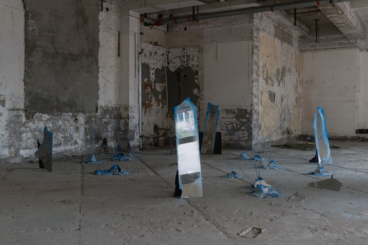
Each participant completed a short structured session (~5 min). Before exposure, participants rated six affective dimensions on a 1–5 scale (Anxiety, Serenity, Isolation, Connectedness, Oppression, Release). Bipolar pairings were introduced only as interpretive anchors; each item was rated independently. Participants then encountered the intervention via a standardised presentation sequence designed to preserve the intended soundscape progression, particularly the shift from industrial textures to lower-arousal, nature-associated rhythms. An overview of the installation setting is shown in Figure 2.
Figure 2: Overview of the installation prototype and the standardised exposure setup used in the study.
Immediately after exposure, participants completed the same ratings again. The post-rating was framed as a retrospective self-assessment of their own affective state at the most salient moment of the experience, rather than an aesthetic evaluation. A brief semi-structured interview (~3 min) followed, focusing on (i) salient moments, (ii) meanings suggested by the material configuration, and (iii) perceived changes in attention or bodily stance. Dwell time was recorded as a low-interference engagement proxy, and participants identified a subjective turning point (when they began to feel more relaxed or more inclined to continue). Time after this point was treated as natural-phase dwell (Bitgood, 2006).
Given the exploratory nature of the sample (N = 10), the analysis prioritised transparency over statistical generalisation. Interview responses were analysed using thematic analysis (Braun and Clarke, 2006). Rating and dwell-time data were summarised descriptively: pre- and post-rating means were calculated for each dimension and visualised as an overlaid radar chart (Figure 3) to indicate direction of change. Dwell time was summarised using basic descriptive values (e.g., mean and range) and interpreted relative to the turning-point boundary. These descriptive summaries were used to triangulate qualitative themes rather than to support population-level causal claims (Creswell and Clark, 2017).
Three key findings emerged from the triangulated analysis of ratings, dwell time, and interview themes. Across these three sources, three key findings emerged.
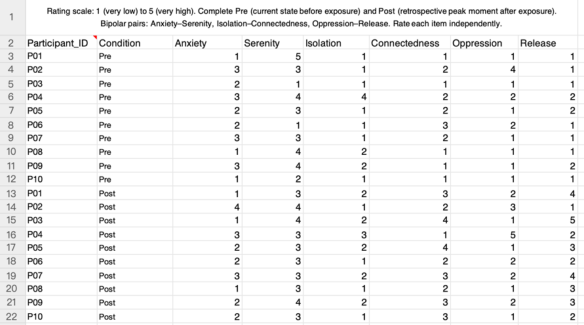
Finding 1. Affective Ratings Retrospective post-ratings suggested a clear directional shift relative to the pre-exposure baseline (Figure 3; Figure 4). The profile moved most visibly toward higher Release and Connectedness, while Serenity showed a smaller upward tendency. Mean Anxiety was broadly stable across the two rating points. Oppression and Isolation did not uniformly decrease; instead, their scores showed modest shifts and noticeable participant-to-participant variability. Taken together, the pattern suggests a “settling-with-tension” profile: at the salient moment, many participants reported higher Release and Connectedness, while Oppression/Isolation showed smaller and more variable shifts.
Figure 3: Mean pre- and post-exposure ratings on six affective dimensions (retrospective self-assessment), shown as an overlaid radar chart.Figure 4: Participant-level pre and retrospective post ratings (1–5) across the six affective dimensions.
Finding 2. Dwell Time (Engagement Tendency Around the Sound Transition) Dwell time was recorded as a low-interference proxy for sustained engagement. Using the soundscape’s crossfade boundary as a shared reference point, where industrial textures became less dominant and nature-associated rhythms became more dominant (Figure 1), participants’ dwell time tended to be longer after this boundary than before it. Several participants also verbally linked this later phase to being easier to stay with and continue looking. These observations
Mitigating Urban Emotional Alienation Through Multisensory Design 241 Finding 3. Thematic Patterns (Narrative Construction and Ambivalence)
Thematic analysis showed recurring ambivalent interpretations anchored in the material configuration (Braun and Clarke, 2006). Glass and plaster fragments were frequently described as sharp or fragile and were often associated with cautious looking and guarded pacing. In contrast, emerging wire-like forms were commonly read as endurance, regrowth, or a force that continues. Multiple accounts condensed this coexistence into phrasing close to “painful yet hopeful,” which participants used to articulate affect more explicitly and to connect the installation to lived experiences of urban change. Overall, the material system was more often used as an interpretive handle for meaning-making and affect naming than as a basis for aesthetic liking or disliking. A material close-up of the brittle residues and emergent wire elements is shown in Figure 5.
Figure 5: Material close-up of the prototype: brittle residues (glass/plaster) and emergent wire elements referenced in participants’ interpretations.
DISCUSSION: IMPLICATIONS FOR HUMAN-CENTERED URBAN DESIGN The contribution of this study is not to claim a single-factor effect, but to offer a transferable mechanism framing (Creswell and Clark, 2017; Gaver, 2012). In efficiency-driven infrastructural contexts, a human-centered intervention can work by organising how multisensory cues unfold over time, making a shift from continuous monitoring toward more stayable engagement and narrative articulation more likely (Kaplan, 1995; Payne and Bruce, 2019). In this discussion, material cues, temporal sound structuring, and spatial choreography are treated as a coupled system to explain how the prototype supported speakable affect and discussable associations with urban change (Rubidge, 2012; Diamantopoulou and Christidou, 2019).
First, the material system sets an entry threshold. Properties such as fracture, glare, and brittleness make risk and instability legible, shaping an initial stance of cautious looking (Jung et al., 2017). Second, wire-like emergence introduces a reading of continuity within the same field, allowing ambivalence to persist rather than closing into a single meaning (Braun and Clarke, 2006). Third, the time-structured soundscape provides a temporal
242 Zhang scaffold, making the encounter feel processual rather than merely atmospheric. Finally, spatial choreography stages exposure through proximity, sightlines, and lighting stability, leaving participants room to regulate intensity via pacing and position (Payne, 2013; Ratcliffe, 2021; Bitgood, 2006).
These interpretations are offered as an organisation of the observed patterns rather than as a direct test of any single theoretical account.
Based on this coupled reading, the following principles are proposed as actionable heuristics for resource-constrained settings where importing literal nature or large-scale redevelopment is unrealistic. They should be read as heuristics rather than universal rules.
Multisensory contrast to make transitions legible: coordinate changes across at least two cue systems so that a shift in attentional mode is perceivable (Kaplan, 1995). The goal is not to add stimulation, but to externalise a pathway from vigilance to release.
Sound as a time-structured interface: treat sound as a temporal interface rather than a background layer by designing recognisable phases and boundaries, aligned with spatial thresholds, to reduce filtering demand and support attentional settling (Payne, 2013).
Material ambiguity for narrative engagement: keep material meaning slightly unresolved so contradictory readings can coexist, prompting interpretive work and enabling affect naming and links to lived experiences without requiring complex technology or overt interactivity (Faraj and Azad, 2012; Jung et al., 2017). This study is exploratory with a small sample, and its affect measures rely primarily on retrospective self-assessment and interpretive accounts, with dwell time as an indirect proxy (Creswell and Clark, 2017). Findings should therefore be interpreted as context-dependent tendencies. Future research can strengthen validity through larger samples, clearer control conditions, and multimodal measures including physiological indicators such as HRV and longitudinal in-situ evaluation. Lightweight adaptive approaches, such as physiology-informed micro-modulation of sound or light, may be explored while maintaining infrastructural compatibility and deployability.
CONCLUSION
This paper argues that installation-based practice can function as a human- factors instrument: a way to prototype, specify, and test how environments shape affective load, rather than a vehicle for aesthetic expression alone (Helander and Khalid, 2012; Zimmerman et al., 2007). By coupling material agency, temporal sound structuring, and spatial choreography, the prototype translated an otherwise diffuse urban experience—governance pressure and “executed” renewal—into perceivable cues with a trackable trajectory.
Across the mixed-methods assessment, reports and behavioural traces pointed to the same directional tendency: after the soundscape shifted toward lower-arousal rhythms, participants more often described settling and tended to sustain engagement for longer. At the same time, the material system repeatedly elicited rupture–persistence narratives, showing how
Mitigating Urban Emotional Alienation Through Multisensory Design 243 ambivalence can be used as a functional condition for affect naming and discussable association, rather than treated as noise in the data.
The broader implication is that affective support in dense cities does not depend on importing “more nature” or rebuilding at scale. It can be advanced through deployable, mechanism-specified multisensory sequences that make tension legible, offer time-structure for down-regulation, and hold enough material ambiguity for re-attachment to occur. This study does not claim single-factor effects; it contributes a transferable framing and evaluative protocol for designing and testing low-cost interventions inside existing infrastructure.
REFERENCES
Bayırbağ, M. K. & Penpecioğlu, M. 2017. Urban crisis:‘Limits to governance of alienation’. Urban Studies, 54, 2056–2071. Bitgood, S. 2006. An analysis of visitor circulation: Movement patterns and the
general value principle. Curator: The Museum Journal, 49, 463–475. Braun, V. & Clarke, V. 2006. Using thematic analysis in psychology. Qualitative research in psychology, 3, 77–101. Creswell, J. W. & Clark, V. L. P. 2017. Designing and conducting mixed methods
research, Sage publications. Diamantopoulou, S. & Christidou, D. 2019. Museum encounters: A choreography of visitors’ bodies in interaction. Museum Management and Curatorship, 34, 344–361. Faraj, S. & Azad, B. 2012. The materiality of technology: An affordance perspective.
Materiality and organizing: Social interaction in a technological world. Oxford University Press. Gaver, W. What should we expect from research through design? Proceedings of the SIGCHI Conference on Human Factors in Computing Systems, 2012. Association for Computing Machinery, 937–946. Helander, M. G. & Khalid, H. M. 2012. Affective engineering and design. In:
SALVENDY, G. (ed.) Handbook of human factors and ergonomics. Wiley. Helander, M. G. & Po Tham, M. 2003. Hedonomics—affective human factors design. Ergonomics, 46, 1269–1272. Jung, H., Wiltse, H., Wiberg, M. & Stolterman, E. 2017. Metaphors, materialities,
and affordances: Hybrid morphologies in the design of interactive artifacts. Design Studies, 53, 24–46. Kaplan, S. 1995. The restorative benefits of nature: Toward an integrative framework.
Journal of environmental psychology, 15, 169–182. Mehrabian, A. & Russell, J. A. 1974. An approach to environmental psychology, the MIT Press. Payne, S. R. & Bruce, N. 2019. Exploring the relationship between urban quiet
areas and perceived restorative benefits. International journal of environmental research and public health, 16, 1611. Payne, S. R. 2013. The production of a perceived restorativeness soundscape scale.
Applied acoustics, 74, 255–263. Ratcliffe, E. 2021. Sound and soundscape in restorative natural environments: A narrative literature review. Frontiers in psychology, 12, 570563.
choreography and performativity in interactive installations: Sarah Rubidge. Contemporary Choreography. Routledge. Ulrich, R. S. 1983. Aesthetic and affective response to natural environment. Behavior and the natural environment. Springer. Zhang, Y., Kang, J. & Kang, J. 2017. Effects of soundscape on the environmental
restoration in urban natural environments. Noise and Health, 19, 65–72. Zimmerman, J., Forlizzi, J. & Evenson, S. Research through design as a method for interaction design research in HCI. Proceedings of the SIGCHI conference on Human factors in computing systems, 2007. ACM, 493–502.
LISTED IN THE AHFE DIGITAL BOOKSTORE CATALOGUE
Explore the complete digital volume
Affective and Pleasurable Design
Read this individual research paper free through the original publisher, or explore the full digital proceedings book.
ISBN 978-1-964867-80-9
Explore this ISBN in the AHFE Bookstore ↗Listed in the July 2026 bookstore catalogue; search by ISBN to confirm current availability · Digital book purchase optional