Veljko Vučinić, Luca Seidel, Marco Stang, Eric Sax (2024). USID - Unsupervised Identification of the Driver for Vehicle Comfort Functions. In: Human Interaction and Emerging Technologies (IHIET-AI 2024): Artificial Intelligence and Future Applications. AHFE Open Access, vol. 120, pp. 142–152. https://doi.org/10.54941/ahfe1004564
Modern vehicles must meet the rapidly increasing customer requirements for in-vehicle comfort. Moreover, the consumer’s demand for personalized comfort functions keeps growing accordingly. Vehicle comfort functions are designed to ensure comfort with a more pleasant and convenient driving experience, including thermal comfort, seating comfort, noise reduction, and entertainment systems. They are highly customized for individual drivers to enhance their effectiveness. To achieve precise adjustment for each driver of a vehicle, it is imperative to identify the driver accurately.The distinctive signature of each driver’s driving style is embedded within the time series data gathered from various vehicle sensors. Therefore, there is no need for integrating novel driver identification sensors, as the identification task can be accomplished by utilizing existing and standardized vehicle data from the On-Board Diagnostic II system (OBD II).This research paper investigates the viability of precise driver identification based on unsupervised machine learning methods. For this purpose, the USID (Unsupervised Identification of the Driver) concept is introduced. Existing driver identification systems are functional, yet they exhibit limitations in precision. For example, a vehicle could detect the presence of a driver’s smartphone but fail to distinguish whether the individual is the actual driver or a passenger. In contrast to the state-of-the-art, the USID approach proposes a seamless and precise solution for driver identification. Due to its unsupervised characteristic, USID offers significant scalability, as its models don’t rely on predefined classes to distinguish and identify drivers. Our USID approach is inspired by the Knowledge Discovery in Databases (KDD) process and comprises several stages. In the initial phase of our process pipeline, we perform data quality checks, identifying and addressing outliers to avoid any potential distortions in model inferences. Given that time series data represents a flow of data points, we apply moving windows to split the time series sequence into variable-length segments. The choice of window length is intended to capture relevant events for predictive purposes. In order to ensure the relevance of our time sequence comparisons across a diverse range of driving contexts, drivers, and vehicles, we utilize global normalization techniques incorporating physical signal boundaries. Our approach integrates feature selection methods, such as information gain, signal-to-signal correlation analysis, and principal component analysis (PCA), facilitating the extraction of the most informative features while effectively reducing input dimensionality. As a final step in transformation, we propose an optional feature space transformation to align with the selected model’s input space. The recorded real OBD II time series of 24 drivers and their driving cycles are used for the purpose of training the models in USID. The dataset comprises 10 driving cycles from a single vehicle driven by 10 different individuals and an additional 14 driving cycles from 14 vehicles, each driven by distinct drivers. Consequently, this paper also explores the feasibility of accurately distinguishing between different drivers operating various vehicles.Unsupervised machine learning methods used in USID models are K-Means, Autoencoders, Self-Organizing maps, and Density-based spatial clustering (DBSCAN). In the end, the models are tested, and the results are outlined with the comparison of the quality of models for driver identification.
Modern vehicles must meet the rapidly increasing customer requirements for in-vehicle comfort. An increase in comfort and safety is a main objective of car manufacturers as well as of their suppliers and a substantial distinguish- ing feature in the market (Bloecher, Dickmann, and Andres, 2015). Vehicle comfort functions are designed to ensure comfort with a more pleasant and convenient driving experience, including thermal comfort, seating comfort, noise reduction, and entertainment systems. Interaction with these systems plays an important role in ensuring comfort and elevating the overall driver experience, therefore they are becoming more tailored for each driver. In general, there is a considerable level of consumer acceptance for automated comfort functions for the highest levels of automation (4 and 5) (Guinea et al., 2021). Thermal comfort represents one part of the comfort in the vehicle which is perceived as subjective and relative. In contrast to its subjective- ness, it has been successfully developed driver-specific (Lahlou, 2020, 2020; Schaut, 2019; Xie, 2020). Furthermore, the automatic drive seat positioning
USID - Unsupervised Identification of the Driver for Vehicle Comfort Functions 143
and rear mirror setting in the ride comfort profoundly influence the driver’s fatigue (Sharma et al., 2021). Many in-vehicle functions can be controlled by the driver while the vehicle is in motion. With that in mind, a driver-specific user interface of an infotainment system can be applied on a vehicle to ensure seamless driver interaction (Kern, 2009; Stang, 2022). All of these comfort functions assume that the driver is identified successfully. Therefore, in order for a vehicle to uniquely recalibrate each comfort function, it is imperative that the driver is precisely identified.
Existing driver identification systems are functional, yet they exhibit lim- itations in precision or practicality. For example, a vehicle could detect the presence of a driver’s smartphone but fail to distinguish whether the individ- ual is the actual driver or a passenger. Similar approaches are proposed with the biometrics methods for driver detection, such as fingerprint, eye scan, face recognition, etc. Their high precision comes with the price of data protection endangerment, especially with oncoming connected vehicles, leaning them towards impracticality. The unique signature of each driver’s style is encoded within the time series data collected from various vehicle sensors. Vehicle data contains valuable information allowing recognition and understanding of the unique driving patterns and behaviors of individuals. Therefore, there is no need for integrating novel driver identification sensors, as the identifi- cation task can be accomplished by utilizing vehicle data from the On-Board Diagnostic II system (OBD II). The numerous OBD II parameters available through the CAN interface lay a strong foundation for in-vehicle Machine Learning (ML) processing, besides their main OBD II purpose.
RELATED WORK
The ML techniques represent a viable choice for creating a driver identifica- tion system with data-based models when a valuable amount of quality data is available. The high quality, variety, and availability of the aforementioned OBD II data make it a valid choice to use these data-driven modelling algo- rithms as a foundation for this type of in-vehicle system. Supervised machine learning models are trained on labeled data, in this case, driver IDs, allow- ing them to detect specific drivers based on historical information fed to it during training phases. On the other hand, unsupervised machine learn- ing deals with uncovering patterns within the OBD data itself, enabling the recognition of distinct driving styles without predefined driver IDs. Both approaches offer unique advantages in enhancing the accuracy and practi- cality of driver identification systems, contributing to increased comfort in the driving experience.
Considering the research done in the field of ML-based driver identifi- cation, supervised learning models seem more favorable. Table 1. lists the research covering driver identification with various purposes and ML solu- tions. All related work listed utilizes the real recorded data which proves the relevance of each work.
The related work proved that it is possible to precisely identify drivers using different supervised algorithms with high accuracy levels of above 90% in all mentioned research. Providing its advantages with high precision
144 Vuˇcini´c et al.
achieved with labeled training data, the disadvantages lead towards low scal- ability and robustness of models. Unsupervised machine learning methods are barely used for driver identification, missing out on the benefits they can bring to enhance comfort functions.
Van et al. (2013) vehicle safety 2 supervised, unsuper- vised Khan et al. (2022) driver behaviour 10 supervised k-NN, SVM, logistic regression, NB, REP tree Uvarov, Ponomarev (2018)
data processing 10 supervised k-NN, decision tree, random forest, GB, SVM Girma et al. (2019) vehicle security 10 supervised LSTM Xun et al. (2019) vehicle security 20 supervised CNN, SVDD Kwak et al. (2016) vehicle security 10 supervised SVM, random forest, NB, k-NN Enev et al. (2016) data privacy 15 supervised SVM, random forest, NB, k-NN
USID ARCHITECTURE In contrast to the related work, this research paper investigates the viabil- ity of precise driver identification based on unsupervised machine learning methods on a larger scale. The requirements for modern comfort functions are a precise, seamless, and scalable driver identification system. Unsuper- vised learning has the potential to cope with the mentioned requirements in the context of driver identification available OBD II data. For this purpose, the authors introduce the USID concept - Unsupervised Identification of the Driver. Due to its unsupervised characteristic, USID offers significant scala- bility, as its models don’t rely on predefined classes to distinguish and identify drivers. This flexibility of USID is valuable when dealing with diverse driver styles that may not fit predefined categories.
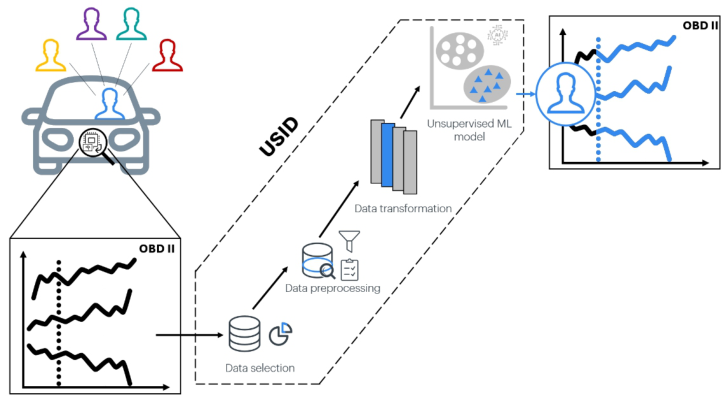
The USID concept is inspired by the known Knowledge Discovery in Databases (KDD) process (Flawley et al., 1992). In general, a vehicle can be controlled with different drivers during its exploitation. Regardless of the driver, the OBD II system internally monitors and diagnoses different pollu- tion and propulsion-related systems. This represents the input for the USID concept. Correlating to the KDD, the USID integrates different steps of data processing, such as data selection, data preprocessing, data transformation, and the model at the end (see Figure 1). In the first step, the scale of the data is reduced to the most relevant parameters, before being preprocessed. After preprocessing, the transformation of the data takes place according to the
USID - Unsupervised Identification of the Driver for Vehicle Comfort Functions 145
unsupervised ML model later used. Finally, the transformed data goes into the model that gives the knowledge about the driver identification. Each step of data processing in USID contains the driver information, which is exploited using the data processing methodology previously noted for clear reasoning of driver identification.
Figure 1: USID concept for unsupervised ML driver identification.
PROPOSED METHODOLOGY The data used to prove the USID concept came from the open-source database published in Barreto (2018). The original data contains a total of 9,261 rows from 28 parameters recorded from the OBD II port, making it a viable source for the machine learning models. The vehicle Chevrolet S10 2.5l was used with 16 different drivers on one route with a length of 18.8km. The data has been already uniformly sampled. Additionally, the mentioned dataset was extended with additional features like longitudinal acceleration and jerk. Longitudinal acceleration and jerk of a vehicle are generated as a first and second time derivative of the vehicle speed signal. This was already proven to give good results in the related research (Enev et al., 2016), therefore it is expected to give similar results with unsupervised driver identification models.
In the initial phase of the proposed process pipeline, the data quality checks were performed with the purpose of identifying and addressing outliers to avoid any potential distortions in model inferences. In the first iteration, basic preprocessing took place, unnecessary column information and rows with empty cells were removed, together with low-variance data. Following, the rough filtering was done with statistical outliers that were detected and removed for the majority of features using quantiles.
Next to the preprocessing, data normalization was done. In order to ensure the relevance of our time sequence comparisons across a diverse range of
146 Vuˇcini´c et al.
driving contexts, drivers, and vehicles, we utilize global normalization tech- niques incorporating physical signal boundaries. With that in mind, the global physical limitation of the OBD II parameters, defined with the SAE Standard J1979-DA (2017), are combined with the min-max normalization method.
Feature selection is an important step in data processing using machine learning methods. In this case, it involves identifying and selecting the most relevant and informative OBD II parameters from the dataset, while discarding the features that could harm the performance of future USID unsupervised machine learning models. By selecting the most applicable features, redundant or irrelevant data are removed, reducing the dimen- sionality and computational heaviness of the USID. In this work, a filter- based feature selection method, the SelectKBest, was used. The goal was to select the 10 best features that can represent the 16 drivers during their driving cycles. The result of feature selection narrows down to engine coolant temperature, fuel level, ambient air temperature, latitude, longi- tude, altitude, engine rpm, air intake temperature, vehicle speed, and timing advance. To validate the meaningfulness of the feature selection, the fea- ture correlation was checked using Spearman’s rank correlation statistical method.
Upon choosing the most relevant features from the dataset, the data trans- formation involves altering the selected features to ensure they improve their interpretability later with the ML model. In this specific case, the Uniform Manifold Approximation and Projection (UMAP) method was used to reduce the dimensionality of the data, in order to streamline the dataset further, reducing noise and computational load while retaining the driver identifi- cation information. The UMAP is a nonlinear dimensionality reduction tech- nique used for embedding high-dimensional data into a lower-dimensional space while preserving the underlying structure and relationships within the data points (McInnes, Healy and Melville, 2018).
Sliding windows represent a fundamental technique in time series analy- sis, enabling the transformation of continuous time series data into discrete manageable subsets suitable for both supervised and unsupervised learning approaches. A window is defined by its length w which moves over the dataset with a stride s. The temporal data stream is effectively segmented into coherent chunks. Local patterns are intricately encoded within the sequence of data, reflecting not just individual data points but the temporal context they inhabit. In this research, a window length of w = 30 with a stride of s = 1 is used. For the mentioned dataset this results in 6636 windows. Win- dows with undefined driver affiliations were neglected due to a lack of back traceability.
Besides the clustering itself, an autoencoder, presented in section Model Training, is used to compromise the time windows into one single temporal dimension. By encoding the temporal dynamics into a one-dimensional rep- resentation, the autoencoder reduces the convolution while preserving the essential information.
USID - Unsupervised Identification of the Driver for Vehicle Comfort Functions 147
MODEL TRAINING To ensure the highest possible performance of the USID, four different unsupervised machine learning methods were used, k-means, autoencoders, density-based spatial clustering, and self-organizing maps. These methods were chosen due to their diverse methodologies, in order to capture various data structures and driver patterns.
The k-means clustering is an unsupervised machine learning algorithm used to partition a dataset into K distinct, non-overlapping clusters. In the case of this research, the K represents the number of drivers that are to be identified, 16 in total. The output of the k-means model is the predicted driver ID, for each time sequence. The success of this model depends highly on the quality of data processing done previously, especially the data transformation step. If the dimension reduction technique manages to separate the OBD data of each driver in non-overlapping order, the k-means would find the fitting centers of each driver successful. The best results after multiple iterations of training and validating, gave the k-means with 16 centroids, training iner- tia set to 10 with 10,000 maximal iterations, and removed randomness of training.
Autoencoders’ self-supervised nature makes them a suitable choice to extract relevant features or to cluster input sequences. Therefore, the autoen- coder can be trained without any labels (Tavakoli et al., 2020). With two one-dimensional convolutional neural network layers and one linear layer the encoder compromises the input dimension from (w, f) to (e), where w is the window length, f is the number of features and e is the dimension of the embedding space. Besides the direct clustering, the embedding layer can be used as input for following clustering approaches while containing the intri- cate patterns of a time series sequence. An embedding space e of 32 is used for embedding time series sequences. For direct clustering, e corresponds to the number of driver IDs and is therefore 16.
DBSCAN is a clustering algorithm designed to uncover clusters in noisy and irregularly shaped datasets. Unlike other clustering methods like k- means, DBSCAN does not rely on a fixed pre-set number of clusters. It defines two parameters, eps, and min-samples. Eps determines the maximum distances within data points that are considered neighbours. Min-samples specify the minimum number of data points within eps distance to define a dense region (cluster). From a seed data point clusters are iteratively expanded to include all direct or indirect reachable data points within the eps distance, forming dense regions. Data points that remain unreachable or do not meet the density criteria are considered outliers (Ester et al., 1993). For the USID evaluation, 0.44 is used for eps and the number of min samples is 10. The distance is based on an Euclidean distance computed.
Self-organizing maps (SOMs) are a type of artificial neural network that excels in the field of unsupervised machine learning. Introduced by Teuvo Kohonen in the 1980s, SOMs are unique in their ability to transform high- dimensional data into a simplified, two-dimensional representation, often referred to as a map or grid (Ritter and Kohonen, 1989). For the purpose of driver identification, the shape of the SOM used is (16, 1). Each neuron in
148 Vuˇcini´c et al.
the SOM is responsible for recognizing a cluster representing one driver. The training of the SOMs consisting of 250,000 iterations was conducted using specific hyperparameters chosen to achieve optimal results. The parameters include a sigma of 0.7, a learning rate of 0.25, and a neighbourhood function set to ‘Gaussian’.
In order to transparently evaluate the models used for USID concept, var- ious external evaluation metrics are used to compare real driver ID with assigned values output by classification models. These vary from pair count- ing metrics, entropy-based metrics, and set-matching-based metrics. Three pair counting metrics were used for evaluation, rand index, adjusted rand index, and Fowlkes-Mallows index. The entropy-based metric used in this research is normalized mutual information (NMI), and it represents the sim- ilarity of clusters by measuring how much information is shared between the clusterings. The last used metric is purity which quantifies the degree of homogeneity in the clusters, without investigating their relationship.
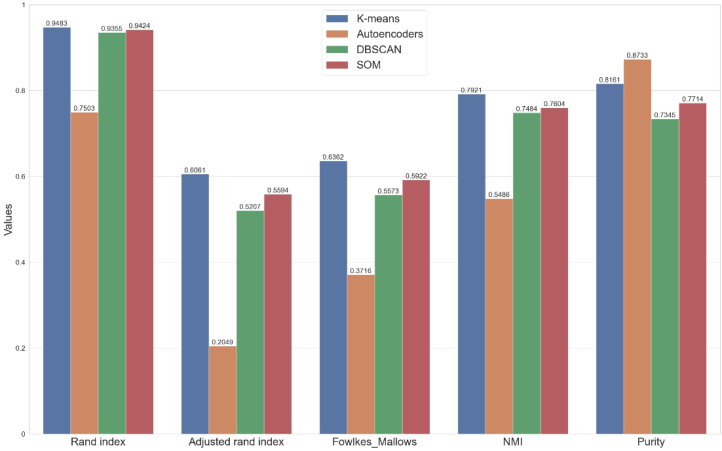
Compared evaluation based on the mentioned criteria is shown in Figure 2. The rand index and adjusted rand index vary from −1 to 1. Other metrics range from 0 to 1, with 1 denoting the highest achievable quality and the proximity to 0 indicating a decrease in each model’s quality. The results from the figure show that the driver can be successfully identified with unsuper- vised ML models and promises the success of the USID concept. The two best models on this dataset turned out to be the k-means clustering and SOM, slightly ahead of DBSCAN. They dominate in every metric, except the purity of the clusters, where autoencoders are on the top. Regardless of their purity, the autoencoders didn’t show great results in other metrics.
Figure 2: Comparation of performance of different unsupervised ML models used for USID.
USID - Unsupervised Identification of the Driver for Vehicle Comfort Functions 149
EXPERIMENTAL ANALYSIS The goal of the USID is to identify the driver with the data available already in vehicles. The main feature is its capability to assign the driver ID to the group of data, later interpreted as a driver identification, without using the label of the driver. Additionally, the concept is expendable to the any number of new drivers seamlessly without requiring new labeled data to be fed to the model, due to its unsupervised characteristics.
In order to do the quantification of the concept, besides the evaluation of the models shown previously, the authors have done the experimental analy- sis. For this purpose, the USID confidence coefficient (Ucc) is proposed. The USID confidence coefficient represents how confident the model is, varying from 0 to 1, in detecting the right driver during the driving cycle, see Equa- tion 1. The equation represents the dependency of the coefficient from the OBD II data index xd during the driving cycle. On the left side, the vari- able xs is number of data indexes for which each driver has been successfully identified so far. The constant x∗
d is the specific data index after which the Ucc gains relevance. The x∗
d is to be selected according to the requirements of the comfort function used with USID, more specifically it defines how flexible the comfort function is towards the driver identification error. The filtering based on a first order system was used for the first x∗
d OBD II data indexes, explaining the right part of the equation. This was done to remove false confi- dence information at the beginning due to the low total number of messages processed, rendering every driver ID decision before x∗
d useless. The USID confidence coefficient is specially designed for use in comfort functions since the variable can be differently interpreted with various comfort functions. Comfort functions like ride comfort require a high degree of confidence in driver identification to apply their functionalities and not as early, while only a medium level of identification is needed in most thermal comfort functions at the start of the driving cycle.
!
xd
4xd x∗ d
= xs
1 −e −
x∗
;
Ucc
= Ucc
xd
; xd ≥x∗
xd
d ∧Ucc d xd
xd < x∗
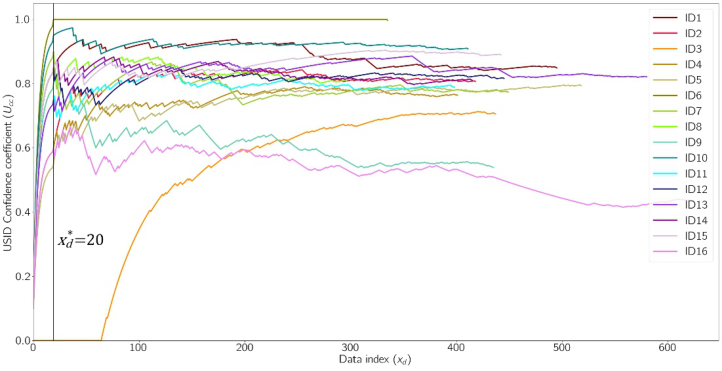
d (1) The experiment is done in such a way that the OBD II data stream from the driving cycles of each driver is inserted into the USID, and the change in Ucc is calculated. The SOM is used as the unsupervised model of USID in the experiment, and the value for x∗
d is picked 20. In this specific case, the frequency of data is 1Hz, and therefore x-axis can be represented as time in seconds with the same labels. The results show the variance of the confidence coefficient for each driver during the time of driving cycle is in the range from medium to high, see Figure 3. The Ucc for majority of drivers is in the range of 0.7 to 0.9, showing the very good confidence of models in detecting the driver and success of USID, even during the early stages of the driving cycle. Outside of this range are the perfect confidence in driver ID6 identification, and the lower confidence of drivers ID9 and ID16 between 0.4 and 0.6 after the 200th data index.
150 Vuˇcini´c et al.
Figure 3: Results of experimental analysis.
CONCLUSION
This paper proposes the USID concept, which deals with the identification of the driver using unsupervised ML techniques, for the purpose of com- fort functions. The architecture of the USID is shown in detail. The proposed USID seems suited to adapt to changes in driver behaviour over time, making it a more versatile approach for long-term driver identification. By not requir- ing labeled data, it simplifies data collection and model training, marking it a practical choice for applications such as comfort functions. These advantages position USID as a promising solution for driver identification in pursuing personalized comfort functions in vehicles.
The results revealed success in the evaluation of USID, with an OBD II dataset of 16 different drivers in one vehicle. Different models were used to validate the concept, where the best results gave k-means and SOM, ahead of DBSCAN and autoencoder models. Covering the 16-driver scenario proposed, the USID with SOM proved capable of coping with the driver identification requirements for comfort functions. The introduced USID con- fidence coefficient of the driver showed very good overall confidence of the predicted driver during the driving cycles of each driver. The findings outlined suggest that the practical implementation of the USID concept in identifying multiple drivers through unsupervised machine learning models with a high level of confidence is achievable.
REFERENCES
Barreto, C. A. S. (2018). “Kaggle OBD-II datasets.”, [Online]. Available: https://ww w.kaggle.com/datasets/cephasax/obdii-ds3 (visited on 09/29/2023). Bloecher, H. L., Dickmann, J., & Andres, M. (2009, September). Automotive active
safety & comfort functions using radar. In 2009 IEEE International Conference on Ultra-Wideband (pp. 490–494). IEEE.
USID - Unsupervised Identification of the Driver for Vehicle Comfort Functions 151
Enev, M., Takakuwa, A., Koscher, K., & Kohno, T. (2016). Automobile Driver Fingerprinting. Proc. Priv. Enhancing Technol., 2016(1), 34–50. Ester, M., Kriegel, H. P., Sander, J., & Xu, X. (1996, August). A density-based algo-
rithm for discovering clusters in large spatial databases with noise. In kdd (Vol. 96, No. 34, pp. 226–231). Frawley, W. J., Piatetsky-Shapiro, G., & Matheus, C. J. (1992). Knowledge discovery in databases: An overview. AI magazine, 13(3), 57. Girma, A., Yan, X., & Homaifar, A. (2019, November). Driver identification
based on vehicle telematics data using LSTM-recurrent neural network. In 2019 IEEE 31st International Conference on Tools with Artificial Intelligence (ICTAI) (pp. 894–902). IEEE. Guinea, M., Stang, M., Nitsche, I., & Sax, E. (2021). Acceptance of Smart Automated Comfort Functionalities in Vehicles. In Human Interaction, Emerging Technolo- gies and Future Applications IV: Proceedings of the 4th International Conference on Human Interaction and Emerging Technologies: Future Applications (IHIET– AI 2021), April 28-30, 2021, Strasbourg, France 4 (pp. 331–338). Springer International Publishing. Kern, D., & Schmidt, A. (2009, September). Design space for driver-based auto-
motive user interfaces. In Proceedings of the 1st International Conference on Automotive User Interfaces and Interactive Vehicular Applications (pp. 3–10). Khan, M. A. A., Ali, M. H., Haque, A. K. M., & Habib, M. T. (2022). A Machine Learning Approach for Driver Identification Based on CAN-BUS Sensor Data. arXiv preprint arXiv:2207.10807. Kwak, B. I., Woo, J., & Kim, H. K. (2016, December). Know your master: Driver
profiling-based anti-theft method. In 2016 14th Annual Conference on Privacy, Security and Trust (PST) (pp. 211–218). IEEE. Lahlou, A., Ossart, F., Boudard, E., Roy, F., & Bakhouya, M. (2020). A real-time approach for thermal comfort management in electric vehicles. Energies, 13(15), 4006. Lahlou, A., Ossart, F., Boudard, E., Roy, F., & Bakhouya, M. (2020). Optimal
management of thermal comfort and driving range in electric vehicles. Energies, 13(17), 4471. McInnes, L., Healy, J., & Melville, J. (2018). Umap: Uniform manifold approximation and projection for dimension reduction. arXiv preprint arXiv:1802.03426. Ritter, H., & Kohonen, T. (1989). Self-organizing semantic maps. Biological cyber-
netics, 61(4), 241–254. Schaut, S., & Sawodny, O. (2019). Thermal management for the cabin of a battery electric vehicle considering passengers’ comfort. IEEE Transactions on Control Systems Technology, 28(4), 1476–1492. Sharma, R. C., Sharma, S., Sharma, S. K., Sharma, N., & Singh, G. (2021). Analysis
of bio-dynamic model of seated human subject and optimization of the passenger ride comfort for three-wheel vehicle using random search technique. Proceed- ings of the Institution of Mechanical Engineers, Part K: Journal of Multi-body Dynamics, 235(1), 106–121. Stang, M., Stock, S., Müller, S., Sax, E., & Stork, W. (2022, March). Development of a self-learning automotive comfort function: an adaptive gesture control with few-shot-learning. In 2022 International Conference on Connected Vehicle and Expo (ICCVE) (pp. 1–8). IEEE. Tavakoli, N., Siami-Namini, S., Khanghah, M. A., Soltani, F. M., & Namin, A.
S. (2020). Clustering time series data through autoencoder-based deep learning models. arXiv preprint arXiv:2004.07296.
152 Vuˇcini´c et al.
Uvarov, K., & Ponomarev, A. (2021, January). Driver identification with OBD-II public data. In 2021 28th Conference of Open Innovations Association (FRUCT) (pp. 495–501). IEEE. Van Ly, M., Martin, S., & Trivedi, M. M. (2013, June). Driver classification and
driving style recognition using inertial sensors. In 2013 IEEE Intelligent Vehicles Symposium (IV) (pp. 1040–1045). IEEE. Vehicle E E System Diagnostic Standards Committee (2017). “Digital annex of E/E diagnostic test modes,” in SAE Standard J1979-DA. DOI: 10.4271/J1979DA 201702. Xie, Y., Liu, Z., Liu, J., Li, K., Zhang, Y., Wu, C., Wang, P., & Wang, X. (2020). A
Self-learning intelligent passenger vehicle comfort cooling system control strategy. Applied Thermal Engineering, 166, 114646. Xun, Y., Liu, J., Kato, N., Fang, Y., & Zhang, Y. (2019). Automobile driver fingerprinting: A new machine learning based authentication scheme. IEEE Transactions on Industrial Informatics, 16(2), 1417–1426.
LISTED IN THE AHFE DIGITAL BOOKSTORE CATALOGUE
Explore the complete digital volume
Human Interaction and Emerging Technologies (IHIET-AI 2024): Artificial Intelligence and Future Applications
Read this individual research paper free through the original publisher, or explore the full digital proceedings book.
ISBN 978-1-958651-96-4
Explore this ISBN in the AHFE Bookstore ↗Listed in the July 2026 bookstore catalogue; search by ISBN to confirm current availability · Digital book purchase optional