Dimitrios Ziakkas, Anastasios Plioutsias, Ibrahim Sarikaya (2024). Workforce Planning in Aviation: The implementation of Artificial Intelligence in Recruitment. In: Human Interaction and Emerging Technologies (IHIET-AI 2024): Artificial Intelligence and Future Applications. AHFE Open Access, vol. 120, pp. 403–408. https://doi.org/10.54941/ahfe1004591
The International Civil Aviation Organization (ICAO) is responsible for international standards and recommended practices (SARPs) to unify aviation globally through regulations and practices with safety, security, efficiency, and green policy of the highest interest. One component of ICAO’s standards is the documentation required to be on board an aircraft, as stated in Article 29, which mandates crew members to carry their “appropriate licenses,” evidence for their competence, and required hiring documents. However, barriers persist to standardizing electronic personnel licensing. ICAO is developing the required technical specifications to implement and verify personnel licenses globally. To support this transformation, IATA (International Air Transport Association) encourages airlines, companies, and aviation organizations to innovate modern solutions, using artificial intelligence and machine learning (AI/ML) to optimize operational goals. A starting point to support this conversion to electronic personnel licensing is during the employee recruitment phase. This research project focuses on implementing a potential pilot recruitment EPL system on digital platforms using visual and graphic design tools with UI/UX considerations for airlines, companies, and aviation organizations. The project followed a SWOT analysis, Safety-Risk Assessment, Benefit-Cost analysis, Sustainability Assessment, and Management of Change, and presented a Functioning digital prototype. The emerging selected technologies are AI/ML following the EASA AI classification Roadmap 2.0 (2023). The application benefit is the offered organizational culture adaptability and Key Performance Indicators selection following a Lean Six Sigma approach. Cybersecurity is granted following multiple layers design - user approach. Finally, the project takes into consideration accessible design features.
The International Civil Aviation Organization (ICAO) is responsible for inter- national standards and recommended practices (SARPs) to unify aviation globally through regulations and practices with safety, security, efficiency,
and green policy of the highest interest (ICAO, 2022). These recommended practices and standards are outlined in annexes for Member States to be in accordance with and referenced when establishing federal regulations within the State’s civil aviation governmental body.
In 2022, ICAO provided an alternative option to a hard copy certificate using digital licenses under Electronic Personnel Licensing (EPL) for partici- pating States (Uniting Aviation, 2023). The world’s digital transformation has shifted society to easily accessible technology with rapid access to the internet and online resources from our fingertips (Hilbert, 2020). ICAO is taking steps toward paperless methods with current interim solutions for electronic per- sonnel licensing using QR codes, manual queries, and visual verification and envisions implementing a global standard with “Electronic personnel licenses on self-contained mobile electronic visual display devices” (ICAO, 2022).
However, barriers persist to standardizing electronic personnel licensing. ICAO is developing the required technical specifications to implement and verify personnel licenses (ICAO, 2022). At the same time, only a few coun- tries are participating in the development of an EPL system – Australia, Brazil, and China – operated domestically (Uniting Aviation, 2023). Other States do not have the framework and have yet to initialize the transition to per- sonnel licensing in the digital era. To support this transformation, IATA (International Air Transport Association) encourages airlines, companies, and aviation organizations to begin innovating modern solutions, using arti- ficial intelligence and machine learning (AI/ML) to optimize their operational goals (IATA, 2023).
A starting point to support this conversion to electronic personnel licensing is during the employee recruitment phase. Typically, prospective employees are requested to submit documents relevant to the applied position during their application process. For pilots, this includes but is not limited to their license(s), medical certificate, passport, and restricted radiotelephone oper- ator permit. Verification and qualification checks are performed manually by the organization’s human resources department to determine if the appli- cant meets the minimum qualifications for the position, and thus, becomes a lengthy procedure. Moreover, digital licenses may help airliners transition to competency-based training and assessment (CBTA), optimizing training hours and costs.
This research focus on the potential of a cutting-edge recruitment tool that has the ability to streamline and optimize the entire hiring process, resulting in enhanced efficiency and productivity. Additionally, the user interaction and experience (UI/UX) of an EPL in any digital format has yet to be explored, which is as equally important to the functionality of the application as it incorporates Human-Computer Interaction (HCI) to ensure an enjoyable user experience by processing and presenting relevant information to the user to accomplish a task (Booher, 2003). Hence, an EPL recruitment tool can be a stepping stone in digitalizing the aviation industry using a bottom-up approach through effective, efficient, and sustainable means.
This project thence addresses the prospect of implementing a potential pilot recruitment EPL system on digital platforms using visual and graphic
Workforce Planning in Aviation: The Implementation of Artificial Intelligence 405
design tools with UI/UX considerations for airlines, companies, and aviation organizations by addressing the following research questions:
1. What are ICAO’s requirements for pilot licensing? 2. What are the differences between ICAO requirements and other civil aviation authorities? (i.e., FAA, EASA, DGCA, CAAS, etc.) 3. What are the current challenges and plausible solutions to implementing the EPL? (Analysis) 4. What are the application(s) features that users can access and interact with? (Design) The deliverables of the project consist of the following:
SWOT analysis
Safety-Risk Assessment
Benefit-Cost analysis
Sustainability Assessment
Management of Change
Functioning digital prototype.
METHODOLOGY
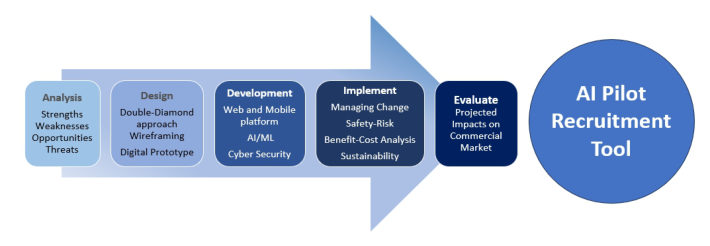
Purdue research team proposes to evaluate the role of the EPL in the aviation workforce planning process using qualitative and quantitative meth- ods (Branch, 2009). The ICAO recommended Analyze-Design-Develop- Implement-Evaluate (ADDIE) approach was selected for the EPL research project as presented in Figure 1.
Figure 1: Purdue ADDIE approach for aviation workforce planning.
The Purdue team has already successfully completed the following deliverables:
SWOT analysis
Safety-Risk Assessment
Benefit-Cost analysis
Sustainability Assessment
Management of Change
Functioning digital prototype.
The functioning digital prototype will be included as applied example in the content of the upcoming book “Implementation Guide of AI in Aviation Workforce Planning” which will be published in 2024.
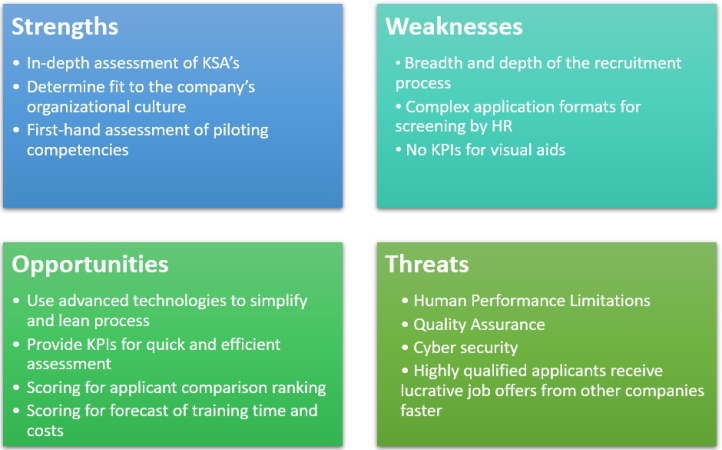
FINDINGS The strategic development of aviation workforce planning facilitates the sec- tor’s growth and progress. To ensure the long-term viability of commercial activities, it is crucial to assess a range of workforce variables, including but not limited to EPL psychological – aptitude, following a Competency Based Training and Assessment approach (CBTA, Ziakkas et al., 2023b). After a six-month analysis of airliners in a worldwide context, the Pur- due research team concluded in the following SWOT analysis regarding the implementation of EPL in the aviation ecosystem.
Figure 2: EPL research project SWOT analysis.
The Safety Risk Management included the AI implementation risks based on the Implementation Guide of AI in Aviation (Ziakkas et al., 2023c), focusing on GDPR and Cybersecurity challenges.
The Benefit – Cost Analysis is based on the initial partners network and it will be expanded after the release of the project for commercial use. The sustainability assessment is highly connected with the organizational culture and it will be customised.
ANALYSIS The primary purpose of the research is to evaluate the role of the Artificial Intelligence – Electronic Pilot License (EPL) process in an airline’s recruit- ment procedure for hiring pilots. There is a high significance for stakeholders
Workforce Planning in Aviation: The Implementation of Artificial Intelligence 407
relating to the aviation industry. Firstly, it has a high significance for academic literature, as the work done on the EPL process in airline workforce planning is limited, as sufficient literature has been collected in the given research. Sec- ondly, the research is highly significant for the industry, as it will benefit from the recommended practices instead of recruiting pilots by achieving higher efficiency.
CONCLUSION
To conclude, the ELP framework overcome problems and limitations inher- ent in human-provided workforce planning (Ziakkas et al., 2023a). The utilization of ELP, holds significant value within the realm of aviation train- ing and operations. This is vital for the workforce planning team, who may leverage the power of Artificial Intelligence (AI) in various dimensions, encompassing social, economic, and environmental considerations.
ACKNOWLEDGMENT
The authors thank faculty members of Purdue and Coventry University and aviators from Turkish Airlines for their invaluable feedback contributing to this work.
REFERENCES
Booher, Harold, ed. (2003). Handbook of human systems integration. New Jersey: Wiley. Branch, R. M. (2009). Instructional Design: The ADDIE Approach. Springer
Science + Business Media, LLC IATA. (2023). Competency Assessment and Evaluation for Pilots, Instructors and Evaluators. International Air Transport Association. (2023). IATA Pol- icy Position on Aviation Cybersecurity. Request for Action From Civil Aviation Stakeholders, Regulators and Authorities. https://www.iata.org/contentassets/f23f6fa53f6b4dff8178bf88102c9f09/acysec- industryposition-2023.pdf International Civil Aviation Organization. (2021). About ICAO. About ICAO.
https://www.icao.int/about-icao/Pages/default.aspx International Civil Aviation Organization. (2021). Personnel Licensing System (PELS). https://store.icao.int/en/personnel-licensing-system-training International Civil Aviation Organization. (2023). CBTA Instructional System
Design. https://www.icao.int/safety/OPS/OPS-Normal/Pages/CBTA-Instructional- system-design.aspx Uniting Aviation. (2023, March 22). The launch of ICAO’s Electronic Personnel Licence Verification Tool Set. https://unitingaviation.com/news/safety/the-launch- of-icaos-electronic-personnel-licence-verification-tool-set/ Ziakkas, D., Pechlivanis, K., & Keller, J. (2023a). The implementation of Artificial
Intelligence (AI) in Aviation Collegiate education: A simple to complex approach. Proceedings of the 6th International Conference on Intelligent Human Systems Integration (IHSI 2023) Integrating People and Intelligent Systems, February 22–24, 2023, Venice, Italy. https://doi.org/10.54941/ahfe1002863
Ziakkas, D., Sarikaya, I., Natakusuma, H. C. (2023b). EBT-CBTA in Aviation Training: The Turkish Airlines Case Study. In: Harris, D., Li, WC. (eds) Engineering Psychology and Cognitive Ergonomics. HCII 2023. Lecture Notes in Computer Science, vol. 14018. Springer, Cham. https://doi.org/10.1007/978-3-031-35389- 5_14 Ziakkas, D., Vink, L.-S., Pechlivanis, K., & Flores, A. (2023c). Implementation Guide
for Artificial Intelligence in Aviation: A Human-Centric Guide for Practitioners and Organizations.
LISTED IN THE AHFE DIGITAL BOOKSTORE CATALOGUE
Explore the complete digital volume
Human Interaction and Emerging Technologies (IHIET-AI 2024): Artificial Intelligence and Future Applications
Read this individual research paper free through the original publisher, or explore the full digital proceedings book.
ISBN 978-1-958651-96-4
Explore this ISBN in the AHFE Bookstore ↗Listed in the July 2026 bookstore catalogue; search by ISBN to confirm current availability · Digital book purchase optional