Yoshifusa Matsuura (2024). Awareness and Empathy in Self-Body Control for Manufacturing Skill Education. In: Affective and Pleasurable Design. AHFE Open Access, vol. 123, pp. 232–238. https://doi.org/10.54941/ahfe1004695
In this presentation, we will discuss the value of skills in the field of manufacturing and introduce a novel approach to effectively acquire skills by focusing on bodily movements. In recent years, the field of manufacturing has rapidly embraced digital transformation (DX). In particular, sensor and computer technologies have significantly advanced over the past decade. This has enabled the real-time acquisition of various physical information related to manufacturing, leading to a substantial increase in the parameters of models. Consequently, the precision of automatic control and robotic technology has greatly improved, facilitating the automation of complex manufacturing processes.However, the importance of human skills has become more pronounced amidst this digital revolution. Although DX ensures certain levels of precision and quality in production, digital information heavily relies on resolution and sampling frequency. Moreover, the number of parameters is finite. Many manufacturing processes involve environments that are not as stable as factory settings. In the pursuit of differentiation through high-precision, high-quality products, human skills are indispensable.Despite ongoing research on human skills in the context of DX, most prior studies have focused on skill evaluation, often framed as the "Expert-Novice Problem.” Evaluation methods assess the quality of end products and use motion capture or image analysis techniques to detect differences in skill movements across various stages. Subsequently, learners are expected to imitate the skill movements of experts, with post-evaluation feedback highlighting product defects and low-skill-level movements.Although imitation learning is effective to a certain extent, it presents limitations in achieving a mastery level of proficiency. To precisely control tools for manufacturing objects, learners must understand how to control their own bodies. Bodily control involves perceiving sensory information related to muscle activity timing, with the balance between body parts and tools collectively referred to as somatosensory information. Learning how to consciously utilize this somatosensory information while processing states during movements is crucial for skill improvement.Because somatosensory information is difficult to verbalize and exhibits an unclear relationship with skills, it has often been regarded as tacit knowledge. We therefore propose a skill information structuring method to clarify somatosensory information, presenting a support approach that encourages learners to be conscious of somatosensory information. This method facilitates mutual understanding between instructors and learners by sharing their respective mental images, enabling empathetic training. Our learning approach is expected to be effective not only for manufacturing, but other skills that involve bodily movements.
The authors of this study have been conducting research on new educational support methods for the crucial skills of skilled workers in manufactur- ing. However, in recent years, significant advancements in sensor, computer, and communication technologies have led to rapid Digital Transformation (DX) in the industrial manufacturing sector. By instantly transmitting large
Awareness and Empathy in Self-Body Control for Manufacturing Skill Education 233
volumes of design and manufacturing information over the internet and con- structing factories with identical manufacturing equipment in locations close to markets worldwide, the same products can be introduced into markets worldwide without any time lag. Various types of physical information in the manufacturing process can be acquired in real time, and the time required for control is significantly reduced, leading to substantial improvements in the accuracy of automatic control and robot technology, thereby facilitating the automation of complex manufacturing processes.
Will manufacturing skills become unnecessary in the near future? Although the introduction of DX enables the production of products with a certain level of precision and quality, the initial investment required is exceedingly large. Only a limited number of companies can afford such investments, and the introduction of DX is challenging without demand at a scale commensurate with investment. Furthermore, because the data handled are digital informa- tion, the accuracy and quality during manufacturing largely depend on the resolution and sampling frequency of the data, and the number of control parameters is finite. Therefore, it is difficult to respond to subtle changes that occur during the manufacturing process. Consequently, human skills are essential to pursue differentiation through high-precision, high-quality products.
Moreover, there are products for which these skills create value. For example, traditional crafts generate value through aspects such as materials, processes, regional characteristics, and history that contribute to the narrative of the product. Skilled craftsmanship plays a vital role in these processes and demonstrations by skilled craftsmen are often conducted at production sites. For instance, in recent years, knives produced using Japanese sword-making techniques, despite being expensive, have been purchased by many overseas travelers. This demand reflects not only the performance and beauty of the knives but also the value attributed to the skills of Japanese sword-making.
Therefore, this study proposes classifying manufacturing skills into four categories to clarify the research focus: (i) skills to be replaced by automa- tion in the future, (ii) skills that are technically difficult to replace, (iii) skills that create value, and (iv) traditional skills. Many existing studies on skills, though ostensibly aimed at skill inheritance, focus on (i). This is the so-called “skilled vs. novice problem,” where motion capture, image analysis tech- nology, and sensor technology are used to analyze the movements of skilled workers and determine the correlation between these analyses and the qual- ity evaluation of the final product. Based on these results, these skills may be automated in the future. Learners are expected to acquire skills by imitating the movements of skilled workers and repeating the imitation of movements with low-evaluation feedback, which may take a long time or be difficult to master.
Imitation learning has a certain degree of effectiveness, but has limitations in achieving mastery levels. To control the tools for creating objects accu- rately, learners must understand how to control their bodies. Controlling body parts involves perceiving sensory information related to the timing of muscle activity and balance between body parts and tools; these data are col- lectively referred to as proprioceptive information. Learning to consciously
234 Matsuura
utilize proprioceptive information and processing state during movement is crucial for skill improvement.
Proprioceptive information is difficult to verbalize, and its relationship with skills has been unclear and is often regarded as “tacit knowledge.” This study proposes a skill information structuring method to clarify pro- prioceptive information, and suggests a learning support approach to make learners aware of proprioceptive information during skill acquisition. Using this method, mutual understanding can be facilitated between instructors and learners by sharing their mental images, thereby enabling empathetic train- ing. This initiative is expected to be effective not only for skill acquisition in manufacturing but also for training various skills involving body movements.
Inheritance Issues of Manufacturing Skills As stated in the previous section, there remains a significant need for the skills of many individuals in manufacturing. However, little progress has been made in resolving skill inheritance issues. The causes for this lack of progress include: (a) the existence of “tacit knowledge” within information involving skills that involve physical movements, making it difficult to quantitatively measure and clarify standards; (b) the disparity between the proficiency of the skills to be inherited and the proficiency goals of the learners; and (c) the motivation decline in learners due to the impact of (b) on their subjective skill acquisition.
Regarding (a), as argued by the author previously, traditional learning involving physical movements related to skills tends to focus on imitating the “form” based on visual information, leading to the emergence of “tacit knowledge.” However, the “form” is the result of muscle activity to con- trol body parts. Therefore, the author has proposed the “Skill Information Structuring Method” (Matsuura, 2012) that involves conscious awareness of muscle activity during skill movements, linking proprioceptive information and body part movements perceived at that time with the quality of skills; they suggest using it as a new form of knowledge in skill learning.
Regarding (b), many skill education programs are based on the experi- ences of instructors, who are often unaware of the proficiency levels they aim to achieve in their teaching content. To train inexperienced learners, they often resort to imitating the instructions provided, making it difficult for the learners to recognize the information related to skill improvements on their own; thus, skill assessment by instructors becomes the primary focus, and learners are unable to pursue skill learning aimed at the desired proficiency levels. Consequently, as mentioned in (c), it becomes challenging for learners to be aware of their agency in skill learning, and their goal becomes simply to acquire the given tasks to meet the standards. As a result, their motivation to learn autonomously decreases, making it difficult for them to gain the ability to improve their skills on their own after acquisition.
Clarification of Proficiency Goals As a solution to the problem of disparities in proficiency goals for skills between instructors and learners, as discussed in the preceding section, we
Awareness and Empathy in Self-Body Control for Manufacturing Skill Education 235
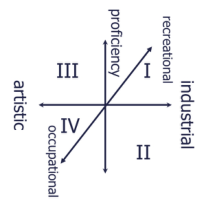
propose a Proficiency Goal Map for target skills. This map (Matsuura, 2023) is constructed along three axes: “Industrial-Artistic,” “Occupational- Hobby,” and “Proficiency.” From this map, we delineate the objectives of the skills to be taught.
Type I : Manufacturing Industry Practitioners --- Advanced skill profes- sionals, contemporary master craftsmen; Type II: Manufacturing Industry Practitioners --- General manufacturing skill workers;
Type III: Traditional Craft Practitioners --- Traditional craftsmen (Takumi), craft artists; Type IV: Craftsmen --- Producers of everyday items, workshop instructors. This approach enables learners to select the objectives of skill education, evaluation criteria, and standards autonomously, thereby fostering enhanced motivation.
Figure 1: Skill proficiency roadmap.
Manufacturing and Narratives In traditional skill education, the proficiency and skills that skilled practi- tioners wish to inherit are fundamental. Naturally, learners understand the significance of aspiring to achieve these goals; however, in the past, skill edu- cation methods that rely on imitation learning have made task completion the primary objective. Ideally, “skill inheritance”involves acquiring current skills and then developing new ones through exploration, adding value not only to the functionality and quality of products but also to the process of acquir- ing new skills. Products made in DIY or experiential workshops may lack market value, but due to the “producers = users” paradigm, they hold high value for users. By actively seeking information on design and production, individuals can become actively involved in manufacturing. Moreover, they understand their current level of skill proficiency, leading to a relatively high self-assessment of the quality of the final product. This assessment includes a narrative of the manufacturing process that contributes to higher satisfaction.
This aspect warrants consideration in skill education. Instead of instructor- led skill education programs, learners autonomously set goals to improve their proficiency using the proficiency goal map proposed in Section 3. Additionally, learners desire acknowledgment, wishing for instructors to understand what they have achieved, understood, and realized during the learning process; consequently, they feel the need to share their achieve- ments and seek validation from their instructors. By progressively setting
236 Matsuura
learning goals, it becomes possible to evoke narratives of learning from learners. Meanwhile, instructors gain insights into what learners focus on and how they evaluate their skills. Initially, instructors and learners “dis- cuss” the proficiency levels they aim for using the proficiency goal map; by “narrating” while being conscious of bodily movements and propriocep- tion based on structured skill information, instructors evaluate proficiency. Continuous engagement in dialogue enables the active verbalization of skill information, sharing information with instructors and other learners, gaining empathy, maintaining motivation, logically contemplating skill mechanisms, and achieving significant learning outcomes.
Differences in Subjective Evaluation Between Instructors and Learners and Their Impact on Empathy Empathy is defined as “the ability to observe the state of a general communi- cation partner and infer their psychological state.” However, in this study, it is defined as “a state in which individuals become aware of information when exposed to similar stimuli from the environment, triggering the same sen- sory organs and experiencing high similarity in the imagery recalled by that information.” To achieve this empathy in skill education involving bodily movements, it is necessary to be conscious of and clarify the propriocep- tion during bodily movements in the target skill and the factors influencing movement during skill evaluation.
However, in traditional skill education methods, learners imitate instruc- tors’ bodily movements based on visual information, focusing on acquiring procedural information regarding bodily movements. On the other hand, instructors have criteria that influence the evaluation of outcomes; how- ever, apart from general criteria, evaluations tend to be subjective, varying from instructor to instructor. Therefore, the subjective evaluation crite- ria for learners and instructors differ significantly, which makes empathy challenging.
In skills involving bodily movements, proprioception, the self-awareness of changes accompanying bodily movements felt internally (hereafter referred to as proprioception), is crucial educational information. Individuals accu- mulate a wealth of subjective information from their experience with bod- ily movements. Expressing this evaluation without distinguishing between verbal and nonverbal cues allows for a comparison of subjective evalua- tions between instructors and learners, clarifying both commonalities and differences.
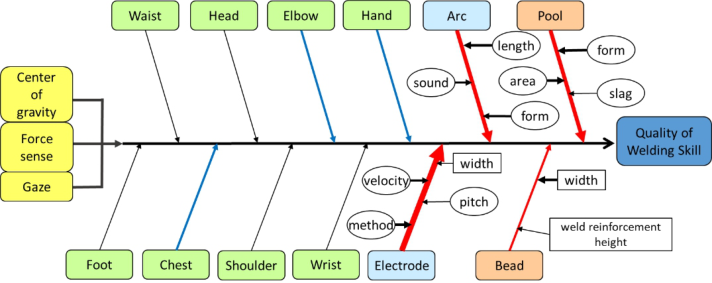
Thus, the skill information structuring method proposed by the author distinguishes demand characteristics from skill quality and categorizes the direct factors influencing skill quality, indirect factors related to direct fac- tors, and bodily factors. Moreover, proprioceptive factors related to bodily control are exceptionally critical factors that influence direct factors but have been largely overlooked thus far. Furthermore, based on these structured pieces of information, attentional factors during skill performance and crucial evaluation factors for quality are proposed.
Awareness and Empathy in Self-Body Control for Manufacturing Skill Education 237
By having learners and instructors evaluate information on attentional factors, evaluation factors, and proprioception on a skill evaluation board, a system is proposed to facilitate empathy between instructors and learners.
Figure 2: Fishbone diagram for welding skill information.
Proposal of an Education System Based on Empathy between Instructors and Learners In this study, empathy is defined not only as “the ability to observe the state of a general communication partner and infer their psychological state,”but also as “a state where individuals become aware of information when exposed to similar stimuli from the environment, triggering the same sensory organs, and experiencing high similarity in the imagery recalled by that information.” While the original educational goals of traditional apprenticeships and on- the-job training (OJT) were similar to the empathy described in this study, they have transitioned to educational systems that prioritize task comple- tion for manufacturing efficiency from an economic standpoint. The issue lies in the fact that learners need to recognize the causes of their own eval- uations during imitative learning, and instructors need to be aware of the learners’ trial-and-error processes, which are extremely challenging in the current system.
Especially in skill learning involving bodily movements, proprioception, i.e., the self-awareness of changes accompanying bodily movements felt inter- nally, is crucial educational information. Moreover, by verbalizing and visu- alizing these two systems of sensory information, the “empathy” described in this study can be achieved.
Therefore, the skill information structuring method developed by the author applies factor analysis to quality engineering methods to clarify the relationships between the factors contained in skill information. It describes demand characteristics as skill quality and lists the direct factors influenc- ing skill quality, indirect factors related to direct factors, and bodily factors, in that order. Additionally, proprioceptive factors concerning how to con- trol the body to manipulate tools are crucial as they directly influence direct factors.
238 Matsuura
Furthermore, based on this structured skill information, instructors first examine factors (attentional factors) for real-time monitoring of their own skill movements and evaluation factors crucial for quality. Then, by ana- lyzing the motion results captured externally through videos and motion capture, they introspect bodily movements and proprioception at that time and verbalize them.
Next, learners engage in movement learning based on instructor informa- tion and evaluate the information regarding attentional factors, evaluation factors, and proprioception. By documenting this information on an evalu- ation board, the promotion of awareness between instructors and learners, and the resulting empathy, can be achieved.
CONCLUSION
I believe that the value of “manufacturing” includes not only economic costs but also the thoughts, techniques, skills, and “consideration” for users by the producers. In this study, we propose categorizing skills into four categories to clarify the purpose of skill succession in manufacturing. The skills that indi- viduals should inherit involve bodily movements, making their acquisition difficult. A significant reason for this difficulty is the limitations of imitative learning in understanding and controlling one’s bodily state. Therefore, by utilizing the skill information structuring method developed by the author, it becomes possible to control one’s body by clarifying the proprioceptive infor- mation that involves awareness of body parts and muscle activities related to skills. Furthermore, by introducing real-time monitoring information and evaluation criteria during skill acquisition, learners can become aware of var- ious aspects of the skills they are learning, enabling them to internalize the knowledge and empathize with their instructors.
ACKNOWLEDGMENT
This work was supported by JSPS KAKENHI Grant Numbers JP18K1156, JP21K02740.
REFERENCES
Matsuura, Y. and Takada, H., (2012), Development of the Evaluation Proficiency Method on Welding Skill, The 26th Annual Conference of the Japanese Society for Artificial Intelligence. Matsuura, Y., (2023), Exploring the generation of self-directed learning behaviours
and their educational impact in manufacturing skill education, The Proceedings of the Technology and Society Conference. No. 23–75.
LISTED IN THE AHFE DIGITAL BOOKSTORE CATALOGUE
Explore the complete digital volume
Affective and Pleasurable Design
Read this individual research paper free through the original publisher, or explore the full digital proceedings book.
ISBN 978-1-958651-99-5
Explore this ISBN in the AHFE Bookstore ↗Listed in the July 2026 bookstore catalogue; search by ISBN to confirm current availability · Digital book purchase optional