Yoshifusa Matsuura (2026). Toward Autonomous Acquisition of Manufacturing Skills -The Importance of Awareness and Understanding of Embodied Cognition for Performance Improvement. In: Affective and Pleasurable Design. AHFE Open Access, vol. 204, pp. 245–254. https://doi.org/10.54941/ahfe1007350
In recent years, manufacturing industries have actively introduced IoT and AI technologies into automated and robotized production processes in order to promote labor reduction and unmanned operation. At the same time, a fundamental question arises as to whether equivalent products can be realized simply by sharing manufacturing models, data, and machinery. Design data and manufacturing models used in production are spatially and temporally discrete, and manufacturing equipment cannot achieve sufficient precision or quality merely by purchase. Consequently, fine adjustment by highly skilled and experienced engineers and technicians remains indispensable. On the other hand, there are products for which the “handmade” nature itself creates high added value. Traditional crafts, for example, derive their value from the fact that materials, manufacturing methods, tools, and product designs have remained unchanged over long periods of time. From this perspective, human skills will continue to play an extremely important role in the manufacturing domain. Based on this recognition, this study develops a methodology to support the learning of human motion skills, focusing on how learners perceive bodily movements that are critical to skill improvement, how they understand the relationship between skills and physical actions, and how such understanding can be facilitated as awareness during the learning process.
In recent years, the manufacturing industry has increasingly established production sites in close proximity to global markets, thereby enabling product localization and rapid product deployment through global supply chains. The integration of IoT and AI technologies into automated and robotized production processes has made it possible to manufacture products of comparable quality anywhere in the world, provided that the required production equipment and manufacturing data are available. In particular, high-resolution sensing and monitoring technologies, combined Received April 23, 2026; Revised May 25, 2026; Accepted June 10, 2026; Available online July 20, 2026
246 Matsuura with AI-driven automatic control based on big-data analysis, have enabled highly precise machining operations. These developments are accelerating labor-saving and unmanned manufacturing, ultimately aiming to achieve efficient production of high-quality products with advanced functionalities.
A fundamental question arises: why is labor-saving manufacturing and unmanned operation being promoted so extensively? Human-based operations inevitably exhibit variations in skill proficiency, resulting in inconsistencies in product accuracy and quality. Uniformity in precision and quality is essential for maintaining customer trust and has a significant impact on the market value of products. Furthermore, as regions surrounding major markets continue to develop, labor costs tend to rise, suggesting that the globalization of supply chains will further accelerate the shift toward labor-efficient and unmanned production systems.
This leads to another important question: will human expertise and craftsmanship become unnecessary in the future? The author argue that such skills will instead become a critical factor for differentiation among competing companies. While automated and robotized production systems are effective for manufacturing standardized and general-purpose products, achieving differentiation requires economies of scale, such as low-cost mass production or high market share. By contrast, incorporating advanced human skills and craftsmanship into the manufacturing process enables the creation of highly specialized and unique products, allowing companies to shift toward markets that demand higher added value.
In this paper, we first examine market requirements for products and the criteria that define product value. Based on these value criteria, we discuss which manufacturing skills contribute to value creation within production processes and analyze their significance. We then introduce methods developed by the author for supporting the autonomous acquisition of essential skills by skilled workers. Specifically, we present an approach for fostering awareness of embodied knowledge aimed at improving physical performance, as well as a quantitative feedback-based learning support system designed to facilitate the preservation and transmission of craftsmanship.
Market Requirements and Value Criteria for Products Historically, industrial manufacturing has evolved from cottage-based handicraft systems, in which a single artisan produced a finished product manually using tools, to proto-industrial workshop production characterized by task specialization, followed by a transition from manual craftsmanship to mechanized manufacturing, and eventually to automated and robotized production systems.
In this study, the author focuses on how the market has evaluated and demanded products with respect to four key dimensions: (1) basic functional performance, (2) quality, (3) production volume, and (4) standardization.
Toward Autonomous Acquisition of Manufacturing Skills 247 Fundamentally, across all historical periods, markets have required products essential to daily life to satisfy a minimum level of basic functionality at a low cost. However, products with inferior quality are eliminated from the market when offered at the same price point. Furthermore, even marginal improvements in design or basic functionality tend to result in higher market share. Under these market principles, manufacturers have been driven to pursue cost reduction through mass production while maintaining stable quality.
A critical challenge in this context lies in the strong dependency of basic performance and quality on the level of skill proficiency of individual workers. In cottage industries, products manufactured by highly skilled artisans were traded at premium prices, even when nominally categorized as identical products. As manufacturing technologies and tools developed and market demand expanded, the shift toward factory-based production necessitated countermeasures against skill-dependent variability. This led to the segmentation of tasks and the standardization of work processes. By decomposing tasks into smaller units, the amount of skill-related knowledge required by individual workers was reduced, thereby facilitating skill acquisition. Further standardization of components limited the range of techniques and skills that needed to be mastered, enabling the formalization and manualization of skills.
With the transition to mechanized industry, scientific and statistical analyses of production processes were introduced through approaches such as Scientific Management proposed by Frederick W. Taylor and Motion Study developed by Frank and Lillian Gilbreth. Collectively, these developments are based on the assumption that the basic functional performance and quality required in the dominant price segments of the product market should be met by uniform and generic products. From this perspective, human worker skill is treated as an uncontrollable source of variability, regarded as a major factor contributing to functional and quality degradation. Consequently, manufacturing systems adopted process standardization and averaging strategies aimed at eliminating waste and inconsistency (muda and mura). Subsequently, the integration of IoT and AI technologies enabled further automation and robotization, leading to labor-saving and fully unmanned production systems.
Thus, manufacturing has predominantly focused on targeting the largest market segments demanding products with standardized basic functionality and quality, a strategy that has persisted to the present day.
In contrast, highly skilled practitioners possessing advanced technical and tacit skills are capable of developing and producing artifacts that exceed the functional and quality standards of generic products. Although the market for such products lies in higher price ranges and is relatively limited in scale, differentiation can be achieved through the acquisition of cutting-edge technologies and the creation of scarcity-based value. Moreover, these products often embody additional values, such as aesthetic, artistic, or historical significance, thereby enabling forms of value creation unique to skilled practitioners.
248 Matsuura The following chapter discusses how manufacturing skills contribute to value creation and examines their significance in contemporary production systems.
Manufacturing Skills for Value Creation and Their Significance In the previous chapter, the historical background of labor division, automation, and robotization in manufacturing was discussed. Variability in workers’ skills has been recognized to affect product functionality and quality. Consequently, manufacturing processes have been transformed through scientific analysis into averaged and standardized operations that do not require skill acquisition, or alternatively, human operations themselves have been eliminated through automation.
On the other hand, in Japan, individuals who possess exceptionally advanced skills are traditionally referred to as Takumi (master artisans), and the products they create are characterized by extremely high functionality and quality. Moreover, highly skilled workers remain responsible for tasks such as the fine adjustment required to ensure stable operation of automated equipment and the final finishing processes of products.
Thus, although the digitalization of design and manufacturing data and control systems has been actively promoted in recent years, such digital information is spatially and temporally discrete. In actual manufacturing environments, even when digital data have high resolution, decoding through data interpolation is inevitably required. While it has become possible to measure machine states in real time using high-precision sensing devices, it is impractical to install sensors across the entire system, and each sensor typically corresponds to only a single physical parameter. As a result, sensors are deployed according to model parameters, and the overall system state is estimated using models based on the acquired physical data.
Although the number of parameters that can be handled has increased dramatically and simulation technologies have advanced significantly through the application of artificial intelligence, manufacturing, machine tuning, and quality control beyond the resolution of digital data remain difficult. Therefore, final judgment and fine adjustments continue to rely on highly skilled workers. This indicates that skilled practitioners are indispensable for the further development of manufacturing systems. If operations performed by skilled workers were completely eliminated, it would be possible to stably manufacture products with a certain level of performance and quality; however, further advancement beyond this level would be difficult to achieve.
It should be noted that the relationship between advanced manufacturing systems and skilled workers described above primarily applies to markets equipped with large-scale facilities and sufficient infrastructure. In the majority of global markets, cost is the dominant requirement, and the priority placed on functionality and quality is relatively low. Consequently, production is mainly carried out by low-wage labor, and high levels of operator skill are not strongly demanded in practice.
From this perspective, when examining the relationship between value creation in manufacturing and skills in relation to market demands, alternative forms of value creation based on different types of skills can be
Toward Autonomous Acquisition of Manufacturing Skills 249 identified. In advanced manufacturing technologies, skilled expertise plays a critical role in enhancing product functionality and quality. Automation and robotization are realized through adjustments and evaluations performed by skilled workers who establish reference standards for manufacturing machinery and measurement technologies. In other words, the value of these advanced skills lies in the ability to minimize variability to an extreme degree during manufacturing and measurement processes through highly refined sensory perception. There are factual cases in which companies capable of responding to extremely demanding customer requirements through such advanced skills have maintained global market share in niche markets.
Conversely, there also exist markets in which variability itself is regarded as a source of value. Handcrafted products, such as traditional crafts, are referred to as “one-of-a-kind” items and are highly valued for their originality. In this context, the value lies not in precise reproducibility, but in the embodiment of the maker’s momentary image and sensory perception through their individual skills. Furthermore, the process leading to materialization constitutes the maker’s “narrative,” and when this narrative is added as artistic value, the product attains high market value as an authorial or artist-created work.
Based on the above discussion, skilled practitioners will become increasingly important in future manufacturing; however, market demands and the corresponding value criteria for skills are highly diverse. Therefore, it is necessary to selectively identify skills that should be prioritized for transmission and to develop learning support methods that correspond to levels of skill proficiency based on the information structures comprising those skills. From the next chapter onward, based on the skill-structuring methodology proposed by the author, a learning support system designed to elicit learners’ awareness of information critical to skill acquisition will be described.
Awareness Required for Learners to Acquire Skills Autonomously In conventional research aimed at educational support for skill acquisition, the primary objective has been to evaluate skill proficiency by having expert instructors compare data obtained from novices with that of skilled practitioners. With recent advances in motion analysis systems, it has become possible to quantitatively assess a learner’s proficiency level, as well as to identify the degree of difference between learners and experts across specific evaluation metrics. However, many of the evaluation items employed in such studies are selected based on whether they are measurable or whether differences in proficiency can be discriminated through analytical models.
As a result, learners themselves are often unable to understand the underlying causes of the evaluation outcomes or how the measured data contribute to the assessment. Naturally, without knowing what aspects should be consciously addressed during training, learners are forced to rely solely on imitation learning and trial-and-error processes. In this context, the author posit the following conceptualization of human movement: bodily motion is generated through the balance of output between agonist and antagonist muscles; “form” represents the musculoskeletal state at a given moment and is determined by the manner of muscular activation. Accordingly, the term
250 Matsuura “good” or “clean form,” which is frequently used as an evaluative descriptor for skills involving bodily movement, can be interpreted as the result of appropriate agonist–antagonist muscle coordination that enables precise control of the body segment relative to the target task.
Based on this conceptual framework, it becomes critically important to support learners in understanding how they should control their own bodies in order to acquire a given skill. In particular, training must focus on fostering learners’ awareness of what they should attend to during movement execution and what types of bodily sensations are experienced while performing the skill. When instruction relies solely on instructors teaching from their own expert perspective and evaluating learners against that benchmark, opportunities for learners to engage in an autonomous skill acquisition process are limited. Simply aiming for automation of motor actions through imitation and repetitive practice does not provide learners with sufficient opportunities to acquire knowledge of the underlying mechanisms governing their own bodies, tools, and target workpieces. This represents a fundamental limitation of imitation-based learning. Furthermore, learners’ intrinsic motivation—specifically, how far they personally aim to advance their skill level—has a significant influence on learning outcomes.
Therefore, in motor skill learning, it is essential to make learners aware of how they should control their bodies to successfully acquire the skill. In this study, using the proposed skill information structuring methodology, “direct factors” that have an immediate effect on the quality of the skill outcome are quantitatively measured. Simultaneously, learners are guided to become consciously aware of the associated body control information and somatosensory information experienced during tool or equipment operation. This process is intended to elicit learner awareness. After each trial, the quantitatively measured direct factors are immediately presented to the learner, while the two aforementioned types of qualitative information— consciously attended body control and somatosensory cues—are recorded and compared against the quantitative data.
Similar to systems such as TrackMan and Rapsodo used in Major League Baseball (MLB), which instantly measure, analyze, and present ball trajectories after pitching or batting practice, the proposed skill learning support system enables immediate comparison between the factors consciously attended to during movement execution and the somatosensory information perceived, relative to quantitative performance evaluations. By explicitly supporting this comparison, the proposed system facilitates skill learning as a process of transforming quantitative metrics and qualitative sensations—that is, an Analog–Digital conversion within skilled performance. This explicit support for linking machining accuracy with sensory perception, and product evaluation with bodily control, constitutes a highly novel contribution to skill learning support systems in manufacturing contexts.
A Novel Skill-Learning Support System for Enhancing Awareness of Bodily Movements As explained in the previous chapter, enabling learners to become aware of how to control body segments involved in manufacturing skills is crucial for fostering autonomous skill learning. Autonomous learning requires the
Toward Autonomous Acquisition of Manufacturing Skills 251 activation of learner motivation; without sufficient motivation, learners cannot take an active role in the learning process. In skill acquisition, improving motivation strongly depends on learners gaining understanding and awareness of the relationships between bodily movements and the operation of machines or tools that directly affect skill outcomes during practice.
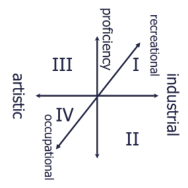
To address this issue, the skill proficiency target map proposed by the author allows learners to proactively select learning objectives as well as corresponding evaluation items and criteria. This learner-centered selection process is expected to enhance motivation and engagement in skill learning.
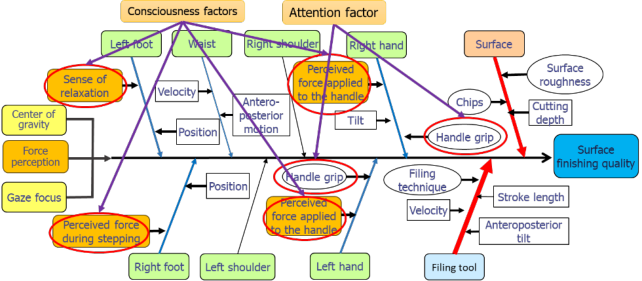
Next, using the skill information structuring method developed by the author, a fishbone diagram for file skill information is constructed. Based on expert advice, learners identify which bodily movements and related sensory information are critical for achieving the target proficiency level. In the following, a skill learning case study of a metal rod filing task conducted in this study is presented.
A skilled worker with over 30 years of experience provided the following comment: “A file is a cutting tool. One should imagine how the teeth of the file are cutting into the material. Moreover, cutting occurs only in the pushing direction.” This statement, which is not found in conventional instructions or textbooks, provided a novel insight incorporating embodied knowledge. Based on this insight, a skill factor diagram was generated as shown in Fig. 1(Matsuura, 2024).
Figure 1: Skill factor diagram.
The direct factors were defined as evaluations related to the “machined surface,” such as cutting depth, surface roughness, and the amount of metal chips generated. Indirect factors consisted of evaluations related to file operation: quantitative parameters included velocity and stroke length, while qualitative parameters included the filing method. Body-related factors included both quantitative evaluations—such as position and movement velocity of both hands, shoulders, waist, and feet—and the sense of force, which is treated as a key factor in this study. In particular, how force is applied to the file handle and what tactile sensations are perceived through the handle during operation were explicitly included as evaluation items to be described by both expert and learner. This treatment of force perception and tactile feedback constitutes a distinctive feature of the proposed method. Additionally, factors such as coordinated movements of the waist and both arms, the sensation of stepping with the right foot, and relaxation of the left foot were identified as attention and evaluation factors through interviews based on the fishbone diagram for file skill information (Fig. 2) (Matsuura, 2023).
Figure 2: The fishbone diagram for file skill information (Matsuura, 2025).
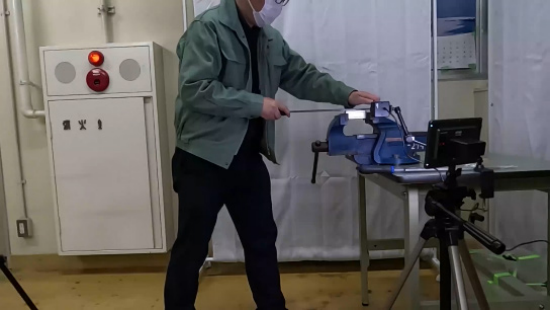
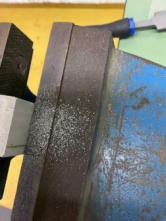
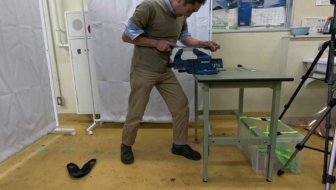
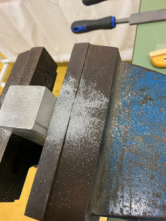
In practice, the author first conducted self-directed learning as a learner, using existing literature related to filing operations. Referring to photographs in the literature, the author attempted the task by paying attention to the distribution of force between the left and right hands while moving the file from the near side to the far side (Fig. 3). Although conscious effort was made to balance the force applied by both hands, very little metal debris was produced (Fig. 4). After the trial, it became apparent that no attention had been paid to the positioning or use of the feet during the operation.
Figure 3: Manual filing operation performed by the author (learner-level execution).Figure 4: Material chips generated during the manual filing operation.
Toward Autonomous Acquisition of Manufacturing Skills 253 Subsequently, an expert demonstrated the task. A key observation was that the expert positioned the head almost directly above the cutting area, allowing the weight of the upper body to be efficiently transmitted from the upper arms through the hands to the file. This realization was obtained after the experiment through analysis using the skill factor diagram, expert interviews, and direct observation. As a result, it was inferred that force was transmitted in a well-timed manner from the right foot stepping motion and relaxation of the left foot, through the upper arms, to the workpiece (Fig. 5). Consequently, the amount of metal chips generated was several times greater than that produced by the learner (Fig. 6).
Figure 5: Manual filing operation performed by an expert practitioner (skilled execution).Figure 6: Material chips generated during the manual filing operation.
Based on this insight, the learner conducted additional interviews with the expert, obtaining the following comments: Position the head as close as possible to the cutting area. Ensure that the file handle contacts the pad of the right thumb, and perceive the reaction force from the cutting surface through that contact point.
Step firmly with the right foot while relaxing the left foot. The file position and force distribution illustrated in literature are rarely consciously considered during actual operation.
The learner then conducted another trial. Although improvement was still incomplete, the head position was closer to the cutting area, and filing motion utilizing the weight of the upper body was achieved. The amount of metal chips generated increased significantly compared with the self-directed learning trial. Furthermore, by deliberately focusing
254 Matsuura attention on the tactile sensation between the file handle and the palm, the learner became able to perceive and recognize the “state of the metal being cut.”
CONCLUSION
In contemporary manufacturing industries, rapid progress toward labor- saving and unmanned production systems is being pursued through the introduction of IoT technologies and artificial intelligence into automated manufacturing processes. However, when market requirements are taken into account, there are still many situations in which production must economically rely on the skills of human operators. In addition, there exist products whose value lies in the skills themselves, as advanced skills enable the manufacture of products with higher functionality and higher quality. Therefore, such skills remain critical elements that must continue to be transferred and preserved.
Skills that generate high value are characterized by how skilled operators evaluate the processing state during tool or machine operation and how they control their own bodies in real time in response to that evaluation. These skills involve close integration of perception, judgment, and motor control during manufacturing tasks. However, strict reproduction of such skills by current automated manufacturing systems based on existing sensor technologies and AI remains infeasible.
Accordingly, based on the skill information structuring method and skill factor diagrams previously developed by the authors, this study developed a learning support approach that intentionally activates learners’ awareness and adapts to individual differences in bodily characteristics and sensory states. As future work, we plan to develop and experimentally validate a system that presents immediate quantitative evaluations of skill performance to learners while organically integrating learners’ awareness-related information, thereby enabling more effective skill acquisition.
REFERENCES
Matsuura, Y., (2023), A Skill Training Method Aiming at Empathy for Body Movements in the Manufacturing Industry, Affective and Pleasurable Design, Vol. 71, 2023, 120–128. Matsuura, Y., (2024), Awareness and Empathy in Self-Body Control for Manufacturing
Skill Education, Affective and Pleasurable Design, Vol. 123, 2024, 232–238. Matsuura, Y., (2025), A study on learning support for filing skills -the influence of cutting sensation on finish evaluation-, Proceedings of the 45th SIG-SKL, Japanese Society for Artificial Intelligence, SKL-45-04.
LISTED IN THE AHFE DIGITAL BOOKSTORE CATALOGUE
Explore the complete digital volume
Affective and Pleasurable Design
Read this individual research paper free through the original publisher, or explore the full digital proceedings book.
ISBN 978-1-964867-80-9
Explore this ISBN in the AHFE Bookstore ↗Listed in the July 2026 bookstore catalogue; search by ISBN to confirm current availability · Digital book purchase optional