This paper explores the craft of ceramic pottery wheel throwing, specifically preserving and transmitting the embodied knowledge required during the early stages of the process. The study introduces an augmented reality (AR) prototype that provides real-time visual guidance through an overlay aligned with the user’s own hands while throwing on the wheel. The prototype is designed to support motor learning without disrupting the tactile and material qualities of the traditional craft. To evaluate its effectiveness, the prototype is validated by experienced ceramicists and tested through beginner participants in a comparative study (AR vs YouTube). Results indicate that experts do not have additional confidence in effectiveness for beginners with the AR prototype. There is a substantial variability with transmission and execution of ceramics techniques. Additionally, the use of mobile based AR faced difficulties due to the physical obstruction currently present. In the comparative beginners study, the YouTube approach was perceived as more clear. While the AR prototype as more flexible and providing increased spatial awareness.
The growth of media technologies and maker culture has expanded craft learning from instructor-guided workshops to diverse self-directed approaches. However, mastering crafts such as ceramics remains challenging due to their embodied nature and the difficulty of tacit knowledge transfer (Ji et al., 2025a). This work was carried out as part of the Tracks4Crafts project, supported by the European Union under the Horizon Europe 2022 programme (Policy Brief | Tracks4crafts, 2022). This project has preservation of crafts as one of its main drivers. This paper focuses specifically on throwing clay on a potter’s wheel, a fundamental activity within the craft of ceramics. Nowadays, in addition to in-person instruction, numerous online tutorials, particularly on YouTube are available. Compared to books, video tutorials offer not only technique but also posture, movement, and the personal experience of the ceramicist. Despite their flexibility, these learning tools have clear limitations. Books lack spatial reference, and videos do not provide real-time feedback or complete spatial insight. Furthermore, neither medium adequately conveys pressure, force, or movement direction. Augmented
Reality (AR) could offer visual instructional overlays, while interaction with the material remains intact. Potential elements for visualization include hand position, movement direction, and the spatial relationship between hands and clay. The aim is therefore not to blindly apply familiar conventions, such as a step-by-step approach, to this new medium. Instead, it is important to explore how these methods can be adapted. The aim is to use them in a way that enhances and fits the learner’s experience (Endow & Torres, 2021).
Augmented reality (AR) has already been researched in various crafts, such as wicker weaving (Garcia et al., 2025), origami (Shi et al., 2025) and woodworking (Jahn et al., 2024). Visual representations have proven to be powerful tools for enhancing understanding in both scientific and craft-based learning contexts. Stefanidi (2022) highlights that visualizing human motion and tool interaction within virtual environments allows for the transmission of intangible knowledge, such as rhythm, pressure, and coordination, which are central to mastering traditional crafts (Stefanidi et al., 2022a). A key technological component enabling AR experiences is image tracking. In related fields such as assembly operations, accurate image tracking is used to monitor task progress and provide context-aware feedback in real time (Zogopoulos et al., 2021).
Wheel throwing is a craft practice that relies heavily on tacit and embodied knowledge, which is traditionally transmitted through in-person demonstration and hands-on guidance (Batra et al., 2023). While ceramicists may use different techniques to achieve similar results, sensory experience plays a major role in the process. This form of knowledge cannot be explicitly taught but is instead acquired through repetition and hands-on experience. The very first challenge, aside from the preparatory wedging of the clay, is centering a lump of clay on the wheel. This is the essential first step; only after successful centering can the throwing process begin, otherwise you risk failure or asymmetric results further on. The correct centering technique involves body and hand position, pressure, timing, and sensitivity to the clay. Proper body posture is important for ergonomic reasons and for maintaining control over the clay mass. Each type of clay differs in composition, hardness, and moisture content, meaning that pressure requirements and material response also vary (Wang et al., 2024).
“Wheel throwing relies heavily on feeling the clay in the moment. Rather than following fixed rules, the ceramicist continuously adapts their movements based on how the material responds.” (expert ceramicist) Especially in the early learning phase, learners experience cognitive overload, as the amount and complexity of information and the need to perform multiple actions simultaneously exceed the capacity of working memory (Ji et al., 2025b). The majority of the learning process occurs through practice. By means of trial and error, learners develop implicit knowledge of the process, internalizing actions and steps until they become automatic. This “feeling the clay” is embodied understanding (Stefanidi et al., 2022b).
Designing Assistive Instructions for Ceramic Craft Education 427 Based on this scope, the main research question is: How can an AR-based tool support beginners during the first steps of wheel throwing? Assisted through the following sub questions: First, how do experienced ceramic practitioners evaluate the accuracy and relevance of the AR guidance for early-stage learning? Second, how do beginners experience learning the basic steps of wheel throwing with AR guidance compared to using a YouTube tutorial? Finally, what do the combined perspectives of both beginners and experts suggest about the potential role of AR in supporting early learning in the ceramic craft?
METHODS
To gain insight into the specific difficulties encountered when learning to center clay, and to verify whether centering indeed constitutes a major bottleneck in the learning process, several professional ceramicists were consulted. These experts not only have many years of experience in ceramic practice, but also in teaching techniques to beginner students. As a result, they are aware of where mistakes commonly occur.
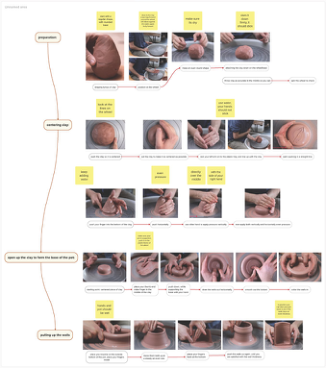
“Centering is often perceived as a simple first step, but in practice it is one of the most difficult actions for beginners. Because errors occur early in the process, they tend to affect all subsequent stages of throwing.” (expert ceramicist) These insights clearly indicate that centering a lump of clay on the wheel represents a critical bottleneck in the ceramic learning process. We will focus on 3 specific parts of the process, centering of the clay, open up the clay to form the base of the pot and pulling up the walls. Based on consultations with professional ceramicists, these were identified as the first three major bottlenecks for beginners, making them the focus for this research. To understand the full craft process, the general steps were captured based on a demonstration by professional ceramicist Florian Gadsby in Figure 1 (Gadsby, 2022).
Figure 1: Basic steps of wheel throwing.
The guidance AR prototype in these initial wheel throwing steps will be tested with both experienced ceramic practitioners and beginner users to gain a well-rounded understanding of its effectiveness. In addition, beginners will compare the AR tool with a widely accessible self-learning resource, namely a YouTube tutorial, in order to explore the differences in learning experiences and the type of guidance each method provides. The beginner participants are individuals with no prior experience in wheel throwing. Their participation focused on evaluating usability, clarity, perceived support, and cognitive effort of the AR tool during the learning process.
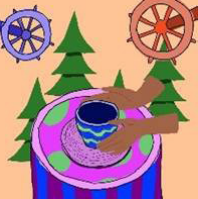
The three participating ceramist experts are around 30 years old Italian active professionals, either self taught or through apprenticeship. Ranging experience from five to eleven years. All experts also have experience in giving workshops in small groups (2-8 people). These experts evaluate the accuracy and instructional validity of the AR guidance. In regard to technology, they all had some minor previous exposure to Augmented Reality. This study employs exploratory and qualitative research using a prototype-driven methodology. The aim is to investigate how an augmented reality (AR) prototype can support intangible knowledge sharing to beginners during the first steps of ceramic wheel throwing as well as identify limitations. To implement image tracking, Mattercraft from ZapWorks was utilized (Zapworks, 2025). In this study, image tracking was used to enable real-time visual feedback, coupled with physical hand movements in wheel throwing. The device’s camera detects a tracking image that functions as a spatial anchor (see Figure 2). Once this marker is recognized, a pre-authored 3D animation is triggered, enabling learners to follow the hand positions.
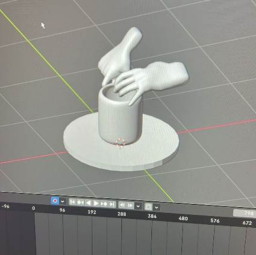
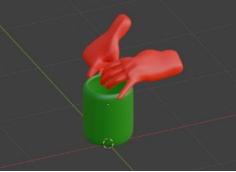
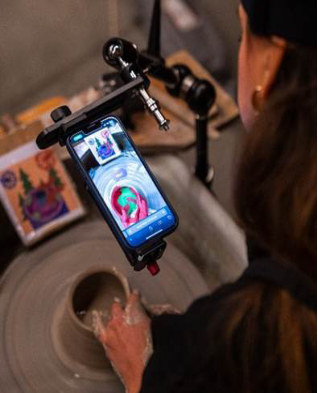
Both the clay and the hands were modeled and animated in Blender as seen in Figure 3. Since the animation shows as an overlay on the user’s own hands, color was added to the model and both the clay and the hands were made transparent as shown in Figure 4. The participant will then look through a smartphone that shows the AR content to follow the hand movements, as demonstrated in Figure 5.
Figure 2: Tracking image.Figure 3: Blender model.Figure 4: Blender model with added colors.Figure 5: Final AR tool, powered by Mattercraft.
Two main instruments will be used for data collection. First, observations through video recordings will focus on participants’ workflow, problem- solving behavior, attention shifts, and overall interaction with the tool. Second, a questionnaire will be administered both before and immediately after the prototype experience. This questionnaire aims to capture participants’
reflections on the tool’s usability, their perceived learning outcomes, and its relevance for supporting beginners in craft practice.
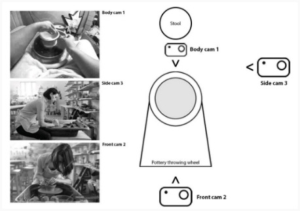
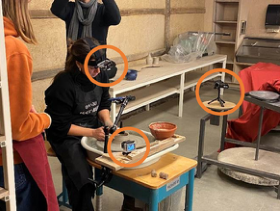
The setup is shown in Figure 6. Body cam 1 (GoPro) is strapped to the head for first person view capturing, meant to analyze visual attention. This indicates whether the participant is looking at the screen or at the work environment. Front cam 2 is positioned across the participant, at close range (+/− 0,5m), to capture detailed hand movements during the wheel-throwing process. Side cam 3 records a side view of the participant to document body posture and overall working position at the wheel (+/− 2m). At last, a clamp arm was used to hold the mobile phone which is displaying the AR content (Figure 7).
Figure 6: Test setup schematic.Figure 7: Test setup expert participants.
Prior to performing the wheel-throwing task, expert participants completed a short pre-test questionnaire consisting of Likert-scale questions (1–5) and several open-ended questions addressing confidence, perceived cognitive load, and expectations regarding visual support. After completing the task, participants filled out a post-test questionnaire containing the same Likert- scale items to enable comparison, along with additional closing questions to capture reflective feedback on the experience.
The final phase of the study involved four novice participants with no prior experience in ceramics: two in their mid-50s and two in their 20s. This procedure compared AR-based guidance with video-based instruction. Two participants first watched a YouTube tutorial demonstrating how to center clay and then attempted to replicate the technique on the wheel. Afterwards,
Designing Assistive Instructions for Ceramic Craft Education 431 they repeated the task using the AR guidance prototype. The remaining two participants followed the reverse order, first using the AR prototype and then the YouTube tutorial. Each beginner participant completed the task twice. This methodological approach enables a structured evaluation of the AR prototype, combining exploratory expert input, technical validation, and comparative beginner testing within realistic craft-making environments.
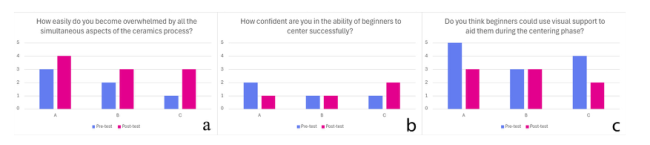
RESULTS At the open air museum Bokrijk (Belgium), the ceramic experts tried out the AR prototype. The pre test and post test question results follow in Figure 8. The first graph shows the scores of the experts with and without the AR tool, where zero indicates not overwhelmed and five indicates very overwhelmed. The participants reported higher levels of overwhelm when using the AR visualization compared to working without any supportive tools (see Figure 8a). The second graph shows the level of experts’ confidence in beginners regarding their belief that the centering technique can be learned more effectively using AR visualisations compared to learning without the supportive tool. Both before and after the test, the scores remain relatively low, indicating that no improvement is observed in experts’ confidence in beginners (see Figure 8b). The third graph shows that experts believe visualisations can have added value, which is reflected in generally high scores. After using the tool, however, the visualisations were rated lower by the participants (see Figure 8c).
Figure 8: a. Overwhelming situation / b. Beginners to center successfully. / c. Visual support for beginners.
Expert evaluation highlighted a discrepancy between the procedural steps demonstrated by the prototype and the practices employed by ceramicists in real-world contexts. This finding points to substantial variability in both the transmission and execution of ceramic techniques, raising questions about the prototype’s representativeness. As one expert noted, “You can repeat some steps, but not all. Such as pulling up,” underscoring the granular nature of expert practice that may not be fully captured by the current AR content.
The need to remove the current physical obstruction was illustrated by one participant in particular, who stated, “AR glasses would be a better way than with the phone, you need the space.” Regarding recommendations after using the tool, all participants provided feedback for improving future test setups.
Finally, a comparative test with beginners was conducted to evaluate AR and YouTube videos as instructional tools for ceramic learning. The aim of
this test was to assess whether AR provides an enhanced learning experience. The following section presents the results of this comparison.
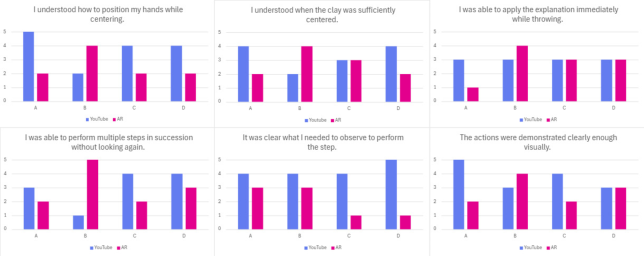
Figure 9: Post-test question results.
The participants were asked to rate the YouTube video and the AR model based on their experience with centering, the clarity of the steps and their ability to apply them. The results indicate that participants A, C and D generally preferred the YouTube video, as reflected in their higher ratings across the majority of questions (see Figure 9). Participant B, on the other hand, showed a preference for the AR model. For the AR visualisations, participants reported that AR lacked side views and depth cues, making it difficult to judge clay position. The “pulling up” step was highlighted as needing additional support. Overall, participants requested more explicit verbal instructions, annotations, or guidance to clarify hand placement, timing and actions. For the YouTube tutorial, participants reported that the instructions were generally clear; however, several shortcomings were identified. Timing issues and the absence of intermediate feedback were particularly evident during the “pulling up” step. Participants suggested that closer views or repeated observation of critical actions would be beneficial. Potential improvements included more explicit visualization of intermediate steps, improved camera angles to provide a clearer overview, and better pacing of instructions to enhance comprehension.
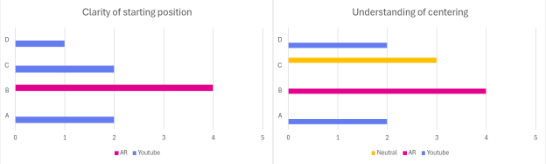
Figure 10: Comparative questions.
The graph shows that Participants A and D rated YouTube higher for both clarity of the starting position and understanding of centering, indicating a preference for YouTube in learning the ceramic process. Participant B
Designing Assistive Instructions for Ceramic Craft Education 433 strongly preferred AR for both measures, while Participant C showed a mixed response, leaning partially toward AR and partially neutral (see Figure 10). As a final question, the participants were asked how they preferred to develop their skills. Three would use a combination of YouTube and AR, while one preferred to use only YouTube.
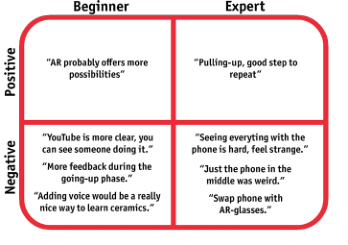
The most common quotes from our participants are displayed in Figure 11. They were categorized as positive and negative feedback respective to their participant pool, meaning beginner or expert. Most of the participants’ contributions consist of feedback aimed at improving the AR visualizations.
Figure 11: Quotes from all participants.
DISCUSSION The aim of this study was to investigate whether AR can contribute to teaching the skills required for centering clay and building the first walls. Interviews revealed that these are critical points in the production of ceramic goods. Although many digital ways exist to learn these techniques, such as YouTube tutorials shown earlier by Gadsby (2022). Pottery requires a good balance between technique and feeling, and it is difficult to teach that feeling, especially when there is no physical teacher present. Preliminary interviews with the experienced ceramists confirmed this finding. Factors such as the moisture of the clay and manual pressure make a big difference, and these are difficult to learn using digital tools.
The professionals found the tool often more difficult than beneficial. For them, centering is a step they have performed hundreds of times. The comment below suggests that the physical presence of the phone disrupts the necessary focus.
“The phone in the middle disconnects from the physical experience.” (expert ceramist) The setup causes physical limitations and restricts the freedom of movement needed when throwing clay. As the research had already shown, the professionals also felt that there was too little guidance on the feel of pottery when you are being guided digitally. A logical solution here is to retain a human instructor while learning the craft. One positive aspect of this
test is that the artists could always see their hands. Repeating the steps in the test also proved to be an added value. The participants felt that an overlay through AR glasses would be a better option than an AR overlay on a screen in front of them, as it allows for greater freedom of movement. Although expert participants were critical of the current implementation of the AR tool, their reactions and level of engagement indicates openness toward the integration of digital tools within ceramic practice. Additionally providing detailed feedback on how such prototypes could evolve.
The second experiment, namely the comparative study, was conducted with complete beginners in ceramics. This test shows that AR guidance provides increased spatial awareness. Video (YouTube) remains a two-dimensional tool, while AR forces the user to more actively mimic the hand position and posture used with clay. However, beginners found it difficult to focus on the screen during the AR test while keeping their hands in the correct position. A potter’s wheel can feel unnatural to a novice clay artist, and it is important that beginners can focus entirely on the wheel and the clay on it.
Given that the sample of experts was limited to three Italian ceramicists, future research should incorporate a more heterogeneous group of experts. This is necessary to determine whether the observed variations stem from methodological diversity (e.g., geographical) or whether they indicate inefficiencies within the model itself.
CONCLUSION This study explored the role of augmented reality (AR) as a supportive instructional tool in the early stages of ceramic wheel throwing. Through an exploratory approach, an AR instructions prototype was developed and evaluated with both experienced ceramic practitioners and inexperienced beginners. An important outcome of this research is that both expert ceramicists and beginners showed openness toward the use of AR in learning and teaching wheel throwing. Experts engaged critically with the tool and reflected on its potential value, limitations, and future evolution. In a comparative study, beginners similarly expressed interest in AR as a complementary learning resource within the physical workspace. At the same time, the results reveal clear constraints related to the current implementation. While AR provided improved spatial awareness compared to two-dimensional video instruction, participants struggled to divide attention between the screen and the tactile interaction with clay. The findings underscore that AR cannot replace embodied practice, but may function as a supportive layer that enhances repetition and spatial understanding. Its value lies not in prescribing rigid procedures, but in offering situational guidance that learners can integrate into hands-on practice. Future research should explore hands-free AR, personalized guidance, and multimodal feedback systems to better support the transmission of tacit knowledge. Such studies could provide further insight into how digital tools can complement traditional craft education.
ACKNOWLEDGMENT
The authors acknowledge the experts who shared their artisan knowledge in ceramics and provided the necessary materials for the tests. We are grateful
Designing Assistive Instructions for Ceramic Craft Education 435 to all participants who generously contributed their time and insights to this study. This publication is part of the Horizon Europe project ‘Tracks4Crafts’ under grant agreement No 101094507.
REFERENCES
Batra, P., Pillai, P. & Kaim, P. (2023). Quality Education from Teachers’ Perspective.
RESEARCH REVIEW International Journal of Multidisciplinary, 8(6), 44–52. https://doi.org/10.31305/rrijm.2023.v08.n06.007 Endow, S. & Torres, C. (2021). I’m Better off on my Own: Understanding How a Tutorial’s Medium Affects Physical Skill Development. DIS 2021 - Proceedings of the 2021 ACM Designing Interactive Systems Conference: Nowhere and Everywhere, 1313–1323. https://doi.org/10.1145/3461778.3462066 Gadsby, F. (2022, 27. March). How to center clay - a beginner’s guide. https://www.
youtube.com/watch?v=-YCGK33c0xs Garcia, I., Huys, J., Van Bouwel, L., Van Volsom, A. & Verlinden, J. (2025). Augmented Reality for Learning Traditional Wicker Weaving. Human-Computer Interaction & Emerging Technologies, 195. https://doi.org/10.54941/ahfe1006262 Jahn, G., Newnham, C. & Van Den Berg, N. (2024). Mixed Reality Carpentry.
https://www.researchgate.net/publication/381189449_Mixed_Reality_Carpentry Ji, H., Hu, P. & El-Zanfaly, D. (2025a). Reshaping Craft Learning: Insights from Designing an AI-Augmented MR System for Wheel-Throwing. DIS 2025 - Proceedings of the 2025 ACM Designing Interactive Systems Conference, 2549–2573. https://doi.org/10.1145/3715336.3735844 Ji, H., Hu, P. & El-Zanfaly, D. (2025b). Reshaping Craft Learning: Insights from
Designing an AI-Augmented MR System for Wheel-Throwing. DIS 2025 - Proceedings of the 2025 ACM Designing Interactive Systems Conference, 2549– 2573. https://doi.org/10.1145/3715336.3735844 Policy Brief | tracks4crafts. (2022). https://tracks4crafts.eu/policy-brief Shi, Y., Liu, L., Lou, X., Lu, Y., Zhang, P. & Liu, E. (2025). OriBot: a novel origami robot creation system to support children’s STEAM learning. Multimedia Tools and Applications, 84(26), 31723–31748. https://doi.org/10.1007/s11042-024- 20438-x Stefanidi, E., Partarakis, N., Zabulis, X., Adami, I., Ntoa, S. & Papagiannakis, G.
(2022a). Transferring Traditional Crafts from the Physical to the Virtual World: An Authoring and Visualization Method and Platform. Journal on Computing and Cultural Heritage, 15(2). https://doi.org/10.1145/3484397 Stefanidi, E., Partarakis, N., Zabulis, X., Adami, I., Ntoa, S. & Papagiannakis, G.
(2022b). Transferring Traditional Crafts from the Physical to the Virtual World: An Authoring and Visualization Method and Platform. Journal on Computing and Cultural Heritage, 15(2). https://doi.org/10.1145/3484397 Wang, Y., Liu, X., Fu, L., Mu, B., Chen, M., Wu, H., Dong, K. & Sun, X. (2024).
works/ Zogopoulos, V., Birem, M., De Geest, R., Hofman, R., Jorissen, L., Vanherle, B. & Gors, D. (2021). Image-based state tracking in Augmented Reality supported assembly operations. Procedia CIRP, 104, 1113–1118. https://doi.org/10.1016/j. procir.2021.11.187
Read this individual research paper free through the original publisher, or explore the full digital proceedings book.
ISBN 979-8-950676-09-3
Explore this ISBN in the AHFE Bookstore ↗Listed in the July 2026 bookstore catalogue; search by ISBN to confirm current availability · Digital book purchase optional