Artur Litwiniuk, Behnam Boobani, Juris Grants, Jan Supinski (2026). Physical Activity and Selected Health Behaviors of Tourism and Recreation Students. In: Human Factors in Sports, Preventive Medicine and Innovative Agonology. AHFE Open Access, vol. 226, pp. 57–62. https://doi.org/10.54941/ahfe1007823
Physical activity is crucial for the health and harmonious psychophysical development of students, in terms of their healthy habits and attitudes later in life. During this period, it also serves as a natural continuation of physical education classes undertaken at lower levels of education. Students, as the future intelligentsia group, should serve as role models for other social groups. The aim was to develop knowledge about physical activity and other health behaviors among university students. The study included a group of 32 students of Tourism and Recreation. The participants were aged 22-24. The International Physical Activity Questionnaire (IPAQ), accepted in 12 countries (Sjöstrom et al. 2000), considered the world's most advanced questionnaire assessing the level of physical activity among the population in various countries, taking into account different social groups, was used as the methodology. The International Physical Activity Questionnaire (HBUSQ) was used (Litwiniuk, Grants 2010). It was found that half of the surveyed students had a low level of physical activity in their free time, spending it passively in front of a computer. 30% declared an average level of physical activity, while only 20% reported a high level. It was observed that the lifestyle of the surveyed students, for a significant proportion of respondents, was more health-promoting than unhealthy. Although TiR students are physically active and adhere to healthy lifestyle principles, they also engage in health-risk behaviors, not least those involving irregular meal times. During studies, both practical and theoretical classes should pay more attention to the future consequences of unhealthy behaviors.
Nowadays, sports, physical activity, and recreational and tourist activities are available in various forms, depending on the interests and capabilities of each individual. However, the development of civilization and urbanization in recent years have had a significant impact on the increased pace of life and professional activity, which have contributed to passive ways of spending free time. Various physical and recreational activities are one of the best ways to prevent this. Physical and recreational activity has a significant impact on the
functioning of the entire body, from improved body posture to psychosocial vitality. It provides a sense of relaxation and peace of mind, improves quality of life, and is a determinant for entering into new social relationships. Activity and physical fitness are increasingly being explored scientifically. While physical fitness is a very complex property and depends on many factors such as gender, age, genetic predisposition, type of professional work, and physical activity undertaken in free time (recreational or sports), physical activity depends mainly on motivation, health status, and access to sports and recreational facilities and equipment (Happanen et al., 1997; Haskell et al., 2007; Janssen & Leblanc, 2010; MacKay & Neill, 2010). Contemporary concepts of physical fitness, physical activity, and health are associated with the ability to achieve an optimal quality of life outdoors (Cornell, 1979; Chen & Cheesman 2013; Boobani et al. (2024, 2024a). The starting point in defining physical fitness is its relationship with overall health, in line with the concept of “health-related fitness” (Bouchard et al., 2007).
Students are a distinctive group of young adults. Lifestyle, behaviors, and interests are largely determined by the type of studies and the university. College is an ideal time to develop responsibility for one’s health and spend leisure time actively. It seems reasonable that students of tourism and recreation actively participate in sports, recreation, and tourism activities (Nelson et al. (2007)). The aim was to develop knowledge about physical activity and other health behaviors among university students.
MATERIALS AND METHODS
Participants The study included a group of 32 students of Tourism and Recreation [T&R]. The participants were aged 22–24. IPAQ [International Physical Activity Questionnaire], accepted in 12 countries (Sjöstrom et al., 2000; Biernat & Stupnicki, 2005), considered the world’s most advanced questionnaire assessing the level of physical activity among the population in various countries, taking into account different social groups, was used as the methodology. HBUSQ [International Physical Activity Questionnaire] was used (Litwiniuk & Grants, 2010).
Statistical Analysis Data were analyzed using Excel including Shapiro-Wilk, paired t-tests, and Wilcoxon signed-rank (W).
Ethical Approval Approved by the Ethical Committee of the Latvian Academy of Sport Education (Nr. 51813) following the Declaration of Helsinki.
RESULTS
Research revealed that, when analyzing the IPAQ (International Physical Activity Questionnaire), nearly 60% of the surveyed students demonstrated a high level of activity during their studies, nearly 20% demonstrated a
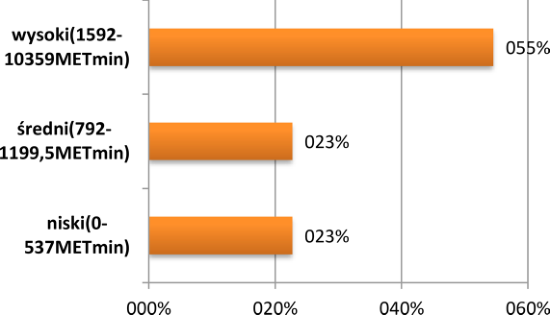
Physical Activity and Selected Health Behaviours of Tourism and Recreation Students 59 low level of physical activity, and approximately 23% demonstrated an average level of physical activity. The results in the next figure show that approximately 41% of the surveyed students demonstrated a low level of physical activity during their commute, only 36% demonstrated an average level of activity, and only one in five demonstrated a high level. However, when assessing activity related to household chores (in and around the home), approximately 41% demonstrated high-intensity activity. Further, 31.83% of respondents rated their household chores as low-intensity activity, and less than one-third, i.e., 27%, as moderate-intensity. Finally, recreational activity was analyzed, and it was found that 54% of students demonstrated a high level of physical activity in their free time, some of whom exercised outside of sports clubs, while the rest had medium and low levels of activity. Therefore, we can assume that a significant portion enjoys spending their free time actively and prefers an active lifestyle when away from studies and household duties.
Figure 1: Level of physical activity related to sports and recreation among students T&R.
DISCUSSION
Numerous studies show that Polish society demonstrates low participation in physical recreation. Numerous efforts are underway to influence young people and their functioning in relation to physical culture and recreation. In an age of continuous civilization, efforts are being made to shape awareness and mental development (Sallis et al., 1985). The ever-increasing influence of civilizational goods is clearly visible, contributing to disturbing trends in unhealthy behaviours, including low levels of recreational physical activity (Oja, 2001; Janssen, 2007). This trend also applies to university students. Adults play a significant role in shaping behaviours for active leisure time. Parents are role models for their children; if families lack active leisure time and various forms of physical activity, their offspring will likely not lead an active lifestyle. Obesity and a general lack of physical activity, resulting from poor role models, are rampant today. This growing civilization contributes to a lack of physical activity, which in children will have negative
health consequences later on. In our study, students who practiced S&T demonstrated a higher overall level of physical activity than those who did not. Significant differences (p < 0.05) were noted between training and non- training students. According to both training and non-training students, it had a negative impact on their physical activity and recreational/tourist activities. The study shows that the most common purpose of trips for training students was sports or recreational camps, while for non-training students, relaxation was the primary purpose. Sporting activity in the form of active tourism is a very effective field, shaping the psychophysical characteristics of young people and acting as a preventative measure against various social pathologies and negative phenomena that are increasingly prevalent in the modern world (Prochaska et al., 2001; Biernat & Tomaszewski, 2015).
The research conducted so far can contribute to an even better diagnosis of the lifestyles of students in various fields of study in Poland and Europe as comparative material. The study results can also contribute to a more complementary perspective on student lifestyles and provide a basis for organizing students’ free time and implementing preventive measures regarding health-risk behaviors for students of other fields of study. A fundamental principle of exercise training is recovery, and optimal strategies to maximize it are essential for the training-adaptation cycle with the goal of homeostasis restoration. In addition to sports trainers, personal trainers also have such competences and qualifications healthy lifestyle (Litwiniuk et al., 2020; Kruszewski & Litwiniuk, 2021).
CONCLUSION
Considering the specific field of study T&R, students of the Faculty of Physical Education constitute a specific sociological category, and their activity level differs significantly from students of other universities. Research has revealed that the level of physical activity, in terms of studying, transportation, homework, and recreational activities, differs slightly between students based on the IPAQ. Based on the HBUSQ results, it was also observed that the results of those who exercise in sport clubs differ significantly from those who do not exercise. It seems advisable to systematically conduct this type of research to prevent behavioral dysfunctions and offer “something in return,” including various forms of student activity, such as through „Student Research Clubs”. Although T&R students are physically active and adhere to healthy lifestyle principles, they also engage in health-risk behaviours, not least those involving irregular meal times. During studies, both practical and theoretical classes should pay more attention to the future consequences of unhealthy behaviours.
ACKNOWLEDGMENT
This research was supported by postdoctoral Grant No. RSU/ LSPA-PG-2024/1-0002, “Recovery Strategies to Improve the Performance of Martial Arts Athletes,” of the project No. 5.2.1.1.i.0/2/24/I/CFLA/005 RSU Internal and RSU with LSPA External Consolidation (financed by the
Physical Activity and Selected Health Behaviours of Tourism and Recreation Students 61 investment of the European Union’s Recovery and Resilience Mechanism and the budget of the Republic of Latvia).
REFERENCES
Biernat E., Tomaszewski P. (2015). Association of socio-economic and demographic factors with physical activity of males and females aged 20–69 years. Ann Agric Environ Med., 22(1), 118–123 Biernat E., Stupnicki R. (2005). An Overview of Internationally Applicable
Questionnaires designed for Assessing Physical Activity. Physical Education and Sport 49:32–42. www.pheds.com. Boobani B., Grants J., Boge I. et al. (2024). Effect of outdoor recreation activity on mental toughness of taekwondo athletes in competition period. Arch Budo Sci Martial Art Extreme Sport; 19: 113–121. Boobani B., Grants J., Litwiniuk A. et al. (2024). Effect of Walking in Nature on
Stress Levels and Performance of Taekwondo Athletes in Competition Period. Journal of Kinesiology and Exercise Sciences; 106(34): 17–27. Bouchard C., Blair S., Haskell W. (2007). Physical activity and health. Human Kinetics, Champaign. Chen M.A., Cheesman D.J. (2013). Mental toughness of mixed martial arts athletes
at different levels of competition. Percept Mot Skills; 116(3): 905–17. Cornell J. (1979). Sharing Nature with Children: The Classic Parents’ & Teachers’ Nature Awareness Guidebook; Dawn Publications: Nevada City, CA, USA. Happanen N., Milunpalo S., Vuori I. et al. (1997). Association of leisure time physical
activity with the risk of coronary heart disease, hypertension and diabetes in middle-aged men and women. Int J Epidemiol; 26, 739–747. Haskell W.L., Lee I.M., Pate R.R. et al. (2007). Physical activity and public health: updated recommendation for adults from the American College of Sports Medicine and the American Heart Association. Med Sci Sports Exerc.; 39(8): 1423–34. Janssen I. (2007). Physical activity guidelines for children and youth. Can J Public
Health.; 98 Suppl 2: 09–21. Janssen I., Leblanc A. ( 2010). Systematic Review of the Health Benefits of Physical Activity in School-Aged Children and Youth. Int J Behav Nutr Phys Act.; 7: 40. Kruszewski A., Litwiniuk A. (2021). The importance of the quality of education of
personal trainers from the perspective of personal security. Arch Budo Sci Martial Art Extreme Sport; 17: 197–202. Litwiniuk A., Waldzinski T., Grants J. (2020). Professional competences of personal trainers. Arch Budo Sci Martial Art Extreme Sport; 16: 79–84. Litwiniuk A., Grants J. (2010). Health Behaviour of University Students Questionnaire
(HBUSQ). Physical Activity and Sport in Changing Society: Research, theory, practice and movement. 3rd Baltic Sport Sciences Conference. Latvian Academy of Sport Education, Riga. MacKay GJ, Neill JT. (2010). The effect of green exercise on state anxiety and the role of exercise duration, intensity, and greenness: A quasi-experimental study. Psychol Sport Exerc; 11: 238–45. Nelson M.E., Rejeski W.J., Blair S.N et al. (2007). Physical activity and public health
in older adults: Recommendation from the American College of Sports Medicine and the American Heart. Oja P. (2001). Dose response between total volume of physical activity and health and fitness . Med. Sci. Sports Exerc; 33, supl, 428.
Prochaska J.J., Sallis J.F., Long B. (2001). A physical activity screening measure for use with adolescents in primary care. Arch Pediatr Adolesc Med.; 155(5): 554–9. Sallis J.F., Haskell W.L., Wood PD et al. (1985). Fortmann SP, Rogers T, Blair SN,
Paffenbarger RS Jr: Physical activity assessment methodology in the Five-City Project. Am J Epidemiol; 121, 91–106. Sjöstrom M., Ekelund U., Poortvliet E. et al. (2000). Assessment of physical activity using IPAQ – version 4 – and activity monitors – CSA”, Measurement. Physical Education Exercises Sciences; 4, 263–264. Ulrich R.S., Parsons R. (1992). Influences of passive experiences with plants on
individual well-being and health. In Role of Horticulture in Human Well-Being and Social Development; Relt P, Ed.; Timber Press: Oregon, Portland; 93–105 .
LISTED IN THE AHFE DIGITAL BOOKSTORE CATALOGUE
Explore the complete digital volume
Human Factors in Sports, Preventive Medicine and Innovative Agonology
Read this individual research paper free through the original publisher, or explore the full digital proceedings book.
ISBN 979-8-950676-02-4
Explore this ISBN in the AHFE Bookstore ↗Listed in the July 2026 bookstore catalogue; search by ISBN to confirm current availability · Digital book purchase optional