Michal Kruszewski, Wojciech Niedomagala, Jaroslaw Klimczak, Artur Litwiniuk (2024). Methodological and mental distance to the dissemination of vertical test fight between girls and boys. In: Human Factors in Design, Engineering, and Computing. AHFE Open Access, vol. 159, pp. 1460–1470. https://doi.org/10.54941/ahfe1005714
The aim of this work is empirical evidence of the need to respect specific methodological standards in the study of the phenomenon of diagnosing mental and motor predispositions to counter physical aggression. The key criterion for ‘situational actionability’ is testing fights in a vertical posture (TFVP) efficiency. Of the 59 TFVP participants aged 7 to 13 years, there were 37 boys and 22 girls. The innovative comparison of motor potentials according to the same criteria, i.e. age- and gender-adjusted for the winner of the GPC (groups of people combats), provides important empirical evidence that the chances of girls' effective self-defence against physical aggression by their peers, boys, dominating them with motor potential and/or body weight, are real.
The expansion on the Internet and other electronic media of gory hand- to-hand combat spectacles for entertainment is not counterbalanced by a message about preparing people from the earliest years of life for decent self-defence – countering physical aggression without exceeding the limits of necessary defence. Unfortunately, the media space ignores the scientific argumentation that competently applied certain categories of combat sports and fun forms of exercise based on hand-to-hand combat are effective means of diagnosing and reducing human aggressiveness. The effectiveness of these measures and the original methods of which they are a key element have been
Methodological and Mental Distance to the Dissemination of Vertical Test Fights 1461
experimentally verified many times with children, adolescents and adults (Trulson, 1986, Kalina, 1997; Syska, 2005; Klimczak et al., 2015, Klimczak and Kalina, 2019).
In addition, authors of scientific justifications emphasise not only the health aspects (encompassing somatic, psychological and social dimensions) and defensive aspects of competent practice of a certain category of exercises derived from hand-to-hand combat systems, but also the links to moral and aesthetic education (Kalina, 1991; Sasaki, 2006, Harasymowicz, 2007, 2022, 2023, Harasymowicz and Kalina, 2005, 2006; Harasymowicz and Novikov 2013; Klimczak and Chodała; 2023; Kruszewski, 2023a, 2023b). Moreover, experts emphatically point out the irreversible return of neogladiatorism (bloody cage shows). They justify such a prognosis primarily (but not exclusively) by the more than 350-year-long process of eradicating gladiatorial games, which were banned by the edict of Emperor Constantine the Great in 326. (Kalina, 1991; Tokarski, 2007; Piepiora and Witkowski, 2020, 2023, Krzemieniecki et al., 2021, Kruszewski, 2023c). In contrast to combat sports, in self-defence there are no criteria for respecting gender identity, age, weight categories etc. Developed by Polish experts INNOAGON (an acronym for new applied science, see: Kalina and Kruszewski, 2023) and empirically verified methods of fun forms combat, modelled on gentle and relatively mild hand-to-hand fighting techniques (Kalina 1997, Chodała, 2003; Kalina et al., 2003; Jagiełło et al., 2015) enable safe confrontation of individuals regardless of gender and motor potential. At the same time, some perform diagnostic functions for the purpose of predicting performance in certain combat sports and self-defence (Kalina 1997, Chodała 2003; Syska, 2003; Tomczak, 2004; Kalina, et al., 2005, Bukowiecka et al., 2006, Jagiełło et al., 2015, Kalina et al., 2015, Niedomagała, 2016). The findings of the authors cited above provide evidence that these are both safe and attractive means of adaptation to counter physical aggression.
Niedomagała’s (2016) observations provided unique empirical evidence that juvenile judo students who were among the leaders during ‘testing fights in a vertical posture’ (TFVP) performed during the recruitment procedure were more likely to be successful during tournament fights during their first three years of professional training. Thus, in the course of the recruitment procedures for judo training, TFVP results proved to be an accurate criterion for measuring ‘possibility of action’ in the sense of ‘dispositional’ – as a simple and safe method for revealing talent for hand-to-hand combat. Since the TFVP formula does not take into account non-settlement (draw), the several times repeated or differing TFVP results in the specific circumstances of their application either confirm or deny the ‘complete possibility of action’ (dispositional’ and ‘situational) precisely in these circumstances.
During the aforementioned recruitment procedures of adepts to leading judo clubs throughout Poland, some coaches organized TFVP on their own initiative, in which boys and girls participated together – with the approval of the participants and the consent of their legal guardians. The availability of the results of those observations enabled us to analyse and synthesise from the perspective of the effectiveness of counteracting interpersonal physical
aggression when these fun forms combat were fought in individual groups of people combats (GPC) by boys and girls differing moreover in physical fitness, age and body weight (Kruszewski et al., 2024). In this work, we continue the issue in relation to peer GPCs. Same age is the only formal criterion for the inclusion of GPC in the studies undertaken.
The aim of this work is empirical evidence of the need to respect specific methodological standards in the study of the phenomenon of diagnosing mental and motor predispositions to counter physical aggression.
MATERIAL AND METHODS Starting from the praxeological definition that ‘possibility of action’ is the strength, intellectual or manipulative prowess, knowledge (skill) and willingness sufficient to perform a given action (Pszczołowski, 1978), we identify the methodological criteria for measuring this phenomenon with both ‘dispositional feasibility’ and ‘situational actionability’.
Dispositional Feasibility In these studies, the primary available criterion for evaluating this phenomenon is ‘strength’, which we equate with motoric potential. We base our assessment of this potential of TFVP participants on the results of two trials of the International Physical Fitness Test – IPFT (Pilicz et al., 2002): standing broad jump (result: jump length in cm), sit ups result number of sit-ups performed in 30 seconds) and ‘Rotational Test’ (RT), which measures the body balance disturbation tolerance skills – BBDTS (Kalina et al., 2013). The reference system for the decomposition of raw trials of IPFT scores into points (according to the T scale) was in each case the norms corresponding to the gender and age of the GPC winner. The RT score is universal and the quantitative-qualitative decomposition of errors indicative of BBDTS level into T-scale (points in brackets) is based on the findings of Ga˛sienica-Walczak (2017): (2017): 0(100); 1(94); 2(89); 3(83); 4(78); 5(72); 6(67); 7(61); 8(56); 9(50); 10(44); 11(39); 12(33); 13(28); 14(22); 15(17); 16(11); 17(6); 18(0). Upper limb strength scores have been omitted as boys up to and including age 11 are assessed by bent arm hang – chin over the bar in seconds, and from age 12 onwards by pull-up count. Girls, regardless of age, bent arm hang results.
We assumed that willingness sufficient to perform a hand-to-hand fighting during TFVP was similar in all participants. In contrast, we treat body weight (a factor omitted from the praxeological definition of ‘possibility of action’) of TFVP participants as a fixed element on the borderline between ‘dispositional feasibility’ and ‘situational actionability’. The indicator ‘kg%’ reports body weight proportion to the heaviest in TFVP.
Situational Actionability The key criterion for ‘situational actionability’ is TFVP efficiency. These are the results of a version of four sumo fights according to the simplified formula, in the system of ‘everybody with everybody else’. The most general indicator is proportions of fights won (F-Index), and the more specific
Methodological and Mental Distance to the Dissemination of Vertical Test Fights 1463
proportions of scuffles won (S-Index). The winner is the person who first pushes a competitor four times outside the ‘battlefield’ (a circle with a diameter of 1.8 m) or causes them to touch the ground with a part of their body other than their feet (Kalina et al., 2005, 2015).
PARTICIPANTS Only those GPCs where the ages of the TFVP participants were identical and at least one of them was of the opposite sex were included. The following were qualified: two three-person GPCs; twelve four-person GPCs- (of which the participants in one were three boys and one girl, all aged 9 years and weighing 30 kg), one five-person GPC. Of the 59 TFVP participants aged 7 to 13 years, there were 37 boys and 22 girls.
STATISTICAL ANALYSIS We based the estimation of the results on: frequency (N, n); mean (M); range; minimum (Min); Maximum (Max); standard deviation (SD or ±). The Pearson correlation coefficient between pairs of specified variables was calculated. The level of at least p<0.05 and higher was shown as statistically significant differences.
RESULTS
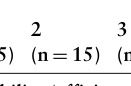
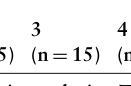
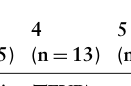
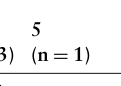
The 15 GPC leaders were dominated by boys (93%) and the F-index including all leaders was 93.8%. Classified in the second ranking positions (RP) were 66% boys, and the F-index for this fraction as a whole was 64.47%. The third RP was dominated by girls (73%), which, with 62% of boys classified in the 4th RP, is evidence that a significant proportion of girls were able to win fighting’s against them. The F-index differences between the different fractions are statistically significant (p<0.001). The extent and quality of these differences are smaller with S-index. There are no statistically significant differences in motoric potential indicators between the leader and classified 2RP fractions, or between the 2RP fraction with the 3RP and 4RP fractions. BBDTS, or RT scores, do not statistically significantly differentiate any of the fractions. Statistically significantly (p<0.05) lower are the kg% ratios of the 4RP fraction relative to the 2Rp and 3 RP, indicating that one of the reasons for the 4RP classified not winning any TFVP was a significant weight difference relative to the non-toughest of the GPC competitors (Table 1).
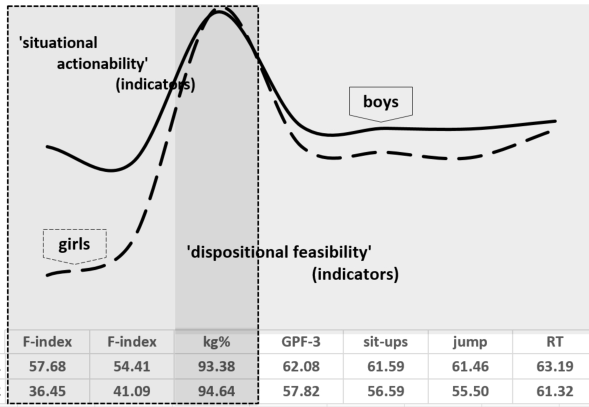
The higher values of the indices of efficiency during TFVP and motoric potential boys formally demonstrate their superiority over girls in terms of both dispositional disability and situational actionability in circumstances of necessary hand-to-hand combat (Figure 1). A general interpretation of this result in a synthetic sense is provided in the ‘discussion’ section. Girls are second to boys in a statistically significant sense (p<0.05) in terms of motoric potential only by a standing broad jump score of 5.96 points. The very high concordance of the kg% ratios is important evidence that body mass during the girls’ bouts with the boys was not a factor in determining the TFVP score.
Table 1. Profiles of the main empirical indicators of the 59 TFVP participants classified by ranking position.
Table available in the original PDF paper.
Equation reproduced from the original PDF.Equation reproduced from the original PDF.Equation reproduced from the original PDF.Equation reproduced from the original PDF.Equation reproduced from the original PDF.
body weight proportion to the heaviest in TFVP kg% 94.07{4} ±7.91
Figure 1: Profiles of the main empirical variables of boys and girls (ordinal variable of motoric potential indicators in line with TFVP leader profile).
The results of the correlation study provide further evidence that the results of multiple TFVPs between girls and boys are not clearly determined by either motoric potential or weight dominance over the competitor. The only significant negative correlation (r = −0.597, p<0.05) of the F-index with the RP of the results of the sit-ups in the individual GPC of the fraction of leaders is evidence that at the same time they often dominated their abdominal muscle
Methodological and Mental Distance to the Dissemination of Vertical Test Fights 1465
strength over their competitors. However, this relationship is not confirmed by the correlation of F-index with raw sit-ups scores. In contrast, the positive correlation of RP sit-ups with kg% (r = 0.526, p<0.05) reports that similar body weight to the heaviest competitor in TFVP was associated with further RP in terms of abdominal muscle strength (Table 2). For the 8 leaders (53%), 3 of whom were the only ones with the highest body weight in the TFVP, the arithmetic mean of their RP sit-ups was 2.6.
Table 2. Intercorrelation of indices of the main empirical variables for the fraction of TFVP leaders (n = 15) – in brackets correlations with RP indicator.
The most statistically significant correlations (all positive) with F-index and S-index occur in the 2RP fraction and relate to RP indicators of motoric potential. GPC-3 and standing broad jump (r = 0.701, p<0.01). GPC-3 (r = 0.634, p<0.05) and sit-ups (r = 0.598, p<0.05) are associated with S-index. This means that the higher the combat efficiency of the second-place finishers in the TFVP, the further their RPs were in terms of demonstrated motoric potential indicators. This is further empirical evidence that success in hand-to-hand combat is not absolutely determined by physical dominance over the opponent. The positive, high correlation (r = 0.575, p<0.05) of F-index with S-index is evident (Table 3).
Table 3. Intercorrelation of indices of the main empirical variables for the fractions classified on the 2RP TFVP (n = 15) – correlations with RP indicator in brackets.
The 3RP fraction has a slightly higher correlation (r = 0.659, p<0.05) of F-index with S-index. The only positive high correlation (r = 0.558, p<0.05) of F-index with raw sit-ups scores does not significantly modify the view that success in hand-to-hand is not absolutely determined by physical dominance over the opponent. Members of this faction lost the majority of TFVPs and 13% of all fights, winning only (each) 33% of scuffles. The very high negative correlation of the F-index with RP scores informing the level of BBDTS in the GPC (r = −0.686, p<0.01) in the 4RP fraction, of which only two boys and one girl each won a TFVP (23% of this fraction), has complementary cognitive value. They were the BBDTS leaders in their GPC. Furthermore, this
is the only fraction in which both sit-ups correlate statistically significantly with kg%: with raw scores –0.613 (p<0.05), with RP 0.664 (p<0.01). Thus, both report that a smaller weight difference relative to the heaviest competitor in their GPC is associated with a higher RP of abdominal muscle strength of 92% of those who ranked last in these GPCs. This result complements the previously stated fact that the mean kg% score of this fraction is statistically lower than this relative to the two higher ranked fractions: 2RP and 3RP (Table 1).
DISCUSSION
The results of this study complement our previous observations when the age of boys and girls fighting was not a key criterion for inclusion in the analysis of a given GPC (Kruszewski et al., 2024). Although the number of GPCs in which the participants in the rivalry are of the same age is smaller than during the observations to which we refer, these results provide general information that, when warding off physical aggression in the case of peer groups, girls can defend themselves effectively even against a boy who is potentially dominant in body mass and physical strength. This, of course, refers to circumstances when the parties use mild or relatively mild means and methods of physical pressure against each other.
We use the term ‘pressure’ in a praxeological sense – a cause directed at the subject of an action or at a thing outside the subject; insofar as the source of pressure is the subject, pressure is identified in praxeology with an impulse of any external or internal kind (Pszczołowski, 1978).
We do not develop this interesting methodological thread. We merely draw attention to the fundamental importance of the language of praxeology in describing phenomena having to do with any form of struggle involving human beings. These phenomena belong to the basic area of exploration of INNOAGON (Kalina and Kruszewski 2023). The precise languages of praxeology and innovative agonology unambiguously expose the pathology of exploiting the attraction of hand-to-hand combat for entertainment through the extreme brutalisation of mutual pressure. Tolerating such motor patterns (neogladiatorism) with the broad reception possibilities of the global digital community is not a good prognosis of interest in the results of this research by actors capable of reversing this extremely negative trend. However, the prospect of cumulative benefits in every dimension of health and in the global survival outcomes that can be achieved through the competent practice of honourable self-defence (Harasymowicz and Kalina, 2005, 2006) is enough to inspire continued research and dissemination of the most valuable findings. It is in the empirical argumentation that we see the greatest chance of remodelling public awareness that the continued omission of exercise and certain hand-to-hand combat from the general education of children and young people will be a mistake with negative consequences for global public health and survival. Of course, applied not only in an attractive way, but above all in a responsible way in terms of mental, emotional effects and personal safety.
Methodological and Mental Distance to the Dissemination of Vertical Test Fights 1467
The authors of project ‘physiotherapist in every school’ as the first step in replacing the physical education paradigm with the subject of preventive medicine in every type of school list ‘safe fall’, ‘diagnosis and reduction of aggressiveness’ and ‘basic of honourable self-defence’ among the key competences of the ‘preventive medicine’ expert (Dobosz et al., 2024). The open motor patterns of these competences are exercises and hand-to-hand combat (those known and those yet to be invented and accepted by experts).
The authors of the publications cited in this work agree that no injuries have ever occurred during the use of TFVP. However, this simple hand-to- hand combat formula, inspired by sumo criteria, does not allow for either strikes or grapples in the likeness of the professional version or any other combat sports. The synthesis of the results of this research and previous publications reporting on the application of TFVP proves only in the most general sense that the ability to defeat an opponent is not determined by dominance over him or her by either body mass or motor potential, or both. In this study, among the leader fraction was a boy ranked in ‘his’ four- person GPC of nine-year-olds of identical body weight (30 kg) last in motoric potential (indicator GPT-3) and trial RT, third in trial sit-ups, but was also the leader in standing broad jump. His 1RP was decided by a higher S-index (73%) than that of the only girl in this GPC (S-index 50%), who, although she beat him, was ranked at 2RP. Indeed, she lost to a boy classified at 4RP (F-index 33%, S-index 42%). The S-index 47% of the boy who beat him secured him a 3R with an identical F-index 33%.
It is precisely the synthetic approach, as an effective way of handling complementary research methodologies, that provides ample opportunities for balanced justifications and to guard against hasty conclusions. The association of TFVP results, limited in these observations to the motor potential and body weight of GPC participants, is only a simple example of the possibilities of complementary research taking into account a larger number of variables and original GPC compilations. Already the authors of the TFVP validation procedures (Kalina et al., 2005; 2015) pointed out that GPCs can be flexibly composed due to different cognitive and application goals. Three- and five-person GPCs have the advantage that, with very similar motor, somatic, intellectual etc. potentials of the GPC members, the probability (although it is still very low) of F-index and S-index identity increases. The variety of variables and their indices, on the other hand, has the cognitive property that previously recommended models may be modified, especially the profiles of TFVP leaders and those individuals who, under the given experimental circumstances, were unable to beat anyone during hand-to-hand combat.
In our previous study based on less stringent criteria for GPC composition, the highest ranked indicator of motoric potential in the TFVP leader fraction was found to be the RT score before standing broad jump and sit-ups (Kruszewski et al., 2024). An experimental model based on the criterion of gender diversity but identical ages of boys and girls in a specific GPC resulted in a modification of this profile. The leading motoric potential component of TFVP leaders appeared to be abdominal muscle strength as measured by the result number of sit-ups. Unfortunately, the reason for reducing the possibility
of analysing and synthesizing motoric potential to three indicators is the different ways in which boys’ arm muscle strength is measured, starting at age 12. The IPFT used in the study (Pilicz et al., 2002) only for girls takes into account measurement using the same trial.
CONCLUSION
The innovative comparison of motor potentials according to the same criteria, i.e. age- and gender-adjusted for the winner of the GPC, provides important empirical evidence that the chances of girls’ effective self-defence against physical aggression by their peers, boys, dominating them with motor potential and/or body weight, are real. A basic prerequisite is a kind of talent for hand-to-hand combat. An important component of this conventional talent is mental and physical predisposition, which cannot be measured analytically. At the current stage of scientific knowledge (based on evidence) of predicting an individual’s defensive capabilities against individual and group physical aggression are the synthetic F-Index and S-Index. Only a secondary issue are methods of stimulating defensive predispositions, the lack of which is documented by observational results modelled, for example, on the model presented in this publication.
REFERENCES
Bukowiecka D, Bukowiecki I, Kalina RM. (2006) Metody oceny kompetencji psychomotorycznych policjantów z zakresu działa´n interwencyjnych. Szczytno: Wy˙zsza Szkoła Policji [in Polish] Chodała, A. (2003) Porównanie efektywno´sci dwóch metod treningu fizycznego
˙zołnierzy przygotowywanych do misji “operacje inne ni˙z wojna”. PhD Thesis. Warszawa: Akademia Wychowania Fizycznego Józefa Piłsudskiego [in Polish]. Dobosz W, Ga˛sienica-Walczak B, Kalina A, Kalina RM, Kruszewski M, Waszkiewicz E, Wicher P. (2004) The ‘physiotherapist in every school’ project is the first step in replacing the physical education paradigm with the subject of preventive medicine in every type of school – a perspective to improve public health and safety in a rational community. Arch Budo J Sci In Agon (forthcoming). Ga˛sienica Walczak BK. Motoryczne, metodyczne i mentalne kwalifikacje studentów
fizjoterapii z zakresu bezpiecznego upadania – perspektywa prewencji upadków osób z wadami wzroku, z unieruchomiona˛ lub amputowana˛ ko´nczyna˛. [PhD thesis]. Rzeszów: Uniwersytet Rzeszowski, Wydział Medyczny; 2017 [in Polish] Harasymowicz, J. (2007) Competences of combat sports and martial arts educators in light of the holistic fair self-defence model of training. Arch Budo; 3: 7–14 Harasymowicz, J, Kalina, R. M. (2005) Training of psychomotor adaptation – a key
factor in teaching self-defence. Arch Budo; 1(1):19–26 Harasymowicz, J, Kalina RM (2006) Honourable selfdefence – the theoretical and methodological basis of training. Płock: Wydawnictwo Novum. Harasymowicz, J., Novikov S (2013) Axiological, ethical and utilitarian benefits of
UNIFIGHT. Arch Budo; 4: 227–232 Harasymowicz, J. (2023) Dialogue of an expert with artificial intelligence about the ethical problems of competition in sports and martial arts. Arch Budo Sci Martial Art Extreme Sport; 19: 11–17
Methodological and Mental Distance to the Dissemination of Vertical Test Fights 1469
Jagiełło W, Kalina RM, Klimczak J et al. (2015) Fun forms of martial arts in positive enhancement of all dimensions of health and survival abilities. In: Kalina RM (ed.) Proceedings of the 1st World Congress on Health and Martial Arts in Interdisciplinary Approach, HMA 2015, 17–19 September 2015, Czestochowa, Poland. Warsaw: Archives of Budo: 32–39 Kalina, R. M. (1991) Przeciwdziałanie agresji. Wykorzystanie sportu do zmniejszania
agresywno´sci. Wrszawa: PTHP [in Polish, summary in English] Kalina, R. M. (1997) Sporty walki i trening samoobrony w edukacji obronnej młodzie˙zy. Warszawa: PTNKF, tom 2, [in Polish, summary in English] Kalina RM, Chodała A, Dadeło, S. Jagiełło, W. Nastula, P. Niedomagała, W.
(2005) Empirical basis for predicting success in combat sports and selfdefence. Kinesiology; 37(1): 64–73 Kalina RM, Jagiello W, Barczynski BJ. (2013) The method to evaluate the body balance disturbation tolerance skills-validation procedure of the ‘Rotational Test’. Arch Budo; 9: 59–80 Kalina RM, Jagiełło W, Chodała A. (2015) The result of “testing fights in a vertical
posture” as a criterion of talent for combat sports and self-defence – secondary validation (part I: the reliability). Arch Budo Sci Martial Art Extreme Sport; 11: 229–238 Kalina RM, Kruszewski A, Jagiełło, W. Włoch G. (2003) Combat sports propedeutics: basics of judo. Warszawa: Wydawnictwo Akademii Wychowania Fizycznego. Kalina RM, Kruszewski A. (2023) INNOAGON is an acronym for ‘innovative
agonology’, but is not synonymous with ‘science of martial arts’. Arch Budo; 19: 193–204 Kano, J. (1932) The Contribution of Judo to Education. Journal of Health and Physical Education; 58(3): 37–40 (originally a lecture given at the University of Southern California on the occasion of the 10th Olympiad) Klimczak, J., Kalina, R. M., Jagiełło, W. (2015) Fun forms of martial arts in
diagnosing and reducing aggressiveness – mental effects of a one-day course for Polish animators of sport. In: Kalina RM, editor. Proceedings of the 1st World Congress on Health and Martial Arts in Interdisciplinary Approach. HMA 2015; 2015 Sep 17-19; Czestochowa, Poland. Warsaw: Archives of Budo; 2015: 187–189 48. Klimczak, J., Kalina, R. M. (2019) Placebo effect – the perspective of diagnosis and therapy of aggressiveness by using fun forms of martial arts during innovative agonology cognitive-behavioural sessions (case study). Arch Budo; 15: 57–66. Klimczak, J. Chodała, A. (2023) The effectiveness of hand-to-hand combat is not
determined by the need for a high level of aggressiveness. Arch Budo; 19: 205 212 Kruszewski, A. (2023a) Antique wrestling is the prototype of a relatively gentle and honourable selfdefence. Arch Budo Sci Martial Art Extreme Sport; 19: 5–10 Kruszewski, A. (2023b) From Ancient Patterns of Hand-to-Hand Combat to a
Unique Therapy of the Future. Int J Env Res Pub He; 20(4): 35–53 Kruszewski, A. (2023c) Wrestling fight – between tradition, sport and spectacle. Arch Budo; 19: 21–27. Kruszewski, M. Kruszewski, A. Niedomagała, W. (2024) Innovative method for
predicting the chances of effective self-defence against physical aggression among children and adolescents based on the results of testing fights in a vertical posture. Arch Budo J Inno Agon (forthcoming). Krzemieniecki, L. A, Piepiora P, Witkowski K. (2021) At the interface of gladiatorship and neo-gladiatorship: humanistic perspective in the diachronic and synchronic terms. Arch Budo Sci Martial Art Extreme Sport 2021; 17: 131–137
Niedomagała W. (2016) The result of “testing fights in a vertical posture” as a selection criterion for professional training of judo sport – prognostic value TFVP. Arch Budo Sci Martial Art Extreme Sport; 12: 181–190 Piepiora P, Witkowski K. (2020) Personality profile of combat sports champions
against neo-gladiators. Arch Budo; 16: 281–293. Pilicz S, Przeweda R, Dobosz J. Dobosz-Nowacka S. (2002) Physical Fitness Score Tables of Polish Youth. Criteria for Measuring Aerobic Capacity by the Cooper Test. Warszawa: Studia i Monografie AWF. Pszczołowski, T. (1978) Zasady sprawnego działania: wstep do prakseologii. 6th ed.
Warszawa: Wiedza Powszechna 1978 [in Polish; the indices of terms: English, French, German, Russian]. Sasaki T. (2006) The meaning and role of budo (the martial arts) in school education in Japan. Arch Budo; 2: 11–14. Syska, J. R. (2005) Psychomotoryczne efekty uprawiania przez kobiety nowoczesnych form gimnastyczno-tanecznych z elementami samoobrony [PhD Thesis]. Warszawa: Akademia Wychowania Fizycznego Józefa Piłsudskiego [in Polish]. Tokarski, S. (2007) Kalaripayatt – the ancient indian art of self-defence. Arch Budo; 3: 15–20 Tomczak, A. (2004) Ocena przygotowania ˙zołnierzy do działa´n w warunkach
odosobnienia. PhD Thesis]. Wrocław: Akademia Wychowania Fizycznego Józefa Piłsudskiego [in Polish]. Trulson, M. E. (1986) Martial Arts Training: A Novel “Cure” for Juvenile Delinquency. Hum Relat; 39(12): 1131–1140
LISTED IN THE AHFE DIGITAL BOOKSTORE CATALOGUE
Explore the complete digital volume
Human Factors in Design, Engineering, and Computing
Read this individual research paper free through the original publisher, or explore the full digital proceedings book.
ISBN 978-1-964867-35-9
Explore this ISBN in the AHFE Bookstore ↗Listed in the July 2026 bookstore catalogue; search by ISBN to confirm current availability · Digital book purchase optional