Elizabeth Waszkiewicz, Artur Kruszewski (2024). Measurement of Motivation and Qualitative Effects of Physical Effort During Two Motor Learning Sessions With Multifaceted Variation of Goals, Methods, Measures and Tools – Example of Violin Playing and Safe Fall. In: Human Factors in Design, Engineering, and Computing. AHFE Open Access, vol. 159, pp. 1471–1482. https://doi.org/10.54941/ahfe1005715
Publisher statistics will load when you open Metrics.
AHFE OPEN ACCESS OPEN ACCESS CONFERENCE PROCEEDINGS PAPER
Measurement of Motivation and Qualitative Effects of Physical Effort During Two Motor Learning Sessions With Multifaceted Variation of Goals, Methods, Measures and Tools – Example of Violin Playing and Safe Fall
The purpose of this case study is to argue empirically about the similarities and differences of the indicators used to evaluate the motor learning effects of new motor competencies with distinct goals and in radically different educational settings. During 14 sessions of remote teaching and improvement of violin playing during the COVID-19 pandemic, a less than 13-year-old boy in the last semester of a six-year first-level music school was observed. Two 22-year-old female students (Girl1 and Girl2) and a 21-year-old male student (Boy) were observed during 8 sessions of a safe fall course (a mandatory subject in a physiotherapy degree program). The effects of the adolescent violinist's effort were evaluated three times during the session (in the beginning, middle, and end parts). The music teacher arbitrarily adopted five kinesiological criteria for evaluating movement characteristics: accuracy, rhythm, range, force, tempo. He combined each individually with artistic effects according to a 25-point scale. The highest arithmetic means of the evaluation scores of the violinist's joint motor and artistic activities were found during the 5th session, when he declared a self-motivation of 5 points. The most positive health effects of exercise of Girl1 and Girl2 are furthermore documented by the highest number of sessions (8 and 7 respectively, representing 87.5% and 75% of the observations) during which exercise was qualified to the high intensity zone. Elements of measuring physical exertion and motor effects with a component of either artistic or prevention component during motor learning in the areas of instrumental music and motor skills related to human personal safety (safe falling, avoiding collisions, self-defence, skiing, etc.) can be mutually implemented to the benefit of public health in particular.
As motor educators representing far-flung areas of practical application - instrumental music, personal security in utilitarian terms – we see benefits in complementary research methodology that go beyond the circular understanding of the boon of a narrow professional specialization. Extreme examples of educational practice provide evidence that the professional preparation of specialists in those areas of human activity where motor skills are a prime factor for success is either based on the recommendations of masters, or masters consistently guard the secrets of their craft. The second circumstance (narrowed down to the realm of marketing) is common in contemporary professional sport – a prominent example is the frequency of so-called ‘high prize pool’ tennis tournaments (week after week in different parts of the world). The opposite pole (not only in a marketing sense) is illustrated by prestigious music competitions – the highest-ranking ones are held every few years.
Educational recommendations of ‘masters of advanced motor skills’ (sport, ballet, music, circus arts, etc.) are not an isolated phenomenon. In verbalised form, they are mainly available through indirect communication – competent authors of specialised publications. From the perspective of complementary research methodology, works referring to the recommendations of the most eminent musicians have particular appeal. Maria Niemira, in the reaction note of her book ‘Jak zdoby´c rozwija´c i utrzyma´c technike pianistyczna˛’ (‘How to acquire, develop and maintain piano technique’), writes: ‘The book, based on the guidance of Bach, Chopin, Liszt and Neuhaus, is intended for musicians of all ages – pupils, students, teachers – who play a variety of instruments, as well as for all people. It includes non-keyboard finger exercises, facilitating the implementation of the Great Masters’ instructions, developing technique, keeping the fingers in constant good condition, preventing hand pain and finger joint degeneration in old age’ (Niemira, 2015). Jan Harasymowicz, expert in honourable self-defence, combat sports and various hand-to-hand combat systems, draws attention inter alia to the achievements of Francois Delsarte (1811–1871) – French teacher of acting and singing – who from 1839 conducted various courses on theatrical arts, and made a great impression on his contemporaries. However, he did not write down his complicated system of meticulous codification of movements which was later referred to as aesthetic gymnastics with elements of free dancing. However, he above all provide a synthetic explanation of the phenomenon of the application of movement exercises and martial arts to the actors’ educational process. He draws attention to the importance of exercise and physical fitness in acting and brings us closer to the views of the performing arts most outstanding educators and reformers (Jerzy Grotowski, Wsiewołod Meyerhold, Henryk Tomaszewski etc.). Harasymowicz examines the relationship between the actor’s body expression and martial arts, explains why ideas about using the body and training methods from Far Eastern martial arts aroused great interest among prominent actors, directors
Measurement of Motivation and Qualitative Effects of Physical Effort 1473
and acting school teachers – an outstanding example is Akiro Kurosawa (Harasymowicz, 2011).
The two cited authors, although making claims about motor learning in the area of different arts, nevertheless differ in the terminology used. We further emphasise the fact that the actors’ multiple repetition of hand-to- hand combat scenarios for the use of a film or theatre play is in close relation to the utilitarian motility of everyday life – in this case, personal safety.
The complementary approach (complementary research method) has the fundamental advantage of providing concepts with universal value (Kalina, 2023b). Scientific research methodology (SRM) – as a branch of broadly understood logic – is a theory of efficient achievement of cognitive goals (Nowaczyk and ˙Zołnowski, p. 122). We have no knowledge whether the ‘Logika i metodologia bada´n naukowych dla lekarzy’ (‘Logic and Research Methodology for Doctors’) published in Polish – to which we refer above – has been translated into other natural languages. The authors of this unique textbook explain that SRM is ‘a particular case of general methodology and therefore praxeology. And as such, it is the terrain of possible applications of its generalisations’ – and this explanation comes from Kotarbinski’s (1965, p. 87) fundamental work ‘Treatise on Good Work’, which is an exposition of ‘the science of good work’ or ‘the theory of effective action’.
It is praxeology that provides the appropriate language. After all, the subjects of the activity are not just athletes, musicians, actors, etc., but anyone in the course of their daily activities. The specific activities are therefore differentiated and concern either education, training or acquiring proficiency in other ways, or circumstances when the mind and body and sometimes necessary (available) things need to be used in an optimal way. Thus, the term ‘posibility of action’ (precisely in the praxeological sense, Pszczołowski 1978) of some subject of action at a certain time, also covers phenomena that are not discussed in this introduction.
The purpose of this case study is to argue empirically about the similarities and differences of the indicators used to evaluate the motor learning effects of new motor competencies with distinct goals and in radically different educational settings.
MATERIAL AND METHODS Presumption and Assumptions
The differences in goals, methods, measures and tools during the violinist’s education and during motor learning of safe fall are obvious. On the other hand, it is only partially true assumption, that man is born neither with the ability to play any instrument nor with the ability to safe fall. Recent findings by the experts of the ‘Polish School of Safe Falling’ provide empirical, evidence that a healthy child up to the age of three effectively protects distal body parts during an unintentional fall during daily motor activity on level ground without vertical obstacles (Kalina et al., 2022, Gasienica-Walczak and Zachwieja, 2024). However, this phenomenon does not qualify as an action, i.e., intentional behaviour (and only such is the subject of praxeology research).
1474 Waszkiewicz and Kruszewski
In the language of praxeology, ‘possibility of action’ is the strength, intellectual or manipulative prowess, knowledge (skill) and willingness sufficient to perform a given action (Pszczolowski, 1978). One detail of this phenomenon is ‘dispositional feasibility’ and this category of action can be empirically verified in the process of education, training and during other forms of skill acquisition, which can be observed with more or less freedom. ‘Situational actionability’ means that the performance of a given action under certain circumstances is not thwarted by those very circumstances (Pszczołowski, 1978).
For both musical and safe fall activities, verifying the compatibility of dispositional feasibility with situational feasibility is a difficult task. In the first case, and only to a certain extent, the verdicts of the most prestigious competitions, festivals etc. can be taken as a reliable criterion for such verification. The greatest confidence in assessing the effectiveness of safe fall education should be placed on reports from witnesses of incidents where participants due to acquired skills avoided or minimised injury during a collision with the ground, with a vertical obstacle or with an object in motion. The findings of the medical history add significantly to the knowledge of this category of events.
A constant element in the variety of human motor activities (those known and those that man will create in the future) is the ‘desire sufficient to perform a given action’ – in short: ‘motivation’. It is difficult to imagine a positive effect of education (acquiring proficiency) in the absence of even a minimal motivation to learn anything – even when the goals are an outright contradiction of humanist ethics.
Circumstances and Participants During 14 sessions of remote teaching and improvement of violin playing during the COVID-19 pandemic, a less than 13-year-old boy in the last semester of a six-year first-level music school was observed. Two 22-year- old female students (Girl1 and Girl2) and a 21-year-old male student (Boy) were observed during 8 sessions of a safe fall course (a mandatory subject in a physiotherapy degree program).
Measurements The common measurement criteria are the identical method of measuring motivation (a 10-point scale) and the duration of the session (effort) in minutes. The violinist’s motivation was assessed three times: before, in the middle of the session, and at the end of the session the ‘self-motivation’ was asked. Students before the workout, and after the end of the exercise about the willingness to continue – comparatives takes into account the motivation ‘before’ and ‘after’.
The differences are in the qualitative evaluation of motor performance. The effects of the adolescent violinist’s effort were evaluated three times during the session (in the beginning, middle, and end parts). The music teacher arbitrarily adopted five (of the recommended nine, by Schnabl, 1987) kinesiological criteria for evaluating movement characteristics: accuracy,
Measurement of Motivation and Qualitative Effects of Physical Effort 1475
rhythm, range, force, tempo. He combined each individually with artistic effects according to a 25-point scale.
A continuous exercise load protocol for physiotherapy and ‘sport for all’ (Kalina, 2012), was applied to the students, which is based on a description of the motor specificity of the exercises, their duration in minutes and intensity (measured by heart rate in 6 seconds - immediately after the end of a short- term effort, or the average value of measurements taken several times during efforts lasting several minutes or longer). The measure of exercise load (LOAD) is based on conventional units: exercise time in minutes multiplied by HR in 6 seconds. Ongoing assessment of qualitative effects included verbal remarks correcting motor errors and praise for the conformity of performance to the motor pattern (in the case of the violinist, this assessment also included artistic effect).
PARTICIPANTS Only those GPCs where the ages of the TFVP participants were identical and at least one of them was of the opposite sex were included. The following were qualified: two three-person GPCs; twelve four-person GPCs- (of which the participants in one were three boys and one girl, all aged 9 years and weighing 30 kg), one five-person GPC. Of the 59 TFVP participants aged 7 to 13 years, there were 37 boys and 22 girls.
STATISTICAL ANALYSIS The violinist’s profile is based on arithmetic averages and/or sums of indicators of session duration, motivation during sessions and for self-work, as well as indicators of qualitative assessment of motor and artistic effects combined (each on a 25-point scale). Person correlation coefficients were calculated between these indicators using additional association criteria for the empirical variables.
The individual profiles of the physiotherapy students were based on physiological (HR) and physical indicators (duration) of exercise and indicators of motivation to exercise and to continue – using raw scores or arithmetic means. Person correlation coefficients were calculated between these indicators.
RESULTS
The violinist’s session time ranged from 30 to 45 minutes (mean 38.18 ±6.07) and the students’ from 32 to 61 minutes (mean 51.38 ±9.02). The fiddler made more specific efforts under the teacher’s guidance, but shorter and less intense. Students on the contrary: fewer efforts, longer and more intense.
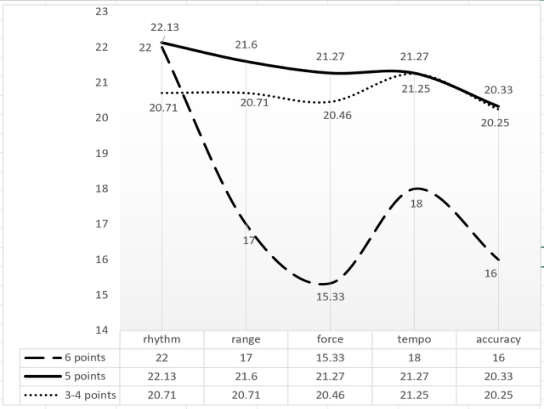
The highest arithmetic means of the evaluation scores of the violinist’s joint motor and artistic activities were found during the 5th session, when he declared a self-motivation of 5 points. The lowest, during one session, when he declared a motivation of 6 points. Only the ‘rhythm’ ratings were almost identical during the compared sessions. Almost identical results of ‘tempo, and ‘accuracy’ were found during sessions ending with self-motivation of
1476 Waszkiewicz and Kruszewski
5 points and during 8 sessions when the violinist declared motivation of 3–4 points. The teacher, irrespective of the violinist’s motivation, rated ‘rhythm’ the highest during all sessions (from 22 to 22.13 points), and ‘accuracy’ the lowest – once of 16 points, and during the other sessions from 20.25 to 2.33 points. On one occasion, the lowest score (15.33 points) was found during a session motivated by 6 points and concerned ‘force’ (Figure 1). There is a negative and weak correlation (r = −0.103) of self- motivation with the arithmetic mean of qualitative ratings of motor effects (movement characteristics) including artistic effects related to individual sessions, while a faint positive correlation (r = 0.038) when the sum of motivation indices during individual sessions is taken into account (in both cases the result applies to 14 observations). There is a positive and weak correlation (r = 0.131) of the sum of motivation indices during sessions with qualitative ratings of motor and artistic effects when the violinist declared self-motivation of 3–4 points during 8 sessions. The positive average correlation of these indicators (r = 0.457) is for self-declared self-motivation of 5 points during 5 sessions. These correlations are not statistically significant.
Figure 1: Qualitative evaluation of arithmetic mean scores of violinist’s motor and artistic effects during sessions differing in self-motivation (ordinal variable: scores from highest arithmetic mean to lowest for motivation of 5 points during 5 sessions).
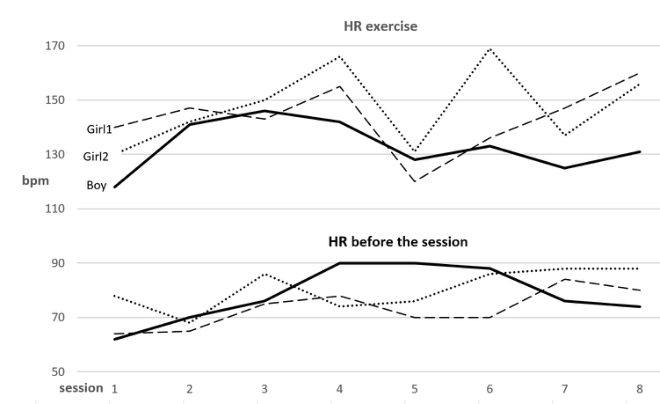
The similarity of the students’ physical efforts in terms of quality applies only to the second (the shortest: 32 minutes) and the third session (the longest: 61 minutes). In addition, before the start of the session, the most similar HRs were found during session two – Girl1 65, Girl2 68 and, Boy 70 beats per minute (Figure 2).
Measurement of Motivation and Qualitative Effects of Physical Effort 1477
Figure 2: Exercise intensity of physiotherapy students measured in beats per minute (bpm) and their HR before each safe fall session.
High positive correlations (r = 0.729, p<0.05 to r = 0.795, p<0.01) of duration with LOAD of individual sessions are evident. However, only statistically significantly (p<0.05) does motivation Girl2 before and after sessions (r = 0.737) correlate positively. Motivation of Girl1 after session with her HR exercises (r = 0.840, p<0.01), and motivation before with LOAD sessions (r = 0.714, p<0.05) correlate positively. Correlations of motivation and effort of Boy are negative: the higher the HR before sessions the lower the motivation to effort (r = −0.854, p<0.01); the longer the session the lower the motivation to continue effort (r = −0.729, p<0.01).
The most positive health effects of exercise of Girl1 and Girl2 are furthermore documented by the highest number of sessions (8 and 7 respectively, representing 87.5% and 75% of the observations) during which exercise was qualified to the high intensity zone. For Girl2, the average exercise intensity during the two sessions bordered on the very high zone (session six 88%, session four 86%). The majority of Boy efforts (62%) qualify for the average intensity zone, with session one, lasting 49 minutes, being the lowest: 61% of his HRmax. An effort based on the same exercises Girl1 performed at an intensity of 73% HRmax, indicating the high zone, and Girl2 at an intensity of 67%, qualifying it on the borderline of the high zone. There are also discrepancies in the motivation to exert effort during this session, before and after respectively: Boy 8÷7 points; Girl1 6÷6 points; Girl2 7÷8 points.
DISCUSSION
We found more differences than similarities between the use of methods to measure the effects of qualitative motor learning skills with extreme application in human activity. Safe fall, although qualifying as a separate
1478 Waszkiewicz and Kruszewski
speciality of modern preventive (complementary) medicine (Kalina, 2023a), is firmly rooted in hand-to-hand-combat practice. However, it is under- promoted both in the global sphere of science and in the prevention of injury, disability and death caused by falls (Dobosz et al., 2018). Recommendations for achieving motor proficiency in instrumental music have a centuries-old tradition, but at the same time fundamental shortcomings – lack justifications based on in-depth scientific knowledge of human motor skills.
The physical efforts and mental stresses that remain in connection with physical education, sport, military training, but also ergonomics and industrial medicine have been widely documented in the scientific literature for many years (e.g.: Christensen et al., 1960, Fibiger 1978, Penc and Szumbach 1978, Jethon et al., 1982, Smidt and Wirsberg 2009). Although the author of one of the few publications dedicated to ‘The Violinist’s Warm- up’ (Tomasik, 2020) alludes to the issue of the importance of warm-up in the practice of sport, he bases his proposals for the preparation of the violinist’s body (especially the fingers) on exercises specific to this particular motor activity – using the violin and bow. Meanwhile, e.g. jumpers (those representing various athletic competitions, ski jumper, diver, high diver, BASE jumper, etc.) do not start their training by performing these very specific and dangerous motor tasks.
Notwithstanding the validity of these general observations, the results of our preliminary research show the potential for the mutual implementation of many of the evaluation criteria developed in these two areas of motor learning. In the 25-point scale based on the assessment of musicians’ competences in the course of formalised education (Obwieszczenie, 2022), and adapted by us as mixed assessment (motor-artistic), it is enough to replace the word ‘artistic’ with ‘prevention’, for the assessments to converge in an evaluative sense. The motor component already contains at least two identical elements: ‘accuracy’ and ‘force’.
It is precisely the motor component of this mixed assessment that is an area of many innovative and cognitive opportunities. After all, the classification of movement characteristics by Schnabel (1987), legitimately criticised by experts in human motor science (Szopa et al., 1996), is neither a unique nor a definitive concept. If it is used in motor learning practice, it is still used selectively, according to the specifics of human motor activity. In our approach, we do not share Schnabel’s view that the ‘movement structure’ is most relevant. In our opinion, both in instrumental music and in the situational use of safe fall techniques, it is sufficient to assess ‘accuracy’ (degree of correspondence between the result and the target). By this we do not claim that ‘structure’ and ‘accuracy’ are synonymous in the classification of movement characteristics. We only emphasise the redundancy of ‘structure’ when using mixed assessment, whether motor- artistic or motor-prevention categories. Of ultimate practical importance is ‘situational actionability’ – the effect of a musical concert, avoiding death or injury from an unintentional or intentional fall, or minimising the negative consequences of such events, etc. This is why motor simulations are so important in safe fall educational practice (Kalina et al., 2008; Ga˛sienica- Walczak et al., 2010; 2023a; 2023b; Michnik et al., 2014; Kalina., 2018).
Measurement of Motivation and Qualitative Effects of Physical Effort 1479
It is only with regard to the violinist, participating in this research, that we have a basis for claiming the congruence of his ‘possibility of action’ with the ‘situational possibility of action’. During the Grade I violin final exam, he received 21 points, a very good grade. We have no knowledge of whether physiotherapy students have ever been involved in events requiring safe fall. Thus, the only criterion verifying this specific motor learning is the result of the ‘test of making safe falls’ (Kalina et al., 2003, 2008). completing the two-semester education. This test consists of four tasks, three of which are two-element tasks. That is, the test person performs 7 falls and the rating ‘possibility of action’ is also determined by the time of implementation – total points 100 or 95 and time of implementation 20 second means a rating of very good. Girls and Boy met these criteria, with the motor effect of each individual being assessed with a score of 95 points.
Each task of this test is evaluated according to a four-point scale: 25, 20, 15, 0. Thus, a score of 95 points means (simplifying the reasoning) that the average task score is 23.75 points. If the evaluation criteria of the ‘test of making safe falls’ were modified and the technique of each fall were assessed instead of the (mostly two-item) tasks, the differentiation of the marks would be more precise when using their arithmetic mean. An extreme score of 25 points would, in a sense, make the grades more like the criteria used in musician education – a score of 25 points would mean excellent, and from 21 to 24 points very good. In such a situation, it would be possible to monitor the effects of motor-prevention on a 25-point scale at those moments in a safe fall session when a specific fall technique is being practised. It would only be necessary to determine which movement characteristics, in addition to ‘accuracy’ and ‘force’, should still be evaluated, after all the leading element is the prevention factor. Thus, the results of observations during motor simulations of unintentional falls would be most valuable.
Such reasoning stimulates the imagination and directs attention to the possibility of improving the effectiveness of motor learning in the area of hand-to-hand combat practice. Especially from the perspective of human defence education – increasing one’s personal security in circumstances where repelling physical aggression is the only sensible way out of an extremely difficult situation.
Innovative ones include the results of correlating motivation with indicators of motor-artistic effects of adolescent violinists and, in the case of students, with indicators identifying quantitative and qualitative effects of physical effort. Motivation is not synonymous with arousal, ale the Yerkes–Dodson (1908) law, which addresses an empirical relationship between arousal and performance, may be useful in interpreting these results if balanced assumptions are made. The fact that the violinist’s highest motivation occurred during the session lowest rated by the teacher in terms of motor-artistic effects, may be derived from his self-assessment that he did not live up to his own expectations. After all, the teacher was not informing him of the results of his own observations, but in the circumstances of such low grades he must have heard far more criticism than in other sessions. Furthermore, a difference of only 1 point higher declared motivation
1480 Waszkiewicz and Kruszewski
from motivation when the observational results showed its highest motor- artistic effects, in the observed cycle, cannot provide an empirical basis for interpretations referring to the Yerkes–Dodson law. Furthermore, the results obtained using a simple 10-degree scale of motivation for physical exertion of violinists and students, which differ in both intensity and motor structure, do not validate interpretations based on contemporary applied psychology Work Extrinsic And Intrinsic Motivation Scale (Tremblay et al., 2009, Chrupała- Pniak and Grabowski, 2016). In this experimental approach, motivation is an element of measuring ‘possibility of action’ in a praxeological sense.
CONCLUSION Elements of measuring physical exertion (in fact physical and mental combined) and motor effects with a component of either artistic or prevention component during motor learning in the areas of instrumental music and motor skills related to human personal safety (safe falling, avoiding collisions, self-defence, skiing, etc.) can be mutually implemented to the benefit of public health in particular. The most appropriate way to pursue such a mission is through a complementary approach. The method identified with the cognitive layer, in our opinion, implies courage and responsible application SRM.
REFERENCES
Christensen, E. H., Hedman, R., Saltin, B. (1960) Intermittent and continuous running. Acta Physiol Scand; 50, 269–286. Chrupała-Pniak M, Grabowski D. (2016). Skala motywacji zewnetrznej i wewnetrznej do pracy (WEIMS-PL): wstepna charakterystyka psychometryczna polskiej wersji kwestionariusza Work Extrinsic and Irinsic Motivation Scale. “Psychologia Społeczna” (2016, nr 3, s. 339-355), DOI: 10.7366/1896180020163808 [in Polish]. Dobosz, D., Barczy´nski, B. J, Kalina, A., Kalina, R. M. (2018) The most effective
and economic method of reducing death and disability associated with falls. Arch Budo; 14: 239–246. Fibiger, W. Obcia˛˙zenie na stanowiskach pracy a wydolno´s´c fizyczna. Warszaw: Instytut Wydawniczy CRZZ 1978 [in Polish] Ga˛sienica-Walczak, B. Barczy´nski, B. J., Kalina, R. M., Kucio, C. (2010) The
effectiveness of two methods of teaching safe falls to physiotherapy students. Arch Budo; 6(2): 63–71. Ga˛sienica-Walczak, B., Klimczak, J. (2023a) Universal safe fall education – the missing pillar of prevention recommended by the WHO. Arch Budo Sci Martial Art Extreme Sport; 19: 67–74. Ga˛sienica-Walczak, B. Zachwieja J. (2023b) Cognitive Effects of Using the Modified
Fun Forms of Falling Method in Measuring the Susceptibility to Body Injuries During a Fall in Children. Applied Human Factors and Ergonomics and the Affiliated Conferences (AHFE 2023); 2023 Jul 20–24; San Francisco, USA. Healthcare and Medical Devices; 79: 316–324. Harasymowicz, J. (2011) Tradition of physical exercises and martial arts in actors’ education. Arch Budo 7(2): 65–71. Jethon, Z. Krasucki, P. Rogozi´nski, A. (1982) Normy fizjologiczno-higieniczne
w medycynie przemysłowej. Wydanie II poprawione i uzupełnione. Warszawa: Pa´nstwowy Zakład Wydawnictw Lekarskich.
Measurement of Motivation and Qualitative Effects of Physical Effort 1481
Kalina, R. M. (2012) Methodology of measurement, documentation and programming optimal workload continuous with variable intensity – applications in sports medicine, physiotherapy, geriatrics, health-related training, sport for all. Arch Budo; 8(4): 235–249. Kalina, R. M. (2018) Multidimensional tests as a fundamental diagnostic tool in the prophylactic and therapeutic agonology – the methodological basis of personal safety (Part II: motor and psychomotor multidimensional tests). Arch Budo Sci Martial Art Extreme Sport; 14: 1–14. Kalina, R. M. (2023a) Complementary Medicine – An Example of the Application
of the Basic Research Method of Innovative Agonology. Proceedings of the 14th International Conference on Applied Human Factors and Ergonomics and the Affiliated Conferences (AHFE 2023); 2023 Jul 20-24; San Francisco, USA. Healthcare and Medical Devices 2023; 79: 316–324 Kalina, R. M. (2023b) Methodology of complementary research as the basis for integrating science in fulfilling its social mission in the future. Arch Budo 19: 77–82. Kalina, R. M., Barczy´nski, B. J., Jagiełło, W., Prze´zdziecki, B., Kruszewski, A.,
Harasymowicz, J., Syska, J., Szamotulska, K. (2008) Teaching of safe falling as most effective element of personal injury prevention in people regardless of gender, age and type of body build – the use of advanced information technologies to monitor the effects of education. Arch Budo 2008; 4(4):82-90 Kalina, R. M. Dłubacz, N. Zachwieja, J. Pilarska, E. Dobosz, D. Gasienica-Walczak, B. Kruszewski, A. (2022) Innovative method of diagnosing the susceptibility to the body injuries during the fall of children from 2 to 6 years. Arch Budo Sci Martial Art Extreme Sport 18: 211–228. Kalina, R. M., Kruszewski, A., Jagiełło W. Włoch, G. (2003). Combat sports
propedeutics – basics of judo. Warszawa: Akademia Wychowania Fizycznego Kotarbinski, T. (1965) Traktat o dobrej robocie. Wrocław: Zakład Narodowy im Ossoli´nskich [in Polish]. Michnik, R, Jurkoj´c J, Wodarski, P. Mosler, D. Kalina, R. M. (2014) Similarities and
differences of body control during professional, externally forced fall to the side performed by men aged 24 and 65 years. Arch Budo; 10: 233–243 Niemira, M. (2025) Jak zdoby´c rozwija´c i utrzyma´c technike pianistyczna˛. Wydanie czwarte. Warszawa: Twoje Zdrowie Sp. z o.o. [in Polish]. Nowaczyk, A., ˙Zołnowski, Z. (1974) Logika i metodologia bada´n naukowych dla
lekarzy. Warszawa: Pa´nstwowy Zakład Wydawnictw Lekarskich [in Polish] Obwieszczenie Ministra Kultury i Dziedzictwa Narodowego z dnia 21 grudnia 2022 r. w sprawie ogłoszenia jednolitego tekstu rozporza˛dzenia Ministra Kultury i Dziedzictwa Narodowego w sprawie oceniania, klasyfikowania i promowania uczniów w publicznych szkołach artystycznych. Warszawa: Dziennik Ustaw Rzeczypospolitej Polskiej. Poz. 147 [in Polish]. Penc, J., Szumbach, S. (1978) Ergonomia przemysłowa a wydajno´s´c pracy. Warszawa: Instytut Wydawniczy CRZZ [in Polish]. Pszczołowski, T. (1978) Zasady sprawnego działania: wstep do prakseologii. 6th ed.
Warszawa: Wiedza Powszechna 1978 [in Polish; the indices of terms: English, French, German, Russian]. Schnabel, G. (Hrsg.) (1987) Methoden zur Gewinnung empirischen Wissens.
In: Forschungsmethoden in sportmethodischen Wissenschaftsdisziplinen. Wiss. Ztschr. DHfK. Sonderheft. Leipzig nr 3. [in German]. Schmidt, R. A., Wrisberg, C. A. (2008) Motor Learning and Performance. A Situation-Based Learning Approach. Fourth Edition. Human Kinetics.
1482 Waszkiewicz and Kruszewski
Szopa, J., Mleczko, E., ˙Zak, S. (1996) Podstawy antropomotoryki, Warszawa- Kraków. Wydawnictwo Naukowe PWN. [in Polish] Tomasik, S. (2020) The Violinist’s Warm-up. Warszaw-Kraków: Polskie Towarzystwo Muzyczne. Tremblay, M. A., Blanchard, C. M., Taylor, S., Pelletier, L. G., Villeneuve, M.
(2009). Work Extrinsic and Intrinsic Motivation Scale: Its value for organizational psychology research. Canadian Journal of Behavioural Science/Revue Canadienne des Sciences du Comportement, 41 (4), 213–226, doi: 10.1037/ a0015167. Yerkes, R. M., Dodson, J. D. (1908). The relation of strength of stimulus to rapidity of habit-formation. Journal of Comparative Neurology and Psychology 1908; 18(5): 459–482.
LISTED IN THE AHFE DIGITAL BOOKSTORE CATALOGUE
Explore the complete digital volume
Human Factors in Design, Engineering, and Computing
Read this individual research paper free through the original publisher, or explore the full digital proceedings book.
ISBN 978-1-964867-35-9
Explore this ISBN in the AHFE Bookstore ↗Listed in the July 2026 bookstore catalogue; search by ISBN to confirm current availability · Digital book purchase optional