Jasmin Dell’Annaa, Armin Janssa, Melanie Blaarb (2021). Analysis of User-Induced Risks in the Neurosurgical OR. In: Advances in Human Aspects of Healthcare. AHFE Open Access, vol. 13. https://doi.org/10.54941/ahfe100483
In the last decades, the number of user interfaces in the OR has considerably increased. Additionally, time pressure forces the surgeons to perform tasks in parallel. The major objective of our work, in the framework of the OR.NET project, was therefore to analyze the present situation in the neurosurgical OR in order to identify potential use-oriented risks and additionally provide proposals for appropriate countermeasures. We analyzed the workflow of 25 neurosurgical procedures with the workflow analysis tool mAIXflow and developed questionnaires for surgeons and nurses. We found that the usage of the navigation system, the CUSA ultrasonic aspirator, and the PACS-PC induced potential risks. Furthermore, various disruptive factors have been identified, such as phone calls during the intervention, longer absence of the unsterile nurse or shifted foot switches. The aforementioned problems may lead to risks, such as erroneous treatment of the patient, a prolongation of anesthesia, or use errors, due to an inappropriate cognitive workload of the surgeon. For risk reduction in case of use deficiencies, we propose the use of a sterile integrated user interface in a networked OR. To enhance communication, team-trainings could be helpful, and the setup of a mailbox could reduce the number of intraoperative phone calls.
In the last decades the number of devices for surgical interventions has considerably increased, supplying the surgeons with new technical options but at the same time overwhelming them with lots of different complex tasks, user interfaces and interaction concepts. Additionally, the time pressure on the surgical team permanently increased due to economic reasons, forcing them to perform several tasks at the same time. All these changes of external performance shaping factors (PSFs) might lead to a higher cognitive workload, favoring latent operating and treatment errors.
The more complex a product or a user interface, the more difficult it is to identify and prohibit human centered risks. This is problematic, since human errors are, according to several studies, the main reason for critical incidents, if technical devices are introduced and used in a medical context (Radermacher et al., 1992, Rau et al., 1996, Zimolong et al., 2003). There are many surveys of adverse events and (human) errors in medicine. They report on a rate of 40-50% of errors in the hospitals occurring in the OR (Cuschieri, 2006, Brennan et al., 2004, Kohn et al., 1999). Conflicts arise between the different occupational groups in the hospital, such as resource bottlenecks in patient care due to profit optimization goals defined by the hospital management (Cuschieri, 2006). The usage of medical devices is a major cause for critical incidents. Mostly, any device works according to its specifications, but a poorly designed user interface often leads to incorrect use by the clinical staff, and consequently to risk for patients, medical personnel and third parties (Zhang et al., 2005, Cooper et al., 2002, Hyman, 1994). Another important factor in error emergence is the social component. In this regard, aspects like communication, information flow, workload and competing tasks play an important role (Christian et al., 2006).
It is a fact that neurosurgery is an extremely risk-sensitive discipline, and patients are often suffering a life- threatening disease. This increases the risk of the intervention and considerably influences the therapy outcome (Weingart et al., 2000). Moreover, in neurosurgical interventions different medical devices have to be handled by medical personnel, such as the X-ray C-arm, the navigation system, the electrophysiological system, the CUSA (Cavitron Ultrasonic Surgical Aspirator), various HF-devices for coagulation and cutting, the microscope, the endoscope, and many more.
The major objective of this study in the framework of the OR.NET project was therefore to analyze the present situation in the neurosurgical operation room of the University Hospital Aachen with focus on the interpersonal communication, Human-Machine-Interaction, and disruptive factors in order to identify potential risks and additionally provide proposals for appropriate countermeasures. The aim is to facilitate the work for surgeons and the surgical team, and to enhance the safety for the patient.
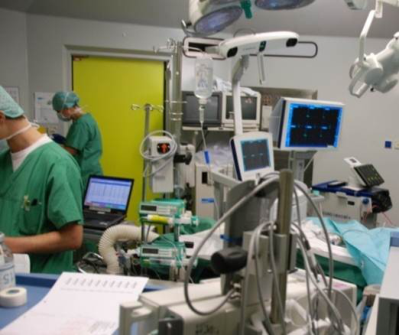
Figure 1: Exemplary situation in the neurosurgical OR at the University Hospital Aachen, Germany
MATERIAL AND METHODS 25 computer-assisted neurosurgical interventions have been analyzed over a period of 6 weeks. There was no prioritization of certain interventions in order to get a representative cross-section. The interventions observed were 17 cranial , 4 spinal, and 4 skull base (pituitary gland). For workflow documentation the workflow analyzing tool mAIXflow (developed by the Chair of Medical Engineering, Aachen, Germany, figure 2) was used. The workflow documentation focused on communication, device usage and disruptive factors. In order to analyze communication, the observation of the OR personnel has been divided into sterile and unsterile persons. The types of communication have been subdivided into four categories: assignment, question, explanation and information. These terms are defined as follows: Assignments are direct orders from one person to another. Questions concern medical and organizational issues and device handling. Explanations serve the education of new personnel and for comprehension of processes or device handling. Information includes statements about vital or device parameters and actual activities. The classification of communication into these four fields was chosen, inter alia, with the aim to identify use deficiencies of medical devices, e.g. by a higher number of questions and explanations during the interaction with certain devices.
In addition to the workflow analysis, questionnaires have been handed out to surgeons, nurses and electrophysiology assistant, in order to get a subjective assessment of the working situation in the OR.
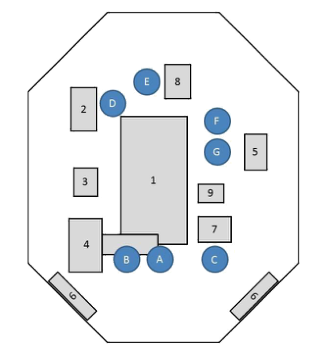
Figure 2. left: Workflow analyzing tool mAIXflow right: Sketch of the intraoperative set-up in the neurosurgical OR at the University Hospital in Aachen, Germany(1 OR table, 2 anaesthesia workstation, 3 HF device, 4 microscope, 5 navigation device or X-ray device, 6 PC and monitor, 7 table for sterile instruments, 8 electrophysiology, 9 CUSA device, A surgeon, B surgical assistant, C sterile nurse, D anaesthesiologist, E neurophysiology technician, F and G unsterile nurses)
For risk analysis the problems observed have been assessed and possible causes and errors have been derived. Based on these causes and errors, risks have been identified and evaluated and appropriate countermeasures have been proposed.
RESULTS
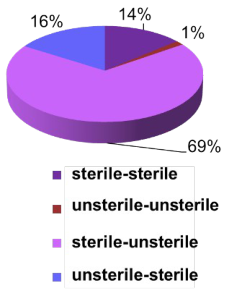
With 69%, the main part of the total communication in the OR takes place from sterile to unsterile surgical personnel, whereas only 1% takes place between unsterile personnel. Concerning the communications of sterile to unsterile personnel, assignments play the main role with 77%. Conversely, the communication from unsterile to sterile personnel does not include assignments at all, but 73% communication related to questions, followed by 26% related to information given. Between sterile personnel, there was no communication related to explanations observed at all, but only questions (56%), assignments and information (both 22%). Between unsterile personnel the percentages of the communication types are more or less equally distributed. (Figure 3) The percentage of communication between surgeon and anesthesia has been 5% of the overall communication. Remarkably, a lack of communication has been complained in the questionnaires by both, surgeons and anesthesiologists.
Figure 3: Communication in the neurosurgical OR
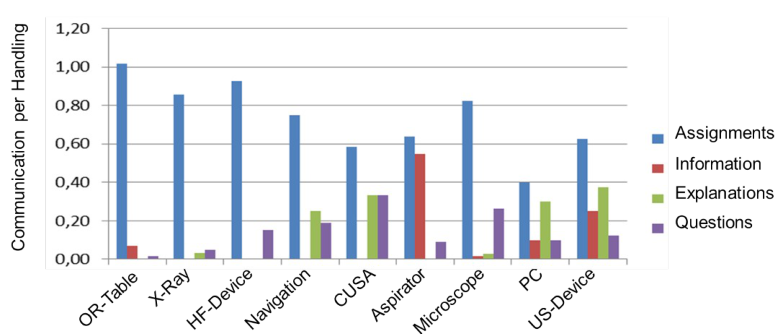
Regarding the human-machine-interaction there has been a higher number of explanations when using these devices: the navigation system, the CUSA, the PC-system for KIS/PACS and the ultrasound device (Figure 4). This can be an indication for usability problems, which has been also confirmed by the surgeons: For the CUSA, the PC and the Micro-Doppler-Ultrasounic device the surgeon indicated (in questionnaires) that it is particularly disturbing not to be able to handle these devices by their own, but only through the help of the unsterile nurse.
Figure 4: Communication related to Device Handling
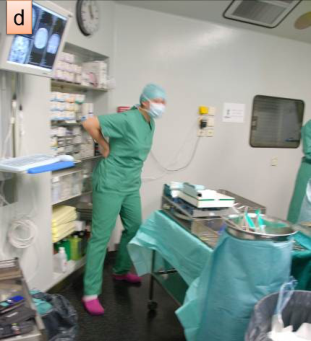
During the 25 different operations many disruptive factors have been identified. The most frequent disturbance has been due to telephone calls (figure 5a, 5b). 109 telephone calls all in all and up to 9 calls per intervention could be observed, and surgeons as well as nurses felt disturbed, also according to their statements in the questionnaires. Another disturbing factor was the absence of the unsterile nurse (38 times), for a time period of up to 8 minutes, where only the anesthesiologist was present in the unsterile area. Problems with foot switches could be observed 27 times (figure 5c). In most cases a wrong switch was activated or a shift or drop of the switches occurred. In these cases the intervention had to be interrupted until the surgeon himself or the unsterile nurse rearranged the foot switch. Furthermore, the employment of nurses from other disciplines, who had to be instructed by the local nurses, caused additional communication (28 questions) and a delay in the process. The necessity of transports of heavy medical devices into or out of the OR during the interventions (15 times) led to interruptions and has also been criticized by both surgeons and nurses. In addition to this, lots of cables and tubes cross the ways of OR personnel and the limited space in the OR impeded mobility of the staff (figure 2 right, figure 5d, 5e and 5f).
Figure 5: Adverse performance shaping factors in the OR: a,b) intraoperative phone calls, c) dropped foot switch, d) limited space, e) traps due to cables, f) cables and tubes at the anesthesia workstation
The aforementioned problems may cause various errors and may lead to risks for patients and the surgical team. Limited space and tripping hazards may cause a loss of sterility and risk of infections. Furthermore tripping hazard may cause tumble and provoke injuries of the surgical team as well as of the patient. Shifted foot switches or misunderstandings of assignments may on the one hand cause use errors and lead to the risk of inadequate treatment of the patient. On the other hand this enhances general risks due to prolongation of intervention and anesthesia. This also holds true for all other time delays and disruptive factors, such as the instruction of an unexperienced nurse, the interim transport of medical devices, the absence of the unsterile nurse, or phone calls. Furthermore, parallel tasks such as talking on the phone, and interruptions as well as questions increase the work load of the surgeon, which may lead to treatment errors on different levels of human tasks and may potentially threaten the health of the patient.
To reduce the identified risks emerging from communication and organization errors, preoperative safety-briefings, check-lists and team-trainings seem to be helpful to standardize and enhance processes in the OR. In preoperative safety briefings, the complete surgical team, including the anesthesiologist and the unsterile nurses, should talk about the intervention, about required devices and materials, and go through a specific check list (DeFontes et al., 2004, Rosenfield et al., 2010, Lingard et al., 2005). This should reduce the number of cases in which heavy or bulky medical devices, such as the X-ray C-arm or the navigation system, had to be pushed into the OR or taken out of the OR during the intervention. Moreover, a daily briefing might lead to a better understanding within the surgical team and enhance communication. Related time needed for these briefings should be easily compensated by intraoperative time-savings.
The number of phone calls during the interventions could be reduced by the use of a mailbox or an emergency number. Usability problems could be reduced by an optimized alignment of devices, in order to enhance the view on device displays. Moreover, the use of devices with sterile user interfaces could be an efficient countermeasure for usability problems. If the surgeon was able to use devices autonomously without the help of the unsterile nurse, problems resulting from misunderstanding or lack of experience could be avoided.
DISCUSSION
This study delivered insight into the daily processes in a neurosurgical OR and pointed out various problems, which surgeons and nurses experience every day. These problems were analyzed, emerging risks could be identified and countermeasures could be derived. For the surgical team many results of the analysis were an affirmation of what they already assumed, but some results were still revealing. Two exemplary risks are the high number of 109 telephone calls in total, and the absence of the unsterile nurse for a time period of up to 8 minutes. These two examples show that the workload for both surgeons and nurses can be high, due to minimized staff on one hand, or due to multiple parallel tasks and resulting ergonomic limitations. An optimization of device/interface usability and alignment in integrated work stations (e.g. processed and represented physiological data at the surgical cockpit) could significantly enhance the work situation for surgeons and hereby reduce potential risks for patient and surgical team.
One main objective of our ongoing work are further analyses of workflows and additional interventions with focus on information availability and presentation to the surgeon, such as preoperative patient image data or intraoperative diagnostic data, with the aim to identify bottlenecks and to enhance the corresponding processes.
The development of a multimodal modular “surgical cockpit” as a central user interface in an integrated OR could enable the surgeon to operate medical devices on his own in a more consistent and efficient manner. This should work without the help of a third person, and could reduce the demand for unsterile personnel. However, in contrast to actual monolithic integrated OR solutions, future integrated OR solutions should enable a flexible and modular integration of devices and human-device-interfaces into a consistent surgical work place (Benzko et al., 2011, Ibach et al., 2006). The development of related concepts and standards is the main objective of the project OR.NET (www.ornet.org).
ACKNOWLEDGEMENT
This study has been funded in part by the Federal Ministry of Education and Research (BMBF) in the framework of the OR.NET project (OR.NET - Secure Dynamic Networking in Operating Room and Clinic; grant No. 16KT1203).
REFERENCES
Benzko, J., Ibach, S., Radermacher, K. (2011) „Der Traum vom Plug and Play im OP“, in: MED Engineering 3-4, pp. 76-79 Brennan, T.A., Leape, L.L., Laird, N.M., Hebert, L., Localio, A.R., Lawthers, A.G., Newhouse, J.P., Weiler, P.C., Hiatt, H.H.
(2004), “Incidence of adverse events and negligence in hospitalized patients: results of the Harvard Medical Practice Study”, in: Qual Saf Health Care; pp. 145-152 Christian, C.K., Gustafson, M.L., Roth, E.M., Sheridan, T.B., Gandhi, T.K., Dwyer, K., Zinner, M.J., Dierks, M.M. (2006), “A prospective study of patient safety in the operating room”, in: Surgery; Volume 139(2): pp. 159-173 Cooper, J.B., Newbower, R.S., Long, C.D., McPeek, B. (2002), “Preventable anesthesia mishaps: a study of human factors”, in:
Qual Saf Health Care, Volume 11, pp. 277-283 Cuschieri, A. (2006), “Nature of Human Error: Implications for Surgical Practice”, in: Annals of Surgery; Volume 244(5), pp.
642-648 DeFontes, J., Surbida, S. (2004), “Preoperative Safety Briefing Project”, in: The Permanente Journal, Volume 8 No. 2 Hyman, W.A. (1994), “Errors in the Use of Medical Equipment”, in: Bogner, M.S. (Ed.), Human Error in Medicine, Lawrence Erlbaum Associates, Inc, pp. 327-348 Ibach, B., Zimolong, A., Portheine, F., Niethard, F.U., Radermacher, K. (2006) “Integrated Medical Workstations for Computer
Integrated Smart Surgery (CISS) – State of the art, bottlenecks and approaches”, in: International Journal of Computer Assisted Radiology and Surgery, Proceedings CARS (Suppl. 1), Springer, Volume 1, pp. 449-451 Kohn, L.T., Corrigan, J.M., Donaldson, M.S., McKay, T., Pile, K.C. (1999), “ To Err is Human: Buildung a Safer Health System”, National Academy Press, ISBN 0-309-06837-1 Lingard, L., Espin, S., Rubin, B., Whyte, S., Colmenares, M., Baker, G. r., Doran, D., Grober, E., Orser,B., Bohnen, J.,
Reznicket, R. (2005), “Getting teams to talk: Development and pilot implementation of a checklist to promote interprofessional communication in the OR”. In: Qual Saf Health Care, Volume 14, pp. 340–346
Radermacher, K., Pichler, C. v., Rau, G. (1992), „Aspekte der Minimalen Invasiven Chirurgie - Analyse und Ansätze im Bereich der Ergonomie“ in: Journal for Biomedizinische Technik, Volume 37, Addendum 2, pp. 210-211 Rau, G., Radermacher, K., Thull, B., Pichler, C. v. (1996), “Aspects of an Ergonomic System Design of a Medical Worksystem”,
in: Taylor,R., Lavallée, St., Burdea, G., Moesges, R. (eds.): Computer Integrated Surgery, MIT-Press, Cambridge, MA, pp.203-221 Rosenfield, L. K., Chang, D. S. (2010), “The Error of Omission: A Simple Checklist Approach for Improving Operating Room Safety”, in: Journal of Plastic and Reconstructive Surgery, Volume 123(1), pp. 399-402 Weingart, S.N., Wilson, R.M., Gibberd, R.W., Harrison, B. (2000), “Epidemiology of medical error”, British Medical Journal;
Volume 320, pp.774–777 Zhang, J., Patel, V.L., Johnson, T.R., Chung, P., Turley, J.P. (2005), “Evaluating and Predicting Patient Safety for Medical Devices with Integral Information Technology”, in: Advances in Patient Safety; Volume 2, pp. 323-336 Zimolong, A., Radermacher, K., Stockheim, M., Zimolong, B., Rau, G. (2003), “Reliability Analysis and Design in Computer-
Assisted Surgery”, in: Stephanides C, et al (Eds.). Universal Access in HCI. Lawrence Erlbaum Ass. Publ., pp. 524-528
LISTED IN THE AHFE DIGITAL BOOKSTORE CATALOGUE
Explore the complete digital volume
Advances in Human Aspects of Healthcare
Read this individual research paper free through the original publisher, or explore the full digital proceedings book.
ISBN 978-1-4951-2093-0
Explore this ISBN in the AHFE Bookstore ↗Listed in the July 2026 bookstore catalogue; search by ISBN to confirm current availability · Digital book purchase optional