Jussi Haapasaari, Taneli Nyyssönen, Dennis Bengs, Eero Nirhamo, Tommi Immonen, Joni Rajamäki, Mikael Manngård, Teijo Lehtonen (2026). Usability Testing of Virtual Reality for Visualizing Indoor Smoke Propagation and Extraction. In: Human-Computer Interaction & Emerging Technologies. AHFE Open Access, vol. 233, pp. 341–351. https://doi.org/10.54941/ahfe1007534
The paper presents the design and usability evaluation of an interactive virtual reality (VR) application for visualizing smoke propagation in large indoor spaces. The application visualizes smoke dynamics derived from computational fluid dynamics simulations and aims to provide a more intuitive and exploratory means of interpreting simulation results compared to traditional post-processing tools. The paper investigates whether immersive VR improves the perception of smoke behavior in complex environments and supports the verification and validation of smoke-extraction system designs. A usability study was conducted with participants of varying levels of experience in VR and smoke-extraction system design. User interaction data, task completion metrics, observations, and post-study questionnaires were collected to assess usability, learnability, and perceived usefulness. The results indicate that VR enables clearer perception of smoke movement, airflow direction, and temperature distribution, and supports exploratory interaction with simulation data. While novice VR users initially experienced difficulties with basic interactions, all participants were able to complete the tasks, and overall usability ratings were high. Domain experts highlighted the potential of VR as a complementary tool to physical smoke tests, particularly for early-stage design evaluation.
Smoke is widely recognized as one of the primary causes of injury and fatalities in fire incidents in buildings and ships (Klote and Zile, 1982). Smoke often obscures evacuation routes and can spread and accumulate in areas remote from the fire source, thereby delaying the evacuation. Adequate testing of indoor safety systems, such as fire detection, ventilation, and smoke-extraction systems in buildings, is therefore essential during both the design and commissioning phases of projects. Numerical testing based on computational fluid dynamics (CFD) is increasingly used during the design of buildings to analyze smoke and fire propagation (Weng et al., 2014; Chang et al., 2003) and to assess human behavior in evacuation scenarios (Korhonen and Hostikka, 2009; Ronchi and Nilsson, 2013). However, Received February 6, 2026; Revised April 8, 2026; Accepted April 23, 2026; Available online July 20, 2026
CFD simulations are generally accessible only to domain experts, as they require specialized expertise, complex setup and validation procedures, and CFD-specific visualization tools. This complexity limits their usability for non-expert stakeholders who could otherwise benefit from intuitive access to simulation results (Solmaz and Van Gerven, 2022). Virtual reality (VR) has the potential to improve the accessibility of CFD simulation visualization for users who are not CFD experts, provided that it offers intuitive interaction and effective perception of smoke propagation.
This paper presents a usability study of a VR–based smoke-extraction application designed to visualize smoke propagation, enable monitoring temperature distributions, and support the validation of automated smoke- extraction control logic in indoor environments. The main research questions of the study are to find out:
How can a realistic and high usability smoke simulation be implemented in VR?
What features are important for VR smoke extraction simulation?
What advantages does VR provide over other methods for smoke extraction simulation?
Furthermore, we assess whether VR enables more exploratory and intuitive approaches to the verification and validation of smoke-extraction system designs.
The scope of this study is limited to usability testing of the exploration and the interaction with the visualization of smoke properties and temperature at different locations in the scene. This work does not include in-depth analyses of flow characteristics, smoke visibility, or human behavior within the scene. Direct comparisons with CFD visualization tools outside of VR were not conducted.
RELATED WORKS Traditionally, CFD results are analyzed and visualized in domain-specific post-processing tools that support quantitative flow analysis but offer limited support for high-level interpretation or interactive tasks. The integration of VR as a means to visualize and explore CFD results remains limited. VR has been applied to simulate fire emergency scenarios in both human-behavioral and safety-related studies (Cha et al., 2012; Lorusso et al., 2022). In particular, Lorusso et al. (2022) demonstrated the potential of VR for realistic fire scenario simulation based on CFD-generated fire and smoke data. Related work has also examined the effects of smoke on visibility and human movement during evacuation (Davis et al., 2023; Wahlqvist and Rubini, 2023), as well as human behavior in fire emergency situations (Oliva et al., 2019; Wheeler et al., 2021). However, usability-focused research on the interpretation and analysis of CFD data in VR-based engineering contexts remains limited.
In the broader domain of architecture, engineering, and construction, prior studies show that VR matches or improves usability compared to traditional methods, particularly in educational and training applications, with no increase in cognitive load and higher user engagement and knowledge retention (Henstrom et al., 2023; Beh et al., 2022; Safikhani et al., 2022; Solmaz
Usability Testing of Virtual Reality for Visualizing Indoor Smoke Propagation 343 and Van Gerven, 2023). Nevertheless, these studies primarily focus on static or geometric tasks, leaving the usability and perceptual effectiveness of VR for visualizing dynamic data, such as CFD simulation results, largely unexplored.
To address this gap in literature, this work studies the usability of VR for visualizing CFD results through a scenario involving the propagation and extraction of smoke in an indoor environment.
SYSTEM OVERVIEW The VR application design includes the 3D scene, interaction mechanics, and smoke visualization variations.
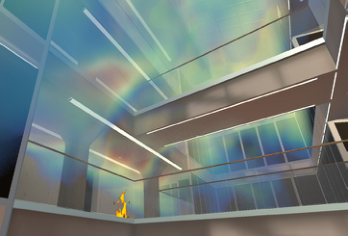
The scene in the VR application recreates the lobby of the Auriga Business Center, Turku, Finland. The lobby consists of five floors arranged around a central atrium, with an additional glass roof level for an overview of smoke propagation. Screen captures from the scene are presented in Figure 1 and Figure 2. The same base 3D model is used both for the smoke simulations and for the visual presentation in the Unity application. Details on the creation of the scene are outlined in the Technical implementation section.
The application visualizes smoke using three modes that balance global overview and local inspection (Figure 2). In cloud mode, smoke is rendered as a volumetric cloud for perceiving overall spread. In cutter and plane modes, an interactive cross-section plane is used to reveal internal structure: cutter shows smoke on one side of the plane, while plane shows only the slice itself. Cutter and plane modes also display airflow vectors, where direction indicates airflow direction and vector length increases with air speed.
Users can switch between multiple color maps to improve interpretability. Gradient-based maps use brighter values to indicate higher local smoke particle concentration. The available schemes include black, white, red– turquoise, green–blue, and yellow–pink (Figure 2). The system also included language selection (Finnish and English), illustrations of the objectives and controls in the application, and clear feedback of actions (sound accompanying task completion). Each mechanic contained floating tutorials that could be navigated back and forth by the test users, and the objectives contained check-boxes that were marked once completed to give a visual sense of progression.
Figure 1: Screen captures from the VR scene. (a) View from the first floor looking upwards into the atrium as red–turquoise smoke has spread through the lobby area. (b) Tutorial panel on the fourth floor, with the timeline slider open for controlling the simulation time.Figure 2: Variations of smoke visualization modes in the VR application shown as a 5×3 grid. Columns correspond to different smoke colours (from left to right: black, white, yellow–pink, red–turquoise and green–blue), while rows correspond to visualization modes (top to bottom: cloud mode, cutter mode and plane mode). (a–e) cloud mode; (f–j) cutter mode; (k–o) plane mode.
Figure available in the original PDF paper.
Controller inputs are role-based: the right controller primarily supports navigation and smoke visualization, while the left controller supports inspection and time controls. The controls are listed in Table 1. The fire source burns for ~22 s, while smoke propagation continues to ~60 s before looping.
The tutorial introduces locomotion and UI interaction, then smoke playback and color changes (Floor 1), probe placement inside a highlighted volume (Floor 2), cross-section control and cutting a target cube (Floor 3), and simulation time and ventilation controls with a recap that repeats key actions to reinforce learning (Floor 4).
TECHNICAL IMPLEMENTATION The application, developed in Unity, runs on a Meta Quest 3 headset wired to a laptop and uses single-pass rendering at 72 fps. Smoke dynamics were generated with Fire Dynamics Simulator (FDS), a widely used CFD-based fire and smoke simulation tool developed by the U.S. National Institute of Standards and Technology (McGrattan et al., 2013). FDS was used to produce physically plausible time-varying volumetric fields, including temperature, air velocity, and soot visibility. The lobby geometry was captured from a real building using Polycam and cleaned in Blender. Because FDS input geometry is specified via text-based primitives, manual authoring is impractical for complex scenes; therefore, a Blender-based FDS extension was used to convert the model into simulation-ready primitives. Key simulation parameters (domain size, grid resolution, and time step) were tuned due to their impact on accuracy, runtime, and exported data volume. To emulate smoke-extraction behavior, a proof-of-concept alarm state machine was implemented to monitor smoke detector states and enable ventilation and fire sources; the logic runs alongside FDS in Python.
Table 1: Tutorial task definitions and their primary inputs. Button codes: RT = right thumbstick (locomotion; probe distance control), LT = left thumbstick (move cross- section plane), S = squeeze/grip (grab probes), I = UI ray trigger, A = right primary (cycle smoke colors) B = right secondary (cycle smoke modes), X = left primary (change cross-section axis), Y = left secondary (activate the timeline slider).
Table available in the original PDF paper.
ID Label Action F1T1 Start the fire Press the UI button in the first panel to start the fire (I)
F1T3 Cycle smoke colors (1 full cycle) Cycle through all 5 smoke colors once (A) F2T1 Spawn probes Press the UI button to spawn probes (I)
F2T2 Place probe into nearby cube Grab and move a probe into a nearby cube (S, RT) F3T1 Reveal smoke cross-section Press the UI button to reveal the smoke cross-section (I)
F3T2 Enable cross-section controls Press the UI button to enable cross-section controls (I) F3T3 Cross-section plane positioning (Y-axis) Switch the cross-section plane to Y axis and move it to cut the highlighted cubes in half (X, LT)
F3T4 Cycle cross-section modes to Cloud mode
Cycle through modes until Cloud mode is active again (B) F4T1 Open timeline slider Open the timeline slider for the first time (Y)
F4T2 Scrub timeline (first interaction) Engage the timeline slider to edit simulation time (I) F4T3 Pause/resume simulation time Pause and then unpause simulation time (I)
F4T4 Toggle vents on/off (first cycle) Use UI buttons to turn vents on and then off (I) F4T1R Cycle smoke colors (recap) Cycle through all 5 smoke colors once (A)
F4T2R Place probe into distant target cube (recap)
Grab a probe and place it into a highlighted cube far from the player (S, RT)
Switch the cross-section plane to Z axis and move it to cut the highlighted cubes in half (X, LT)
F4T4R Cycle cross-section modes to Cloud mode (recap)
Cycle through modes until Cloud mode is active again (B) FDS outputs (2D slices and 3D scalar fields) are typically visualized using the included Smokeview tool. However, these output formats are not compatible with the Unity engine.
Simulation outputs were therefore exported to a custom binary format designed for compact storage. The format encodes time-varying volumetric data, which is parsed by a custom importer within Unity.
Smoke is rendered in Unity using GPU-based ray marching (Zhou et al., 2008; Viktorsson, 2022), where rays sample the volumetric field to support extinction-based compositing, clipping planes, and value-dependent color mapping (Engel et al., 2004). We apply this to time-varying soot visibility to produce animated volumetric smoke.
Airflow is visualized using animated arrow-based flowlines sampled from the velocity field (Figure 2). To meet VR performance constraints, ray- marching sample density is adapted to the available frame budget. Simulation data are imported from a compact binary format as time-indexed 3D textures resident in GPU memory, allowing both smoke and flow visualization to run without per-frame CPU processing.
METHODOLOGY
The research methodology followed by this study is Design Science Research Methodology for Information Systems Research (DSRM) by Peffers et al. Peffers et al. (2007). The methodology consists of the following phases: identify a problem, define objectives, design and develop, demonstrate the artifact, evaluate performance, and communication Peffers et al. (2007); Hevner et al. (2004); Järvinen (2007). In the context of this research, the IT artifact is the smoke-extraction VR-application, while the problem that is to be solved is how to improve smoke-extractor system designing and how VR compares with the currently widely utilized methods: physical testing and 2D-applications. The participants of the study were recruited utilizing both purposive and convenience sampling. For the purposive sampling, test users were recruited among project participants with knowledge related to smoke-extraction system utilization. These include six participants with hands-on experience on physical smoke-extractor testing. The idea was to acquire realistic evaluations of the designed system’s positives and negatives from test users with sophisticated level of understanding of the topic. Additionally, test users were picked from both academia and industry, to compare how the background impacts the evaluations and test performance. Furthermore, convenience sampling was used to recruit test users among project partners, with a goal of maximizing the sample size together with disseminating for project partners. Another goal with this was to see how much the perspectives and opinions between inexperienced and experienced smoke-extractor system users differ.
The test began by presenting each test user with a consent form outlining study phases, objectives, and data collection to be signed, to ascertain informed consent. This was followed by instructions about the nature of VR (boundary system) and how the VR-goggles and controllers work. Nineteen participants completed the study. Each session was overseen by two facilitators. Verbal guidance was permitted following a consistent protocol: participants first attempted tasks independently and were assisted if they were unable to progress. All participants completed a post-test questionnaire assessing usability, perceived usefulness, and perceived clarity of smoke behavior. The questionnaire contained questions with a 5-option
Usability Testing of Virtual Reality for Visualizing Indoor Smoke Propagation 347 Likert scale and the options ”Fully disagree, somewhat disagree, neutral, somewhat agree, and fully agree”, scale of 1-10 questions, and open-ended questions. The questionnaire also queried users’ basic demographic related questions such as age, sex and past experience with VR and smoke extraction systems. In parallel, facilitator observations and assistance events were noted.
RESULTS AND DISCUSSION
Test user questionnaire results are shown in Table 2. Most participants had little VR and smoke extractor systems experience. Respondents of both affiliations had familiarity with the marine industry and a number of industry affiliated participants verbally reported familiarity with real-world smoke extraction systems during testing. Respondents who selected “Moderately experienced” or “Expert” were categorized as experienced users of VR and smoke extraction systems.
Table 2: User demographics.
Table available in the original PDF paper.
User Demography Participants VR experience Little or no 15 Experienced 4
Smoke extractor system experience Little or no 16 Experienced 3 None to low 15 High to extreme 3 Self-rated tendency for motion sickness
Unknown 1 Affiliation Industry 10 Academia 9
Sex Male 15 Female 4 Age 18-25 years 2 26-35 years 5
26-45 years 6 46-55 years 3 56- years 3
Participants rated the overall usability of the application with a mean of 4.4 / 5. The ease of learning of the system received a mean rating of 4.4, and the reliability was rated with a mean of 4.3. A slight difference for the overall usability was found between the ratings of those experienced with VR (mean = 4.8) and those who were not (mean = 4.3). Ease of learning and reliability received similar ratings for both groups. Of the seven open ended responses regarding usability, five were related to instructions (too much text, or desire to receive more instructions at certain points) and their placement (blocking the view, or being hard to find).
Specific functions within the application were also evaluated in terms of their ease of use, ease of learning and reliability, see Table 3. The movement controls showed a difference between experienced VR users (mean = 4.8) and those with little to no experience (mean = 4.4). Facilitator observations indicated that some participants struggled with teleportation and snap turning early in the session, despite the initial welcome panel. This could have been avoided by adding a brief introductory locomotion task that requires at least one successful teleport and snap turn before advancing.
Table 3: Mean ratings of system functions (scale: 1–5).
Table available in the original PDF paper.
Function Ease of Use Ease of Learning Reliability Temperature probe control 4.3 4.3 4.7
Cross-section control 4.6 4.5 4.6 Timeline slider 4.5 4.5 4.7
The temperature probe control received the lowest ease of use rating of all functions, and was tied for lowest ease of learning together with movement controls. The smoke extractor on/off toggling function received the highest mean ratings compared to the other functions on all different metrics.
The experience was rather visually dense with fire and smoke in different colors and included a lot of movable, interactable parts and choices which impacted the visual outlook. Despite this, only three participants experiencing cyber sickness with the lowest possible rating of “very little”. This could be evidence that complex smoke visualization can be deployed without inducing discomfort, countering a common criticism of VR in safety-critical simulations. However, the movement controls only included teleportation and snap-turning, leaving out continuous locomotion, which often induces the most cyber sickness.
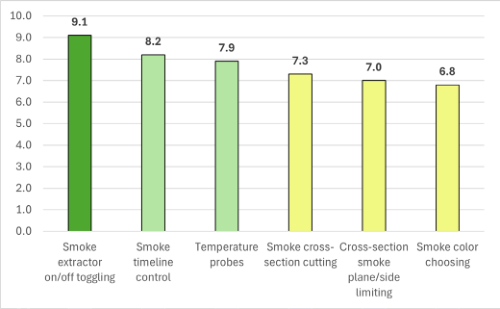
As seen in Figure 3, all features had importance ratings over the scale midpoint of five, but their importance for participants could be categorized into three groups of importance. These are color coded in the figure. Interestingly, the ability to choose smoke color was rated being of the lowest importance, despite there being clear trends in the color-gradient preference.
According to verbal feedback, white smoke is utilized in physical smoke extractor testing already, so this could be a reason why it had a high preference rating (chosen as the best color by 32% of participants, tied with Red - Turquoise). Two participants gave feedback that the black color was not as visible, a color rated as the worst by the most participants (37%). Regarding the cross-section and cross-section plane visualization, the spatial slicing tools were both noticed and had some added value in the experience. 95% of test users noticed the airflow arrows on planes and 94% rated the arrows as useful or very useful. There was also a clear preference between the visualization modes with the cloud mode having a 58% preference and plane mode 32%, leaving the cutter mode with just negligible 5% (tied with not sure). This rather strongly suggests that the cutter mode where smoke is rendered on one side of a plane and not on the other is not a necessary feature in smoke extraction system visualization.
The two participants with previous experience with 2D/desktop smoke extractor visualization rated the realism of VR as a lot better than 2D systems. Usability was rated as either a lot better, or 2D as slightly better regarding usability. Verbal feedback during testing indicated that placing temperature
Usability Testing of Virtual Reality for Visualizing Indoor Smoke Propagation 349 probes anywhere and the timeline slider are desired features implausible for real-world smoke extraction testing.
Figure 3: Feature importance ratings as rated by the test users.
CONCLUSION
We present the design and usability study of an interactive VR solution to visualize smoke movement in and extraction from an office lobby. The solution is developed for the Meta Quest 3 headset and features the Fire Dynamics Simulator to simulate smoke behavior. Evaluation is performed by user testing 19 participants. Motivation for our research stems from the safety-critical nature of testing indoor smoke extraction systems. More accurately, our research addresses three main concerns of VR smoke extraction simulations: how can a realistic smoke simulation be implemented in VR, what features are important for smoke extraction simulation, and what advantages does VR provide over other methods for smoke extraction simulation?
The results suggest that realistic, accurate and functionally useful smoke extraction simulations can be implemented in VR without compromising user comfort or usability. In our computationally accurate VR solutions, users prioritized analytical visualization and interactive diagnostic tools over aesthetic realism features, highlighting the importance of understandability in safety-critical simulations. Compared to traditional 2D or real-world testing methods, VR enables unique exploratory capabilities, including dynamic thermometer placement, temporal manipulation, and heightened immersion. These findings support the use of VR as a complementary tool for smoke extraction testing.
ACKNOWLEDGMENT
This research was supported by Business Finland Virtual Sea Trial project under Grant 7316/31/2023.
REFERENCES
Beh, H. J., Rashidi, A., Talei, A., and Lee, Y. S. (2022). Developing engineering students’ capabilities through game-based virtual reality technology for building utility inspection. Engineering, Construction and Architectural Management, 29(7):2854–2877. Cha, M., Han, S., Lee, J., and Choi, B. (2012). A virtual reality based fire training
simulator integrated with fire dynamics data. Fire safety journal, 50:12–24. Chang, C.-h., Banks, D., Meroney, R. N., et al. (2003). Computational fluid dynamics simulation of the progress of fire smoke in large space, building atria. Journal of Applied Science and Engineering, 6(3):151–157. D. (2004). Real-time volume graphics. In ACM Siggraph 2004 Course Notes, pages
29–es. Davis, C., Sole, C., Khan, H., and Nilsson, D. (2023). Investigating movement through smoke in virtual reality. Fire safety journal, 140:103890. Engel, K., Hadwiger, M., Kniss, J. M., Lefohn, A. E., Salama, C. R., and Weiskopf,
D. (2004). Real-time volume graphics. In ACM Siggraph 2004 Course Notes, pages 29–es. Henstrom, J., De Amicis, R., Sanchez, C. A., and Turkan, Y. (2023). Immersive learning in engineering: A comparative study of vr and traditional building inspection methods. In Proceedings of the 28th international ACM conference on 3D web technology, pages 1–11. Hevner, March, Park, and Ram (2004). Design science in information systems
research. MIS Quarterly, 28(1):75. Järvinen, P. (2007). Action research is similar to design science. Quality & Quantity, 41(1):37–54. Klote, J. H. and Zile, R. H. (1982). Smoke movement and smoke control on merchant
ships. Technical report. Korhonen, T. and Hostikka, S. (2009). Fire dynamics simulator with evacuation: Fds+ evac. Technical Reference and User’s Guide. VTT Technical Research Centre of Finland. Lorusso, P., De Iuliis, M., Marasco, S., Domaneschi, M., Cimellaro, G. P., and Villa, V.
(2022). Fire emergency evacuation from a school building using an evolutionary virtual reality platform. Buildings, 12(2):223. McGrattan, K., Hostikka, S., McDermott, R., Floyd, J., Weinschenk, C., and Overholt, K. (2013). Fire dynamics simulator user’s guide. NIST special publication, 1019(6):1–339. Oliva, D., Somerkoski, B., Tarkkanen, K., Lehto, A., and Luimula, M. (2019). Virtual
reality as a communication tool for fire safety-experiences from the virpa project. In GamiFIN, pages 241–252. Peffers, K., Tuunanen, T., Rothenberger, M. A., and Chatterjee, S. (2007). A design science research methodology for information systems research. Journal of Management Information Systems, 24(3):45–77. Ronchi, E. and Nilsson, D. (2013). Fire evacuation in high-rise buildings: a review of
human behaviour and modelling research. Fire science reviews, 2(1):7. Safikhani, S., Keller, S., Schweiger, G., and Pirker, J. (2022). Immersive virtual reality for extending the potential of building information modeling in architecture, engineering, and construction sector: systematic review. International Journal of Digital Earth, 15(1):503–526. Solmaz, S. and Van Gerven, T. (2022). Automated integration of extract-based cfd
results with ar/vr in engineering education for practitioners. Multimedia Tools and Applications, 81(11):14869–14891.
Usability Testing of Virtual Reality for Visualizing Indoor Smoke Propagation 351 Solmaz, S. and Van Gerven, T. (2023). Immersive technologies with computational
fluid dynamics in engineering education. Viktorsson, L. (2022). Simulation of volumetric smoke. Wahlqvist, J. and Rubini, P. (2023). Real-time visualization of smoke for fire safety engineering applications. Fire safety journal, 140:103878. Weng, M. C., Yu, L. X., Liu, F., and Nielsen, P. V. (2014). Full-scale experiment and
cfd simulation on smoke movement and smoke control in a metro tunnel with one opening portal. Tunnelling and underground space technology, 42:96–104. Wheeler, S. G., Engelbrecht, H., and Hoermann, S. (2021). Human factors research in immersive virtual reality firefighter training: A systematic review. Frontiers in Virtual Reality, 2:671664. Zhou, K., Ren, Z., Lin, S., Bao, H., Guo, B., and Shum, H.-Y. (2008). Real-time
smoke rendering using compensated ray marching. In ACM SIGGRAPH 2008 papers, pages 1–12.
Read this individual research paper free through the original publisher, or explore the full digital proceedings book.
ISBN 979-8-950676-09-3
Explore this ISBN in the AHFE Bookstore ↗Listed in the July 2026 bookstore catalogue; search by ISBN to confirm current availability · Digital book purchase optional