Olmo Alonso Moreno Franco, Marco Carega, Gabriele Giurin, Yonas Tefera, Maria Lazzaroni, Sergio Leggieri, Christian Di Natali, Luigi Monica, Darwin Caldwell, Jesus Ortiz (2026). Usability and Interaction Evaluation of a Mixed-Reality Adaptive Control Strategy for Wearable Robotics. In: Human-Computer Interaction & Emerging Technologies. AHFE Open Access, vol. 233, pp. 179–187. https://doi.org/10.54941/ahfe1007517
Robotics has increasingly focused on motion-assisting technologies, such as occupational back support exoskeletons, designed to reduce physical strain while preserving natural movement in rehabilitation, augmentation, and industrial ergonomics applications. Manual material handling tasks involving repetitive lifting and lowering remain a primary contributor to lower back disorders in industrial contexts, motivating the development of active exoskeletons capable of modulating assistance through adaptive control strategies. Existing acceleration-based controllers effectively adapt support to lifting dynamics but typically provide continuous assistance across task phases, including lowering, which may reduce transparency and perceived comfort. Recent advances in mixed reality, computer vision, and hand tracking technologies enable the integration of contextual and interaction cues into the control loop, allowing for more intuitive and selective assistance. In this study, a mixed reality interaction interface for an active back support exoskeleton based on a virtual muscle activity concept is evaluated. The virtual approach controller uses hand tracking to activate assistance during lifting and automatically configures assistance through visual load weight estimation. We experimentally compare this approach with a classical manual data entry interface using subjective, usability, workload, and comfort metrics during standardised and combined lifting tasks. The results indicated higher efficiency and satisfaction with the virtual muscle activity interface.
In recent years, robotics has expanded substantially into the development of motion-assisting devices, such as occupational exoskeletons, that aim to reduce physical strain while preserving natural human movement for applications in rehabilitation, prosthetics, human augmentation, and haptic technologies (Sharma et al., 2024). Improvements in lightweight actuation,
sensing technologies, and real-time computation have supported the inte- gration of these systems into industrial environments, where physically demanding tasks remain a major contributor to work-related musculoske- letal disorders. In particular, manual material handling (MMH) activities involving repetitive lifting, lowering, and carrying are strongly associated with lower back injuries, which continue to represent a leading cause of work-related disability despite existing preventive measures (Yang et al., 2020). Back support exoskeletons are designed to mitigate spinal loading and muscle fatigue by partially compensating the torques generated during trunk and hip extension. These devices are commonly classified as passive or active systems. Passive exoskeletons rely on elastic elements to store and return energy, whereas active exoskeletons provide powered assistance through actuators driven by control strategies that adapt to user movement (Poliero et al., 2022). Active systems offer greater versatility and potential effecti- veness across diverse tasks, but their performance and acceptance critically depend on the control strategy design that governs when and how assistance is delivered (Poliero et al., 2021).
Current control approaches for active back support exoskeletons predomi- nantly rely on biomechanical signals, such as inertial measurements, trunk kinematics, or electromyography, to estimate user intent and modulate assi- stance. Acceleration-based control strategies have shown promising results in adapting support to movement dynamics during lifting tasks. However, these strategies typically provide continuous assistance across task phases, including lowering movements where support may be unnecessary or unde- sirable. Continuous assistance can reduce transparency, increase perceived stiffness, and negatively affect user experience, limiting real-world adoption in industrial settings (Lazzaroni et al., 2022).
More advanced approaches, such as electromyography-based (EMG) intent detection, attempt to address these limitations through task recogni- tion or physiological sensing. Although effective under controlled conditions, these methods often require careful sensor placement and extensive cali- bration and may suffer from signal variability, noise, and long-term drift. Furthermore, most existing controllers lack explicit awareness of task con- text and environmental cues, limiting their ability to align assistance with user intent in a natural and intuitive manner (Lazzaroni et al., 2020).
Recent advances in mixed reality, computer vision, and hand-tracking technologies have created new opportunities to improve exoskeleton control by incorporating contextual information and interaction cues that extend beyond conventional body-worn sensors (Prete et al., 2026). By leveraging visual feedback and natural interaction modalities, it becomes possible to more robustly infer task phases and user engagement and selectively activate assistance only when it is functionally required. However, the incorporation of mixed-reality interfaces into the control loop of occupational exoskele- tons remains largely underexplored, especially regarding their impact on transparency, usability, and user acceptance in realistic manual material handling scenarios.
Usability and Interaction Evaluation of a Mixed-Reality 181 In this study, we address this gap by proposing and evaluating a novel interaction interface control for an active back support exoskeleton that integrates mixed reality interaction and computer vision through a virtual muscle activity concept. The proposed interaction controller activates assi- stance only during lifting phases using hand tracking as a proxy for muscle engagement and automatically configures assistance levels based on load weight estimation. We hypothesise that this computer-based control stra- tegy can improve the usability and interaction experience of mixed reality automatic setup systems relative to a classical manual data entry interface. To test this hypothesis, we conducted an experimental evaluation with human participants, comparing the proposed virtual control strategy against a classical controller interface using subjective, usability, workload, and comfort metrics during standardised and combined lifting tasks.
METHODOLOGY
In this study, we conducted a task-based usability test (Bernhaupt et al., 2020) for the VR experience after performing one combined lifting task. The system description and the evaluation metrics used are described next.
System Description This study was presented by the Wearable Robots, Exoskeletons and Exo- suits Laboratory (XoLab) and the VICARIOS Mixed Reality and Simulati- ons Laboratory, both part of the Advanced Robotics Department (ADVR) at the Istituto Italiano di Tecnologia (IIT). XoLab designs and develops wearable devices for occupational applications, such as the backsupport exoskeleton XoTrunk (Sposito et al., 2022) and VICARIOS group focuses on immersive mixed reality (MR) interfaces, intuitive control devices, and real-time data from remote sensors (Tefera et al., 2024).
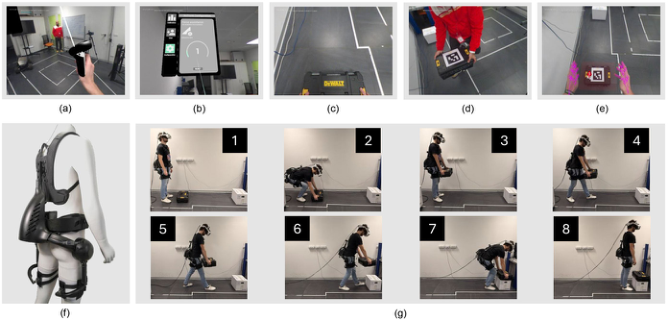
According to its actuation type, XoTrunk is an active exoskeleton, and its primary function is to reduce spinal cord compression when workers perform MMH activities (see Fig. 1-(f)). The user wears it as a backpack with straps attached to the chest, waist, and legs. The exoskeleton weight is 6 kg, and two brushless DC motors located next to the hips can apply a force of 20 N m (Poliero et al., 2020). In Lazzaroni et al. (2022) is presented XoTrunk’s control strategy is pre- sented. This study aimed to evaluate the efficacy of an active back support exoskeleton for MMH-related tasks. It leverages the raw signal from an accelerometer placed on the user’s torso to adapt assistance based on the user’s movement dynamics. The strategy provides increased assistance during the lifting phase, which is typically more demanding, and reduced assistance during the lowering phase. This dynamic adaptation, which considers both the statics and dynamics of the user’s movements, improves on previous inclination-based strategies by offering more responsive and natural support, especially during the crucial lifting and lowering transition phases.
A setup interface is required to modify the controller parameters, such as gain (Kacc), user’s weight (Mub), and height (Lub), the interface adjusts and configures the exoskeleton control strategy, as presented in Lazzaroni et al. (2022). The Kacc parameter adjusts the amount of force assistance (FA) provided by the exoskeleton during a lifting activity. The VICARIOS group developed a VR visual setup interface to interact with XoTrunk in two modes: (a) manual data entry control (MDE) and (b) virtual muscle activity control (VMA).
When using the MDE controller (see Fig. 1-(a)-(b)-(c)), the participant holds the hand motion control to manually modify the control strategy parameters (exoskeleton’s gain and user weight and height). Depending on the load’s weight, the user must modify the gain of the controller to obtain more or less FA. When the gain is set, the FA operates throughout the entire time, until the gain is set to zero again.
In contrast, the VMA controller uses a visual marker located at the top of the load (see Fig. 1-(d)-(e)). The marker is scanned by the head set camera and contains the load weight. Once the weight is known, the VMA controller automatically adjusts the Kacc parameter before the user performs the lifting task. In addition, the VMA controller recognises when the user is holding the load, which triggers the FA until the user drops the load.
The visual interface was designed using the Unreal Engine (UE) and OpenXR software. The VR system used was the Varjo XR-4 HS-10 MR headset with hand motion controllers.
Evaluation Metrics The standardized evaluation metrics employed in this study were derived from the user-centered evaluation framework for wearable robotic devi-ces (WRDs), as implemented within the Interactive Usability Toolbox (IUT) user research platform (Meyer et al., 2023). The interpretation scale for Cronbach’s alpha as a measure of internal consistency reliability follows the criteria outlined by Tavakol and Dennick (2011). Based on these foundations, two assessment metrics were selected.
1. Virtual Reality System Usability Questionnaire (VRSUQ). It is a spe- cialised tool for thoroughly evaluating how easy and enjoyable virtual reality systems are to use. It addresses unique aspects of VR experie- nces that general usability questionnaires might miss, such as feelings of immersion or physical discomfort. The VRSUQ assesses usability across three main dimensions: (a) effectiveness (how accurately and completely users can achieve their goals with the system), (b) efficiency (how much effort is required for users to achieve their goals), and (c) satisfaction (the level of contentment and comfort users experience). The questionnaire consists of nine items in total, three for each of the dimensions. It uses a 5-option Likert scale from “Strongly Disagree (1)” to “Strongly Agree (5)”. The overall VRSUQ scores are presented as percentages, allowing for a comprehensive comparison with other usability metrics (Kim and Rhiu, 2024).
2. Visual Comfort Questionnaire (VCQ). The questionnaire was designed to assess how head-mounted displays (HMD) respond to a computer- generated image introduced into the visual field. The assessed attributes are the perception of symptoms, including visual discomfort, dryness, irritation, focussing difficulty, visual fatigue, headache, dizziness, nau- sea, and general tiredness. The scale used is a 10-point scale, with ratings ranging from “None” to “Severe” for each symptom (Knight et al., 2006).
EXPERIMENTAL EVALUATION In this study, the experiment evaluates the usability of the participant’s VR experience and visual comfort after performing a lifting activity using the exoskeleton and the VR headset with the MDE and VMA controllers. With the MDE controller, participants manually introduce the exoskeleton’s FA configuration before starting the lifting activity. In contrast, with the VMA controller, the participants scan a marker to automatically set the FA to the exoskeleton and then perform the lifting activity.
Participants A group of nine persons participated in this evaluation. The experiment was conducted in accordance with the Declaration of Helsinki and was approved by the Ethics Committee of Liguria (protocol no.: CER Liguria 001/2019).
Experiment Design The experiment was designed to interact with physical loads using the exoskeleton and two controllers (MDE and VMA) with the VR headset. The participants performed a combined lifting activity based on the study of Reimeir et al. (2023) in laboratory settings. This experiment simulates realistic workplace logistics operations. This activity involved lowering, lif- ting, walking, and carrying (see Fig. 1-(g)) a 1 kg load, which was placed on a 40 cm high surface 2m away from the participant’s starting point. The load weight was the same throughout the experiment. In this way, the participant can experience better FA changes when the exoskeleton control strategy is modified. First, the participants wore the exoskeleton and VR headset and performed the combined lifting activity using the MDE con- troller. Second, the participants repeated the combined lifting activity while wearing XoTrunk and the VR headset but using the VMA controller (see Fig. 1-(a)-(b)-(c)). The participants initially configured the FA to a Kacc value of 0.1 using the MDE controller and then performed the combined lifting activity. The FA value was manually set to Kacc = 0.2 and later to Kacc = 0.3, and the combined lifting activity was repeated. Finally, the participants used the VR markers to configure the FA automatically using the VMA controller with the same Kacc previous values (0.1, 0.2, 0.3). The participants performed the combined lifting activity after each configura- tion (see Fig. 1-(d)-(e)). At the end of the experiment, each participant performed 6 combined liftings. The VSUQ and VCQ questionnaires were completed at the end of the whole experiment.
RESULTS AND DISCUSSION
The results of the evaluation of the two controllers (MDE and VMA) in one activity by nine participants are presented in the Virtual Reality System Usability Questionnaire and Visual Comfort Questionnaire sections.
Figure 1: Experiment design: (a) motion-tracked hand controller used with the MDE control-ler, (b) MDE controller interactive interface, (c) participant’s point of view when performing the combined lifting activity using the MDE controller, (d) VMA controller VR marker, (e) participant’s point of view when performing the combined lifting activity using the VMA controller, (f) occupational exoskeleton XoTrunk, and (g) combined lifting activity sequence.
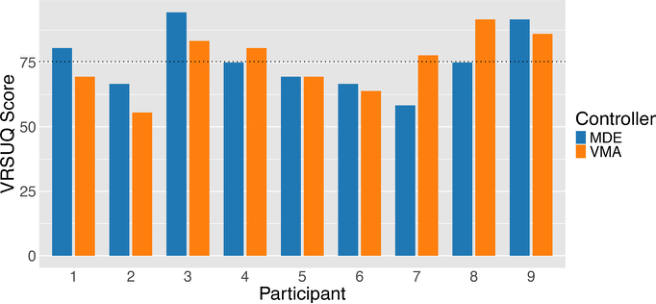
Virtual Reality System Usability Questionnaire The reliability of the survey data was tested using the Cronbach’s alpha coef- ficient, the MEDM controller presented a value of α = .465 and the VMA controller a value of α = .825. Figure 2 shows the VRSUQ score obtained from each participant using the MDE and VMA controllers. The MDE con- troller had the highest individual score of 94.4/100, and the VMA controller had the lowest individual score of 55.5/100. The mean score for both control- lers was 75.3/100 (MDE: SD = 11.9; VMA: SD = 11.5). The observed score range and similar standard deviations further indicate moderate variability in participant evaluations across both control groups. Taken together, these findings suggest that MDE and VMA controllers have equivalent average usability perceptions.
Table 1 presents the VRSUQ results. The MED controller registered the highest score in the “Effectiveness” with a mean value of 4.37 ± 0.46, and the VMA controller recorded higher scores for the “Efficiency” and “Satisfa-ction” attributes with mean values of 4.25 ± 0.27 and 3.85 ± 1.12 respectively. A Wilcoxon signed-rank test indicated that the usability scores for the “Effe-ctiveness” attribute did not differ significantly between the MED and VMA controllers, V = 40, p = .214; neither for the “Efficiency” attribute, V = 12, p = .429; nor the “Satisfaction” attribute, V = 3, p = .275. Although the statistical analyses indicated that the observed differences did not reach
Usability and Interaction Evaluation of a Mixed-Reality 185 significance, the descriptive scores suggest that the MED and VMA control- lers have broadly comparable perceived usability in terms of effectiveness and efficiency. In contrast, the satisfaction ratings for the VMA controller were higher, indicating a more favourable subjective user experience among the participants. Given the absence of statistically significant effects and the limited sample size, these descriptive trends should be interpreted cautiously. Nomenclature and abbreviations for Table 1: LB: lower bond and UB: upper bond.
Figure 2: Scores of the virtual reality system usability questionnaire per participant using MDE and VMA controllers.Table 1: Results of the virtual reality system usability questionnaire for MDE and VMA controllers.
Table 2 shows the VCQ results. The “Visual discomfort” attribute registered the highest score with a mean value of 2.77 ± 2.48, and reported by the 77.78% of the participants. Followed by the “Visual fatigue” attribute with a mean value of 1.44 ± 2.69, and reported by the 44.44% of the participants. The “Dryness in eyes” attribute was indicated by 44.44% of the participants with a mean value of 1.44 ± 2.12. A third of the participants also reported diverse symptoms, such as eye irritation, headache, and general tiredness. The results indicate that the use of the VR headset was associated with low to moderate levels of visual and physical discomfort on average, as reflected by the relatively low mean scores across all nine symptoms. Symptoms such as difficulty focusing and nausea were the least frequently reported and had
the lowest percentages. However, the relatively large standard deviations and high maximum scores for several items suggest substantial variability in responses, indicating that a smaller subset reported more pronounced discomfort, whereas most participants experienced minimal symptoms.
Table 2: Results of the visual comfort questionnaire.
Table available in the original PDF paper.
Attribute Mean & SD LS HS Percentage Visual discomfort 2.77 ± 2.48 0 7 77.78%
The XoTrunk back-support exoskeleton requires a setup interface to modify the control strategy’s controller parameters. The proposed mixed-reality virtual muscle activity interface provides a more favourable interaction experience than the conventional manual data entry controller, particularly in terms of efficiency and user satisfaction, while maintaining compara- ble perceived effectiveness and workload. Although the overall usability scores between the two controllers were similar and no significant diffe- rences in effectiveness, efficiency, or satisfaction were observed, the virtual muscle activity approach had higher efficiency and satisfaction ratings. The reliability analysis further indicated that the internal consistency of the vir- tual controller was stronger than that of the manual interface. In terms of visual comfort, the use of the mixed reality headset was associated with low to moderate discomfort levels, with most participants reporting minimal symptoms despite some variability across individuals.
ACKNOWLEDGMENT
This work was supported by the Italian Workers’ Compensation Authority (INAIL) and Istituto Italiano di Tecnologia (IIT) within the project Sistemi Ciberneteci Collaborativi - Esoscheletro Collaborativo 3.
REFERENCES
Bernhaupt, R., Martinie, C., Palanque, P. and Wallner, G. (2020), A generic visualization approach supporting task-based evaluation of usability and user experience, in R. Bernhaupt, C. Ardito and S. Sauer, eds, ‘Human-Centered Software Engineering’, Springer International Publishing, Cham, pp. 24–44. Kim, Y. M. and Rhiu, I. (2024), ‘Development of a virtual reality system usability
Usability and Interaction Evaluation of a Mixed-Reality 187 Knight, J. F., Deen-Williams, D., Arvanitis, T. N., Baber, C., Sotiriou, S.,
Anastopoulou, S. and Gargalakos, M. (2006), Assessing the wearability of wea- rable computers, in ‘2006 10th IEEE International Symposium on Wearable Computers’, pp. 75–82. Lazzaroni, M., Fanti, V., Sposito, M., Chini, G., Draicchio, F., Natali, C. D., Caldwell, D. G. and Ortiz, J. (2022), ‘Improving the efficacy of an active back- support exoskeleton for manual material handling using the accelerometer signal’, IEEE Robotics and Automation Letters 7(3), 7716–7721. Lazzaroni, M., Tabasi, A., Toxiri, S., Caldwell, D. G., De Momi, E., van Dijk, W.,
de Looze, M. P., Kingma, I., van Die¨en, J. H. and Ortiz, J. (2020), ‘Evaluation of an acceleration-based assistive strategy to control a back-support exoskeleton for manual material handling’, Wearable Technologies 1, e9. Meyer, J. T., Tanczak, N., Kanzler, C. M., Pelletier, C., Gassert, R. and Lambercy, O.
(2023), ‘Design and validation of a novel online platform to support the usability evaluation of wearable robotic devices’, Wearable Technologies 4, e3. Poliero, T., Fanti, V., Sposito, M., Caldwell, D. G. and Natali, C. D. (2022), ‘Active and passive back-support exoskeletons: A comparison in static and dynamic tasks’, IEEE Robotics and Automation Letters 7(3), 8463–8470. Poliero, T., Lazzaroni, M., Toxiri, S., Di Natali, C., Caldwell, D. G. and Ortiz, J.
(2020), ‘Applicability of an active back-support exoskeleton to carrying activities’, Frontiers in Robotics and AI Volume 7 - 2020. URL: https://www.frontiersin. org/journals/robotics-and-ai/articles/10.3389/frobt.2020.579963 Poliero, T., Sposito, M., Toxiri, S., Di Natali, C., Iurato, M., Sanguineti, V., Caldwell, D. G. and Ortiz, J. (2021), ‘Versatile and non-versatile occupatio- nal back-support exoskeletons: A comparison in laboratory and field studies’, Wearable Technologies 2, e12. Prete, A. D., Ofori, S., Sin, C. Y., Narayan, A., Shuo, D., Braghin, F., Gandolla, M.
and Yu, H. (2026), ‘Toward context-aware exoskeleton assistance: Integrating computer vision payload estimation with a user-centric optimization space’. URL: https://arxiv.org/abs/2508.06207 Reimeir, B., Calisti, M., Mittermeier, R., Ralfs, L. and Weidner, R. (2023), ‘Effects of back-support exoskeletons with different functional mechanisms on trunk muscle activity and kinematics’, Wearable Technologies 4, e12. Sharma, B., Phan, P. T., Davies, J., Hoang, T. T., Nguyen, C. C., Ji, A., Zhu, K.,
Nicotra, E., Lovell, N. H. and Do, T. N. (2024), ‘Soft upper-limb wearable robotic devices: Technology and applications’, Advanced Intelligent Systems 6(12), 2400266. URL: https://advanced.onlinelibrary.wiley.com/doi/abs/10.1002/ aisy.202400266 Sposito, M., Fanti, V., Sencandan, P., Caldwell, D. G. and Di Natali, C. (2022), Measuring anthopometric fit for exoskeletons: Methodologies and preliminary assessment, in ‘2022 9th IEEE RAS/EMBS International Conference for Biome- dical Robotics and Biomechatronics (BioRob)’, IEEE Press, pp. 01–08. URL: https://doi.org/10.1109/BioRob52689.2022.9925340 Tavakol, M. and Dennick, R. (2011), ‘Making sense of cronbach’s alpha’, Interna-
tional Journal of Medical Education 2, 53–55. Tefera, Y. T., Sarakoglou, I., Deore, S. N., Kim, Y., Barasuol, V., Villa, M., Anastasi, S., Caldwell, D. G., Tsagarakis, N., Semini, C. and Deshpande, N. (2024), Robot teleoperativo: Collaborative cybernetic systems for immersive remote teleoperation, in ‘2024 IEEE Conference on Telepresence’, pp. 1–4. Yang, S. T., Park, M. H. and Jeong, B. Y. (2020), ‘Types of manual materials handling
(mmh) and occupational incidents and musculoskeletal disorders (msds) in motor vehicle parts manufacturing (mvpm) industry’, International Journal of Industrial Ergonomics 77, 102954. URL: https://www.sciencedirect.com/science/article/pii/ S0169814118301690
Read this individual research paper free through the original publisher, or explore the full digital proceedings book.
ISBN 979-8-950676-09-3
Explore this ISBN in the AHFE Bookstore ↗Listed in the July 2026 bookstore catalogue; search by ISBN to confirm current availability · Digital book purchase optional