Mahnaz Asgharpour, Roberto Pitzalis, Olmo Alonso Moreno Franco, Luigi Monica, Darwin Caldwell, Jesus Ortiz (2025). Intelligent Elbow Exoskeleton Control: A Neural Network-Based Framework for Optimized Performance. In: Human Interaction and Emerging Technologies (IHIET 2025). AHFE Open Access, vol. 197, pp. 304–314. https://doi.org/10.54941/ahfe1006723
Elbow exoskeletons have emerged as promising technologies in the field of wearable robotics, offering assistance and support for tasks involving elbow flexion and extension. Musculoskeletal disorders associated with the elbow are prevalent in occupational environments, leading to work-related injuries and discomfort. Active elbow exoskeletons with integrated sensors, actuators, and control boards have been proposed to mitigate these issues by reducing joint strain and supporting repetitive tasks. The design and control of elbow exoskeletons are essential to ensure effective assistance, user comfort, and operational safety. Key design considerations include joint alignment, adaptability to real-world tasks, and intuitive user interaction to enhance usability and acceptance. Although current control strategies have made significant progress, they still require improvements in terms of user adaptability, feedback responsiveness, robustness, energy efficiency, and dynamic assistance. This study introduces a comprehensive methodological framework to optimise control strategies in the ExoElbow. The primary focus is on adapting assistive responses to individual user needs through real-time adjustments using advanced neural network architectures. Neural networks enable the system to learn from user inputs, adapt to feedback, model dynamic behaviours, and personalise assistance strategies. Convolutional Neural Networks are used to extract spatial features from sensor data, providing insights into user movement patterns and environmental cues while supporting energy-efficient computation. Recurrent Neural Networks are employed to capture temporal dynamics, enabling predictive assistance and smooth adaptation to varying task demands, which are key for real-time, user-centred control. Together, these models support intuitive human-machine interaction, such as brain-machine interfaces, significantly enhancing the usability and responsiveness of the system. The proposed control system dynamically adjusts assistive torque levels by continuously monitoring and analysing sensory inputs, thereby optimising user experience while reducing discomfort and strain. Validation strategies, including simulation and real-world experimentation, will be used to assess performance and user satisfaction. By addressing the limitations in adaptability, intuitive interaction, and energy efficiency found in existing approaches, this research lays the foundation for smarter, more responsive assistive technologies in active industrial exoskeletons.
Intelligent Elbow Exoskeleton Control: A Neural Network-Based Framework 305
INTRODUCTION
Wearable robotics has gained significant traction in recent years, particularly in the development of active exoskeletons designed to assist and augment human movement. Among these, elbow exoskeletons are promising solutions for mitigating musculoskeletal disorders, improving rehabilitation outcomes, and enhancing workplace ergonomics (Herr, 2009). These devices offer active assistance during elbow flexion and extension, reducing joint strain and facilitating repetitive or physically demanding tasks. Despite their potential, elbow exoskeletons’ effectiveness and adoption are heavily influenced by their control strategies, which must ensure adaptability, user comfort, intuitive interaction, and real-time responsiveness to varying task demands (Young, 2017).
Current control approaches for elbow exoskeletons predominantly rely on predefined assistance models or heuristic-based adaptation mechanisms. Although these strategies offer a degree of support, they often lack the flexibility required to accommodate diverse user needs, dynamic work environments, and complex motion patterns (Kiguchi, 2012). Moreover, many existing systems fail to integrate real-time learning capabilities, limiting their ability to personalise assistance based on user feedback and evolving task requirements. These challenges highlight the necessity for more advanced control methodologies that enable seamless human-exoskeleton interaction while maintaining efficiency and safety (Vélez-Guerrero et al., 2021).
This study introduces a novel methodological framework aimed at optimising control strategies for the ExoElbow exoskeleton (former called Elbow-side WINDER), which was developed at The Exosuits, Exoskeletons and Wearable Robotics Laboratory (XoLab) of the Advanced Robotics Department of the Italian Institute of Technology. The ExoElbow exoskeleton is designed to assist with elbow flexion and extension during occupational tasks by employing a medium-level control strategy comprising an arm kinematics estimator, a load estimator, and a friction compensator. The arm kinematics estimator relies on data from a three-axis accelerometer integrated into the MYO device, which measures forearm movements to enhance alignment with elbow dynamics. The load estimator calculates the external weight being lifted, allowing for dynamic adjustments in the assistance provided, while the friction compensator ensures smooth movement by counteracting resistive forces. Testing has shown significant reductions in muscle activation of the biceps brachii and triceps brachii during load-lifting tasks, indicating effective ergonomic support and minimising discomfort associated with joint misalignment (Park et al., 2023).
One deficiency observed in the approach taken with the ExoElbow exoskeleton is its reliance on a single sensory system, the MYO, which may limit the accuracy and responsiveness of the assistive torque provided. This singular focus could lead to challenges in adequately capturing the complex movements and forces experienced during various occupational tasks. Furthermore, the existing control strategy does not account for potential variations in muscle strength and activation patterns across different users, which may result in unequal assistance or activation when lifting items
of different weights. Without a more comprehensive sensory array or adaptive feedback mechanisms, the exoskeleton may struggle to optimise its performance across diverse user profiles and dynamic working environments. These challenges underscore the importance of not only robust control algorithms but also ergonomic and intuitive user interaction design, which has been shown to significantly enhance usability and system effectiveness in industrial exoskeletons (Moreno et al., 2024).
In this research, we aim to address these limitations by incorporating a more robust multi-sensor system and implementing an advanced machine- learning-based adaptive control strategy that can adjust dynamically to individual user needs and task-specific demands. The proposed framework enhances real-time adaptability and user-centred assistance. By employing advanced machine learning techniques, such as Convolutional Neural Networks (CNNs) for analysing spatial features of the sensor data and Recurrent Neural Networks (RNNs) for capturing temporal dynamics, the framework aims to optimise the control of the ExoElbow. This integration will enable the exoskeleton to dynamically adjust assistive torque in response to varying task demands and user feedback, ultimately facilitating a more intuitive and efficient user experience in industrial and rehabilitative applications.
Ultimately, this work aspires to bridge the gap between existing control strategies and the growing demand for more intelligent, adaptable, and user-friendly exoskeleton systems. By setting the foundation for future advancements in wearable robotics, this study contributes to the broader field of human-centred assistive technology, with potential applications in the industrial sector.
METHODS AND MATERIALS The ExoElbow has been developed to assist with elbow flexion and extension in industrial settings, enhancing ergonomics and reducing physical strain. The proposed system employs a medium-level control strategy that integrates three control units: a) an arm kinematics estimator, b) a load estimator, and c) a friction compensator. This control system is designed to assess the dynamics of the user’s arm and external loads in real-time, providing assistive torque during elbow flexion and extension tasks. By using data from a single sensory system, the MYO, the control algorithm minimises complexity and enhances overall performance while ensuring that the user benefits from reduced muscle activation in the biceps and triceps during load-lifting activities (Park et al., 2023). The following methods are required:
Stage 1 - Data Acquisition: The ExoElbow is equipped with a motion capture system and electromyography (EMG) sensors to collect essential data during its operation. The system measures muscle activation levels in the biceps brachii and triceps brachii, providing insights into how effectively the exoskeleton reduces strain during tasks. The analysis is based on these muscle activation patterns and the kinematic changes measured using inertial sensors, ensuring that the performance of the exoskeleton can be validated against the intended user movements.
Intelligent Elbow Exoskeleton Control: A Neural Network-Based Framework 307
Comprehensive data acquisition is critical for understanding user intent and movements when operating the ExoElbow exoskeleton. This multifaceted approach integrates various sensor technologies to ensure real- time monitoring and adaptive responsiveness of the exoskeleton system. Key sensors include: Electromyography (EMG): Surface EMG sensors will be placed on the biceps brachii and triceps brachii of both arms. This setup allows continuous monitoring of muscle activation levels in real-time, providing insights into the user’s physiological state during exertion. The EMG data will inform the control algorithm of the user’s effort and fatigue levels, allowing for adjusted assistive torque based on muscle activation patterns. Research has shown that EMG feedback can significantly improve the performance of rehabilitation devices by providing accurate estimations of muscle workload and activity (Farina et al., 2014).
Inertial Measurement Units (IMUs): Accelerometers and gyroscopes will be used to track the kinematics of the arm during motion. These sensors provide valuable data on the angular velocity and acceleration of the arm, which is essential for understanding how the exoskeleton interacts with user movements. This information helps refine the control strategies by enabling more precise detection of changes in posture and movement intent. Studies have indicated that IMU data can be effectively used for real-time motion analysis and have proven effective in various applications surrounding wearable robotics (Haratian, 2022).
Electroencephalography (EEG): A cap fitted with multiple EEG electrodes will monitor brain activity, particularly the motor cortices associated with movement intention and execution. By capturing electroencephalographic patterns, the system can gain insights into the cognitive aspects of motor planning, allowing the control system to anticipate intended movements before they occur physically. This neurofeedback mechanism facilitates smoother interactions between the user and the exoskeleton, thereby enhancing responsiveness and efficiency. Recent advancements in EEG applications in wearable robotics have highlighted the potential of integrating brain-machine interfaces for improved control and performance (Lebedev and Nicolelis, 2006).
This multi-sensor approach will lay the groundwork for developing an intuitive and adaptive exoskeleton that can respond to the specific needs of the user, minimising discomfort and optimising assistive performance across various occupational tasks.
Stage 2 - Adaptive Control Strategy: To enhance the performance of the ExoElbow exoskeleton, we propose an advanced adaptive feedback mechanism using CNNs and RNNs. The proposed methodology aims to improve the responsiveness and accuracy of assistive torque generation adapted to individual user movements and muscle activation patterns.
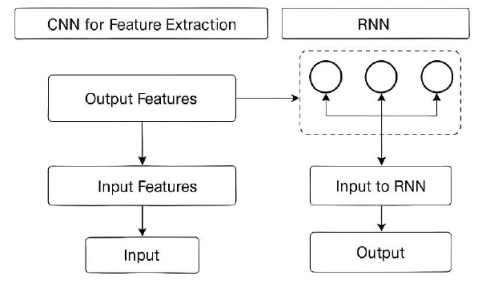
The proposed architecture utilises a CNN in conjunction with a RNN to analyse and process both EMG and IMU signals for an advanced exoskeleton system. Here is a more detailed improvement and explanation of the process: CNN for Feature Extraction: The CNN plays a crucial role in analysing spatial features derived from the EMG and IMU data. The proposed
architecture is designed to efficiently extract meaningful patterns from high- dimensional input data, which is essential for understanding user intentions during movement.
Input Layer: The CNN accepts time-series data segmented into fixed-size windows. This structure ensures that the model processes consistent-length inputs, which facilitates effective feature extraction.
Convolutional Layers: The architecture features multiple convolutional layers, each containing different filters. These filters are crucial because they allow the network to learn various characteristics of the spatial distribution of muscle signals. For instance, some filters may emphasise high-frequency activation patterns, whereas others focus on lower-frequency trends, effectively capturing the unique signatures associated with diverse movements or tasks. By identifying these activation patterns, the CNN can discern the user’s intent, such as grasping or lifting an object.
Pooling Layers: Following the convolutional layers, the pooling layers reduce the dimensionality of the produced feature maps, thereby reducing the computational complexity while retaining the most significant features. This step not only accelerates the processing time but also mitigates the risk of overfitting by simplifying the model.
Output Layer: The final output of the CNN comprises a refined set of features that capture user movements. These features carry critical information, such as the timing and intensity of muscle activations, which will inform subsequent control strategies for torque output in the exoskeleton.
Application of RNNs for Temporal Analysis: The RNN complements the CNN by focusing on the temporal aspects of the data. Given the sequential nature of the movement dynamics, this integration is vital for accurately modelling changes over time.
Input to RNN: The feature vectors generated by the CNN serve as sequential inputs to the RNN. This design allows the RNN to analyse the time-dependent patterns in muscle activation and kinematic behaviour. The model can recognise how prior movements influence future states, which is especially important for dynamic tasks that require anticipation of motion transitions.
RNN Structure: The RNN architecture is equipped to handle sequences of varying lengths, which makes it adept at processing continuous inputs from the user movements. By learning the temporal dependencies in the data, the RNN enhances the system’s capability to foresee future user intentions and adjust outputs accordingly.
Output Layer: The RNN ultimately produces a set of predictions of the required assistive torque levels. This output is key for directing the exoskeleton actuators and ensuring that the assistance offered aligns with the predicted movement intention and timing of muscle activation. This real- time response mechanism is crucial for providing seamless and intuitive user support.
The integrated CNN-RNN model (illustrated in Figure 1) is specifically designed to process the spatial and temporal patterns in physiological signals. The proposed architecture has demonstrated high accuracy in classifying EMG and movement-related signals in real-time applications (Li and Langari, 2022).
Intelligent Elbow Exoskeleton Control: A Neural Network-Based Framework 309
Figure 1: The integrated CNN-RNN model.
In summary, the symbiotic integration of CNN and RNN enables a sophisticated analysis of both the spatial and temporal features of muscle signals, leading to enhanced exoskeleton performance when assisting users with varied tasks. This architecture underscores the potential of advanced machine-learning techniques in the development of adaptive and responsive wearable robotic systems.
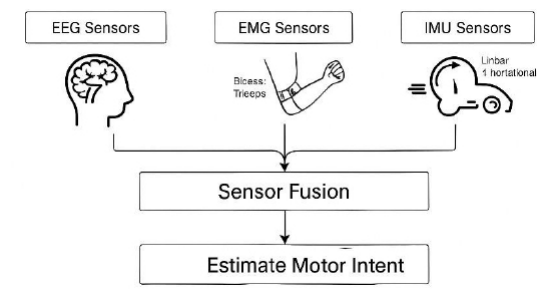
Stage 3 - Sensor Fusion Methodology: Recent advancements have demonstrated that EEG integration significantly enhances motion intent prediction when fused with EMG and IMU signals (Jackson and Zimmermann, 2012). To seamlessly integrate and leverage EEG data along with EMG and IMU signals, a sensor fusion framework will be developed as follows: Preprocessing of EEG Signals: EEG signals will be filtered to remove noise using techniques such as band-pass filtering (0.5–40 Hz) and Notch filtering (50 Hz) to eliminate electrical interference. The pre-processed EEG data will be segmented into overlapping time windows corresponding to the periods of interest.
Fusion Algorithm: A Kalman filter or a complementary filter is used for real-time sensor fusion of EEG, EMG, and IMU signals. The algorithm will combine the predictive outputs from CNN and RNN models with the real- time data provided by sensors to optimise the estimation of motor intent.
State Prediction: The algorithm predicts the state of user activity based on the fused sensor signals, adjusting weights dynamically based on the reliability of each sensor input.
Feedback Loop: Continuous feedback from the integrated sensory system allows the exoskeleton to adaptively modify its assistive torque in response to user needs detected through both muscle activation patterns and neural signals.
Figure 2 illustrates the fusion architecture in which EEG, EMG, and IMU signals are integrated using a Kalman filter to estimate motor intent. The proposed hybrid sensor framework enables robust real-time estimation of the user’s motor state, thereby improving responsiveness of assistive torque delivery (Zou et al., 2025).
Figure 2: Sensor fusion framework integrates EEG, EMG, and IMU via Kalman filtering to enhance motor intent detection and adaptive control in the elbow-side WINDER system.
Stage 4 - Experimental Protocol: Fifteen healthy participants will be recruited to evaluate the effectiveness of the proposed adaptive feedback mechanism. Each participant will undergo a series of tasks involving lifting and lowering objects of varying weights while wearing the ExoElbow exoskeleton. Throughout the trials, data from all sensors will be recorded for analysis, allowing the evaluation of adaptive assistance and overall performance improvement compared to traditional control methods. Statistical analyses will be conducted to determine the significance of the findings across various conditions and tasks.
By employing this innovative approach, we aim to create a highly responsive exoskeleton that maximises user comfort and reduces the risk of musculoskeletal disorders in industrial settings.
Stage 5 - Expected Evaluation of Adaptation and Method Integration: The proposed hybrid framework—integrating EEG, EMG, and IMU signals through deep learning and sensor fusion—will be evaluated using a set of performance metrics that reflect responsiveness, intuitiveness, adaptability, and efficiency. Although experimental validation is reserved for future work, the following expectations outline how the framework is designed to assess its efficacy: Real-Time Motor Intent Prediction: The CNN-RNN architecture is expected to improve the classification accuracy of dynamic motor intentions by capturing both the spatial and temporal features of biosignals. The anticipated outcomes include high classification accuracy (e.g., >90%) and prediction-to-actuation latency under 600 milliseconds, supporting real-time assistive control.
Torque Adaptation Performance: The Kalman filter-based sensor fusion is designed to yield a dynamically updated torque profile that adapts to changing motor states. The output is represented as a time-varying control vector that is expected to modulate torque based on user intent and the biomechanical context. Performance would be evaluated by comparing the predicted torque adjustments with those of the reference biomechanical models or user feedback.
User Effort Reduction: Post-deployment, EMG signal amplitude comparisons between assisted and unassisted conditions are expected to
Intelligent Elbow Exoskeleton Control: A Neural Network-Based Framework 311
quantify reductions in muscle effort. A successful outcome would show a statistically significant decrease in muscular activation during typical upper-limb tasks (e.g., a 2–4× reduction), indicating effective support.
Task Performance in Simulated Scenarios: User trials (in simulation or physical prototype environments) would assess task completion success rates, completion time, and user comfort. Tasks may include object manipulation, repetitive reaching, or resistive movements, which are chosen to reflect daily living activities.
Comparison with Baseline or Unassisted Conditions: Evaluating the framework against baseline (non-adaptive or non-assisted) conditions will be key in quantifying improvement. This includes measuring reductions in task execution time, smoother torque transitions, and lower signal misclassification rates.
System Adaptability and Robustness Over Time: Future assessments will monitor the consistency of prediction accuracy, adaptation quality, and system stability across multiple sessions and users, reflecting real-world applicability.
RESULTS AND DISCUSSION
This study introduces a comprehensive methodological framework to optimise the control strategies of the ExoElbow exoskeleton, which utilises a novel joint alignment mechanism and an adaptive control strategy to enhance usability in industrial settings. Our experimental design is oriented towards evaluating the exoskeleton’s performance in assisting elbow flexion/extension. Although the system is currently in the methodological development stage, the design and integration of its components allow for well-founded expectations of performance based on established sensor processing and machine learning approaches.
Part 1 - Design and Mechanism Evaluation: The ExoElbow incorporates a self-alignment mechanism that effectively decouples the rotational and translational movements of the elbow joint. This feature aligns the centre of rotation (CoR) of the exoskeleton with that of the user’s anatomical elbow joint, which is essential for providing optimal assistance during tasks requiring frequent elbow flexion and extension. The initial tests demonstrated that the joint alignment mechanism contributed to smoother motion during activities while minimising the risk of joint misalignment and discomfort.
Additionally, the proposed actuation mechanism aims to reduce the overall size and inertia of the device, which is critical for maintaining agility and ease of use in work environments where movement is often constrained. The compact design was well-received in the preliminary feedback sessions, highlighting the importance of addressing traditional limitations associated with bulky exoskeleton designs.
Part 2 - Control Strategy Development: A central innovation of this framework is its adaptive control strategy, which is driven by a hybrid CNN-RNN model and sensor fusion of EEG, EMG, and IMU signals.
The evaluation of this adaptive system will be based on the following key performance expectations: Real-Time Motor Intent Prediction: The CNN-RNN architecture is expected to provide robust recognition of motor intent by extracting both spatial (via CNN) and temporal (via RNN) features from EMG and IMU signals. High classification accuracy (expected >90%) and low prediction- to-actuation latency (<600 milliseconds) are critical metrics for validating intuitive and responsive control.
Adaptive Torque Output: Through Kalman filter-based fusion of EMG, IMU, and EEG data, the system dynamically generates a control vector representing assistive torque profiles. These systems are expected to adapt in real-time to user biomechanics, thereby reducing over-assistance or delay in support. Performance will be evaluated by comparing the estimated torque profiles with the user-reported comfort and objective task data.
Muscle Effort Reduction: The reduction in EMG signal amplitude during assisted tasks (compared to unassisted or baseline control) will be used as a proxy for user effort. A successful implementation is expected to yield a 2–4× decrease in muscle activation, particularly in the biceps and triceps during lifting and lowering tasks.
Task Performance and Responsiveness: Simulated or physical trials will track task completion time, success rate, and perceived user comfort during activities such as object manipulation and resistive movement. These metrics provide insights into the practical benefits of adaptive control under real- world conditions.
System Adaptability and Robustness: Over multiple trials and users, consistent control performance (e.g., stable torque output, low misclassification rates) is critical for demonstrating system reliability. Longitudinal data will be used to assess whether the adaptive system maintains performance over time and accommodates inter-user variability.
Part 3 - Future Work Directions: Future studies will aim to comprehensively validate the ExoElbow’s performance across diverse operational tasks. In addition to quantifying reductions in muscle activation (via EMG) and analysing joint kinematics (via IMUs), future assessments will include user experience metrics, such as perceived comfort, cognitive load, and exertion. These multidimensional metrics are essential to determine the exoskeleton’s real-world efficacy and ergonomic benefit in industrial environments.
Moreover, the iterative refinement of the control architecture will be guided by empirical data on system adaptability and responsiveness under dynamic task conditions. This includes evaluating the real-time prediction accuracy of motor intent, responsiveness of torque adaptation, and consistency of performance across users and sessions, ensuring that the system aligns with both biomechanical demands and operator expectations.
An important direction for enhancing control efficiency is the integration of Spiking Neural Networks (SNNs) into the control loop. SNNs, which emulate the temporal dynamics of biological neurons, offer event-driven processing that can significantly reduce computational and energy costs
Intelligent Elbow Exoskeleton Control: A Neural Network-Based Framework 313
(Roy et al., 2019; Tavanaei, 2019). Their ability to process sparse, temporally encoded inputs aligns well with biosignal data, such as EMG and EEG data, and can support low-latency, low-power control without sacrificing responsiveness (Lora-Millan et al., 2022). By leveraging SNN-based architectures, future ExoElbow iterations may achieve more sustainable energy profiles, improved user satisfaction, and extended operational durations, ultimately enhancing the system’s viability for long- term deployment in industrial applications.
CONCLUSION
In this methodological research, we introduced the design principles and control strategies for the ExoElbow exoskeleton, highlighting its potential applications in industrial settings. The unique joint alignment mechanism paired with an adaptive control framework presents a promising approach for enhancing worker performance and safety by minimising the physical burden associated with repetitive elbow movements.
Although this study has laid the groundwork for further experimental validation, it underscores the significance of a thoughtful design and control methodology in developing effective wearable technologies. Our future work will aim to apply these concepts in controlled experiments to substantiate the exoskeleton’s functionality and usability, ultimately contributing to advancements in ergonomic assistive devices in the workplace.
REFERENCES
Farina, D., Colombo, R., Merletti, R., & Baare Olsen, H. (2001). Evaluation of intramuscular EMG signal decomposition algorithms. Journal of Electromyography and Kinesiology, 11(3), 175–187. https://doi.org/10.1016/S1050-6411(00) 00051-1 Haratian, R. (2022). Motion Capture Sensing Technologies and Techniques: A
Sensor Agnostic Approach to Address Wearability Challenges. Sensing and Imaging, 23(1), 25. https://doi.org/10.1007/s11220-022-00394-2 Herr, H. (2009). Exoskeletons and orthoses: Classification, design challenges and future directions. Journal of NeuroEngineering and Rehabilitation, 6(1), 21. https://doi.org/10.1186/1743-0003-6-21 Jackson, A., & Zimmermann, J. B. (2012). Neural interfaces for the brain and spinal
cord–restoring motor function. Nature reviews. Neurology, 8(12), 690–699. https://doi.org/10.1038/nrneurol.2012.219 Kiguchi, K., & Hayashi, Y. (2012). An EMG-Based Control for an Upper-Limb Power-Assist Exoskeleton Robot. IEEE Transactions on Systems, Man, and Cybernetics, Part B (Cybernetics), 42(4), 1064–1071. https://doi.org/10.1109/ TSMCB.2012.2185843 Lebedev, M. A., & Nicolelis, M. A. (2006). Brain–machine interfaces: Past, present
and future. TRENDS in Neurosciences, 29(9), 536–546. Li, Q., & Langari, R. (2022). EMG-based HCI Using CNN-LSTM Neural Network for Dynamic Hand Gestures Recognition. IFAC-Papers Online, 55(37), 426–431. https://doi.org/10.1016/j.ifacol.2022.11.220
Lora-Millan, J. S., Moreno, J. C., & Rocon, E. (2022). Coordination Between Partial Robotic Exoskeletons and Human Gait: A Comprehensive Review on Control Strategies. Frontiers in Bioengineering and Biotechnology, 10, 842294. https:// doi.org/10.3389/fbioe.2022.842294 Moreno F., O. A., Lambranzi, C., Pitzalis, R., Sposito, M., Asgharpour, M., Park,
D., Di Natali, C., Monica, L., Caldwell, D. G., & Ortiz, J. (2024) “Evaluating ergonomic design: A user command interface for industrial exoskeletons”, proceedings of the 12th International Conference on Human Interaction and Emerging Technologies (IHIET, 2024), Venice, Italy. https://doi.org/10.54941/ ahfe1005497 Park, D., Di Natali, C., Sposito, M., Caldwell, D. G., & Ortiz, J. (2023). Elbow-side WINDER (Elbow-side Wearable Industrial Ergonomic Robot): Design, control, and validation of a novel elbow exoskeleton. Frontiers in Neurorobotics, 17, 1168213. https://doi.org/10.3389/fnbot.2023.1168213 Roy, K., Jaiswal, A. & Panda, P. (2019). “Towards spike-based machine intelligence
with neuromorphic computing.” Nature, 575, 607–617. https://doi.org/10.1038/ s41586-019-1677-2 Tavanaei, A., Ghodrati, M., Kheradpisheh, S. R., Masquelier, T., & Maida, A. (2019).
Deep learning in spiking neural networks. Neural Networks, 111, 47–63. https:// doi.org/10.1016/j.neunet.2018.12.002 Vélez-Guerrero, M. A., Callejas-Cuervo, M., & Mazzoleni, S. (2021). Artificial Intelligence-Based Wearable Robotic Exoskeletons for Upper Limb Rehabilitation: A Review. Sensors, 21(6), Article 6. https://doi.org/10.3390/ s21062146 Young, A. J., & Ferris, D. P. (2017). State of the Art and Future Directions for Lower Limb Robotic Exoskeletons. IEEE Transactions on Neural Systems and Rehabilitation Engineering, 25(2), 171–182. https://doi.org/10.1109/ TNSRE.2016.2521160 Zou, H., Wu, Q., Yang, L., Zhu, Y., & Wu, H. (2025). Design and EMG-EEG Fusion-
Based Admittance Control of a Hand Exoskeleton with Series Elastic Actuators. IEEE Transactions on Medical Robotics and Bionics, 7(1), 347–358. https:// doi.org/10.1109/TMRB.2024.3503899
LISTED IN THE AHFE DIGITAL BOOKSTORE CATALOGUE
Explore the complete digital volume
Human Interaction and Emerging Technologies (IHIET 2025)
Read this individual research paper free through the original publisher, or explore the full digital proceedings book.
ISBN 978-1-964867-73-1
Explore this ISBN in the AHFE Bookstore ↗Listed in the July 2026 bookstore catalogue; search by ISBN to confirm current availability · Digital book purchase optional