Jeeyoon Han (2026). User Scenario-Based Interaction Design for Level 4 Autonomous Robo-Ride Systems. In: Advances in Human Factors of Transportation. AHFE Open Access, vol. 224, pp. 361–366. https://doi.org/10.54941/ahfe1007864
As interest in driverless mobility continues to grow, the importance of human-machine interface (HMI) design for Level 4 autonomous vehicles is becoming increasingly critical. This study investigates user interactions and expectations in autonomous robo-ride environments through a scenario-based approach. A user study was conducted to explore key factors influencing user experience, including safety, privacy, accessibility, and trust. Based on these findings, we designed an HMI concept tailored for shared, driverless mobility services, focusing on intuitive interaction and inclusive design. The proposed system incorporates features such as clear navigation guidance, interaction cues, and a face-to-face seating configuration to enhance communication and usability, particularly for users with mobility challenges. To evaluate the effectiveness of the proposed HMI, a prototype-based assessment was performed. The results indicate that the design improves perceived safety, usability, and user trust, while reducing uncertainty in autonomous ride situations. In addition, accessibility considerations contributed to a more inclusive user experience across diverse user groups. These findings highlight the importance of human-centered HMI design in autonomous mobility systems and provide design implications for future robo-ride services.
With the advancement of autonomous driving technologies, interest in driverless mobility has been steadily increasing. Unmanned autonomous services such as robotaxis are emerging as a new form of shared mobility, with global companies actively pursuing their commercialization. Robotaxis, typically based on Level 4 autonomous driving, shift the control of the vehicle to an artificial intelligence (AI) system, allowing the system to take full responsibility for driving without requiring human intervention. In such environments, users directly interact with a driverless vehicle, rather than relying on a human driver. As users are not yet familiar with fully autonomous vehicles, the importance of interaction between the vehicle and passengers— namely the human-machine interface (HMI) becomes significantly more critical. In shared mobility contexts, where vehicles are used by a wide range of users, service-oriented HMI design must consider diverse user needs, with
362 Han particular emphasis on safety, usability, and accessibility. In this study, a Level 4 autonomous vehicle operating as a shared mobility service is defined as a “robo-ride.” Based on user experience scenarios, this research aims to derive HMI design directions and propose design implications for future autonomous mobility services.
ROBO-RIDE USER SCENARIO DEVELOPMENT To design the human-machine interface (HMI) for robo-rides, the service structure and user experience scenarios were systematically developed based on the operational design domain of Level 4 autonomous vehicles. The design process consisted of defining the operational design domain, specifying the service, establishing UX scenarios, deriving HMI design directions, and refining the HMI configuration. Through this process, user experiences in autonomous environments were systematically identified, and a consistent interaction structure was established.
To identify user requirements, interviews were conducted with users who have experience with mobility services and experts in autonomous driving. The findings revealed key user needs for robo-ride services, including ensuring safety in the absence of a driver, providing a comfortable and private personal space, and supporting accessibility for diverse users, including those with mobility challenges. In addition, it was confirmed that autonomous mobility services have the potential to complement existing transportation systems.
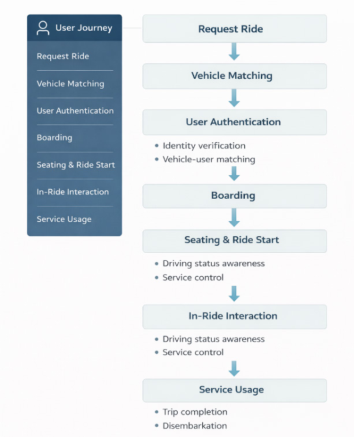
Figure 1: Robo-ride user experience scenario flow.
Based on these user characteristics and service requirements, the robo-ride user experience was defined in a step-by-step manner. The overall service flow consists of pre-boarding interaction and user authentication, boarding, seating and departure, in-ride interaction, and service utilization. Each stage includes interaction elements specific to autonomous environments, such as user authentication, driving status awareness, and service control.
Furthermore, multiple use cases were derived by considering various scenarios at each stage. Based on these use cases, HMI design directions and
User Scenario-Based Interaction Design for Level 4 Autonomous Robo-Ride Systems 363 interaction structures were defined. Through this process, a prototype-based HMI design was developed, and key design implications for user experience in autonomous mobility environments were identified.
ROBO-RIDE HMI DESIGN PRINCIPLES Based on the user scenarios and use cases derived in the previous section, the HMI design direction for robo-rides was defined. This study establishes two key design principles “Intelligent and Intuitive” to enhance user experience in autonomous environments.
1) The Intelligent principle refers to the automation of driving and convenience functions within the vehicle, minimizing user intervention during service usage. This allows users to utilize autonomous mobility services without complex interactions. 2) The Intuitive principle considers the unfamiliar nature of shared, non- owned vehicles and aims to provide interaction methods that are easy to understand and use without prior learning.
In addition, to reduce uncertainty in driverless environments, essential functions are provided through multiple interaction methods. The system is also designed to ensure universal usability by accommodating diverse user needs, thereby improving overall accessibility and usability.
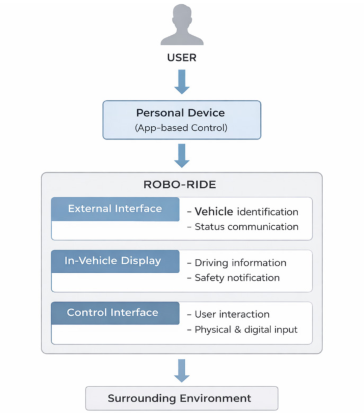
ROBO-RIDE HMI CONFIGURATION The robo-ride HMI was designed based on the identified user characteristics and requirements, as well as the established design principles. To effectively support user experience in autonomous environments, the HMI was structured as an integrated interaction system consisting of external vehicle interfaces, in-vehicle interfaces, and personal devices (Figure 2, Table 1).
Component Role Key Functions Personal Device Service access Reservation, authentication
External Interface Vehicle recognition Status display, communication In-vehicle Display Information delivery Route, safety info
Control Interface User interaction Trip control, environment setting Personal devices serve as the primary interface for accessing robo- ride services, supporting functions such as ride hailing and reservation, user authentication, destination setting, trip information monitoring, and payment. Through location-based integration with the vehicle, users can track the arrival status and position of the assigned vehicle in real time, enabling a seamless transition from request to boarding. In addition, personal devices provide supplementary control functions, allowing flexible interaction across diverse user scenarios.
External vehicle interfaces provide visual information that enables users to identify and approach their assigned vehicle from a distance. At closer range, these interfaces communicate essential information related to boarding, such as availability, authentication status, and door operation. During boarding, alighting, and driving, the vehicle state is clearly conveyed to users and surrounding road participants, supporting safe and predictable interactions in the absence of a human driver.
In-vehicle interfaces consist of display systems that continuously provide driving and safety-related information, and control systems that allow users to manage various functions. Displays present key information such as route, destination, and estimated arrival time, along with safety-related notifications, in a clear and intuitive manner. Control interfaces enable users to perform essential actions such as trip initiation, destination modification, environmental adjustments, and media control with minimal effort.
Additionally, voice-based interaction is incorporated to allow users to perform tasks without manual input. Content services and environmental features are also provided to enhance in-ride experience, supporting the transition from a simple transportation function to an experience-oriented mobility service.
Control interfaces are designed to minimize physical effort and ensure intuitive use, with careful consideration of accessibility and reachability. Key functions are provided through both digital and physical interaction methods, particularly for safety-critical operations, enabling immediate response in unexpected situations.
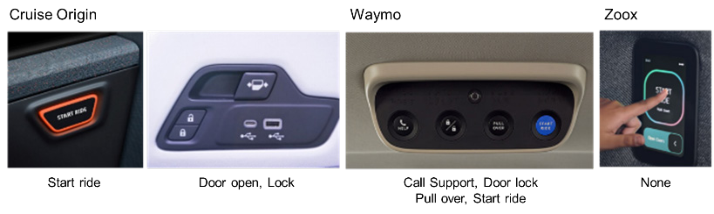
Physical controls are incorporated to support safety-critical and time- sensitive functions, ensuring reliable operation in driverless environments. These controls are designed to allow users to quickly access essential actions such as ride initiation, door operation, emergency response, and temporary stops. By integrating physical controls with digital interfaces, the system provides redundant interaction pathways, enhancing both usability and operational safety. Furthermore, the configuration of physical controls is optimized to minimize complexity while maintaining accessibility to key functions, drawing on established practices in existing mobility systems (Table 2).
Table 2: Physical control functions in robo-ride HMI.
Table available in the original PDF paper.
Category Function Type Description Ride Control Ride initiation Initiates autonomous driving
Temporary stop Request temporary stop of vehicle Ride termination Ends the ride session
Vehicle Control Door operation Controls door opening and closing Support Assistance request Connects to support center
Safety Emergency response Enables emergency stop and assistance
Figure 3: Comparison of HMI strategies in autonomous mobility services.
Overall, the robo-ride HMI is designed based on the principles of intelligence and intuitiveness and aims to enhance user experience in autonomous mobility environments through an integrated interaction framework that accommodates diverse users and usage scenarios.
CONCLUSION
This study derived user experience scenarios for Level 4 autonomous robo- rides and proposed HMI design directions based on these findings. In addition, an interaction framework to support user–vehicle communication was developed, and a prototype-based design approach was used to concretize user experience in autonomous environments. Although interest in autonomous driving technologies and robotaxi services continues to grow, several challenges remain in terms of safety and reliability in real-world applications. User experience in driverless environments requires a fundamentally different approach compared to conventional mobility systems, highlighting the need for systematic research in this area. Accordingly, this study presents interaction design directions for autonomous mobility environments that differ from traditional shared mobility services. A scenario-based approach was adopted to explore user experience in autonomous contexts that are difficult to experience directly. While this study focuses on a specific service context, the user scenarios and use cases derived in this research are expected to serve as foundational HMI design guidelines applicable to a wide range of future autonomous mobility services.
ACKNOWLEDGMENT
This study was supported by Hyundai Motor Company.
REFERENCES
SAE International (2019) Taxonomy and definitions for terms related to driving automation systems for on-road motor vehicles (SAE J3016). Yang, Z. (2024) ‘What’s next for robotaxis in 2024’, MIT Technology Review.
LISTED IN THE AHFE DIGITAL BOOKSTORE CATALOGUE
Explore the complete digital volume
Advances in Human Factors of Transportation
Read this individual research paper free through the original publisher, or explore the full digital proceedings book.
ISBN 979-8-950676-00-0
Explore this ISBN in the AHFE Bookstore ↗Listed in the July 2026 bookstore catalogue; search by ISBN to confirm current availability · Digital book purchase optional