Olmo Alonso Moreno Franco, Chiara Lambranzi, Roberto Pitzalis, Matteo Sposito, Mahnaz Asgharpour, Daegeun Park, Christian Di Natali, Luigi Monica, Darwin Caldwell, Jesus Ortiz (2024). Evaluating Ergonomic Design: A User Command Interface for Industrial Exoskeletons. In: Human Interaction and Emerging Technologies (IHIET 2024). AHFE Open Access, vol. 157, pp. 377–384. https://doi.org/10.54941/ahfe1005497
Industrial workers perform daily activities with a high risk of musculoskeletal disorders. Diverse studies have reported high rates of musculoskeletal disorders among distinct industry professionals, with values exceeding 75% for most occupations considered. Commonly affected body areas include the neck, back (particularly the lower back), shoulders, and lower limbs. A potential solution to reduce the risk of injury among industrial workers is the use of exoskeletons in the workplace. This wearable suit improves ergonomics depending on the body part it supports. From the actuation point of view, exoskeletons can be categorised in three branches: passive, active, and quasi-passive or active. Active exoskeletons contain sensors, actuators, and electric controller boards; these characteristics make them more versatile for adapting the control strategy to the required task. The wearer of an active exoskeleton, needs of a human-machine interface to modify parameters that impact the exoskeleton control strategy. The user command interface is a wearable device that allows easy adjustments when an interaction occurs.Purpose: In this paper, we present an ergonomic assessment of the User Command Interface. The interface plays a crucial role in addressing the challenges faced by developers in optimising industrial exoskeleton capabilities by offering adaptability, control, usability and performance enhancement features. This electromechanical device attached to the exoskeleton provides a solution for achieving user interaction and is open to the user exoskeleton´s assets. However, human factors regarding physical ergonomics have not been addressed with exoskeleton´ users when the interface is in use.Methods: It is important to highlight the difficulties faced when analysing design requirements in wearable devices, particularly in terms of measuring attributes such as comfort. For instance, this term may be defined differently in various studies, sometimes as a standalone design requirement and in other cases as part of a group of requirements. However, comfort was found to encompass aspects such as freedom from discomfort and pain, acceptable temperature, texture, shape, weight, and tightness, all of which contribute to the overall comfort and usability of a device. To assess the interface, we performed a comparison test of three physical ergonomic attributes: comfort, durability, and safety. Using the mapping wearable design requirements method, five shape-like interfaces were evaluated. Four out of five interfaces are previous versions according to the evolution of our interface, and the last one is a mobile phone. This approach of quantifying and analysing design requirements helps in understanding the complex relationships between different terms and ensures a more systematic and thorough evaluation of design aspects in wearable devices.Results: Twenty subjects participated in the study. The results show the statistical differences of the five shape-like interfaces between the attributes of physical ergonomics, including shape, breathability, hygiene, temperature, size, weight, movement, harm, anxiety, and resistance.Conclusions: Aspects of comfort, such as interface size and weight, represent a challenge when users present diverse ergonomics. Although the interface does not represent a hazard to the user when it is being handling, some versions present a more fragile pattern.
Musculoskeletal disorders (MSDs) are physical diseases provoked in many cases by overexertion of muscles at specific joints, being the back the most commonly affected region. MSDs can result from factors such as incongruous postures, handling heavy loads, and repetitive lifting (Poliero
et al., 2021). Industrial exoskeletons offer several benefits in the workplace, including the reduction of biomechanical strains, prevention of MSDs, enhanced worker safety, increased productivity, and improved ergonomics. Exoskeletons can help reduce physical exertion by providing external support and assistance during physically demanding tasks. By reducing muscle demand and biomechanical stresses on the body, exoskeletons prevent work- related MSDs such as low back pain and shoulder tendinopathy (Theurel et al., 2019).
In addition, exoskeletons improve worker safety by minimising the risk of injuries associated with repetitive or strenuous tasks, such as manual material handling (MMH). By decreasing fatigue and physical effort on workers, exoskeletons play an important role in improving productivity and efficiency in the workplace. The use of these wearable devices promotes better posture and movement patterns, leading to improved ergonomics and mitigating the risk of musculoskeletal injuries (Theurel et al., 2019).
An active exoskeleton is an electromechanical structure worn by an operator that mimics the shape and functions of the human body. It is designed to augment the abilities of the human limb or trunk or to assist in the prevention of MSDs (Khairul et al., 2012). The main applications of active exoskeleton robots discussed include their use as assistive devices, rehabilitation devices, human amplifiers, and haptic interfaces (Gopura et al., 2019). From the actuation point of view, active exoskeletons use electrical or pneumatic actuators together with sensors and control boards (Lazzaroni et al., 2019).
These components make active exoskeletons more versatile to adapt to the user and the tasks to perform; allowing to achieve proper force modulation according to the control strategy adopted (Poliero et al., 2021). A human- machine interface (HMI) is required to provide communication between a human operator and the wearable device to modulate and adjust the parameters of the active exoskeleton. The HMI is the basis of cognition, communication, and interaction (Gong et al., 2009). HMI ergonomics takes a holistic, human-centred approach when designing and evaluating systems. The traditional domain of specialisation within ergonomics comprises physical ergonomics. This domain is primarily concerned with human anatomical, anthropometric, physiological, and biomechanical characteristics as they relate to physical activity. By improving HMI and human-computer interactions, ergonomics enhances system performance and user experience (Karwowski et al., 2005).
In this paper, we present an ergonomic assessment of the User Command Interface (UCI), a wearable HMI device used to configure the industrial exoskeleton XoTrunk. The interface plays a crucial role in addressing the challenges faced by developers in optimising industrial exoskeleton capabilities by offering adaptability, control, usability and performance enhancement features. This electromechanical device attached to the exoskeleton provides a solution for achieving user interaction. However, human factors regarding physical ergonomics have not been addressed with exoskeleton’ users when the interface is in use. The UCI interface has been integrated into the back-support XoTrunk (Moreno et al., 2023) and upper-limb Shoulder-SideWINDER (Moreno et al., 2024) exoskeletons.
Evaluating Ergonomic Design: A User Command Interface for Industrial Exoskeletons 379
Experiments were conducted with 20 subjects. Ergonomics assessment was performed by comparing the physical attributes of four different versions of the UCI interface and a smartphone, considering the last one a standardised device.
METHODOLOGY
Highlighting the difficulties faced is important when analysing design requirements in wearable devices, particularly in terms of measuring attributes such as comfort. For instance, this term may be defined differently in various studies, sometimes as a standalone design requirement and in other cases as part of a group of requirements. However, comfort was found to encompass aspects such as freedom from discomfort and pain, acceptable temperature, texture, shape, weight, and tightness, all of which contribute to the overall comfort and usability of a device (Francés-Morcillo et al., 2020). To assess the interface, we performed a comparison test of three physical ergonomic attributes: comfort, durability, and safety. Using the mapping wearable design requirements method, five shape-like interfaces were evaluated. Four out of five interfaces are previous versions according to the evolution of our interface, and the last one is a mobile phone. This approach of quantifying and analysing design requirements helps in understanding the complex relationships between different terms and ensures a more systematic and thorough evaluation of design aspects in wearable devices.
System Description The UCI is designed to enhance the functionality and versatility of industrial wearable robots, specifically the XoTrunk and Shoulder-sideWINDER exoskeletons. The UCI serves as a control interface that allows users to interact with and customise the settings of the exoskeleton system. It provides a user-friendly platform for users to access and modify various parameters related to the exoskeleton’s operation, such as secure identification, signal monitoring, user management, control strategy adjustments, session management, task-specific configurations, and user profiles. The UCI includes features such as menus, submenus, cards, and decks to facilitate user interaction and task execution. In addition, the UCI is designed with the principles of security and interaction in mind, featuring a navigation wheel and buttons for user input and control (Moreno et al., 2022). Figure 1 depicts the interface, which has a display with a resolution of 800×480 pixels and a colour screen.
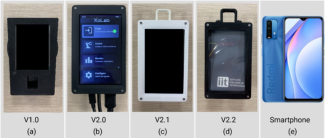
Navigation through the menu occurs when the user spins the lateral wheel and presses to select the desired option. The device fits in one hand and can be used by both left- and right-handed people. When the user is not interacting with the device, the interface is attached to the front of the XoTrunk exoskeleton. Currently, UCI V2.0 and V2.1 are in operation along with the XoTrunk and Shoulder-SideWINDER exoskeletons. Although these are similar in dimensions, UCI V2.1 differs because it has a holder component at the top of the case to allow the interface to be attached to the exoskeleton
with less weight. UCI V1.0 was the first prototype designed to test the low- level control layer for electronic components in a housing case. UCI V2.2 is a proof of concept that does not use the reduced size from the previous version.
Figure 1: User command interface system. The UCI is a wearable gadget that fits in the palm of the hand and is attached to the exoskeleton.
Figure available in the original PDF paper.
Evaluation Metrics The assessment metric used in this study comes from the co-evaluation checkpoint presented by Francés-Morcillo in the wearable design requirements, parameters, and definitions table (Francés-Morcillo et al., 2020). The evaluation for this study consisted of 20 items, including aesthetics, comfort, durability, and safety. It uses a Likert–scale option from 1 (“Totally disagree”) to 5 (“Totally agree”) and includes an “not applicable” (N/A) option. The metric can be found in the Sec. Appendix.
EXPERIMENTAL EVALUATION The experiment assessed the ergonomics and attributes of the User Command Interface related to comfort, durability, and safety. The newest version of the UCI is compared with three older versions and a commercial cell phone used as a reference device.
Participants A group of 20 subjects participated in the experiments; among the participants, 8 were females and 12 were males. Two participants were left handed. The experiment was conducted in accordance with the Declaration of Helsinki and was approved by the Ethics Committee of Liguria (protocol no.: CER Liguria 001/2019).
Experiment Design The experiment evaluated the differences in the physical and ergonomic aspects of the diverse versions of the UCI by holding and using the physical interfaces. Figure 2 shows the five devices: a) UCI V1.0, b) UCI V2.0, c) UCI V2.1, d) UCI V2.2, and e) smartphone Xaomi Redmi Note 9.
Figure 2: Experimental devices for comparison. a) UCI V1.0, b) UCI V2.0, c) UCI V2.1, d) UCI V2.2, and e) smartphone.
Evaluating Ergonomic Design: A User Command Interface for Industrial Exoskeletons 381
Because the UCI is a wearable device that is similar in shape to a mobile phone, a smartphone was used as a pivot to compare the attributes of the UCI and a standardised device. Although the shape is similar, the functionality of the UCI and the smartphone is far from being comparable. The UCI was designed to navigate using a rotating wheel coupled with push buttons and not to operate with a touch screen. This feature is due to the potential existence of dust, grease, water, or gloves on the user’s hands. In contrast, navigation with the smartphone is performed using the touch screen. The experiment was conducted in a sequence of three tasks. First, each participant for all five devices held the device in the left hand, and only for the UCI versions rotated the wheel and pressed the push button for at least 5 s. For the smartphone, the user was required to unlock the screen. Second, the same task as the previous one was repeated, but this time the participants were using the right hand. Finally, each participant held the device in both hands, rotated the wheel, and pressed the push button for at least 5 s using the UCI version. For the smartphone, the participant had to unlock the screen. Table 1 shows the physical characteristics, such as the dimensions and weight of each device.
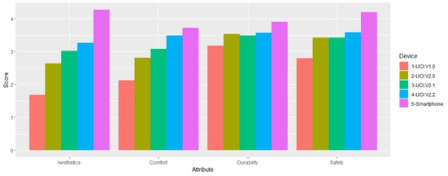
The 20-item results of the wearable design requirements co-evaluation checkpoint were grouped into four categories, as shown in Fig. 3. Results show that the smartphone obtained the highest grade in ergonomics attributes, including aesthetics, comfort, durability, and safety, followed by the UCI V2.2. In contrast, UCI V1.0 had the lowest score among all previously mentioned attributes.
Figure 3: Experimental results of the wearable design requirements co-evaluation checkpoint. The ergonomics attributes such as aesthetics, comfort, durability and safety were evaluated using five different interfaces: 1) UCI V1.0, 2) UCI V2.0, 3) UCI V2.1, 4) UCI V2.2, and 5) smartphone.
Because UCI V2.0 and UCI V2.1 are the current operative interfaces, the characteristics presented in Table 1 show that the difference between these interfaces is related to the weight and extra length of UCI V2.1 from the top holder component. This extra length does not affect grip on the user’s hand. Mann–Whitney U test was conducted to determine whether there is a perception in difference in weight between the UCI V2.0 and the UCI V2.1. The results indicate a nonsignificant difference, W = 230, p-value = 0.4011. Therefore, we must not reject the null hypothesis and conclude that there is no difference in weight between these interfaces.
The UCI V2.2 was designed with a reduction in size to improve the operability of the interface with smaller hands. We conducted a Mann– Whitney U test to find a significant statistical difference in the concept of size from the comfort attributes between UCI V2.0 and UCI V2.2. The results indicate a significant difference, W = 323, p-value = 0.0005914; therefore, we reject the null hypothesis. Therefore, we have sufficient evidence to say that there is a significant difference in the size of UCI V2.0 and UCI V2.2.
CONCLUSION
Ergonomic aspects such as aesthetics, comfort, durability, and safety have an impact on the usability and functionality of human–machine interfaces. We emphasise in the need for user-friendly interfaces that prioritise comfort, durability, and safety. The results of the study indicate that UCI V2.2, designed with a reduction in size, showed a significant difference compared with UCI V2.0. This finding underscores the importance of considering user comfort and adaptability in the design of exoskeleton interfaces. The incorporation of a smartphone in the experiment demonstrated that the UCI devices in all their versions have a distinction of ergonomics aspects such as aesthetics and safety. In addition, this study used a systematic evaluation approach to quantify and analyse design requirements, providing valuable insights into the complex relationships between different ergonomic terms. By incorporating user feedback and conducting rigorous testing, future developments in exoskeleton technology can further enhance worker well-being and productivity in industrial environments.
APPENDIX
Table A1. Wearable design requirements co-evaluation checkpoint: attributes, concepts and items (Francés-Morcillo et al., 2020).
Attribute Concept Item Aesthetics Customization The device is customizable Fashion The device is coherent to the aesthetical and fashion that have been defined The device is appealing to use
Continued
Evaluating Ergonomic Design: A User Command Interface for Industrial Exoskeletons 383 Table A1. Continued.
Attribute Concept Item Comfort Breathability The device is breathable and it avoids the accumulation of sweat The device has some slack to circulate air without compromising fit hand Hygiene The device can be washed Movement The device is sufficiently flexible to allow the natural movement of the body region Obstrusiveness The device does not cause fatigue or decrease the confort The device enables the natural body movements Shape The adjustment to the body region is the proper one The device is properly attached to the user and there is no danger of losing it The device fits the shape of the body region Sizing The device adapts to my hand size Temperature The temperature does not increase above the recommended value Weight The device is light Durability Resistance The device seems to be resistive for its life cycle The device is properly protected from external elements (eg. hand tools) Safety Harm The device is safe it does not cause pain to my hand All the device components are properly attached Heat dissipating devices are separated from the user skin
ACKNOWLEDGMENT
This work was supported by the Italian Workers’ Compensation Authority (INAIL) and Istituto Italiano di Tecnologia (IIT) within the project Sistemi Ciberneteci Collaborativi - Esoscheletro Collaborativo 3.
REFERENCES
Anam, K., & Al-Jumaily, A. A. (2012). Active Exoskeleton Control Systems: State of the Art. Procedia Engineering, 41, 988–994. Gong, C. (2009). Human-Machine Interface: Design Principles of Visual Information
in Human-Machine Interface Design. 2009 International Conference on Intelligent Human-Machine Systems and Cybernetics, 2, 262–265. Lazzaroni, M., Tabasi, A., Toxiri, S., Caldwell, D. G., Momi, E. D., Dijk, W. van, Looze, M. P. de, Kingma, I., Dieën, J. H. van, & Ortiz, J. (2020). Evaluation of an acceleration-based assistive strategy to control a back-support exoskeleton for manual material handling. Wearable Technologies, 1, e9. Francés-Morcillo, L., Morer-Camo, P., Rodríguez-Ferradas, M. I., & Cazón-Martín,
A. (2020). Wearable Design Requirements Identification and Evaluation. Sensors, 20(9), Article 9. Karwowski, W. (2005). Ergonomics and human factors: The paradigms for science, engineering, design, technology and management of human-compatible systems. Ergonomics, 48(5), 436–463.
Moreno Franco, O. A., Ortiz, J., & Caldwell, D. G. (2022). Evaluation of the User Command Interface, an Adaptable Setup System for Industrial Exoskeletons. 2022 9th IEEE RAS/EMBS International Conference for Biomedical Robotics and Biomechatronics (BioRob), 01–07. Moreno, F. O. A., Crespo, J., Di Natali, C., Ortiz, J., & Caldwell, D. G.
(2023). Integration of the User Command Interface to the Industrial Exoskeleton XoTrunk. 2023 IEEE/SICE International Symposium on System Integration (SII), 1–7. Moreno, F. O. A., Park, D., Di Natali, C., Caldwell, D. G., & Ortiz, J.
(2024). Integration and Task Assessment of the User Command Interface to the Occupational Exoskeleton Shoulder-sideWINDER. 2024 IEEE/SICE International Symposium on System Integration (SII), 1176–1182. Poliero, T., Iurato, M., Sposito, M., Natali, C. D., Toxiri, S., Anastasi, S., Draicchio, F., Monica, L., Caldwell, D. G., Sanguineti, V., & Ortiz, J. (2021). A case study on occupational back-support exoskeletons versatility in lifting and carrying. The 14th PErvasive Technologies Related to Assistive Environments Conference, 210–217. Theurel, J., & Desbrosses, K. (2019). Occupational Exoskeletons: Overview of Their
Benefits and Limitations in Preventing Work-Related Musculoskeletal Disorders: IISE Transactions on Occupational Ergonomics and Human Factors: Vol. 7, No. 3–4. IISE Transactions on Occupational Ergonomics and Human Factors, 7(3–4), 264–280.
LISTED IN THE AHFE DIGITAL BOOKSTORE CATALOGUE
Explore the complete digital volume
Human Interaction and Emerging Technologies (IHIET 2024)
Read this individual research paper free through the original publisher, or explore the full digital proceedings book.
ISBN 978-1-964867-33-5
Explore this ISBN in the AHFE Bookstore ↗Listed in the July 2026 bookstore catalogue; search by ISBN to confirm current availability · Digital book purchase optional