Chien-Hsiung Chen, Shih Ju Wang (2025). AI-Assisted Creativity Support for Persona Creation Tools. In: Artificial Intelligence and Social Computing. AHFE Open Access, vol. 163, pp. 219–229. https://doi.org/10.54941/ahfe1006208
Creativity is both a crucial and complex experiential process, valued not only for its outcomes but also for the ideation journey (O'Toole, 2024). With the increasing adoption of generative AI technologies, such as AI image generators, studies have shown that these tools can lead to fixation on initial examples, limiting idea diversity and originality (Wadinambiarachchi et al., 2024). To address this, designers must learn to identify and reflect on such fixation to enhance creative collaboration with AI. This study investigates how AI-assisted tools, through interface design and interactive features, can better support the creativity of design students in persona creation. The research employs an experimental design involving task tests with two types of AI-assisted persona creation tools. Evaluations using the Creativity Support Index (Cherry et al., 2014) and post-task interviews provide insights into user experience and creativity performance. Preliminary results indicate that both tools effectively support exploratory creativity, with participants viewing AI as a collaborative assistant rather than a dominant force. Additionally, the findings highlight distinct AI support needs across different stages of the creative process, such as inspiration generation in early ideation and refinement support in later stages. This study emphasizes the importance of designing AI tools that address diverse user needs and align with the phased nature of the creative process. The results contribute to design education by offering new perspectives on AI’s role in creativity and provide practical implications for developing AI-assisted tools that foster innovative workflows.
Persona is a crucial tool in design and user research, aiding design teams in understanding user needs and behaviour patterns (Cooper, 1999). Traditionally, constructing personas required significant time and resources. However, with the advancement of generative artificial intelligence (Generative AI) and large language models (LLMs), researchers can now efficiently create more representative personas (Shin et al., 2024).
Studies have shown that AI tools can accelerate the ideation process in design (Yu et al., 2024), enhance the quality of creative outputs, and assist users with weaker creative abilities (Doshi et al., 2024). However, AI tools may lead to over-reliance on initial examples, limiting the diversity of creative
outputs (Wadinambiarachchi et al., 2024). Designers need to reflect on these limitations and explore effective human-AI collaboration models.
This study investigates how AI-assisted persona tools can support user creativity, using the Creativity Support Index (CSI) to evaluate six dimensions: exploration, expressiveness, immersion, enjoyment, result worthiness, and collaboration (Cherry et al., 2014). By analysing two tools, FounderPal and InstantPersonas, we aim to uncover their strengths and limitations.
The findings will contribute to understanding the impact of AI tools on creative work, providing valuable references for design education and user research. Through exploring human-AI collaboration, we hope to offer design guidelines for future creativity support tools.
LITERATURE REVIEW
Generative Artificial Intelligence (GAI) leverages machine learning algorithms like RNNs and transformers to generate diverse and innovative content such as text, images, and music (Creely et al., 2024). While GAI enhances productivity and lowers creative barriers by automating mundane tasks (Autor, 2023; O’Toole et al., 2024), it also presents challenges like idea fixation and reduced diversity in outputs (Wadinambiarachchi et al., 2024). To address these issues, tools need to balance explainability and guidability, ensuring user control and fostering creative collaboration (O’Toole et al., 2024). Personas are essential tools in design, aiding in understanding user needs and fostering empathy (Cooper, 1999; Grudin, 2006). However, traditional persona creation is time-intensive and resource-heavy (Matthews et al., 2012). GAI, especially with large language models (LLMs), has revolutionized this process by efficiently analysing user data and generating representative personas (Shih et al., 2024). To maximize their effectiveness, AI-assisted tools should support user creativity through interactive features, flexible customization, and data transparency while ensuring users retain control over the process.
The Creativity Support Index (CSI) is a robust framework for assessing tools designed to enhance creativity (Cherry et al., 2014). CSI evaluates six dimensions: exploration, expressiveness, immersion, enjoyment, result worthiness, and collaboration. These metrics provide insights into how tools like AI-CSTs enhance creativity while identifying areas for improvement. A critical design challenge for AI-CSTs is balancing autonomy with user agency to maintain creativity and engagement (Ning et al., 2023). Using CSI, researchers can better understand and optimize the role of AI in creative tasks.
METHODOLOGY
This study investigates the extent to which AI-assisted persona creation tools support creativity. We selected two AI-assisted persona tools, FounderPal and InstantPersonas, for comparative testing. Both tools are user-friendly and exhibit distinct AI interaction characteristics: FounderPal emphasizes
AI-Assisted Creativity Support for Persona Creation Tools 221
AI-generated inspiration suggestions, while InstantPersonas focuses on user input and real-time feedback. The study employed a quantitative measurement using the Creativity Support Index (CSI) and supplemented it with qualitative interviews to comprehensively analyse participants’ creative experiences and the effectiveness of support provided.
Participants This study involved 20 participants, who were evenly divided into two groups and randomly assigned to use one of the two AI-assisted persona creation tools. This randomization aimed to mitigate learning effects caused by task familiarity. All participants possessed basic persona design skills and experience with AI tools. The participant pool included 18 design students, 1 innovation student, and 1 applied linguistics student.
Task Design Participants were tasked with using the assigned AI-assisted persona creation tool to develop a persona for the Museum of Contemporary Art, Taipei. To support this task, a field study interview summary about the museum was provided as reference material. After completing the task, participants were required to thoroughly review their created personas.
Evaluation and Interviews The study employed the Creativity Support Index (CSI; Cherry, 2014) as the evaluation framework. The CSI consisted of two main components: 12 Agreement Statements on the CSI for assessment (as shown in Table 1) and the paired-factor comparison test has 15 comparisons for each pair (as shown in Table 2). To ensure objectivity, the agreement statements were presented to participants in random order, while the paired comparisons were displayed in a randomized two-by-two format on separate pages.
1. It was easy for me to explore many different ideas, options, designs, or outcomes, using this system or tool.
1-2-3-4-5-6-7-8-9-10
2. The system or tool was helpful in allowing me to track different ideas, outcomes, or possibilities.
1-2-3-4-5-6-7-8-9-10
3. I was able to be very creative while doing the activity inside this system or tool.
1-2-3-4-5-6-7-8-9-10
4.The system or tool allowed me to be very expressive. 1-2-3-4-5-6-7-8-9-10 5. My attention was fully tuned to the activity, and I forgot about the system or tool that I was using.
1-2-3-4-5-6-7-8-9-10
6. I became so absorbed in the activity that I forgot about the system or tool that I was using.
1-2-3-4-5-6-7-8-9-10
7. I would be happy to use this system or tool on a regular basis.
8. I enjoyed using the system or tool. 1-2-3-4-5-6-7-8-9-10 Continued
222 Chen and Wang
Table 1: Continued 12 Agreement Statements Highly Disagree—Highly
Table available in the original PDF paper.
Agree 1-2-3-4-5-6-7-8-9-10
9. I was satisfied with what I got out of the system or tool.
1-2-3-4-5-6-7-8-9-10
10. What I was able to produce was worth the effort I had to exert to produce it.
1-2-3-4-5-6-7-8-9-10
11. The system or tool allowed other people to work with me easily.
1-2-3-4-5-6-7-8-9-10
12. It was really easy to share ideas and designs with other people inside this system or tool.
Table 2: 15 comparisons for the paired-factor. “When doing this task, it’s most important that I’m able to...”
Table available in the original PDF paper.
A. Enjoy using the system
A. Become immersed in
A. Be creative and
the activity B. Enjoy using the system or tool
expressive B. Become immersed in the activity
A. Enjoy using the system
A. Become immersed in
or tool B. Produce results that are worth the effort I put in A. Be creative and or tool B. Work with other people expressive B. Enjoy using the system or tool
the activity B. Explore many different ideas, outcomes, or possibilities
A. Explore many different
A. Become immersed in
A. Be creative and
the activity B. Produce results that are worth the effort I put in
expressive B. Explore many different ideas, outcomes, or possibilities
A. Explore many different
A. Become immersed in
ideas, outcomes, or possibilities B. Produce results that are worth the effort I put in A. Be creative and
the activity B. Work with other people
expressive B. Produce results that are worth the effort I put in
A. Produce results that are
A. Enjoy using the system
ideas, outcomes, or possibilities B. Work with other people A. Be creative and worth the effort I put in B. Work with other people expressive B. Work with other people
or tool B. Explore many different ideas, outcomes, or possibilities
The calculation process for the Creativity Support Index (CSI) involves three steps: First, the agreement statements for each factor are summed to obtain a subtotal for that factor. Next, each factor’s subtotal is multiplied by the number of times it was selected in the paired comparisons. Finally, the resulting values are totaled and divided by three to yield the final index score. This CSI score, with a maximum of 100 points, reflects the extent to which the tool supports user creativity in a specific task or activity.
To gain deeper insights into the effectiveness of AI-assisted persona creation tools in supporting participants’ creativity, post-experiment
AI-Assisted Creativity Support for Persona Creation Tools 223
interviews were conducted after completing the evaluation scale. The interview questions were as follows:
1. What specific support did this AI tool provide in creating the persona? 2. What challenges, if any, did you encounter that might have impacted your creative thinking during the persona creation process using the AI tool? 3. What additional interface or interaction features would you like the AI tool to offer to further enhance your work efficiency?
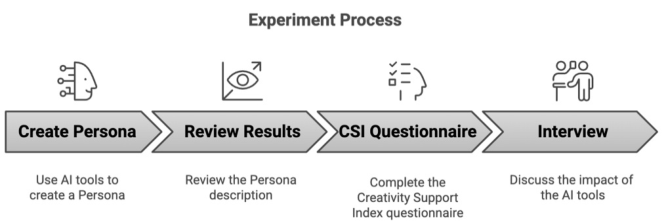
Procedure As shown in Fig. 1, participants were first required to create a persona using the assigned AI-assisted persona creation tool. Upon completing the task, they reviewed their created persona, followed by completing the Creativity Support Index (CSI) questionnaire. Finally, the researcher conducted post- experiment interviews. With the participants’ consent, the interview process was audio-recorded for documentation purposes.
Figure 1: Experiment process.
Experimental Samples This study selected two AI-assisted persona tools for comparative testing:
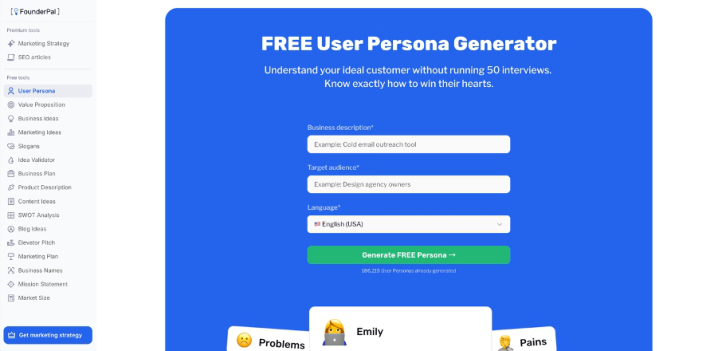
FounderPal (2024) is an AI-driven platform (see Fig. 2) designed to help individual entrepreneurs craft effective marketing strategies. The platform provides streamlined tools for understanding target audiences, optimizing product positioning, and developing personalized marketing ideas. For this study, we utilized its free User Persona feature for testing.
This tool requires users to fill in two fields: Business Description and Target Audience. Although the input fields appear to allow only brief descriptions, they can accommodate longer content. Once the input is complete, users can activate the AI persona generation feature. FounderPal generates a comprehensive persona, including elements such as a portrait illustration, name, pain points, goals, triggers, benefits, and barriers.
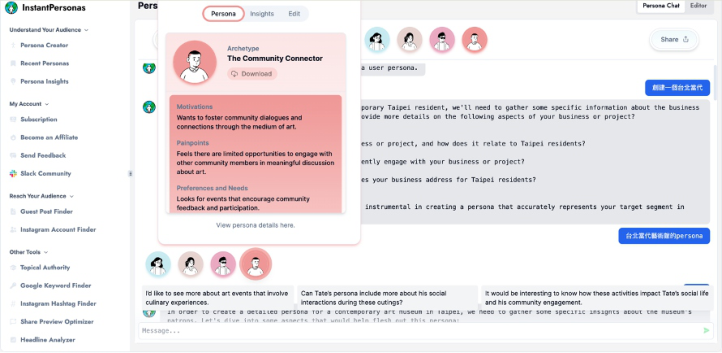
InstantPersonas (2024) is an online platform that utilizes AI-powered conversational interactions to create personas (as shown in Fig. 3). The tool claims to provide practical insights and downloadable persona templates for
224 Chen and Wang
marketing managers without the need for extensive customer research. For this study, we used the individual monthly subscription version for testing.
Figure 2: FounderPal interface (2024).
The tool guides users through a conversational interface to describe their product or service, which serves as the basis for creating personas. InstantPersonas gradually prompts users to provide more detailed information and offers predefined options in the dialogue interface to facilitate smoother interaction with the AI.
Once sufficient information is provided, InstantPersonas generates four persona options. Each option includes a portrait illustration, a placeholder name, motivations, pain points, preferences and needs, as well as deeper insights. Users can directly edit the content of these personas.
Figure 3: Instant personas interface (2024).
AI-Assisted Creativity Support for Persona Creation Tools 225
ANALYSIS AND FINDINGS Creativity Support Index
Based on participants’ evaluations of the Creativity Support Index (CSI) for AI-assisted persona creation tools, as shown in Table 3, both tools exhibited similar trends. Among the six evaluation dimensions, exploration received the highest support scores, indicating that these tools effectively assist users in exploring and developing diverse creative ideas. Conversely, immersion received the lowest scores, reflecting that the current AI-assisted tools still have room for improvement in providing a deeply engaging and focused experience.
While the two AI-assisted persona tools did not show significant differences across most of the six evaluation dimensions, a notable disparity was observed in the dimension of result worthiness. The AI-assisted conversational construction model provided by InstantPersonas offered participants a more meaningful experience in terms of outcome value compared to FounderPal, which only required input in two suggested fields.
In terms of the overall Creativity Support Index (CSI), both tools demonstrated satisfactory performance, exceeding the passing threshold of 60 points. However, statistical analysis results revealed no significant differences in support levels between the two tools (P-value > 0.05). This finding suggests that despite the differences in design philosophy and functional implementation between the two tools, their overall effectiveness in fostering user creativity is comparable.
Table 3: Descriptive statistics and independent samples t-test of the CSI for AI-assisted persona creation tools.
Ideal Role of AI in Assisted Creation This study found that most users prefer AI to serve as a reliable assistant throughout the creative journey rather than dominate the entire creative process. While maintaining user autonomy, AI can effectively take on three key roles: First, as a systematic organizer of information, helping users structure and manage various creative materials; second, as an objective validator of ideas, assisting users in reviewing and refining their creative concepts; and third, as a source of inspiration, providing innovative ideas and insights at the right moments. Additionally, AI systems need to establish a clear and structured framework for thinking, but this framework must
226 Chen and Wang
remain sufficiently flexible to avoid overly prescriptive suggestions that could constrain users’ creative potential.
Credibility and Controllability of AI Tools In-depth analysis revealed that users’ expectations of AI tools primarily focus on the following key aspects:
Editable Outputs: Users strongly desire the ability to flexibly modify and adjust AI-generated content to ensure the final outcomes fully align with their needs and vision.
Process Transparency: Users expect a clear understanding of the AI’s computational logic and decision-making processes. Such transparency not only increases trust in the system but also helps users better leverage and control AI tools.
Balanced Anthropomorphism: The AI interface should strike a balance between human-like and functional elements. Overly anthropomorphic designs may create unrealistic expectations, whereas a pragmatic design approach allows users to interact with the tool more effectively.
Traceable Sources: To establish credibility, users expect AI to clearly indicate the sources of the information it provides, including specific references, data origins, and other verifiable details.
Different Needs Across Creative Stages The study conducted an in-depth analysis of the unique needs and characteristics of each stage in the creative process, revealing that different forms of AI support are required at each stage:
Early Stage: During the ideation phase, users primarily need inspiration and triggers. At this point, short fill-in-the-blank exercises or structured menu guidance are most effective in opening users’ minds and sparking creative ideas.
Mid Stage: As ideas begin to take shape, users often require more specialized knowledge. At this stage, AI can assist users in exploring unfamiliar areas, supplementing relevant knowledge, and expanding the depth and breadth of their creativity.
Late Stage: When the creative work is nearing completion, the focus shifts to precision and completeness. This stage involves carefully refining content, ensuring the accuracy of wording, and building a coherent and clear structure.
It is particularly noteworthy that AI should not merely function as a simple answer-generation tool but should serve as a true creative partner capable of engaging in interactive dialogue with users to collaboratively explore more creative possibilities. This study specifically found that AI’s support is especially impactful for less experienced users, as it provides timely and relevant prompts that help them gradually develop their creative thinking skills.
AI-Assisted Creativity Support for Persona Creation Tools 227
DISCUSSION
This study examined how AI-assisted persona creation tools enhance design students’ creativity. Both FounderPal and InstantPersonas showed benefits in supporting creativity, though their effectiveness varied across different CSI dimensions.
The tools particularly excelled in exploration, helping users generate diverse ideas and perspectives. This confirms previous findings that AI tools facilitate creative ideation by reducing cognitive load and providing novel suggestions (Cherry et al., 2014). However, lower immersion and expressiveness scores revealed limitations in user engagement and personalization.
The results underscore the potential of AI-assisted Creativity Support Tools (AI-CSTs) in the persona creation process while identifying areas for improvement:
1. Enhancing Tool Transparency
The transparency of tool-generated results is crucial for maintaining user trust and enabling meaningful interactions. Participants noted that understanding the logic behind AI-generated personas helped them refine their outcomes more effectively. Future tools should provide clearer explanations of data processing and decision-making processes to align with principles of explainable AI (O’Toole et al., 2024).
2. Improving Flexibility and Control
Allowing users greater control over the personas generated by AI is essential. Providing editable attributes and dynamic customization options can enable users to adjust AI outputs more flexibly, ensuring alignment with their design objectives.
3. Stage-Specific Functional Features for Creative Development
Creativity involves multiple stages, including early ideation, concept generation, detailed refinement, and outcome evaluation. AI and users should assume different roles at each stage: in the early ideation phase, AI tools can inspire creativity by generating examples that expand users’ perspectives; during concept generation and refinement, tools should offer higher controllability, allowing users to adjust outputs; and in the evaluation and improvement phase, tools should act as supportive assistants, offering suggestions to help users assess whether their ideas meet specific requirements.
4. Optimizing Inspiration and Immersion
While these tools performed well in supporting exploration, user immersion remains an area for improvement. Incorporating interactive narrative elements into persona creation could make the process more engaging, strengthening the connection between users and their creative outcomes.
228 Chen and Wang
This Study Has Limitations First, participants were mainly design students with a small sample size, limiting generalizability. Future research should include diverse participants from different professional and cultural backgrounds.
Second, testing only two AI tools provided limited insights. A broader tool evaluation would better reveal how AI supports creativity.
Third, the short-term study couldn’t assess long-term impacts. Longitudinal research is needed to understand how sustained AI tool use affects creativity and problem-solving.
This research demonstrates AI-assisted persona creation tools’ potential in design. While strong in exploration and efficiency, these tools need improvement in immersion, expressiveness, and user autonomy. Enhanced transparency, flexibility, and engagement could maximize AI-CSTs’ potential. Future work should explore AI’s role in creativity while preserving user control.
CONCLUSION
This study explored how AI-assisted persona creation tools support the creativity of design students in persona generation tasks. The findings reveal that these tools demonstrate strengths in exploration and creative ideation but require improvement in immersion, expressiveness, and user autonomy. By enhancing transparency, flexibility, and engagement, the potential of AI- CSTs can be further realized. As AI technologies continue to evolve, their application in creativity support tools opens new possibilities for augmenting human creativity and fostering human-AI collaboration.
Using the Creativity Support Index (CSI) framework, this study contributes to the field of Creativity Support Tools (CSTs) by evaluating AI-assisted tools. It not only deepens our understanding of how AI technologies influence various dimensions of creativity but also provides empirical evidence of their strengths and limitations. For the design of AI-CSTs, this study offers specific recommendations: tool functionalities should align with different stages of the creative process, providing inspiration during the early stages, enhancing flexible control during development, and assisting evaluation in the final stages. Additionally, improving tool transparency and user autonomy will further strengthen their practical value.
REFERENCES
Autor, D. (2023, April). How generative AI could disrupt creative work. Harvard Business Review. https://hbr.org/2023/04/how-generative-ai-could-disrupt- creative-work Cherry, E., & Latulipe, C. (2014). Quantifying the Creativity Support of Digital
Tools through the Creativity Support Index. ACM Trans. Comput.-Hum. Interact., 21(4), 21:1-21:25. https://doi.org/10.1145/2617588 Cooper, A. (1999). The Inmates Are Running the Asylum. SAMS. Creely, E., & Blannin, J. (2025). Creative partnerships with generative AI.
Possibilities for education and beyond. Thinking Skills and Creativity, 56, 101727. https://doi.org/10.1016/j.tsc.2024.101727
AI-Assisted Creativity Support for Persona Creation Tools 229
Doshi, A. R., & Hauser, O. P. (2024). Generative AI enhances individual creativity but reduces the collective diversity of novel content. Science Advances, 10(28), eadn5290. https://doi.org/10.1126/sciadv.adn5290 FounderPal. (2024). User persona generator. Retrieved December, 2024, from https://
founderpal.ai/user-persona-generator. Grudin, J. (2006). 12 - Why Personas Work: The Psychological Evidence. In J. S.
Pruitt & T. Adlin (Eds.), The Persona Lifecycle (pp. 642–663). Morgan Kaufmann. https://doi.org/10.1016/B978-012566251-2/50013-7 InstantPersonas. (2024). Instant Personas. Retrieved December, 2025, from https:// instantpersonas.com/. Matthews, T., Judge, T., & Whittaker, S. (2012). How do designers and user
experience professionals actually perceive and use personas? Proceedings of the SIGCHI Conference on Human Factors in Computing Systems, 1219–1228. https://doi.org/10.1145/2207676.2208573 Ning, B., Liu, F., & Liu, Z. (2023). Creativity Support in AI Co-creative Tools: Current Research, Challenges and Opportunities. 2023 26th International Conference on Computer Supported Cooperative Work in Design (CSCWD), 5–10. https://doi.org/10.1109/CSCWD57460.2023.10152832 O’Toole, K., & Horvát, E.-Á. (2024). Extending human creativity with AI. Journal
of Creativity, 34(2), 100080. https://doi.org/10.1016/j.yjoc.2024.100080 Shin, J., Hedderich, M. A., Rey, B. J., Lucero, A., & Oulasvirta, A. (2024).
Understanding human-AI workflows for generating personas. Proceedings of the 2024 ACM Designing Interactive Systems Conference (DIS ‘24), 757–781. Association for Computing Machinery. https://doi.org/10.1145/ 3643834.3660729 Wadinambiarachchi, S., Kelly, R. M., Pareek, S., Zhou, Q., & Velloso, E. (2024). The Effects of Generative AI on Design Fixation and Divergent Thinking. Proceedings of the 2024 CHI Conference on Human Factors in Computing Systems, 1–18. https://doi.org/10.1145/3613904.3642919 Yu Jin, Juhyeok Yoon, James Self and Kyungho Lee. (2024). Understanding Fashion
Designers’ Behavior Using Generative AI for Early-Stage Concept Ideation and Revision. Archives of Design Research, 37(3), 25–45.
LISTED IN THE AHFE DIGITAL BOOKSTORE CATALOGUE
Explore the complete digital volume
Artificial Intelligence and Social Computing
Read this individual research paper free through the original publisher, or explore the full digital proceedings book.
ISBN 978-1-964867-39-7
Explore this ISBN in the AHFE Bookstore ↗Listed in the July 2026 bookstore catalogue; search by ISBN to confirm current availability · Digital book purchase optional