Today, our world changes drastically. Yesterday, changes were smooth, so we could differentiate and predict the future. Today, they are sharp. So,we cannot predict the future. And our world was closed with boudnary yesterday, but todayour world becomes open. Thus, yesterday, we could control. Today, datasets become not only complex, but complicated. And materials are getting soft with the progress of material engineering. When things were hard, we could understand what it is and how we should handle it with our eyes alone. But today, we need to interact with them directly. To cope with such drastically changing real world, we need to coordinate all parts of our body. Thus “coordination” is increasing its imortance. Brain is getting wide attention. But most of these studies focus on digital processing. But drastically changing real world needs not only digital processing, but analog procesing, too. Take medical diagnosis for example. Doctors observe blood flow using MRI. Blood is analog. And even after brain death, heart circulates blood around body. And while blood is circulating, we can transplant body parts. In AI, heart is rarely talked about. But heart is deeply associated with emotion. Our need is material-centric at early stage, but with time it shifts to mental and finally to “self-actualization”. We want to demonstrate how capable we are as “self”. Humans can think about the future. Animals live for now. But humans live for tomorrow. This contributed greatly to the development of humans. Many species became extinct because they were not diversified enough. We should realize the big role of instinct. In material-based world, objective and quantitative evalution was important. But to satisfy our emotional expectations, we need to evaluate things subjectively and qualitatively. We need to make decisions what actions we should take by trial and error. AI has been regarded as a man-made tool, and nature has nothing to do with it. But this is a big mistake. Humans are part of nature. The etymology of artifical is related with art. It is associated with “creation”. But who creates? It is us, human and human is part of nature. Babies learn to scrall and walk by themselves. They learn using their instinct alone. So, if we can make the most of our instinct, we can create experience and adapt to the drastically changing world. And “emotion” and “motivation” come from the same Latin word “movere”, i.e. movement. We perceive the environment and situation and we became situationally aware and motivated. And we make decisions what actions to take. If it satisfies our emotional expectation, then it is fine. It not, we repeate the process until we are satisfied. Thus, AI in the next step will be Instinctive Intelligence.
Recently, the change has become a hot topic. Indeed, change has recently become more frequent, pervasive and unpredictable than ever before. However, if you think about it carefully, even in our daily lives, our sur- roundings are constantly changing. It means that the degree has become more intense, but the essence has not changed.
However, a new and unprecedented change has emerged. It is the softening of things. Until now, society has been an industrial society. Therefore, product manufacturing was the main focus. Since the product is a material thing, so it is Hard and was called Hardware.
However, due to the rapid development of material engineering, things began to soften rapidly. In the days when things were hard, we could imme- diately understand what kind of thing it was and how to handle it just by looking at it. And even from a distance.
However, once it was made soft, it became impossible to understand what the object is and how to use it without directly interacting and confirming how it behaves.
Due to the softness of the material, haptics have recently attracted atten- tion. However, haptics are only skin sensations. If things are small, skin
sensation is important. However, it is necessary to use the whole body to deal with huge objects.
Until now, things were hard, so when you tried to manipulate things, the muscles stiffened, and the muscle and joint movements were integrated, form- ing a musculoskeletal system. So, you could control your body based on the skeleton. we could manipulate huge objects. In other words, a joint is nothing other than a node, and how to control the joints leads to network analysis of nodes, which is a typical example of graph theory.
Therefore, we must urgently consider how to deal with the era of rapid softwarization of things. This paper discusses possible countermeasures and their value.
Living things are called Creatures. It comes from Create movement to sur- vive. We, living things, cannot live without creating movement. However, until now, we have not thought deeply about the creation of movement. In other words, when we discussed human movement, it was model-based and tactical.
However, in an age where things are becoming softer and softer, it has become increasingly necessary to have a strategy for how to respond to softwareization and what kind of movement to create.
This paper discusses the creation of body movements and its strategic implications.
HUMAN MOVEMENT Human movement is classified into two types.
Motion that can be observed from the outside and Motor, which is movement inside the body, such as muscles.
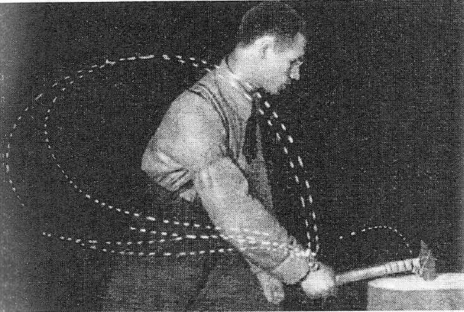
Nikolai Bernstein clarified Motion (Bernstein, 1967), (Figure 1).
Figure 1: Motion movement.
At first, the trajectory varies greatly each time it is repeated. However, when approaching an object, the muscles harden, become one with the skeleton, and move as a musculoskeletal system, so the trajectory can be con- trolled. Most of the current research on Motion in human movement targets
Instinctive Intelligence: Our Next AI 237
this stage. Therefore, since it can be controlled, commands can be issued to a machine such as a robot to control the machine.
Then why do the initial trajectories vary greatly? This is to respond to changes in the surrounding environment and circumstances.
In order to respond in this way, it is necessary to mobilize all body parts and balance the body. In other words, at the controllable stage, it was possible to respond by focusing only on the external movement, but at this initial stage, not only the motion but also the movement of the motor, that is, the internal movement of muscles, etc., i.e., the motor must be comprehensively coordinated.
FROM CONTROL TO COORDINATION The importance of Coordination is increasing rapidly now because the out- side world is constantly and greatly changing. In other words, while tactical considerations (motion) have been the main focus of human movements so far, strategic responses (motion and motor) becomes important from now on. In other words, a comprehensive response capability has come to be required.
FROM DIGITAL TO ANALOG To describe it another way, we have been focusing on digitalization. DX is getting wide attention these days. And current AI (Artificial Intelligence) is developed on digital basis. But to take strategic response, we have to con- sider not only motion, but also motor. In short, we must stop thinking as musculosekeletal system. We need to pursue muscles own movement.
When we relied on musculosekeletal system, we could use node-link net- work. We can use the network approach in graph theory. When we only noted movements of joints, this discrete mathamatics analysis was effective. But when it comes to muscle movements, we need to shift to continuous mathematics, because decision making on how to move becomes crucially important.
But we should note that what we need to deal with this problem is not an ordinary continuous mathematics issue. The important thing is to find out how each muscle moves and realizes flexible body movements. The problem here is not how to apply continuous mathematics to the hard world, but how to analyze the soft world.
But we do not have such a tool right now. The current AI only deals with digital world and it cannot detect unexperienced possibilities. In short, it cannot explore the new frontiers. In the softening world, what is needed is to predict the unforeseen environment and situation and to prepare for it.
Jean Piaget proposed Cognitive Development Theory (Piaget) and made it clear that babies develop cognitive capabilities up to 2 years old. Although nobody tell them how, they can learn to crawl, walk and talk within 2 years.
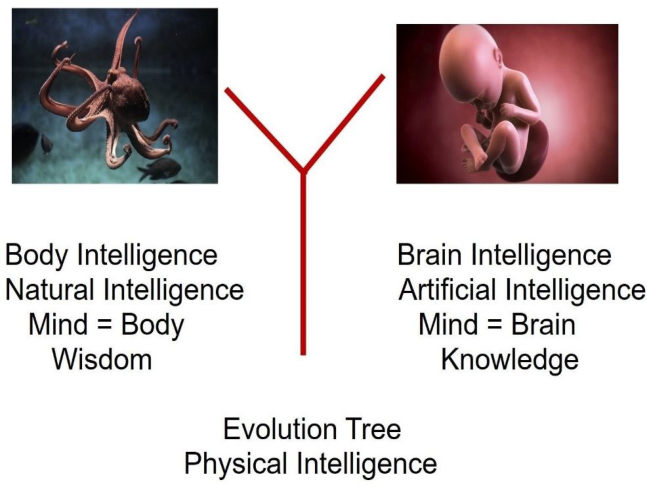
When it comes to Coordination and Analog, we learn a lot from Octopus. Octopuses have a large head, but its brain capabilities are at the same level of a dog. But they can escape from any environment. They can recognize the environment with their 8 arms and they escape from anywhere, using them.
238 Fukuda
They can even escape from a screwed container. Thus, they are called “expert of escape”.
As Figure 2 shows, their intelligence is body intelligence. Human intelli- gence, on the other hand, is brain intelligence. In short, octopus intelligence is wisdom, while human intlligende is knowledge. Knowledge is structured accumulation of personal experience. As envrionments and situations change continuously today, knowledge is losing it value quickly.
Figure 2: Octopus and human intelligence.
IMPORTANCE OF BODY SENSATION, PROPRIOCEPTION Importance of body sensation, i.e., proprioception will be understood if we know that octopus is the only invetebrate which can identifly self in a mirror. In verbrates, only humans and some apes can. Such self mirror image identif- ican can be made possbile because they “feel” their body balance and mirror images move in response to their feelings.
The importance of body sensation can be understood easily if we think of sports. We balance our body movements to play. And Chinese Tai Chi, martial art, emphasizes not external body movement, but internal body movement, because muscle movement is more important than external musculoskeletal movement.
For the same reason that humans like sports, children play tag and acquire the ability of managing proprioception.
FROM EUCLIDEAN TO NON-EUCLIDEAN What is important to acquire the ability of managing proprioception is to chanage our approach from Euclidean to Non-Euclidean. In Euclidean
Instinctive Intelligence: Our Next AI 239
apporach, datasets are required to satisfy orthonormality and interval scale distance with units.
But to acquire the ability of moving our body in a soft way, we need to make decisions on what movement we should take. This calls for strate- gic decsion making. And it needs to prioritize our decisions. In short, we must change our approach from cardinal (one, two, three,---) to ordinal (first, second, third,---).
MAHALANOBIS DISTANCE P. C. Mahalanobis proposed Mahanalobis Distance (MD) (Mahalanobis). He is a researrcher of design of experiments. He proposed MD to remove outliers from his datasets. But MD is ordinal, so we can use it for prioritizing our strategic decsion making.
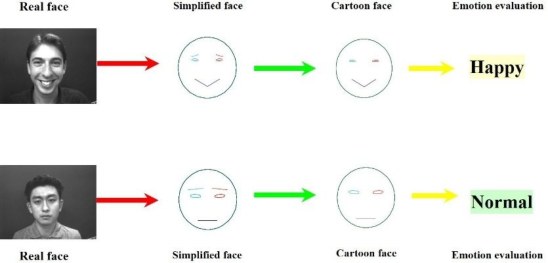
PATTERN Shuichi Fukuda and his group used to study detection emotion from face. Detecting emotion from face movement works very well to communicate bet- ter. They tried many image processing techniques. But they dook too much time and they did not produce satisfactory results.
During these challenges, Fukuda suddenly realized that we can detect emo- tion from characters in cartoons. Manga at that time was an era of still images. And most of them was in black and white. But when we see Manga, we can immediately understand emotion. So, we introduced Manga-face- model and succeeded in detecting emotion from face. It does not take time. We can detect emotion at once and without any difficulty (Kostov, 2001), (Figure 3).
Figure 3: Manga-face-model approach.
MAHANANOBIS-TAGUCHI SYSTEM (MTS) Around the same time we developed Manga approach, Genichi Taguchi, et al. developed Mahalanobis-Taguchi System (Taguchi, et al. 2000). He developed Taguchi Method (Piaget, n.d.) to manage quality statistically. But companies cannot manage quality element by element. What they did and are doing right
240 Fukuda
now is to manage product quality holistically on the group basis of factory, organization, etc.
Taguchi realized if they combine MD with pattern, they can meet industrial demands. He introduced thresholds and if MD is smaller than this threshold, then the expected holistic quality is ensured, if it is larger than the threshold, it does not. MTS was exactly what the industry wanted, so it was welcomed by companies.
RESEVOIR COMPUTING MTS has met industry expectations, but its pattern matching is static.
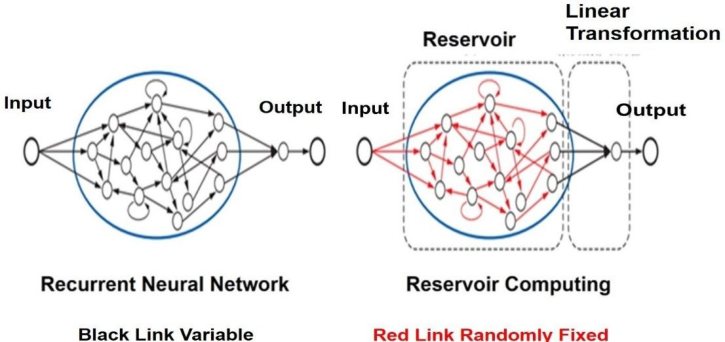
But changes are dynamic today. We can make it dynamic by introduc- ing Recurrent Neural Nework (RNN). But RNN is a blackbox. It processes automatically.We cannot manage the system. To manage the system, we can itnroduce Reservoir Computing (RC). RC allows us to make adjustment at the output.
Figure 4: Reservoir computing.
HUMAN ENHANCEMENT In addition, RC has a more important advantage. It can introduce micro tech- nologies. Therefore, we can make it possible to make sensors and actuators part of our body.
Up to now, sensors detect signals and actuators which can process them are driven. It was sequential processing. But if we can make sensors and actuators parts of our body, we can work sensors and actuators at the same time and process signals simultaneouslly. Thus, there will be no delays. Real time response can be realized.
To describe it another way, we can enhance our human capabilities. We can directly interact with the outside world without any delay.
Instinctive Intelligence: Our Next AI 241
MAHALANOBIS DISTANCE-PATTERN (MDP) APPROACH Basic idea and importance of new AI (Analog Intelligence) is described.
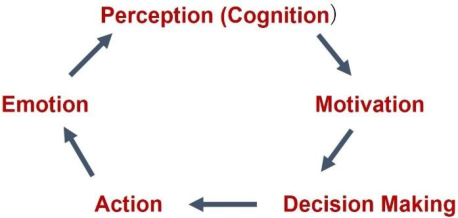
This new AI is basically pragmatic and explores the new frontiers as shown in Figure 5.
Figure 5: P-M-D-A-E cycle.
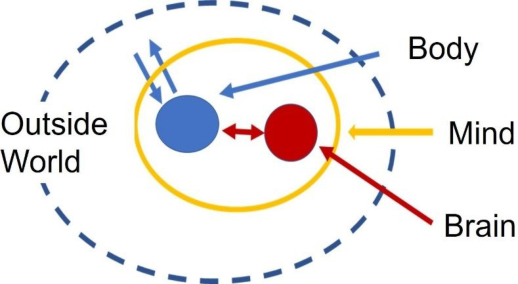
We should note that this approach make the most of Mind-Body Interac- tion. Mind- Body-Brain is shown in Figure 6. Although Brain is getting wide attention these days, it is bodythat directly interact with the outside world. But we should remember Mind accommodates body ahd Brain. In other words, Mind-Body Integration is important for holistic body movement. Mind is nothing other than Heart. We should remember the Wordworth’s poem “My heart leaps up when I behold a rainbow in the sky”. Our world is shifting from material or product-based to mental or emotional-focused. When we succeed in coordinating our such inner body parts as muscles, we feel we are achieving Self-Actualization and we get the maximum satisfaction and feeling of achievement.
Figure 6: Mind-body-brain.
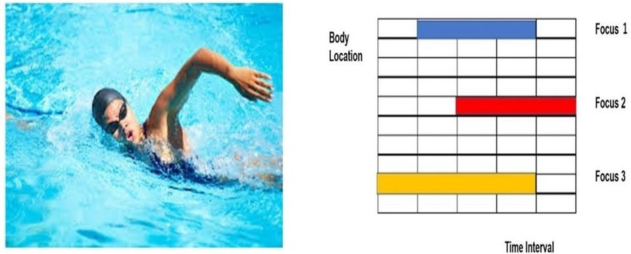
Let me explain how MDP approach works by taking swimming as an example (Figure 7).
In swimming, water changes continuously, so we cannot identify parame- ters and we cannot apply mathematical approaches. This is the same context as we experience in the Real World.
242 Fukuda
Figure 7: Mahalanobis distance-pattern approach to support instinct.
As our body builds and how to move are different from person to person. Thereore, you have no choice but to learn swimming by yourself. So, you put on wearable sensors and swim. Then you can produce such a data sheet shown on the right. Each row corresponds to each muscle at that location. So, you can track the behavior of each muslce at various locations over time. If MD is decreasing between time T1 and T2, then you are moving that muscle in the right way. If MD is increasing, you must change the current moventment of that mucles, so that MD changes to decrease.
SUMMARY As materials are getting softer and softer, we need to directly interact with objects and move our internal organs such as muscles flexibly. To achieve this goal, we need to develop Analog approach. This paper describes new AI (Analog Intelligence), which supports our instict to make decisions how to move our body holistically.
It should be added that a new research has begun to pursue how cells share the burden and achieve flexible body movements as a team.
REFERENCES
Bernstein, N. A. (1967). The co-ordination and regulation of movements, Oxford, Pergamon Press. Kostov V, Fukuda S, Johansson M. (2001). Method for Simple Extraction of Paralin-
guistic Features in Human Face. Image & Visual Computing, The Journal of the Institute of Image Electronic Engineers of Japan, Volume 30, no. 2, pp. 111–125. Mahalanobis, P. C. https://en.wikipedia.org/wiki/Mahalanobis_distance Piaget, J. https://en.wikipedia.org/wiki/Jean_Piaget Taguchi, G., Chowdhury, S., Wu, Y. (2000), The Mahalanobis-Taguchi System, New York, McGraw-Hill.
Read this individual research paper free through the original publisher, or explore the full digital proceedings book.
ISBN 978-1-958651-87-2
Explore this ISBN in the AHFE Bookstore ↗Listed in the July 2026 bookstore catalogue; search by ISBN to confirm current availability · Digital book purchase optional