Hang Shang, Wenbo Liu, Yuhuan Li (2022). Risk of COVID-19 infection and prevention and control strategies in universities. In: Global Issues: Disease Control and Pandemic Prevention. AHFE Open Access, vol. 24, pp. 91–99. https://doi.org/10.54941/ahfe1001363
At the beginning of 2020, a sudden COVID-19 outbreak swept the world. So far, more than 300 million people worldwide have been infected with COVID-19 virus. Although the successful development of the COVID-19 virus vaccine has brought a great turnaround to the early stage of epidemic prevention and control.However, when the discovery of asymptomatic infected people, cold chain transmission routes, the emergence of novel coronavirus mutation and many other situations, the world faces new challenges.As a place with dense personnel flow and frequent contact in universities, infection cases will be more prone to the rapid spread of the epidemic, causing very serious social problems.Studying the relationship between the transmission rate of the campus epidemic and the prevention and control measures is the need of formulating efficient campus epidemic prevention and control strategies.Prediction the spread of novel coronavirus using the infectious disease model is an important means to study the spread of COVID-19 and make prevention and control decisions.This study mainly studied the risk of infection and prevention and control strategies.In the aspect of infection risk analysis, with the student dormitory of a university as the research object, five levels of campus epidemic prevention and control strategies were first established, and then through the establishment of healthy person-infection (SI) infection model based on statistics and probability judgment, the transmission speed of the epidemic under different epidemic prevention strategies was investigated.Then, the diffusion situation of the epidemic was simulated. Taking two dormitory buildings A and B as an example, the simulation results of dormitory students under vaccination and non-vaccination and different levels of prevention and control measures were analyzed to find out the key factors for the prevention and control of the epidemic.To provide help for the implementation of epidemic prevention and control strategies in colleges and universities.
In the globalization of novel coronavirus today, slowing the growth of infe- cted people remains the top priority of all countries around the world. However, in addition to the development of virus vaccines, another very effe- ctive method is the prevention and control of the route of virus transmission.
In early November 2021, the source of the virus suddenly broke out on a uni- versity campus (Wu Fei et al. 2020). As the university campus is a place with dense personnel turnover, the emergence of COVID-19 infected people will quickly cause a widespread secondary spread of the virus, causing a very seri- ous impact on the teachers and students on the campus (Hu Yi et al. 2021). Due to the large scope of the campus, the first step to find the epidemic is to isolate known infected persons and close contacts, and stop large-scale campus activities to narrow the scope of other groups (in the dormitory). Therefore, after the detection of infected people, rapid prevention and con- trol measures can effectively slow down the spread of the epidemic. This article takes the epidemic events in universities as the research object, establi- shes a virus transmission model (Sun Boli, 2021), and analyzes the impact of the transmission speed of the epidemic on campus when different prevention and control measures are adopted. Through comparison and analysis, we can identify the key factors that can effectively control the spread of the epide- mic. It will provide some help for the future effective treatment of similar COVID-19 infection emergencies on campus, and minimize the risk of virus infection.
FIVE-LEVEL CAMPUS PREVENTION AND CONTROL STRATEGY SETTING According to the daily life trajectory of campus students and the different severity of the epidemic infection, the five action trajectory of students, inclu- ding outside school, class, dining, bedtime and personal hygiene, are the main ways of infection, and the five-level prevention and control strategy were constructed, which are as follows (Chen Xiang and Hu Zhibin, 2020):
First-level prevention and control: implement campus closed management, and strictly prohibit anyone inside and outside the school. All students should wear masks in any place except in the dormitory. Set a unified dormitory access path, the dormitory domestic demand for daily air disinfection.
Second-level prevention and control: stop the development of offline tea- ching activities, and turn the teaching work into online, to avoid personnel gathering. On the basis of first-level prevention and control, students should order online meals or take one person to return to bed in the dormitory, so as to avoid a large range of personnel gathering. Students’ daily household gar- bage is sent to the designated place for disinfection and treatment. (Because of the emergence of asymptomatic infections, their household waste also incre- ases the risk of infection.) Make daily 3:00-5:00 PM for students to travel, and divide the designated activity area.
Third-level prevention and control: on the basis of the second-level prevention and control, the dormitory corridors are disinfected three times in the morning, afternoon and evening every day. Students are strictly prohi- bited to take meals and daily activity time to go out of the dormitory. Daily temperature monitoring was conducted early, noon and late, once abnormal body temperature or initial symptoms of novel coronavirus were found. The abnormal dormitory should be immediately closed, and nucleic acid all in the
Risk of COVID-19 Infection and Prevention and Control Strategies in Universities 93
dormitory should be tested to check whether they were infected with novel coronavirus.
Fourth-level prevention and control: on the basis of thrid-level prevention and control, if the infected person appears, the contact contacts will be qui- ckly investigated, and these personnel will be quarantined for observation. As well as the floor where the dormitory is closed, and all personnel on the floor are prohibited from going out of the dormitory building, the school sends a unified distribution, distribution personnel must wear protective clothing into the closed floor, and must be disinfected after distribution.
Fifth-level prevention and control: on the basis of fourth-level prevention and control, if through the observation of quarantined personnel, once there are new infected persons and infected persons outside quarantine observa- tion, the whole campus dormitory will be closed immediately, and all the student dormitories will be distributed by the school commissioner on time. In addition, the medical staff conducts all the nucleic acid testing on campus every day, and the prevention and control time range is 14 days.
ESTABLISHMENT OF NOVEL CORONAVIRUS CAMPUS INFECTION MODEL The Principle of Campus Infection Model
This model is a healthy person-infected person infection model based on sta- tistics and probability judgment, where S represents the number of healthy persons and I indicates the number of infected persons. hereinafter referred to as SI infection model, the principle is as follows (Yuan Cunde and Hu Baoan, 2002).
Students are divided into two groups: one is the “healthy person” who is not infected by the virus, and the other is the group carrying the virus, including symptomatic and asymptomatic. In order to facilitate statistical analysis, the virus-carrying group is uniformly called as the “infected person”. As we know that in daily life, there is mutual contact between student groups. In this process, the infected person will have direct or indirect contact with the healthy person, which will have a certain probability of spreading the virus to the healthy person and transforming it into the infected person. The results of the current novel coronavirus show that healthy people cannot convert to infected people without contact with the novel coronavirus. Infected people, without medical treatment, can not even be transformed into healthy people in the short term.
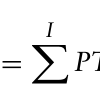
According to statistics and probability, assuming each infection in con- tact with a number of healthy, remember i infected in unit time contact with the number of Ti, contact health, everyone has a certain probability of be infected, the probability of infection is P, because contact i infection increa- sed PTi. for all infected, without the condition of repeated contact, the total number of healthy persons due to contact becoming infected are given by (1).
Equation reproduced from the original PDF.
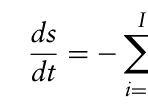
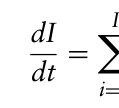
Changes in the number of healthy persons and infected persons per unit of time are given by (2) and (3).
I X PTi (2)
Equation reproduced from the original PDF.
PTi (3)
Equation reproduced from the original PDF.
The Modeling Process of Campus Contagion Model According to different levels of prevention and control measures, the number of contact and infection probability under the corresponding situation were set, and the SI model was used to simulate the infection situation under diffe- rent prevention and control measures and vaccination conditions. Taking two dormitory buildings A and B with different dormitory buildings on campus as the simulation scenario, assuming that a virus carrier appears in the dor- mitory building, we will discuss the virus infection situation under different levels of prevention and control strategies within 14 days (Sang Maosheng et al. 2021). (The maximum number of symptoms known to identify in novel coronavirus carriers is often 14 days). The structures of the dormitory buildings A and B are as follows:
(1) Dormitory Building A: five floors, with 20 dormitories on each floor. The number of dormitories in each dormitory is 6, with a total of 600 people living, and two public toilets on each floor. (2) Dormitory Building B: six floors, 30 dormitories on each floor, each dormitory is 4 rooms, a total of 720 people live, each dormitory has an independent sanitary ware.
Students’ daily work and rest activities are divided into five stages: washing, going out, class, dining and dormitory rest. Each link will make contact with people, which will give the virus carrier a certain chance of transmitting the virus to the healthy person and converting it into an infected person.
SI Model Operation Steps and Related Parameter Settings Suppose an infected person in a dormitory will spread the virus to several others in the same dormitory; In the next situation simulation, these people will contact the other population. Modeling and simulation of the SI model were run in the MATLAB software.
SI Model Run Steps (1) Initialization settings. A data form was generated, including the dormi- tory floor and number of all students, student physical status (health is 0, infection is 1), and all students are healthy. And each student’s number is unique. (2) One student was randomly selected as the initial infection, and the body status parameters were modified to 1.
Risk of COVID-19 Infection and Prevention and Control Strategies in Universities 95
Table 1. Parameters set under different prevention and control levels and infection situations in dormitory A (number of contacts and infection probability).
Table available in the original PDF paper.
Scenario (Number of contacts / infections) Prevention and control level Outside Attending Dining Bedtime Washing class No prevention and control 10/0.2 10/0.5 20/0.6 5/0.8 3/0.3 First-level prevention and control 10/0.001 10/0.2 20/0.6 5/0.8 3/0.1 Second-level prevention and control 10/0.001 5/0 20/0.001 5/0.8 3/0.1 Third-level prevention and control 10/0.001 5/0 20/0.001 5/0.8 3/0.1 Fourth-level prevention and control 10/0.001 5/0 5/0 5/0 3/0 Fifth-level prevention and control 5/0 5/0 5/0 5/0 3/0
Table 2. Parameters set under different prevention and control levels and infection situations in dormitory B (number of contacts and infection probability).
Table available in the original PDF paper.
Scenario (Number of contacts / infections) Prevention and control level Outside Attending Dining Bedtime Washing class No prevention and control 10/0.2 10/0.5 20/0.6 3/0.8 First-level prevention and control 10/0.001 10/0.2 20/0.6 3/0.8 Second-level prevention and control 10/0.001 3/0 20/0.001 3/0.8 Third-level prevention and control 10/0.001 3/0 20/0.001 3/0.8 Fourth-level prevention and control 10/0.001 3/0 3/0 3/0 Fourth-level prevention and control 3/0 3/0 3/0 3/0
(3) The infection process was simulated in five orders of students’ work and rest activities. In the process of simulation, first read from the data table, in a random way to generate the student in a certain situation may contact healthy student number list, and then each healthy student, by generating a random number, with set infection probability, determine whether the contact is effective infection (infected and healthy people contact and infection). After the simulation of the infection process, all infected student numbers were counted and the data table was updated. (4) When all the five infection scenarios are completed, it will be regarded as the end of the day. Students’ time of infection and the list of infe- cted persons are updated, and prepare to start the infection situation simulation of the new day, with a total of 14 d simulation.
According to the structure of the dormitory building and the level of epidemic prevention strategy, referring to the selection of parameters in the SI infection model with reference to the existing research results at domestic and abroad, the number of contact and the probability of infection in the infection situ- ation of dormitory A and B are set (see Table 1 and Table 2) (Zhou Wulüe, 2020). Due to the different structure of apartment B building and Apartment A building, the number of contact people has changed, and each dormitory in dormitory B building has an independent bathroom, so the washing scene is deleted during the simulation. The remaining conditions are the same as those in dormitory A. With the improvement of prevention and control level,
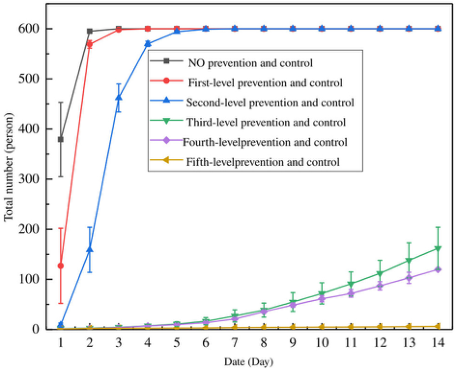
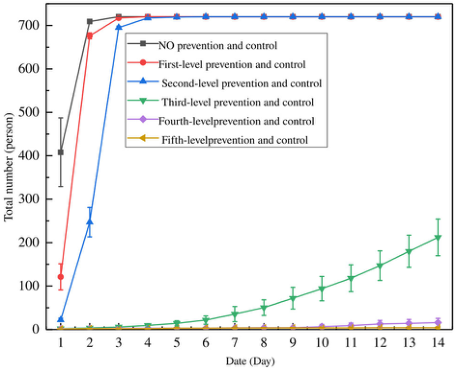
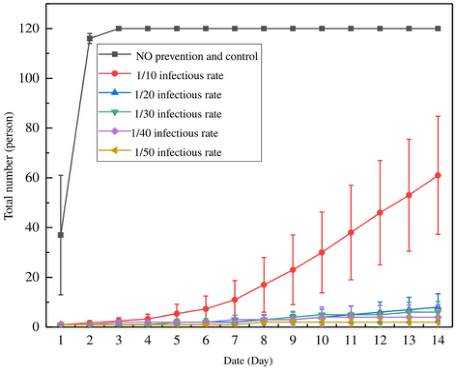
Figure 1: Trend of number of infected over time under different levels of prevention and control. (Dormitory A).Figure 2: Trend of number of infected over time under different levels of prevention and control. (Dormitory B).
each student is under different pairs of infection scenarios, so the infection probability has also changed.
SIMULATION OF EPIDEMIC INFECTION AND SPREAD ON CAMPUS Simulation of Epidemic Infection Between Dormitory Buildings A and B
One virus carrier appeared in the dormitories A and B, respectively. The simu- lation results under different levels of prevention and control measures are shown in Figures 1 and 2.
Risk of COVID-19 Infection and Prevention and Control Strategies in Universities 97
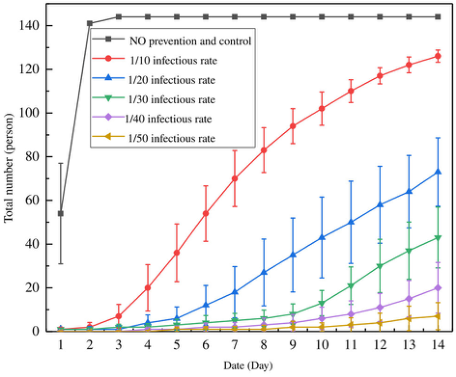
Figure 3: The number of infections changes with time at different levels of infection rates after vaccination. (Dormitory A).
From Figure 1, novel coronavirus is very infectious. In the absence of pre- vention and control measures, all 600 students in the whole A dormitory building were infected in only 2-3 days. With the improvement of preven- tion and control level, the appreciation of the number of infected students gradually decreased in a short period of time. The improvement of secon- dary prevention and control over primary prevention and control changed the mode of class and dining, and reduced a large area of personnel contact, but did not have much impact on slowing the transmission speed, delayed by only 2 days. With the implementation of three-level prevention and con- trol, it mainly reflects the impact of going out on transmission, and students are restricted from going out, and closed and nucleic acid detection and investigation, which effectively slowed down the transmission speed and gre- atly reduced the number of infected people. This shows that the isolation of already infected groups has a positive role in slowing down the speed of transmission and reducing the number of people infected. The improvement of four and five prevention and control lies in that the contact between infe- cted groups and healthy groups is blocked in different ranges, especially the implementation of five prevention and control, reducing the total number of infected people to 1/100 of the total number of groups. This shows that the separate isolation of the infected persons found, and the secret and secon- dary secret next investigation and isolation, has a great effect in inhibiting the spread of infection.
The difference between Figure 2 and Figure 1 is reflected in the four-level prevention and control, mainly reflected in the impact of washing on the epi- demic infection. Under the four-level prevention and control, it can be seen from the comparison of the two pictures that the infection rate in dormitory B is significantly lower than that in dormitory A, and the total number of people infected is also less than that in dormitory A. Therefore, in the class, each dormitory building B, with an independent bathroom, effectively blocks
Figure 4: The number of infections changes with time at different levels of infection rates after vaccination (Dormitory B).
the contact with the infected person in the washing scene, and has an impor- tant impact on the spread of the epidemic. Figures 3 and 4 are simulations of epidemic infection at different infection levels set after Novel Corona- virus vaccination. Assuming that all students in dormitories A and B were vaccinated against COVID-19 and all students had antibodies, the succes- sful probability of exposure to infection in various situations was reduced (Li Zhongyuan, 2021). For the convenience of discussion, the reduction of the probability of contact infection after vaccination is divided into five gra- des, that is, 1/10, 1/20, 1/30, 1/40 and 1/50 with no prevention and control, and the infection situation after vaccination.
CONCLUSION
Novel coronavirus has a strong transmission ability and a long incubation period. Once someone is infected on campus, it will spread quickly. Through the simulation of epidemic infection in different dormitories of dormitories A and B, it can be concluded that: avoid gathering and contact; isolate infe- cted and suspected infected persons; and inject COVID-19 vaccine to produce antibodies to form herd immunity. The combination of the above three points and the implementation of five-level prevention and control measures are effective strategies to reduce the spread of novel coronavirus. Facts have proved that it is precisely because China has adopted strict epidemic pre- vention measures that the serious consequences of the catastrophic spread of the epidemic on university campuses have been avoided.
ACKNOWLEDGMENT
The authors would like to acknowledge Professor Min Zhao for his valuable opinions and suggestions. We also thank the School of Art and Information
Risk of COVID-19 Infection and Prevention and Control Strategies in Universities 99
Engineering of Dalian University of Technology for supporting part of this research.
REFERENCES
Hu Yi, Zhao Jie, Le Jiaxu, et al. (2021) Modeling of a coronavirus disease outbreak at the beginning of 2021 in Shijiazhuang, Hebei Province, China, Shanghai Journal of Preventive Medicine, p. 287. Wu Fei, Kang Xin, Cui Yan, et al. (2020) Thoughts against the backdrop of the
Covid19 epidemic: how to strengthen urban public health governance capacity— an analysis of the outbreak of the Covid-19 epidemic in Dalian on Jul, 22. China Development, p. 37. Sun Bolin. (2021) A glimpse of the New Coronavirus model —overview of “New Coronavirus” model supporting the fight against epidemic, Computer Simulation, p. 38. Chen Xiang, Hu Zhibin. (2020) Guidelines on COVID-19 prevention and control in
higher education institutes. Beijing: People’s Medical Publishing House, p. 50. Yuan Cunde, Hu Baoan. (2002) A SI epidemic model with two-stage structure, Acta Mathematicae Applicatae Sinica, p. 193. Sang Maosheng, Ding Yi, Bao Minglei, et al. (2021) Propagation dynamics model
considering the characteristics of 2019-nCoV and prevention-control measure- ments, Systems Engineering Theory & Practice, p. 124. Zhou Wulüe, Bai Di, Zhao Jijun. (2020) Modeling and analysis of COVID-19 in Wuhan, Complex Systems and Complexity Science, p. 58. Li Zhongyuan. (2021). China’s first COVID-19 vaccine conditional listing, Friend
for Senior Middle School Students, p. 9.
LISTED IN THE AHFE DIGITAL BOOKSTORE CATALOGUE
Explore the complete digital volume
Global Issues: Disease Control and Pandemic Prevention
Read this individual research paper free through the original publisher, or explore the full digital proceedings book.
ISBN 978-1-958651-00-1
Explore this ISBN in the AHFE Bookstore ↗Listed in the July 2026 bookstore catalogue; search by ISBN to confirm current availability · Digital book purchase optional