Ana Moreira da Silva (2023). In a Digital/Artificial Intelligence time can sketches still be useful for Design Process?. In: Human Systems Engineering and Design (IHSED 2023): Future Trends and Applications. AHFE Open Access, vol. 112, pp. 162–170. https://doi.org/10.54941/ahfe1004126
Design is, undoubtedly, a creative process. To solve several design problems, designers need tools with specific qualities. Can sketches still be beneficial during design creative process?The relationship between freehand drawing and designers is very old, as the designers use this medium as a way of giving space to creative thinking.Sketching is often used as a tool during idea generation in the early stages of design process. It is in this initial phase of project conception in design where sketches are more frequently used.With the advent of digital drawing tools, most designers, from several design areas, still prefer to sketch with a pen, or a pencil on a paper during the ideas generation.However, and for several users, sketches may seem obsolete representations, totally unable to compete with the modern and sophisticated modeling tools.Nowadays, the use of digital rendering has grown, as the advancement of hardware and software that provide the use of the technique via computer is notorious.With the evolution of technology, the end of manual drawing has long been one of the most discussed issues.There are, however, questions for its future: should technological means completely replace the old method in the name of speed, practicality and immediate results?This paper reflects on sketching as the conception and representation or presentation of an idea, essential to human-centered design practice.We intend to investigate how sketches can still be powerful representations of new ideas, as part of a larger design process, as a key method for thinking, reasoning, and exploring solutions for design problems.
This paper stems from a current post-doc research project intending to pro- duce more knowledge and reflection on Drawing. In this project we consider the close connection between Drawing and Design. This post-doc main research topic is about the importance of freehand drawing/sketch as a critical instrument and as operative support within the conceptual process in design. Its main objective is to investigate the importance of freehand drawing/sketch in the design process.
Through the critical analyses of several authors, we search for answers and arguments that can corroborate our main question: despite the nowadays
In a Digital/Artificial Intelligence Time Can Sketches Still Be Useful for Design Process? 163
great advances in digital/Artificial Intelligence tools, can sketches still be useful for designers and architects professional activity during their creative process?
SKETCHES WITHIN DESIGN PROCESS Sketches are quick freehand drawings, carried out with the intention of dis- cussing graphic ideas or simply registering them, they are used by almost all professionals of the project area: architects, engineers, interior designers, product designers, graphic designers and many others design professionals. According to Silva & Nakata (2012), defining the term “sketch” is not an easy task. In general the word sketch refers to a rough draft quickly made. Sketching is actually a practice, a quick freehand drawing, usually done when the project area professionals design. They also sketch having a coffee, or even sitting in a square and recording the ambiance with quickly drawn lines. Most professionals in the area carry the sketchbooks with them, as they allow making possible to draw anywhere and at any time.
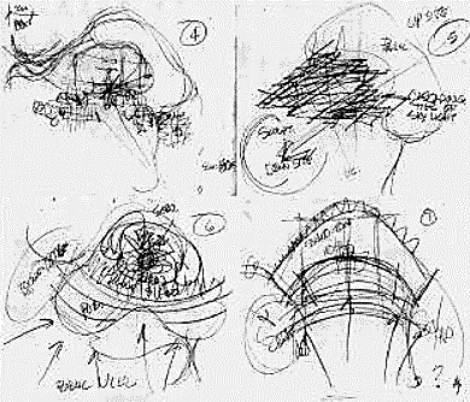
Sketches externalize ideas, turn evasive thoughts into reality, confer coher- ence on disperse conceptions, and communicate ideas and concepts to others. Unlike the designer’s imagination, a sketch can be seen. At the beginning design sketches are imprecise and vague (Figure 1). They represent experi- mental attempts, without precise definitions, exact shapes or rigorous spatial relations (Tversky & Suwa, 2009).
Figure 1: Design first sketches are imprecise and vague. http://papers.cumincad.org/ data/works/att/24db.content.00583.pdf.
A characteristic of the design process common in all areas of design is the use of a large number of different types of drawings which are associated with the different stages of the process.
164 Moreira da Silva
Design process starts with the creative phase when sketches support the flow of information between external and internal mental representations and the first still vague ideas with the purpose of finding design solutions. The next step is the critical process of selection, discussion and improve- ment of the chosen solution, which verifies the possible ways to achieve the proposed objective, thus creating more detailed and clarifying drawings. At last, the elaboration of the final proposal, usually a well-crafted image of the artefact, of the architectural or engineering achievement, from differ- ent angles showing what the project will really be, with the use of all the details and diagrams, normally being carried through the use of new digital technologies.
Sketches are widely used in the development of concepts, being a quick and unfinished drawing, it allows a change of shape and inclusion of new lines in a faster and more practical way. In the early phases of design process, design- ers of several areas, architects and engineers sketch to help themselves to see, to reason, and to explore ideas and solutions. This type of drawing serves to externalize internal thoughts, turning flowing ideas permanent, making them visible for all. They can be recreated, examined and re-examined, con- figured and reconfigured, conferring a critical vision useful for clarity and for creativity (Tversky & Suwa, 2009).
Embryonic ideas are quickly recorded for primary analysis before they disappear, permitting reflection and detailed observation of several ideas, val- idating or discarding them, generating a constant flow of more ideas (Barreira da Costa, 2019). Sketching allows ideas to come out. Each sketch works as a bridge between the abstract world of the imaginary and the concrete material explanation through graphic synthesis.
The act of sketching helps designers not only to see and understand the forms they work with, but also as an easy way for communication with others demonstrating their ideas. For Joshua Brewer, senior designer at Twitter and UX designer, sketching value is that it allows to explore and refine ideas in a quick, iterative and visual way. Rapid ideation flow and interact, layout can be quickly established, rearranged or discarded, all of this without ever using a computer (Mills, 2017).
Sketching is a knowledge-based, knowledge-rich activity. The act of draw- ing by hand involves both functional and formal reasoning. The scientific community has shown interest in the relationship between hand drawing and cognition, offering arguments that this kind of drawings can enhance think- ing, along with the value of being a visual thinking tool in design process (Moreira da Silva, 2022).
During early design process ideas come and go, sketching allow to translate this first ideas into physical existence, helping to document those ideas in real-time as they arise in few seconds (Mills, 2017).
According to graphic designer Jorge dos Reis, the base of his production is on the permanent and indispensable use of sketches as a working tool, with the purpose of anticipating and reorganizing the definitive graphic work. He states that along his design process, the systematic sketching allows to achieve a gradual approximation to the desired graphic project, in a continuous search (Reis, 2022).
In a Digital/Artificial Intelligence Time Can Sketches Still Be Useful for Design Process? 165
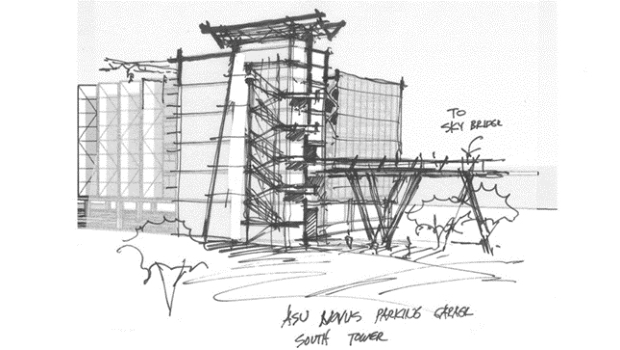
In a recent interview, Craig Stoffel, specialist in architectural design, ques- tioned about the importance of the use of sketches throughout the entire design process or just in initial phases. Stated that sketching is a form of visual thinking and is useful anytime. Architects sketch throughout the entire design process from initial concepts, details and even during construction. Sketching is a fundamental form of communication for designers (Stoffel, 2021). Sketching is a very simple tool still used by many project profession- als, despite the paradigm shifts produced by the technological advances (Figure 2).
Figure 2: Architectural sketch by Craig Stoffel (2021). https://toddassoc.com/the-role- of-sketching-in-the-design-process/.
Sketches are easier to create and easier to revise, helping moving from one idea to the next, permitting to communicate visually what is in the mind, facil- itating team working, and also can inspire future projects, therefore sketches can assist the design creative process.
CREATIVE PROCESS The definition of creativity can be based on the origin of the word that comes from the Latin verb ‘creare’, which means to originate, to generate, to form.
Designing is undoubtedly a creative process as the designers work is related to generate new forms. The relationship between designers and sketching is timeless and usually very intense, as they use this practice as a way of giving output to creative thinking. In the design process, the creative phase usually starts with sketches, followed by several stages: register and devel- opment of multiple ideas, mainly through sketches; the selection of some for their improvement; critical analyses of the chosen possible solutions and their refinement; being the last phase the detailed representation of the final concept (Silva & Silva, 2016).
The creative phase is one of the most complex part of the design process, and requires that the designer can register the flowing ideas in a quickly way
166 Moreira da Silva
with a few strokes allowing to capture them. During this phase, designers take advantage on the use of a large number of sketches because the act of sketch- ing enables their thoughts to be gradually translated and decoded throughout drawn lines. When sketches are carried out emerge a propitiatory capacity for reflection, which allows and encourages the elaboration of new and creative ideas.
Freehand drawings are often used to facilitate development of the design- ers’ ideas and to work on them more quickly and efficiently. Sketching is an essential tool for many designers, no matter if their work is in informational, graphic, product, communication, fashion or another pro- fessional areas such as: engineering, architecture, marketing, advertising, cinematography, teaching and many others. Sketches seem to be present in almost all disciplines that identify with creativity (Moreira da Silva, 2021). In creative teams, sketches also represent a valuable tool, validating brain- storming, materializing concepts, externalizing the various ideas that float in different work groups. Sketching breeds collaboration and is a tool accessible to the whole team, like a common language that can bring clarity to ideas.
The process of thinking through sketching helps designers to keep their creativity flowing while they record ideas in quickly drawn lines (Mills, 2017). Scientific studies about creativity can be useful for understanding the cre- ative process. Recent progress of computational and cognitive science has opened new horizons in the neuro-scientific approach, bridging the concept of creativity and specialized brain function.
Cognitive scientists and psychologists examined the mind’s representa- tional structures, their interconnections, and the mental processes that trans- forms them. One of their conclusions is that creativity emerges from cognitive abilities, with variations in the use of specific processes, such as: flexibility on the cognitive structure, memory capacity, reflection and concept develop- ment, adapting and combining ideas, attention systems, motivation, among others (Sun-Hyung, Kwang & Jarang, 2016).
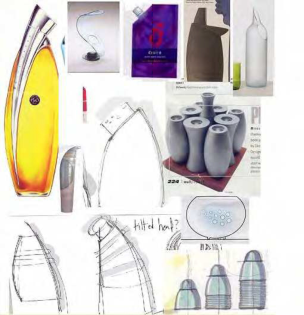
Several scientific researches examining neural mechanisms underlying the generation of creative new ideas for various problems solutions and for dif- ferent task supports, proved that creative processing emerges in the cerebral cortex. The act of creation requires the brain to find new associations, new connections between its neurons. Considering that creativity is also a cogni- tive function as a result of the functioning of the brain, scientists observed that hand drawings support a flow of information between external and internal mental representations (Figure 3) and that there is a direct link between the thinking and the hand that performs the sketch. The hand as an extension of the brain, of the reasoning (Kaufman & Gregoire 2015; Goel 1995; Gl˘aveanu 2014). Sketching is a way of discovering clues through the ideas representation, therefore pertinent to the designer’s own visual thinking. So, sketching as a tool for expressing and developing intentions can be useful for facilitating visual thinking needed during conceptual design creative phase (Self, Evans & Kim, 2016).
In a Digital/Artificial Intelligence Time Can Sketches Still Be Useful for Design Process? 167
Figure 3: Mood board for product design showing multiple sketches of the object and the sources of inspiration. http://papers.cumincad.org/data/works/att/24db.conten t.00583.pdf.
By drawing rough lines and shapes, designers begin to use that spark of creativity within them to come up with interesting concepts that can be the initial foundation of their next design work (Moreira da Silva, 2022).
We can conclude that sketches assume a peculiar and determinant char- acter in the creative process, giving to the designers the possibility of trans- figuring their thoughts through graphics that reveal the ideas giving rise to creativity.
NEW TECHNOLOGIES V/S SKETCHING In our 21st Century, New Technologies represent an important role in every- day human tasks. With the technological constant evolution, it has long been discussed about the end of manual drawing, replaced by new software tools. Most of the daily tasks in design professionals’ offices are carried out through digital means, especially in the later stages of projects, yet designers of several areas still continue to use sketches during the early phases of the design process. We can observe a joint use for both digital and conventional means. In relatively recent years, computer-aided design and manufactur- ing (CAD/CAM) and product data management (PDM) have been widely used. However, the majority of CAD systems are used quite late in the design process, mostly during the detailed final phases (Zha, 2005).
Designers have been using sketches along times, nevertheless, although the growing development of digital drawing tools, Hayden Mills searched to understand the reasons why some project practitioners still prefer to sketch with a pen or a pencil on a paper or even on tablets. He concludes that sketches give to designers a place to start; that’s why many creative profes- sionals begin their work on a project with a pen and paper. Thinking through sketches helps them to keep flowing their creativity. During design first phase, ideas arise very quickly but sketching enable register designer ideas into paper or tablet, helping to capture them as they arise momently (Mills, 2017).
The creative phase is one of the most complex part of the design process, consequently it is still difficult to come up with an efficient AI model for
168 Moreira da Silva
specific designing creativity. However, during design creative phase, AI can improve and enlarge multiple learning components, and so, can be very useful for breeding creativity through more knowledge. Creativity is a special apti- tude that, for now, is only innate for the human being, however, AI can help to build more precise foundations and accurate researches for many creative works (Moreira da Silva, 2018). There are many opportunities for AI to assist design process directly, such as agent learning, for methodology generation and for planning (Stahovich, 2001).
AI could be more involved in the design process assisting in several tasks that designers can profit. Intelligent tools can provide support when search- ing for design ideas, can assist designers when they search for failures in the design proposals and can, actually, do some of the designing tasks to relieve the designer for other project responsibilities (Brown, 2005).
During engineering designing, there are many uses for AI techniques such as Expert Systems, Genetic Algorithms, Case-Based Reasoning and Formal Grammars. They can be used to aid engineers in several phases of their work. (Russell & Norvig, 2003). AI has definitely contributed to producing better and more accurate theories about design processes, and we can conclude that AI can also be involved in the process itself to help improving it (Moreira da Silva, 2022).
Technological means use is indispensable, functioning as a complement, as an increasingly sophisticated aid. However, design professionals relevant role must be maintained as decision-makers with a human being vision, capable of generating differentiated and unique value propositions (Oliveira, 2021).
Designing involves interlocked processes in which design knowledge and sketches interact with each other to advance the design process. These inter- actions make current computer-aided design systems unsatisfactory for the design creative phases. Understanding these interactions, that occur during designers creative processes, would provide the foundations of more useful AI tools. Therefore, more work is now required, that should be based on a detailed investigation and analysis of the design process, to further improve current computational tools used by designers. In design processes, sketches not only record ideas, but are also connected with abstract concepts, func- tional questions or materialization possibilities. When designers redraw their previous sketches, they do not always transform them in the same way, they make reinterpretations interacting with the existing sketches.
The issue is if AI tools can provide similar specific characteristics as free- hand sketches, stimulating unpredicted ideas generation provided by the sketches vagueness that trigger unexpected discoveries and solutions. The vagueness and uncertainty of sketches and their direct relation with new ideas generation in design activity are some of the features that AI systems should support for the conceptual design process. For achieving creativity, designers work continuously in order to generate a series of alternative solutions, fol- lowed by a progressive process of readjustment, testing and selection. Design practice should explore digital tools that can promote and empower this creative solutions stage (Silva, 2023).
For Carlos Oliveira, technology is an indispensable aid, but it functions as a complement for professionals, in several areas, which are important
In a Digital/Artificial Intelligence Time Can Sketches Still Be Useful for Design Process? 169
decision-makers with a human being vision, capable to discern distinguished and unparalleled solutions (Oliveira, 2021). Most designers, nevertheless the new technology advances and their operational support in the design process, maintain sketching central role when the first ideas emerge during creative phases and, also, keep using sketches that allow a quick ideas redesigning and development for reaching a potential solution.
CONCLUSION
Based on the literature review we can conclude there is a common agreement that sketching is essential during conceptual designing for many project pro- fessions. Designers place great emphasis on sketching because it is associated with creativity. The creative phase is one of the most complex part of the design process, so it is still hard to come up with an efficient AI model for specific designing creativity. However, design practice should explore more digital tools that can promote and empower creative solutions. AI can impact the design processes. During designing activities, there are many opportuni- ties for AI techniques that can be used to aid the designer. New digital tools drive to more accurate domains and interpretations about creativity and can be used for enabling creation activities.
Finally, AI can be used to produce better processes themselves, for example, via agent learning, methodology generation, and planning. Although techno- logical development has created several tools and new techniques for graphic representation, we can deduce about the importance of sketches permanence in many creative professions.
A more profound study of designers sketching activity could help for the implementation of more advanced computational sketching tools to sup- port design process. With the wide Artificial Intelligence constant advances, some pertinent questions arise: Can artificial systems be creative like human brains? Can they be designed to be creative on their own? What are the requirements of such creative artificial systems that make them able to support humans who are expected to deliver creative solutions?
ACKNOWLEDGMENT
The author would like to acknowledge the support given by CIAUD – Research Centre in Architecture, Urbanism and Design, Lisbon School of Architecture, Universidade de Lisboa, and by FCT – Foundation for the Science and Technology, Portugal. This work is financed by national funds through FCT - Fundação para a Ciência e a Tecnologia, I.P., under the Strate- gic Project with the references UIDB/04008/2020 and UIDP/04008/2020.
REFERENCES
Barreira da Costa, R. (2019) Sketch Thinking - As Ideias não verbais no território do Design de Produto. Dissertação de mestrado, Instituto Politécnico do Cávado e do Ave. Brown, D. C. (2005). “Artificial Intelligence for Design Process Improvement”. In
Design process improvement. Clarkson, J., Eckert, C. (Eds.), London: Springer.
170 Moreira da Silva
Gl˘aveanu V. P. (2014) Distributed Creativity: Thinking Outside the Box of the Creative Individual. London: Springer. Goel, V. (1995). Sketches of Thought. Cambridge, Mass. MIT Press. Kaufman S, B. & Gregoire C. (2015) Wired to Create: Unraveling the Mysteries of
the Creative Mind. New York: Penguin Publishing Group. Mills, H. (2017), 11 Creative Professions that use Sketching as a tool in their Design Process and Why. https://medium.com/@haydmills/11-creative-professions-that- use-sketching-as-a-tool-in-their-design-process-and-why-995e40b2c6fb. Moreira da Silva, A. (2017) Drawing within the Design Process. In Convergências -
Revista de Investigação e Ensino das Artes, Vol. X. Moreira da Silva, A. (2018), “Will Sketching survive in confront with the use of artificial intelligence tools?” Karwowski, Waldemar, Ahram, Tareq (Eds.) Intelli- gent Human Systems Integration, Proceedings of the 1st International Conference on Intelligent Human Systems Integration (IHSI 2018): Integrating People and Intelligent Systems, Springer International Publishing, New York, USA. Moreira da Silva, A. (2021) “Sketches Versus New Technologies in the Creative Pro-
cess”. Proceedings of the 13th World Congress of the RSAI - Opportunities for sustainable development in the digital era. Goa, India. Moreira da Silva, A. (2022). Drawing as a Strategy on Design Education. Raposo, D., Neves, J., Silva, J. (Eds) Perspectives on Design II. Springer Series in Design and Innovation, vol 16. Cham: Springer. Oliveira, C. M. (2021) Marketing molecular e humano. A Small Data. Marketeer
Journal. January 2021. https://marketeer.sapo.pt/marketing-molecular-e-humano -a-small-data Plácido da Silva, J. C. R.; Silva, J. C. P. (2016) The Importance of Manual Representation in Design - Methods and Techniques. Revista Educação Gráfica, V.20 – N0. 02. Reis, J. (2022) Um Projectista na Academia, vinte e cinco anos de Design Gráfico
para a Universidade de Lisboa. Imprensa da Universidade de Lisboa. Russell S. & Norvig P. (2003) Artificial intelligence: a modern approach. Prentice Hall. Self, J., Evans, M. & Kim, E. J. (2016) A comparison of digital and conven-
tional sketching: implications for conceptual design ideation, In Design Research, Vol. 14, No. 2, pp. 171–202. Silva, J. C. P.; Nakata, M. K. (2012). Sketch para design; sua importância no processo de criação de produtos. Ed. Canal 6. Silva, A. (2023). Sketches versus Artificial Intelligence Systems in Design Creative
Process. Tareq Ahram, Waldemar Karwowski, Pepetto Di Bucchianico, Redha Taiar, Luca Casarotto and Pietro Costa (Eds) Intelligent Human Systems Inte- gration (IHSI 2023): Integrating People and Intelligent Systems. Vol. 69. AHFE International, USA. Stahovich T. F. (2001) Artificial intelligence for design. In: Formal engineering design synthesis. Cambridge University Press. Stoffel, C. (2021), The Role of Sketching in the Design Process, https://toddassoc.co
m/the-role-of-sketching-in-the-design-process/ Sun-Hyung P., Kwang K., & Jarang H. (2016) Neuro-Scientific Studies of Creativity https://synapse.koreamed.org/articles/1120230 Tversky, B., & Suwa, M. (2009). Thinking with Sketches. In Tools for Innovation,
Oxford University Press. Zha, X. F. (2005). Artificial Intelligence and Integrated Intelligent Systems in Product Design and Development. Cornelius T. Leondes (Ed.) Intelligent Knowledge-Based Systems: Information Technology in the New Millennium, Volume 2, 1067–1123. Kluwer Academic Editions.
LISTED IN THE AHFE DIGITAL BOOKSTORE CATALOGUE
Explore the complete digital volume
Human Systems Engineering and Design (IHSED 2023): Future Trends and Applications
Read this individual research paper free through the original publisher, or explore the full digital proceedings book.
ISBN 978-1-958651-88-9
Explore this ISBN in the AHFE Bookstore ↗Listed in the July 2026 bookstore catalogue; search by ISBN to confirm current availability · Digital book purchase optional